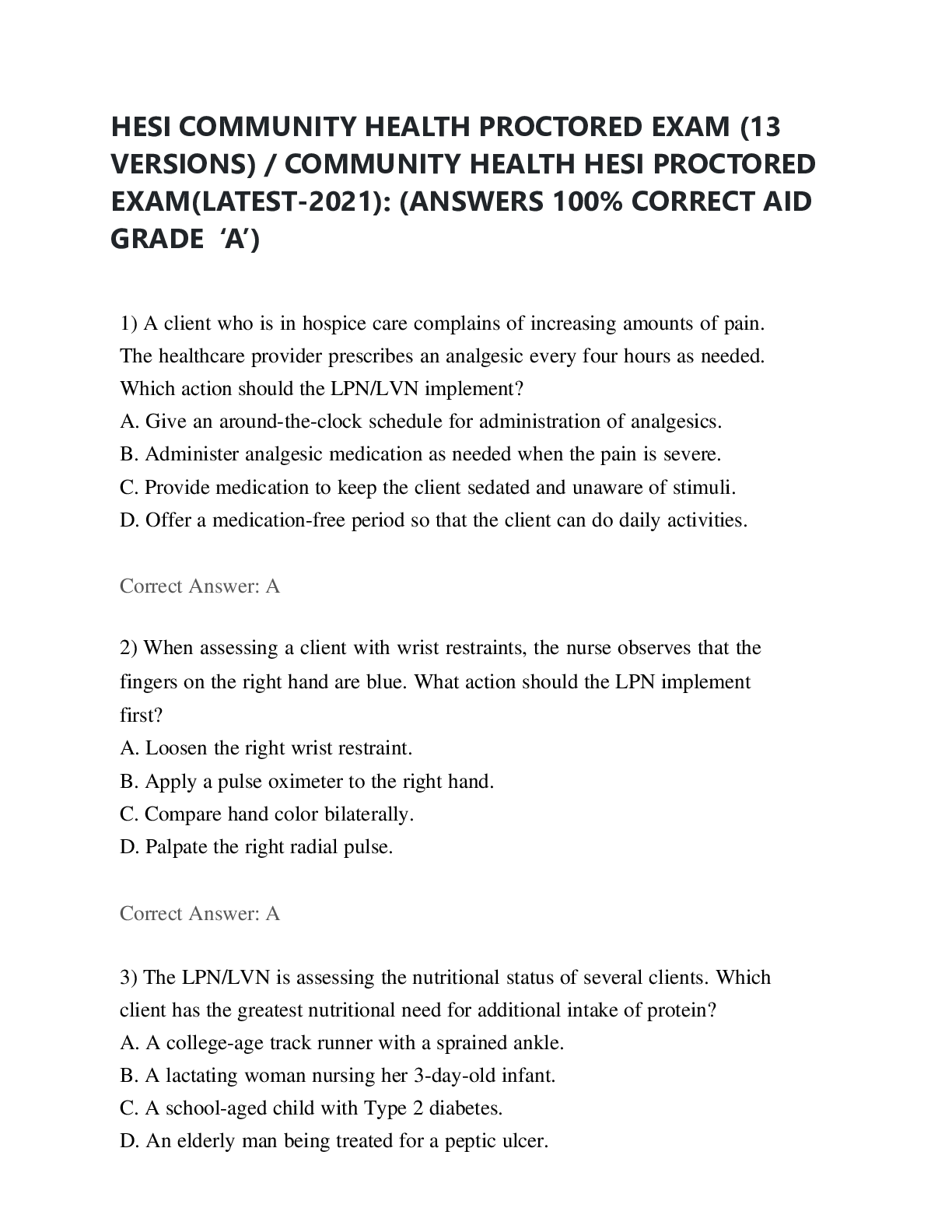
are one or more molecules of DNA or RNA that invade normal living cells and multiply, causing disease.
Question options:
1) Viruses
2) Bacteria
3) Fungi
4) Protozoa
Question WRONG 0 / 2
points
Microbes belo
...
are one or more molecules of DNA or RNA that invade normal living cells and multiply, causing disease.
Question options:
1) Viruses
2) Bacteria
3) Fungi
4) Protozoa
Question WRONG 0 / 2
points
Microbes belonging to the bacteria group are made up of only one cell. Scientists have discovered fossilized remains of bacteria that date back more than years.
Question options:
1) 3.5 million
3) 3.5 billion
4) 10.0 billion
Question 2 / 2
points
Bacteria, called Psychrophiles, can live in temperatures: Question options:
1) as cold as those found in the Arctic and Antarctic.
2) as high as in the hot springs of Yellowstone National Park in Wyoming.
3) As high as 235°F near volcanic vents on the ocean floor.
4) As mild as in a human body.
Question WRONG 0 / 2
points
Viruses are responsible for causing numerous diseases, including:
Question options:
1) Ebola hemorrhagic fever
2) Gonorrhea
4) Botulism
Question 2 / 2
points
Nurses who are using standard precautions appropriately assume that all patients may be infected with an organism that could be spread in the healthcare setting. Standard precautions involve recognizing that patients and the healthcare environment may be reservoirs of infectious organisms. Essential elements of standard precautions include all of the following except:
Question options:
1) hand hygiene
2) risk assessment with appropriate use of personal protective equipment (PPE)
3) injection and medication safety
Question 2 / 2
points
Protozoa:
Question options:
1) are a group of microscopic one celled animals.
2) do not cause disease in humans.
3) cause tuberculosis.
4) cannot live in water.
Question 2 / 2
points
Examples of some newly emerging microbes are: Question options:
1) Tuberculosis
2) HIV/AIDS
4) Malaria
Question WRONG 0 / 2
points
The global effort to eradicate polio has become the largest public health initiative in history. During 1999, the extraordinary progress continued. Polio incidence declined to the lowest levels ever in 1999. Polio virus 2:
Question options:
1) has reached extinction.
2) is still around in many countries.
3) still exists in some parts of India.
4) vaccines cannot be given orally.
Question 2 / 2
points
Viruses, ___ and _______ caused two major pandemics in modern times.
Question options:
1) Clostridium tetani and Mycobacterium tuberculosis
2) HPV and Hepatitis B
4) CMV and varicella-zoster
Question
WRONG 0 / 2
0
All of the following diseases are caused by viruses except: Question options:
1) Meningitis
2) Genital herpes
3) Shingles
4) Tuberculosis
points
Question 2 / 2
1
The risks of ceasing vaccination are obvious. If poliovirus is reintroduced into a susceptible population, a catastrophic epidemic of paralytic disease, disability, and death could ensue. Poliovirus could reemerge through all of the following ways except:
Question options:
1) reintroduction of poliovirus from a laboratory.
points
2) prolonged replication in immunodeficient patient.
3) persistent transmission of vaccine-derived virus in populations.
Question 2 / 2
2
The body’s defense mechanisms against pathogens include all of the following except :
Question options:
1) the inflammatory response
2) coughing and sneezing
3) B and T cells
points
Question 2 / 2
3
Diarrhea can be caused by all of the following microbes except:
Question options:
1) Cryptosporidia
2) Giardia
3) Salmonella
points
Question
WRONG 0 / 2
4 points
Tuberculosis: Question options:
1) is an uncommon disease.
2) is an important reemerging disease.
3) is a disease of the past.
Question 2 / 2
5
AIDS (Acquired immunodeficiency syndrome) was first recognized in the United States in the:
Question options:
1) 1980s
2) 1960s
3) 1940s
4) 1970s
points
Question 2 / 2
6
HIV can be transmitted by: Question options:
[Show More]



.png)