Course NURS-6521N-32,Advanced Pharmacology.2016 Winter Qtr 11/28-02/19-PT27 Test Week 9 - Quiz
Started 1/28/17 8:19 PM
Submitted 1/28/17 9:15 PM Status
Completed
Attempt Score
35 out of 35 points
Time Elapsed
...
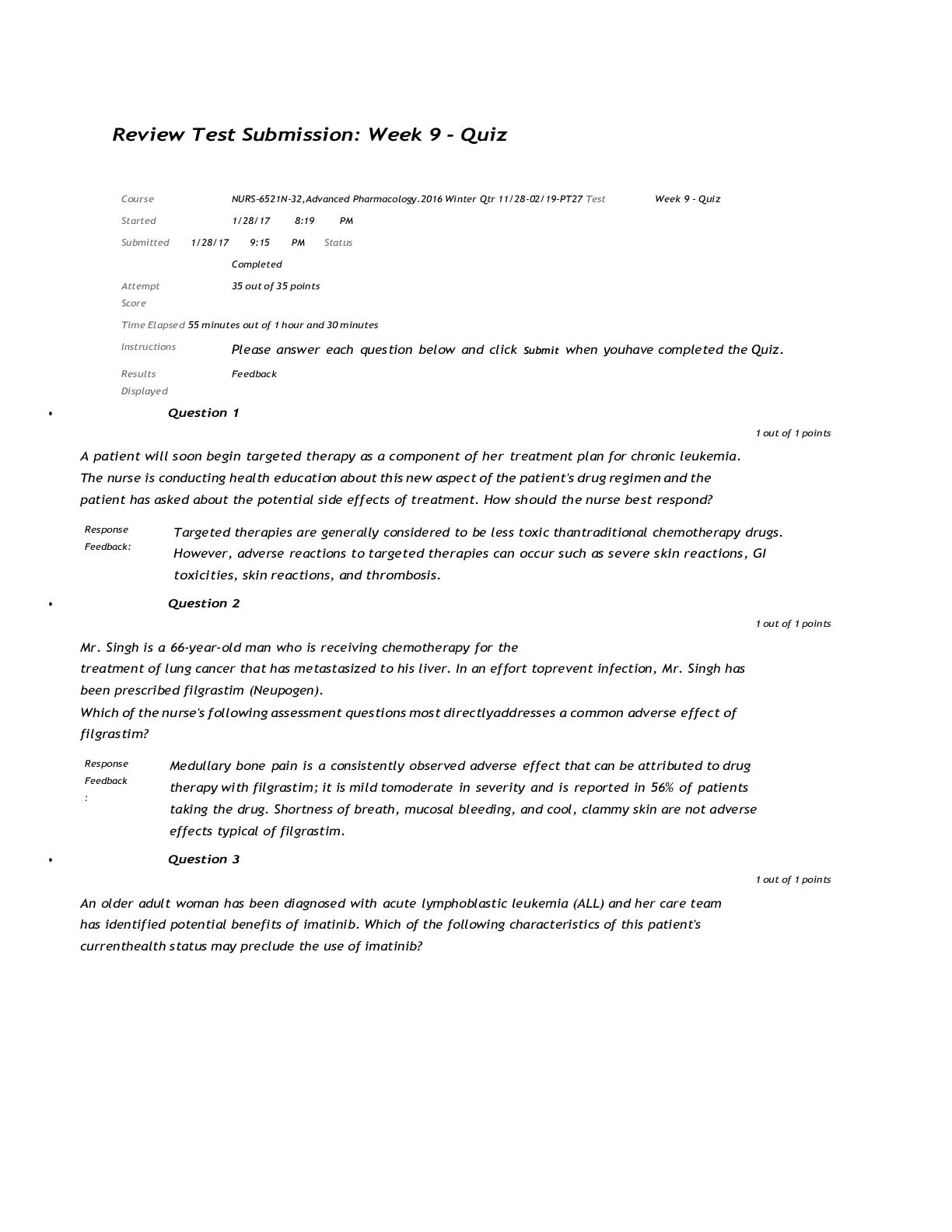
Course NURS-6521N-32,Advanced Pharmacology.2016 Winter Qtr 11/28-02/19-PT27 Test Week 9 - Quiz
Started 1/28/17 8:19 PM
Submitted 1/28/17 9:15 PM Status
Completed
Attempt Score
35 out of 35 points
Time Elapsed 55 minutes out of 1 hour and 30 minutes
Instructions Please answer each question below and click Submit when you have completed the Quiz.
Results Displayed
Feedback
• Question 1
A patient will soon begin targeted therapy as a component of her treatment plan for chronic leukemia. The nurse is conducting health education about this new aspect of the patient's drug regimen and the patient has asked about the potential side effects of treatment. How should the nurse best respond?
1 out of 1 points
Response Feedback:
Targeted therapies are generally considered to be less toxic than traditional chemotherapy drugs. However, adverse reactions to targeted therapies can occur such as severe skin reactions, GI toxicities, skin reactions, and thrombosis. • Question 2
Mr. Singh is a 66-year-old man who is receiving chemotherapy for the
1 out of 1 points
treatment of lung cancer that has metastasized to his liver. In an effort to prevent infection, Mr. Singh has been prescribed filgrastim (Neupogen). Which of the nurse's following assessment questions most directly addresses a common adverse effect of filgrastim?
Response Feedback :
Medullary bone pain is a consistently observed adverse effect that can be attributed to drug therapy with filgrastim; it is mild to moderate in severity and is reported in 56% of patients taking the drug. Shortness of breath, mucosal bleeding, and cool, clammy skin are not adverse effects typical of filgrastim. • Question 3
An older adult woman has been diagnosed with acute lymphoblastic leukemia (ALL) and her care team has identified potential benefits of imatinib. Which of the following characteristics of this patient's current health status may preclude the use of imatinib?
1 out of 1 points
Response Feedback :
Imatinib may be associated with edema. Patients should be weighed regularly and assessed for signs of fluid retention that could be severe. The risk of edema increases with higher doses of imatinib and age greater than 65 years. Previous strokes, orthopedic surgery, or well-controlled diabetes may not contraindicate the use of imatinib. • Question 4
An oncology nurse is reviewing the pathophysiology of cancer and is discussing with a colleague the factors that contribute to the success or
1 out of 1 points
failure of a patient's chemotherapy. Which of the following cancerous cells is most susceptible to the effects of chemotherapeutic drugs?
Response Feedback :
Cells that have a short generation time or rapid mitotic rate are most sensitive to antineoplastic agents. All cells (both cancerous and noncancerous) have a blood supply. A lack of contact inhibition is characteristic of cancer, but this is not associated with susceptibility to chemotherapeutic drugs. • Question 5
A nurse is caring for a patient with cancer who has been prescribed dronabinol (Marinol) to help reduce nausea and vomiting from
1 out of 1 points
chemotherapy. The nurse will inform the patient that he or she is taking an oral form of
Response Feedback:
The major ingredient of Marinol is 9-tetrahydrocannabinol (THC), the active ingredient in marijuana. • Question 6 1 out of 1 points
When planning care for a patient who is receiving filgrastim (Neupogen) for a nonmyeloid malignancy, the nurse should formulate which of the following patient outcomes? (Select all that apply.)
Response Feedback :
Desired outcomes for a patient receiving filgrastim include that febrile neutropenia will be avoided and infection and bone pain will not develop, or at least bone pain will not be unmanageable if it develops. Also, because this drug is administered subcutaneously every day during therapy, management of their own administration would be a positive outcome for patients. A patient who is taking oprelvekin would be at risk for fluid retention. Filgrastim is not associated with this adverse effect. • Question 7 1 out of 1 points
A nurse has been assigned to a 55-year-old woman who has a malignant brain tumor. The patient is receiving
[Show More]