MOCK AMCAT_ENGLISH
Readthesentencetofindoutwhetherthereisanygrammaticalerrorinit.Theerror,ifany,willbeinone part of the sentence. The letter of that part is the answer. Ignore the error of punctuation, ifany.
A] The ph
...
MOCK AMCAT_ENGLISH
Readthesentencetofindoutwhetherthereisanygrammaticalerrorinit.Theerror,ifany,willbeinone part of the sentence. The letter of that part is the answer. Ignore the error of punctuation, ifany.
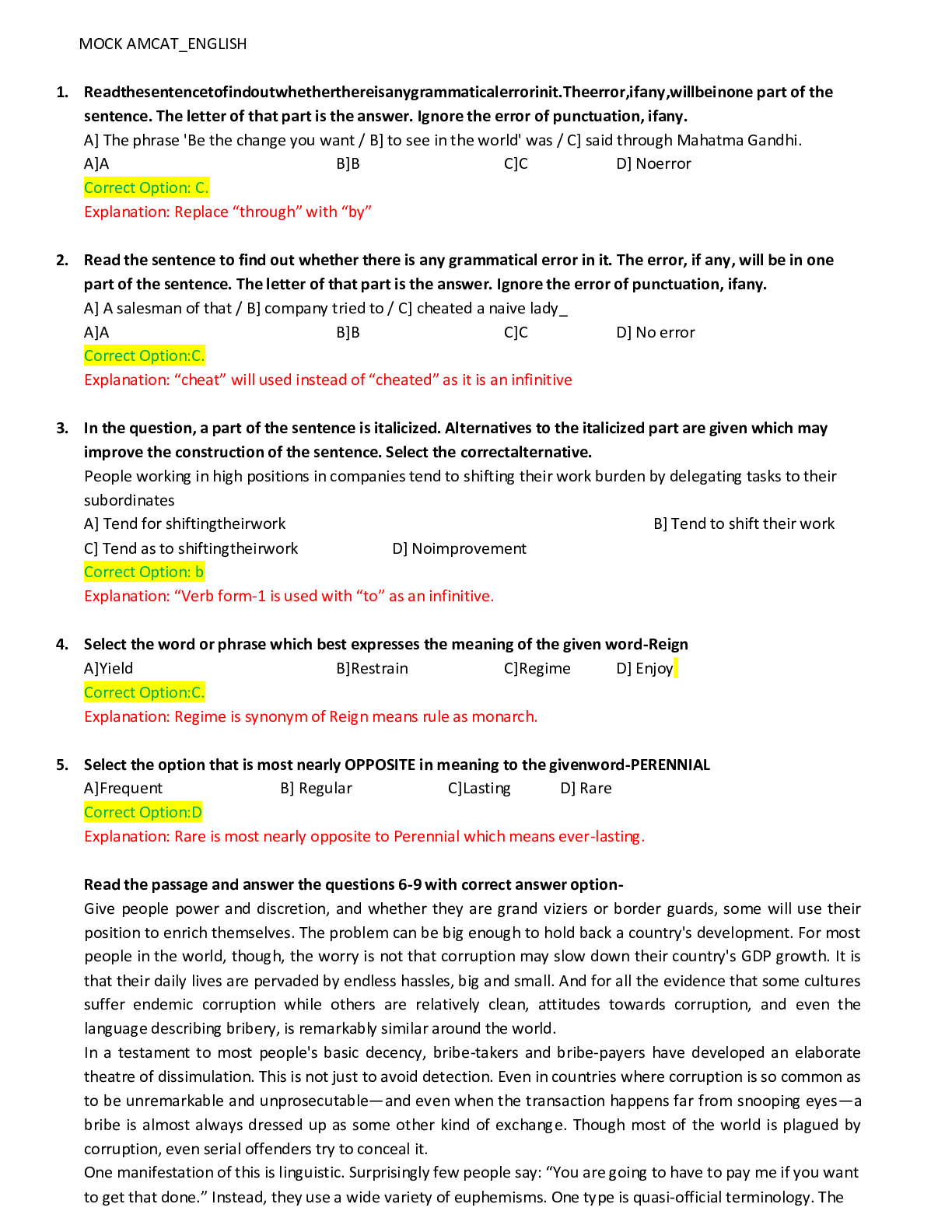
A] The phrase 'Be the change you want / B] to see in the world' was / C] said through Mahatma Gandhi. A]A B]B C]C D] Noerror Correct Option: C.
Explanation: Replace “through” with “by”
2. Read the sentence to find out whether there is any grammatical error in it. The error, if any, will be in one part of the sentence. The letter of that part is the answer. Ignore the error of punctuation, ifany.
A] A salesman of that / B] company tried to / C] cheated a naive lady_
A]A B]B C]C D] No error Correct Option:C.
Explanation: “cheat” will used instead of “cheated” as it is an infinitive
3. In the question, a part of the sentence is italicized. Alternatives to the italicized part are given which may improve the construction of the sentence. Select the correctalternative.
People working in high positions in companies tend to shifting their work burden by delegating tasks to their subordinates
A] Tend for shiftingtheirwork B] Tend to shift their work C] Tend as to shiftingtheirwork D] Noimprovement Correct Option: b
Explanation: “Verb form-1 is used with “to” as an infinitive.
4. Select the word or phrase which best expresses the meaning of the given word-Reign A]Yield B]Restrain C]Regime D] Enjoy Correct Option:C.
Explanation: Regime is synonym of Reign means rule as monarch.
5. Select the option that is most nearly OPPOSITE in meaning to the givenword-PERENNIAL
A]Frequent B] Regular C]Lasting D] Rare Correct Option:D
Explanation: Rare is most nearly opposite to Perennial which means ever-lasting.
Read the passage and answer the questions 6-9 with correct answer option-
Give people power and discretion, and whether they are grand viziers or border guards, some will use their position to enrich themselves. The problem can be big enough to hold back a country's development. For most people in the world, though, the worry is not that corruption may slow down their country's GDP growth. It is that their daily lives are pervaded by endless hassles, big and small. And for all the evidence that some cultures suffer endemic corruption while others are relatively clean, attitudes towards corruption, and even the language describing bribery, is remarkably similar around the world.
In a testament to most people's basic decency, bribe-takers and bribe-payers have developed an elaborate theatre of dissimulation. This is not just to avoid detection. Even in countries where corruption is so common as to be unremarkable and unprosecutable—and even when the transaction happens far from snooping eyes—a bribe is almost always dressed up as some other kind of exchange. Though most of the world is plagued by corruption, even serial offenders try to conceal it.
One manifestation of this is linguistic. Surprisingly few people say: “You are going to have to pay me if you want to get that done.” Instead, they use a wide variety of euphemisms. One type is quasi-official terminology. The
Term widely used at border crossings is “expediting fee”. For a euphemism it is surprisingly accurate: paying it will keep your bags, and perhaps your contraband, from being dumped onto a floor and sifted through at a leisurely pace. (A related term, used in India, is “speed money”: paying it can get essential business permits issued considerably faster.)
A second type of euphemism dresses up a dodgy payment as a friendly favor done by the bribe-payer. There is plenty of creative scope. Nigerian policemen are known to ask for “a little something for the weekend”. Mexican traffic police will su
[Show More]