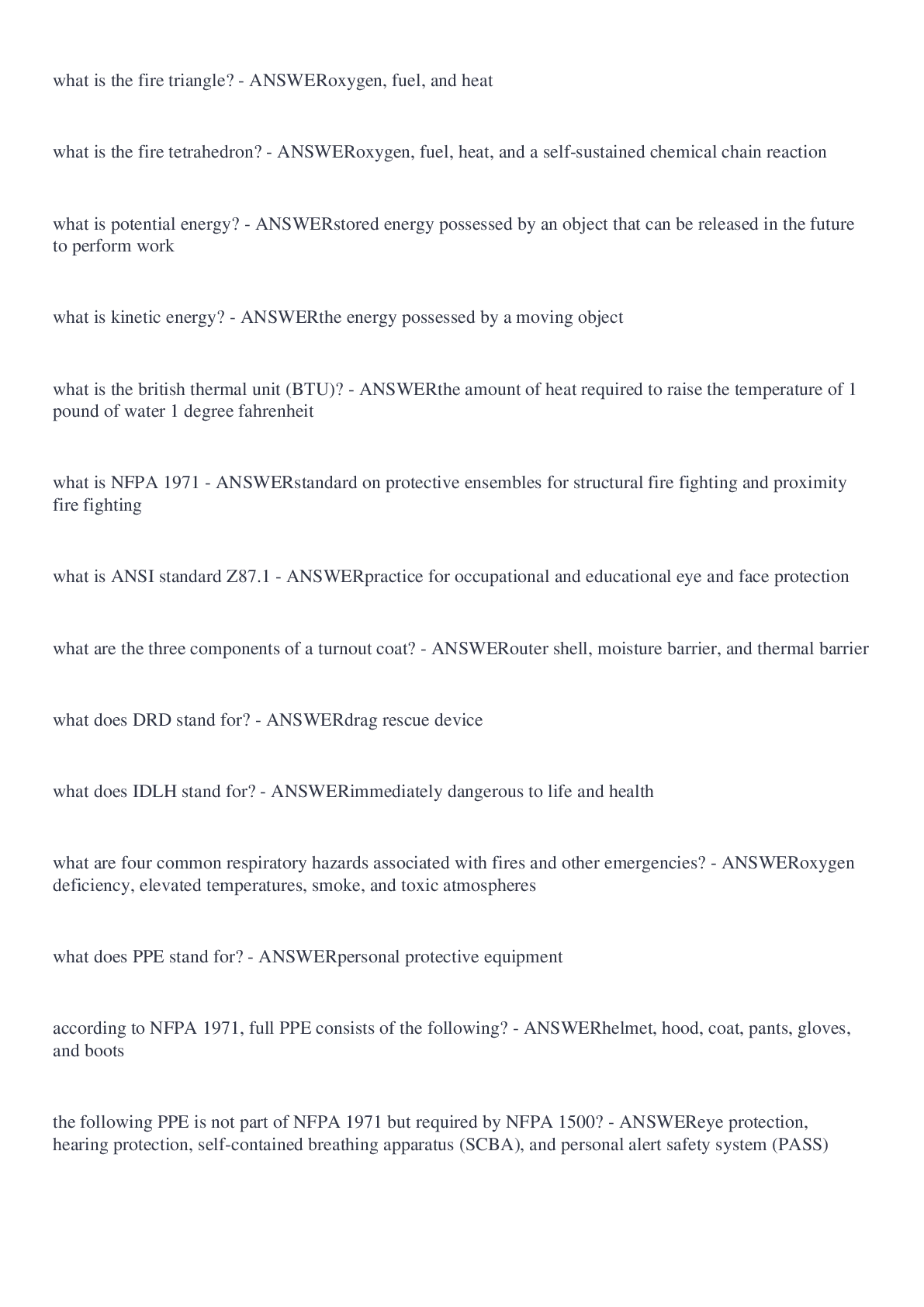
what is the fire triangle?
oxygen, fuel, and heat
what is the fire tetrahedron?
oxygen, fuel, heat, and a self-sustained chemical chain reaction
01:02
01:15
what is potential energy?
stored energy po
...
what is the fire triangle?
oxygen, fuel, and heat
what is the fire tetrahedron?
oxygen, fuel, heat, and a self-sustained chemical chain reaction
01:02
01:15
what is potential energy?
stored energy possessed by an object that can be released in the future to perform work
what is kinetic energy?
the energy possessed by a moving object
what is the british thermal unit (BTU)?
the amount of heat required to raise the temperature of 1 pound of water 1 degree fahrenheit
what is NFPA 1971
standard on protective ensembles for structural fire fighting and proximity fire fighting
what is ANSI standard Z87.1
practice for occupational and educational eye and face protection
what are the three components of a turnout coat?
outer shell, moisture barrier, and thermal barrier
what does DRD stand for?
drag rescue device
what does IDLH stand for?
immediately dangerous to life and health
what are four common respiratory hazards associated with fires and other emergencies?
oxygen deficiency, elevated temperatures, smoke, and toxic atmospheres
what does PPE stand for?
personal protective equipment
00:02
01:15
Upgrade to remove ads
Only $35.99/year
according to NFPA 1971, full PPE consists of the following?
helmet, hood, coat, pants, gloves, and boots
the following PPE is not part of NFPA 1971 but required by NFPA 1500?
eye protection, hearing protection, self-contained breathing apparatus (SCBA), and personal alert safety system (PASS)
what are the four basic SCBA componets?
harness assembly, air cylinder assembly, regulator assembly, and face piece assembly
air cylinders must be stamped or labeled with the dates of?
manufacture, and hydrostatic test
according to both the u.s. department of transportation and transport canada, steel and aluminum air cylinders must be tested every __ years and composite air cylinders every __ years?
5 and 3
what is a class B fire?
flammable and combustible liquids, gases, and greases such as alcohol, cooking oils, gasoline, lubricating oils, and liquefied petroleum gas (LPG)
what is a class C fire?
class A or class B fires created by electrical energy
what is a class D fire?
combustible metals and alloys such as lithium, magnesium, potassium, and sodium
what is a fire extinguisher?
a portable fire fighting device designed to combat incipient fires
every fire extinguisher extinguishes fire by at least one of the following mechanisms?
smothering, cooling, chain breaking, and saponification
what is NFPA 10?
standard for portable fire extinguishers
what is a class A fire?
ordinary combustibles such as textiles, paper, plastic, rubber, and wood
what is a class K fire?
combustible cooking oils
what does AFFF stand for?
aqueous film forming foam
what is the PASS method for a fire extinguisher?
pull, aim, squeeze, and sweep
what is ventilation?
the systematic removal of heated air, smoke, and fire gases from a burning building and replacing them with cooler air
what is conduction?
the transfer of heat within a body or to another body by direct contact
what three mechanisms can heat be transferred from one body to another?
conduction, convection, and radiation
what is convection?
the transfer of heat energy by the movement of heated fluids or gases, usually in an upward direction
what is radiation?
the transmission or transfer of heat energy from one body to another body at a lower temperature through intervening space by electromagnetic waves, such as infrared thermal waves, radio, or x-rays.
what are the stages of fire development?
incipient, growth, fully developed fire, and decay
what is a rollover?
a condition where the unburned fire gases accumulated at the top of a compartment ignite and flames propagate through the how gas layer or across the ceiling
what is a flashover?
stage of fire at which all surfaces and objects within a space have been heated to their ignition temperature and flame breaks out almost at once over the surface of all objects in the space
what is a backdraft?
instantaneous explosion or rapid burning of superheated gases that occurs when oxygen is introduced into an oxygen-depleted confined space
what are the reasons for ventilation?
life safety, fire attack and extinguishment, fire spread control, reduction of flashover potential, reduction of backdraft potential, and property conservation
what is natural ventilation?
techniques that use the wind, convection currents, and other natrual phenomena to ventilate a structure without the use of fans, blowers, or other mechanical devices
what is forced ventilation?
is accomplished mechanically with fans or blowers or hydraulically with fog streams
what is horizontal ventilation?
the venting of heat, smoke, and gases through horizontal openings such as windws and doors
what is vertical ventilation?
generally means opening the roof or existing roof opening for the purpose of allowing heated gases and smoke to escape to the atmosphere
when ventilating a residential structure what size hole should you cut?
4ft by 4ft
when ventilating a commercial structure what size hole should you cut?
8ft by 8ft
what is trench ventilation?
defensive tactic that invloves cutting an exit opening in the roof of a burning building, extending from one outside wall to the other, to create an opening at which a spreding fire may be cut off
what size should trench ventilation be?
at least 4 feet wide and extends from one exerior wall to the opposite exterior wall
what is span of control?
that any officer can effectively supervise or manage only a certain number of individuals or groups. Rule of thumb is an officer can directly supervise three to seven firefighters effectively, with five being optimum
what is division of labor?
is the process of dividing large jobs into small jobs to make them more manageable
what are the fireground priorities?
life safety, incident stabilization, and property conservation
what is command?
untimately responsible for all incident activities, including the development and implementation of an incident action plan (IAP)
what does the command staff consists of?
safety officer, liaison officer, and public information officer
what does the general staff consists of?
operations, planning, logistics, and finance/administration section chief
what is the operations section chief?
reports directly to the IC and is responsible for all activities focused on reducing the immediate hazard, saving lives and property, estavlishing situational control, and restoring of normal operations. Operations is also responsible for staging and may be subdivided into ten branches
what is the planning section chief?
responsible for the collection, documentation, evaluation, and dissemination of incident situation information and intelligence to the IC. The planning section is also responsible for tracking the status of all resources assigned to incident and developing the IAP for review and approval by the IC.
what is the logistics section chief?
responsible for all support requirement needed to facilitate effective and efficient incident management
what is the finance/administration section chief?
established when the agencies involved require finance and other administrative support service
what is the safety officer?
monitors incident operations and advises the IC on all matters related to operational safety, including the health and safety of emergency responder personnel
what is the liaison officer?
point of contact for other governmental and nongovernmental agencies and private-sector organizations invloved in the incident
what is the public information officer?
responsible for interfacing with the public and media and/or other agencies with incident-related information requirements
what is a division?
a geographic designation assigning responsibility for all operations within a defined area
what is a group?
functional designations (forcible entry, salvage, ventilation, etc)
what is a strike team?
a set number or resources of the same kind and type with an established minimum number of personnel
what is a task force?
any combination of resources assembled in support of a specific mission or operational need
what is a supervisor?
is someone in command of a dicision or a group
what is a branch?
the organizational level between divisions/groups and the IC and operations. It is managed by a brach director.
what is NFPA 1500?
standard on fire department occupational safety and health program
what does PASS stand for on a SCBA?
personal alert safety system
what does SCBA stand for?
self-contained breathing apparatus
if sirens and engine noise levels exceed ____ decibles and ____ decibles in canada firefighters must wear hearing protection
90 and 85 decibles
what does PAR stand for?
personnel accountability report
[Show More]