Care of the older Adult study guide OBjectives
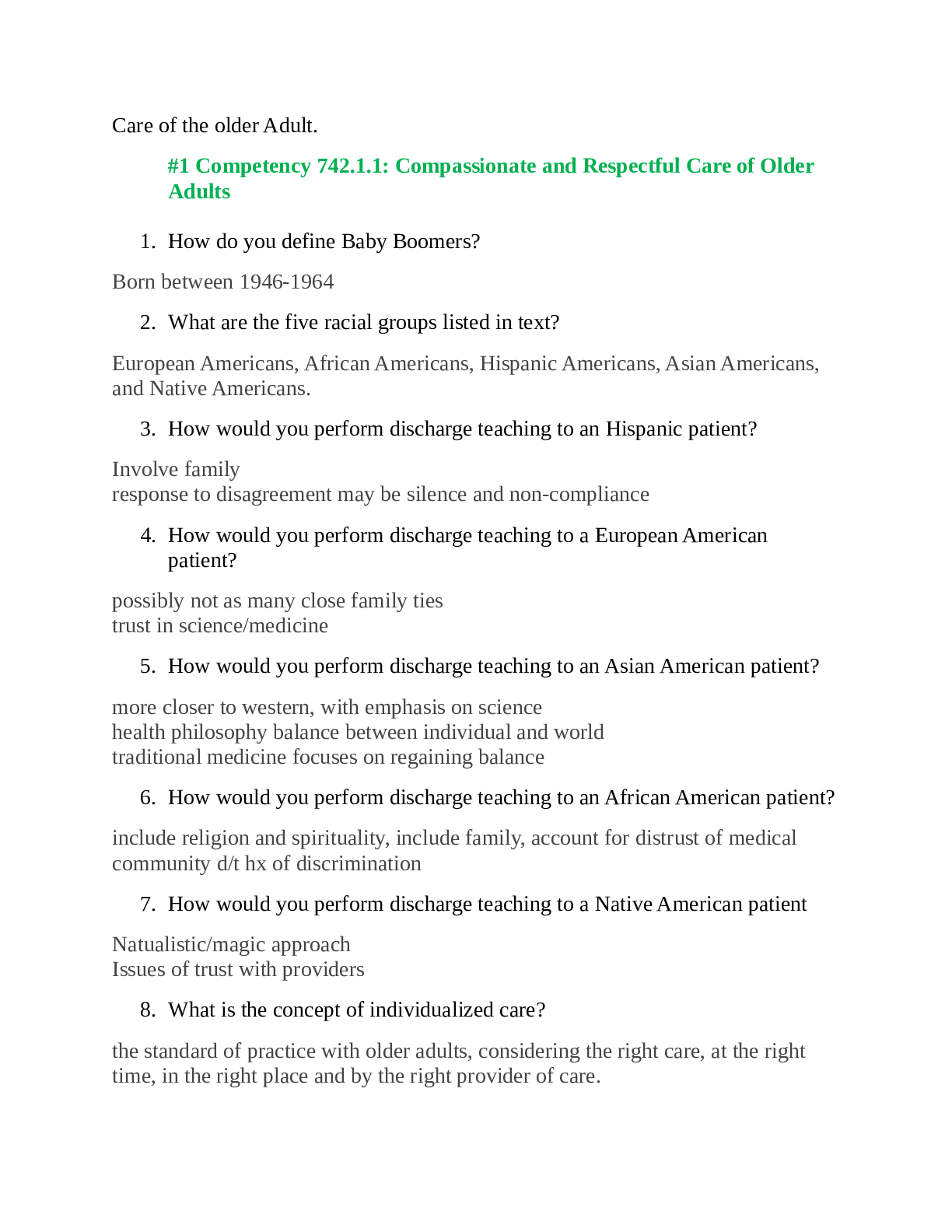
Care of the older Adult.
#1 Competency 742.1.1: Compassionate and Respectful Care of Older Adults
How do you define Baby Boomers?
What are the five racial
...
Care of the older Adult study guide OBjectives
Care of the older Adult.
#1 Competency 742.1.1: Compassionate and Respectful Care of Older Adults
How do you define Baby Boomers?
What are the five racial groups listed in text?
How would you perform discharge teaching to an Hispanic patient?
How would you perform discharge teaching to a European American patient?
How would you perform discharge teaching to an Asian American patient?
How would you perform discharge teaching to an African American patient?
How would you perform discharge teaching to a Native American patient
What is the concept of individualized care?
What are some visual changes related to aging?
What are some communication accommodations that can be made for visual deficits?
What are some hearing changes related to aging?
What is presbycusis?
What are some communication accommodations that can be made for hearing deficits?
What are some speech/language changes associated with aging?
↓What are some communication accommodations that can be made for speech/language deficits?
What are some somatosensory changes associated with aging?
What are some communication accommodations that can be made for somatosensory deficits?
What is an AAC?
What are some communication tips for someone with dysarthria?
Describe a BTE
Describe an OTE
Describe an ITE
Describe an ITC
Describe a CIC
What patients could benefit from an AAC?
What are Satir's five principles of contact and communication?
#2 Competency 742.1.2: Health Promotion/Maintenance and Living Environments of Older Adults
What are the five A's to tobacco cessation?
What are the Five R's to tobacco cessation?
3. What is the criterion for the pneumococcal vaccine?
4. What 5 areas do Healthy People 2010 and the USPSTF suggest that nurses focus on to promote health & prevent disability in the older adult?
5. Describe the difference between ADLs and IADLs (instrumental activities of daily living)
6. Review the USPSTF Screening
7. Review the I HATE FALLING risk assessment tool, Box 12-4 on page 361. What can the nurse recommend to reduce risk of falling?
#3 Competency 742.1.3: Health Needs of Older Adults
What are the 5 most common geriatric syndromes?
What aspects of pharmacokinetics are affected by age-related changes?
How is absorption of medications affected by age related changes? What is the significance?
How is distribution of medications affected by age related changes? What is the significance?
What do you have to take into account when evaluating creatinine levels in the elder adult?
How is metabolism of medications affected by age related changes? What is the significance?
How is excretion of medications affected by age related changes? What is the significance?
How is the pharmacodynamics of medications affected by age related changes? What is the significance?
What are some functional changes and mobility issues that may threaten independence in the older adult?
What are some factors that may contribute to alterations in nutrition in older adults?
What are some examples of alterations in metabolism in older adults?
•What are some factors that may contribute to alterations in elimination in older adults?
What are the signs and symptoms of pressure ulcers?
What are the risks for pressure sores?
17. Explain the difference between intrinsic and extrinsic risk factors for falls.
18. What is a MAP?
19. What are the Five Rights of Medication Administration?
20. Why are older adults more apt to polypharmacy?
21. What are some ways to avoid polypharmacy?
•
22. What common classes of drugs cause ADRs?
•
#4 Competency 742.1.4: Promoting Independence and Autonomy While Reducing Risk Factors in Older Adults
What is autonomy?
What is self-determination?
What is frailty?
.
What are the characteristics of frailty?
What is the Kohlman Evaluation of Living Skills (KELS)?
•8. What are the factors that influence the quality of life of an older adult?
9. What is the one of the most common role changes faced by the aging person? List all.
10. What is role reversal for the older adult?
11. List and the care options for the older adult (when independent living is no longer possible)
13. Describe the care option of independent living with help
Describe the care option of adult daycare at a facility
Describe the care option of adult daycare at a home
Describe the care option of family
Describe the care option of adult daycare at Senior living complexes/continuing care/supported care retirement communities
Describe the care option of assisted living
Describe the care option of paid
in-home caregivers
Describe the care option of extended care facilities
What is the Borg Category Rating Scale?
[Show More]