NCSBN ON-LINE REVIEW
1.A client has been hospitalized after an automobile accident. A full leg cast was applied in the
emergency room. The most important reason for the nurse to elevate the casted leg is to
A) Promote
...
NCSBN ON-LINE REVIEW
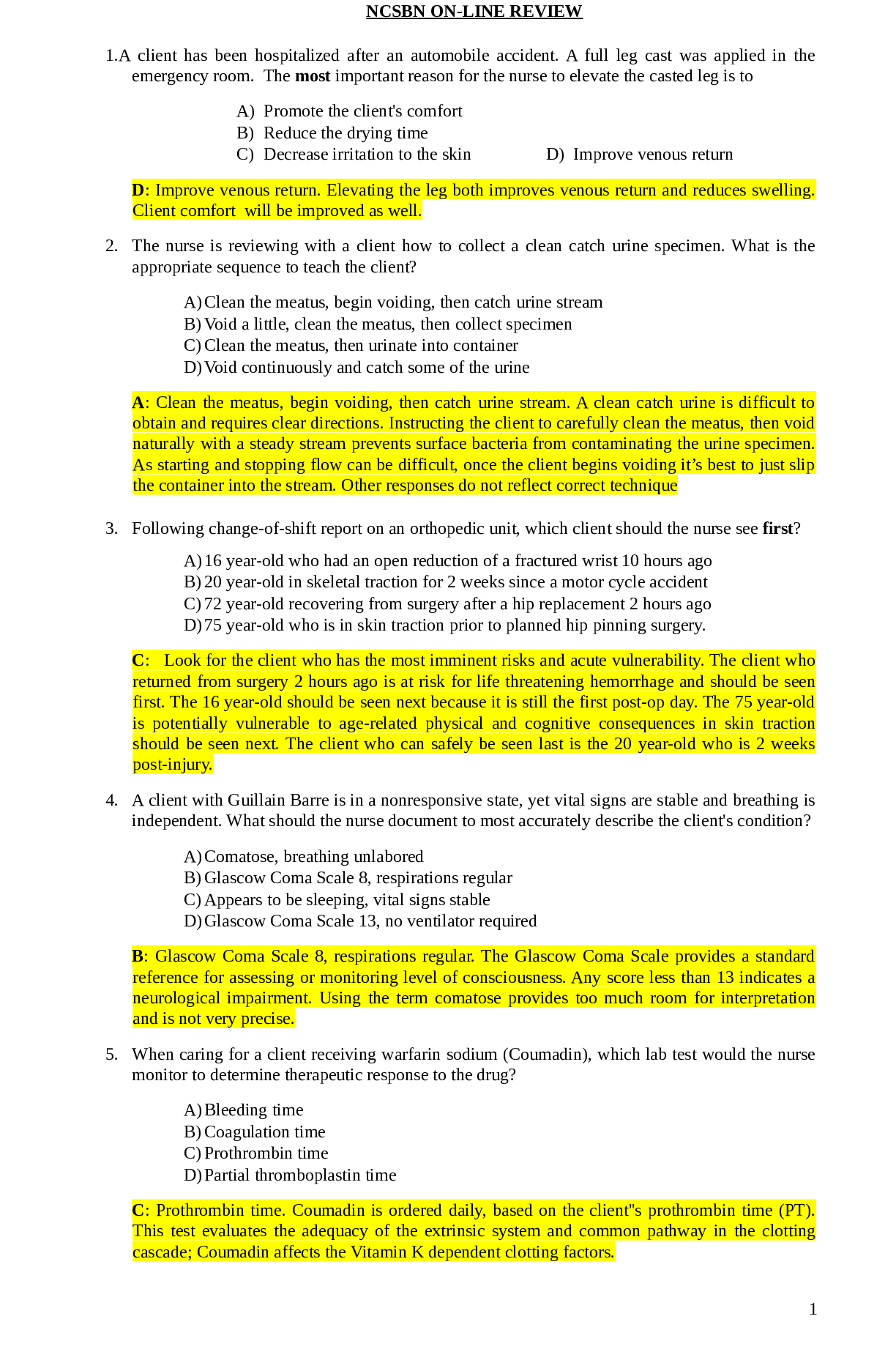
1.A client has been hospitalized after an automobile accident. A full leg cast was applied in the
emergency room. The most important reason for the nurse to elevate the casted leg is to
A) Promote the client's comfort
B) Reduce the drying time
C) Decrease irritation to the skin D) Improve venous return
D: Improve venous return. Elevating the leg both improves venous return and reduces swelling.
Client comfort will be improved as well.
2. The nurse is reviewing with a client how to collect a clean catch urine specimen. What is the
appropriate sequence to teach the client?
A)Clean the meatus, begin voiding, then catch urine stream
B) Void a little, clean the meatus, then collect specimen
C) Clean the meatus, then urinate into container
D)Void continuously and catch some of the urine
A: Clean the meatus, begin voiding, then catch urine stream. A clean catch urine is difficult to
obtain and requires clear directions. Instructing the client to carefully clean the meatus, then void
naturally with a steady stream prevents surface bacteria from contaminating the urine specimen.
As starting and stopping flow can be difficult, once the client begins voiding it’s best to just slip
the container into the stream. Other responses do not reflect correct technique
3. Following change-of-shift report on an orthopedic unit, which client should the nurse see first?
A)16 year-old who had an open reduction of a fractured wrist 10 hours ago
B) 20 year-old in skeletal traction for 2 weeks since a motor cycle accident
C) 72 year-old recovering from surgery after a hip replacement 2 hours ago
D)75 year-old who is in skin traction prior to planned hip pinning surgery.
C: Look for the client who has the most imminent risks and acute vulnerability. The client who
returned from surgery 2 hours ago is at risk for life threatening hemorrhage and should be seen
first. The 16 year-old should be seen next because it is still the first post-op day. The 75 year-old
is potentially vulnerable to age-related physical and cognitive consequences in skin traction
should be seen next. The client who can safely be seen last is the 20 year-old who is 2 weeks
post-injury.
4. A client with Guillain Barre is in a nonresponsive state, yet vital signs are stable and breathing is
independent. What should the nurse document to most accurately describe the client's condition?
A)Comatose, breathing unlabored
B) Glascow Coma Scale 8, respirations regular
C) Appears to be sleeping, vital signs stable
D)Glascow Coma Scale 13, no ventilator required
B: Glascow Coma Scale 8, respirations regular. The Glascow Coma Scale provides a standard
reference for assessing or monitoring level of consciousness. Any score less than 13 indicates a
neurological impairment. Using the term comatose provides too much room for interpretation
and is not very precise.
5. When caring for a client receiving warfarin sodium (Coumadin), which lab test would the nurse
monitor to determine therapeutic response to the drug?
A)Bleeding time
B) Coagulation time
C) Prothrombin time
D)Partial thromboplastin time
C: Prothrombin time. Coumadin is ordered daily, based on the client''s prothrombin time (PT).
This test evaluates the adequacy of the extrinsic system and common pathway in the clotting
cascade; Coumadin affects the Vitamin K dependent clotting factors.
1
6.A client with moderate persistent asthma is admitted for a minor surgical procedure. On admission
the peak flow meter is measured at 480 liters/minute. Post-operatively the client is complaining
of chest tightness. The peak flow has dropped to 200 liters/minute. What should the nurse do
first?
A)Notify both the surgeon and provider
B) Administer the prn dose of albuterol
C) Apply oxygen at 2 liters per nasal cannula
D)Repeat the peak flow reading in 30 minutes
B: Administer the prn dose of albuterol. Peak flow monitoring during exacerbations of asthma is
recommended for clients with moderate-to-severe persistent asthma to determine the severity of
the exacerbation and to guide the treatment. A peak flow reading of less than 50% of the client''s
baseline reading is a medical alert condition and a short-acting beta-agonist must be taken
immediately.
7.A client had 20 mg of Lasix (furosemide) PO at 10 AM. Which would be essential for the nurse to
include at the change of shift report?
A)The client lost 2 pounds in 24 hours
B) The client’s potassium level is 4 mEq/liter.
C) The client’s urine output was 1500 cc in 5 hours
D)The client is to receive another dose of Lasix at 10 PM
C: The client’s urine output was 1500 cc in 5 hours. Although all of these may be correct
information to include in report, the essential piece would be the urine output.
8.A client has been tentatively diagnosed with Graves' disease (hyperthyroidism). Which of these
findings noted on the initial nursing assessment requires quick intervention by the nurse?
A) a report of 10 pounds weight loss in the last month
B) a comment by the client "I just can't sit still."
C) the appearance of eyeballs that appear to "pop" out of the client's eye sockets
D) a report of the sudden onset of irritability in the past 2 weeks
C: the appearance of eyeballs that appear to "pop" out of the client''s eye sockets. Exophthalmos
or protruding eyeballs is a distinctive characteristic of Graves'' Disease. It can result in corneal
abrasions with severe eye pain or damage when the eyelid is unable to blink down over the
protruding eyeball. Eye drops or ointment may be needed.
9. The nurse has performed the initial assessments of 4 clients admitted with an acute episode of
asthma. Which assessment finding would cause the nurse to call the provider immediately?
A)prolonged inspiration with each breath
B) expiratory wheezes that are suddenly absent in 1 lobe
C) expectoration of large amounts of purulent mucous
D) appearance of the use of abdominal muscles for breathing
B: expiratory wheezes that are suddenly absent in 1 lobe. Acute asthma is characterized by
expiratory wheezes caused by obstruction of the airways. Wheezes are a high pitched musical
sounds produced by air moving through narrowed airways. Clients often associate wheezes with
the feeling of tightness in the chest. However, sudden cessation of wheezing is an ominous or
bad sign that indicates an emergency -- the small airways are now collapsed.
10.During the initial home visit, a nurse is discussing the care of a client newly diagnosed with
Alzheimer's disease with family members. Which of these interventions would be most helpful
at this time?
A)leave a book about relaxation techniques
B) write out a daily exercise routine for them to assist the client to do
C) list actions to improve the client's daily nutritional intake
2
D)suggest communication strategies
D: suggest communication strategies. Alzheimer''s disease, a progressive chronic illness, greatly
challenges caregivers. The nurse can be of greatest assistance in helping the family to use
communication strategies to enhance their ability to relate to the client. By use of select verbal
and nonverbal communication strategies the family can best support the client’s strengths and
cope with any aberrant behavior.
11.An 80 year-old client admitted with a diagnosis of possible cerebral vascular accident has had a
blood pressure from 160/100 to
180/110 over the past 2 hours. The nurse has also noted increased lethargy. Which assessment
finding should the nurse report immediately to the provider?
A)Slurred speech
B) Incontinence
C) Muscle weaknessD) Rapid pulse
A: Slurred speech. Changes in speech patterns and level of conscious can be indicators of
continued intracranial bleeding or extension of the stroke. Further diagnostic testing may be
indicated.
12. A school-aged child has had a long leg (hip to ankle) synthetic cast applied 4 hours ago. Which
statement from the parent indicates that teaching has been inadequate?
A) "I will keep the cast uncovered for the next day to prevent burning of the skin."
B) "I can apply an ice pack over the area to relieve itching inside the cast."
C) "The cast should be propped on at least 2 pillows when my child is lying down."
D) "I think I remember that my child should not stand until after 72 hours."
D: "I think I remember that my child should not stand until after 72 hours.". Synthetic casts will
typically set up in 30 minutes and dry in a few hours. Thus, the client may stand within the initial
24 hours. With plaster casts, the set up and drying time, especially in a long leg cast which is
thicker than an arm cast, can take up to 72 hours. Both types of casts give off a lot of heat when
drying and it is preferable to keep the cast uncovered for the first 24 hours. Clients may
complain of a chill from the wet cast and therefore can simply be covered lightly with a sheet or
blanket. Applying ice is a safe method of relieving the itching.
13. Which blood serum finding in a client with diabetic ketoacidosis alerts the nurse that immediate
action is required?
A)pH below 7.3
B) Potassium of 5.0
C) HCT of 60
D)Pa O2 of 79%
C: HCT of 60. This high hematocrit is indicative of severe dehydration which requires priority
attention in diabetic ketoacidosis. Without sufficient hydration, all systems of the body are at risk
for hypoxia from a lack of or sluggish circulation. In the absence of insulin, which facilitates the
transport of glucose into the cell, the body breaks down fats and proteins to supply energy
ketones, a by-product of fat metabolism. These accumulate causing metabolic acidosis (pH <
7.3), which would be the second concern for this client. The potassium and PaO2 levels are near
normal.
14. The nurse is preparing a client with a deep vein thrombosis (DVT) for a Venous Doppler
evaluation. Which of the following would be necessary for preparing the client for this test?
3
A)Client should be NPO after midnight
B) Client should receive a sedative medication prior to the test
C) Discontinue anti-coagulant therapy prior to the test
D)No special preparation is necessary
D: No special preparation is necessary. This is a non-invasive procedure and does not require
preparation other than client education.
15. A client is admitted with infective endocarditis (IE). Which finding would alert the nurse to a
complication of this condition?
A)dyspnea
B) heart murmur
C) macular rashD) Hemorrhage
B: heart murmur. Large, soft, rapidly developing vegetations attach to the heart valves. They
have a tendency to break off, causing emboli and leaving ulcerations on the valve leaflets. These
emboli produce findings of cardiac murmur, fever, anorexia, malaise and neurologic sequelae of
emboli. Furthermore, the vegetations may travel to various organs such as spleen, kidney,
coronary artery, brain and lungs, and obstruct blood flow.
16. The nurse explains an autograft to a client scheduled for excision of a skin tumor. The nurse
knows the client understands the procedure when the client says, "I will receive tissue from
A) a tissue bank."
B) a pig."
C) my thigh."
D)synthetic skin."
C: my thigh.". Autografts are done with tissue transplanted from the client''s own skin.
[Show More]







.png)