CRJ 2501 Criminology Unit 3 Assessment test solution 2020 docs
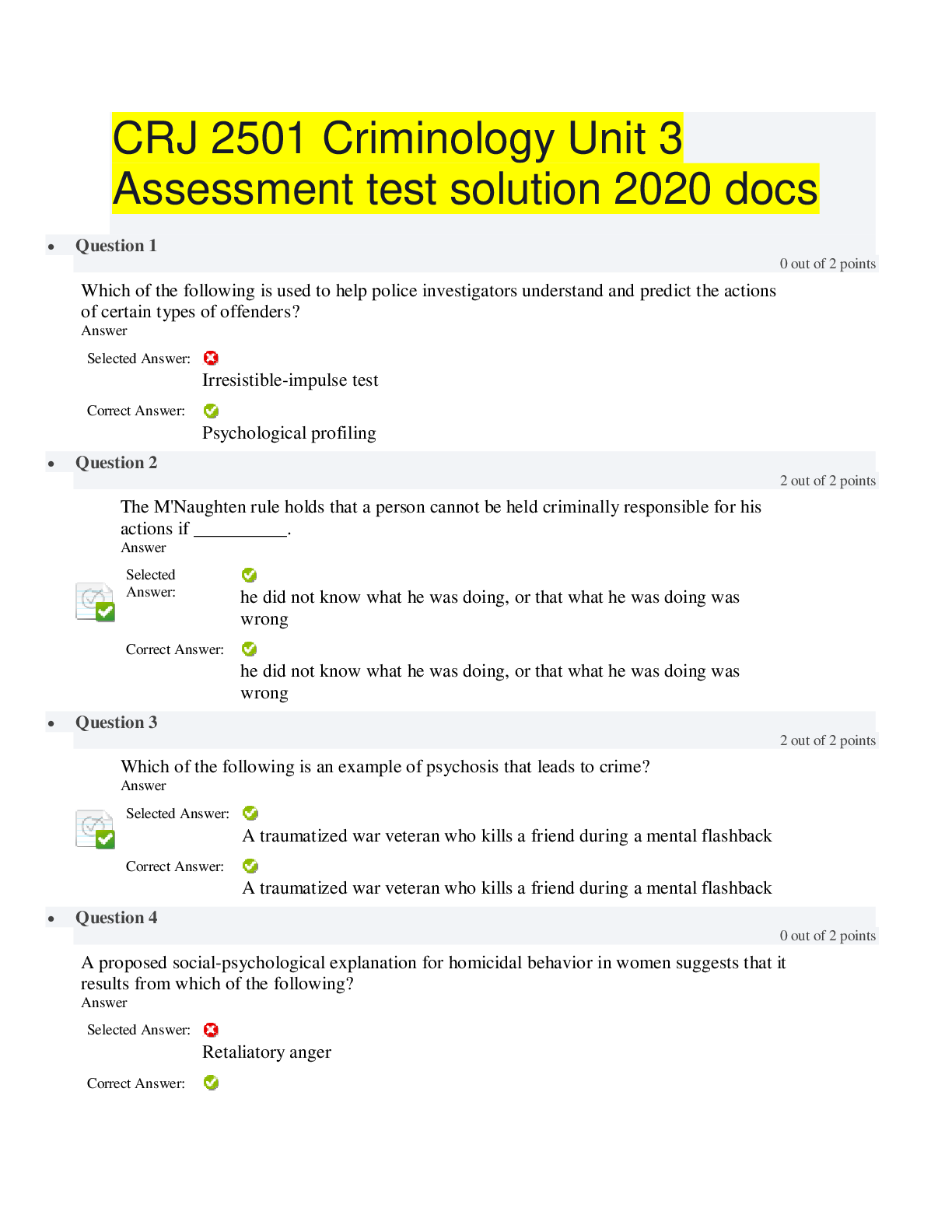
• Question 1
0 out of 2 points
Which of the following is used to help police investigators understand and predict the actions of certain types of o
...
CRJ 2501 Criminology Unit 3 Assessment test solution 2020 docs
• Question 1
0 out of 2 points
Which of the following is used to help police investigators understand and predict the actions of certain types of offenders?
• Question 2
2 out of 2 points
The M'Naughten rule holds that a person cannot be held criminally responsible for his actions if __________.
• Question 3
2 out of 2 points
Which of the following is an example of psychosis that leads to crime?
• Question 4
0 out of 2 points
A proposed social-psychological explanation for homicidal behavior in women suggests that it results from which of the following?
• Question 5
2 out of 2 points
Phrenology studies which of the following in an attempt to predict criminality?
• Question 6
0 out of 2 points
The biocriminological theory of crime that enabled former police officer Dan White to receive a reduced sentence for killing a San Francisco mayor and a city councilman was based on which of the following?
• Question 7
0 out of 2 points
A religious young man rapes a girl he has had a crush on for months. When caught, he weeps and tries to defend himself by claiming "It's not my fault! Look what she is wearing-she was asking for it!" He is exhibiting which of the following?
• Question 8
2 out of 2 points
According to Sigmund Freud, what causes offenders to behave in ways that ensure their eventual capture, such as when serial killers send taunting messages to the police?
• Question 9
2 out of 2 points
According to Sigmund Freud, which of the following is the component of personality that is the source of guilt when a person does something that is judged to be morally inappropriate?
Answer
• Question 10
10 out of 10 points
Match the explanation with the appropriate Key Term.
• Question 11
2 out of 8 points
Match each scenario with the theory it demonstrates.
• Question 12
16 out of 16 points
Identify five types of biological theories of criminology and list their characteristics and major principles. If these theories are correct and criminal behavior results from genetics or external factors, how does this impact the issues of free will and the justness of punishment, which form the basis of our criminal justice system?
• Question 13
16 out of 16 points
Can past behavior predict future actions? Selective incapacitation is a theory that advocates giving longer sentences to offenders when it is believed that they will commit future crimes (if set free). How does research and legislation support this strategy? Why do some people criticize the practice of selective incapacitation?
• Question 14
13 out of 16 points
How has testosterone been shown to relate to aggression? What other hormones can affect criminality? Are these effects the same in males and females? What do you think of the masculinity hypothesis, which is the belief that, over time, men and women will commit crimes that are increasingly similar in nature, seriousness, and frequency?
• Question 15
0 out of 16 points
What is the modeling theory, and how does it explain crime causation? What role does modeling play in aggression, which is often the foundation for violence? What types of rewards do people receive through aggression, and why does this happen?
[Show More]