HESI Comprehensive Exit Exam Answered A+ Solution Guide; Spring 2022.
Document Content and Description Below
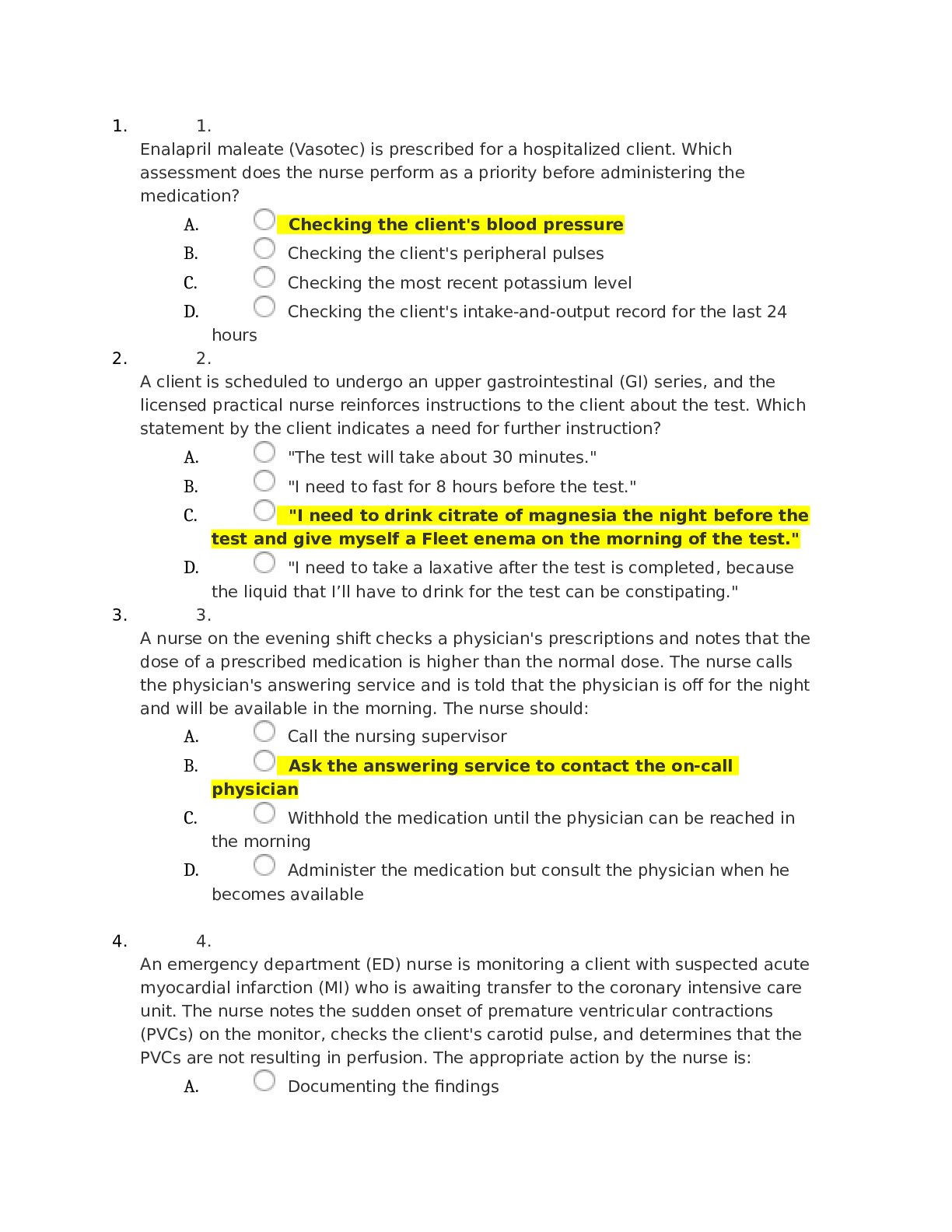
1. 1.
Enalapril maleate (Vasotec) is prescribed for a hospitalized client. Which
assessment does the nurse perform as a priority before administering the
medication?
A. Checking the client's blood pressure
B. Checki
...
[Show More]
Last updated: 3 years ago
Preview 1 out of 69 pages
Instant download
Buy this Document to get the Full Access Instantly
Provided by Students Who Aced it
We Verify Document Content to Gurantee Accuracy
Reviews( 0 )
Document information
Connected school, study & course
About the document
Uploaded On
Jun 03, 2022
Number of pages
69
Written in
All

Additional information
This document has been written for:
Uploaded
Jun 03, 2022
Downloads
0
Views
231
Topic Tags
Recommended For You
Get more on HESI »
$17.5
7 Pages
HESI Exit Exam - Leadership & Management || Correctly Answered...

$25.5
396 Pages
NGN Nursing Med-Surg HESI Exit Exam – Latest 2025 Test Bank wi...
$20.5
282 Pages
HESI EXIT EXAM QUESTIONS AND CORRECT VERIFIED ANSWERS || A COM...
$29
961 Pages
HESI RN COMPREHENSIVE EXIT EXAM Compiled 14 Versions Answers...

.png)
 Questions, Answers & Rationale, A+ Guide.png)

$22.5
307 Pages
TEST BANK for Davis Advantage for Psychiatric Mental Health Nu...
$17
588 Pages
Test Bank For Fundamentals of Nursing 11th Edition Potter Perr...
$16
496 Pages
TEST BANK for Essentials of Psychiatric Mental Health Nursing:...
$19
553 Pages
Essentials of Psychiatric Nursing 2nd Edition Boyd TEST BANK

More related documents below
.png)