PHI 208 Week 1 Quiz 1 solution test latest updates
Question 1
Dunia thinks that in her society, it is appropriate for women to dress a certain way. But she doubts that those standards can be defended in a way that wo
...
PHI 208 Week 1 Quiz 1 solution test latest updates
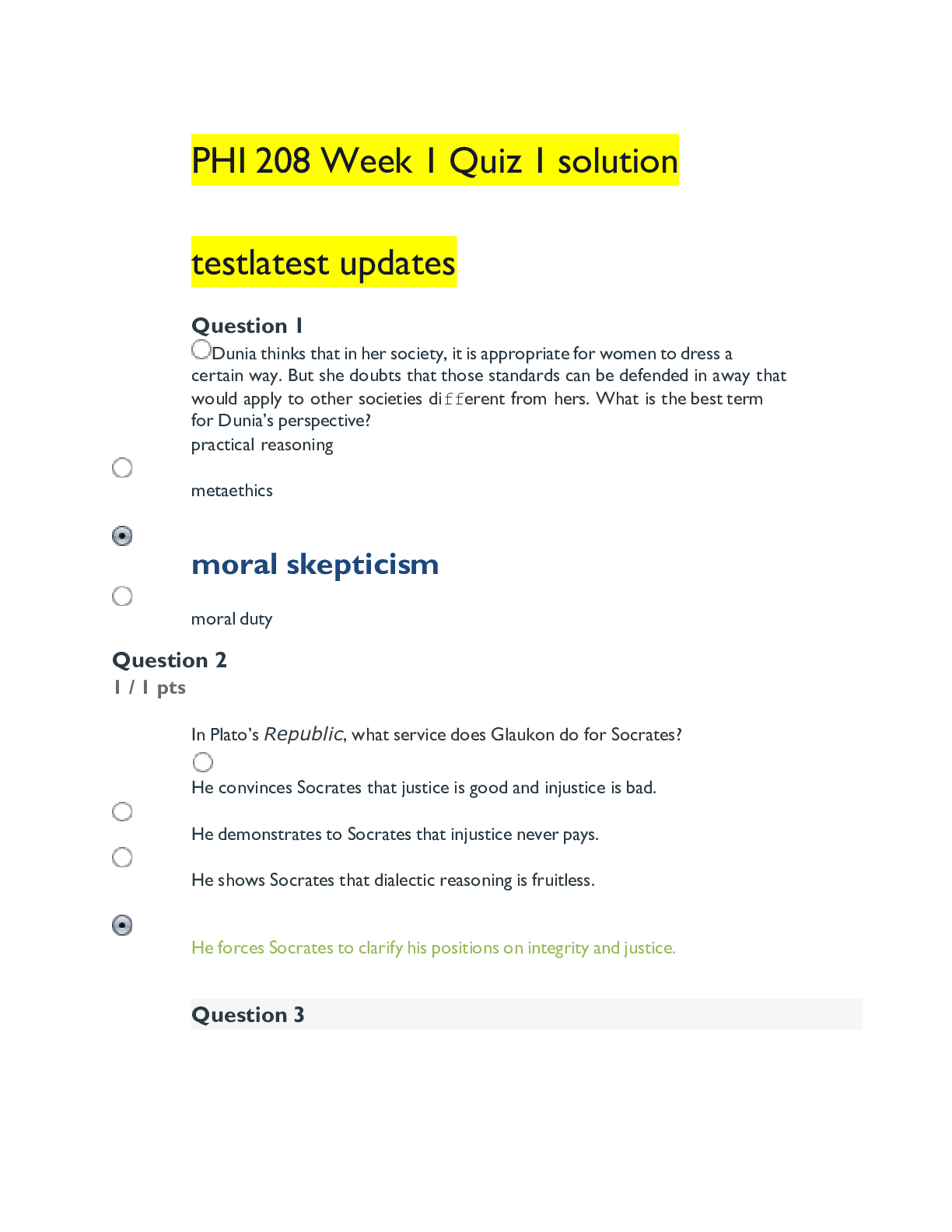
Question 1
Dunia thinks that in her society, it is appropriate for women to dress a certain way. But she doubts that those standards can be defended in a way that would apply to other societies different from hers. What is the best term
for Dunia’s perspective?
practical reasoning
metaethics
moral skepticism
moral duty
Question 2
1 / 1 pts
In Plato’s Republic, what service does Glaukon do for Socrates?
He convinces Socrates that justice is good and injustice is bad.
He demonstrates to Socrates that injustice never pays.
He shows Socrates that dialectic reasoning is fruitless.
He forces Socrates to clarify his positions on integrity and justice.
Question 3
1 / 1 pts
Paulette is a philosopher who is trying to evaluate the strength of a major moral theory. As such, which of the following questions is Paulette LEAST likely to ask about the theory?
Does this theory reflect our understanding of what it means to be human?
Does this theory explain why we ought to respect a particular set of moral standards?
Does this theory offer us good answers to ethical questions?
Does this theory avoid the frustration that can come with exploring ethical issues?
Question 4
1 / 1 pts
All of the following are common features of skepticism EXCEPT:
An attempt to formulate general ethical rules.
Doubt that moral systems are truly objective or unconditional.
Reasoning that supports criticisms of moral claims.
Alternative explanations for why people believe the moral claims that they do.
Question 5
1 / 1 pts
Nafi, a cultural anthropologist, believes that at least some moral truths are independent of the values and beliefs of any particular culture or individual. What is the term for Nafi’s belief?
moral objectivity
moral relativism
moral subjectivism
moral skepticism
Question 6
0 / 1 pts
Jewish law prescribes that their deceased be buried in a shroud (a tachrichim) in simple pine box with no metal parts. Muslims, however, do not bury their deceased in a casket, but rather in a shroud (a kafan) directly into an excavated grave oriented toward Mecca. The claim that each of these kinds of burial rites can be right would be an example of cultural __________.
coherence
egotism
objectivity
relativism
The answer can be found in Chapter 2, Section 2.2: The Relativist Challenge
Question 7
0 / 1 pts
Jessie tells Adam, “Murder is wrong, no matter what beliefs or traditions a culture has.” Jessie’s idea is an example of
applied ethics.
metaethics.
moral subjectivity.
moral objectivity.
Question 8
1 / 1 pts
In Plato’s Republic, Glaukon plays the role of devil’s advocate for Socrates. Which of the following is one of Socrates’s positions, as opposed to Glaukon’s?
Justice is a social convention to benefit the weak.
The possibility that one can get away with injustice doesn’t mean it’s good to do so.
No one is willingly just.
The best life is that of the unjust person who seems just.
Question 9
1 / 1 pts
Among the following choices, what is the best indication that a particular ethical theory is strong?
It is consistent.
It is popular.
It feels right.
It is written down.
Question 10
1 / 1 pts
What constitutes an argument, in the context of philosophy?
a set of claims and the reasons supporting them
a heated debate
an unanswerable question
a civilized disagreement
Question 11
1 / 1 pts
Victor assumes that each individual is primarily concerned with his or her own benefit. Victor’s assumption is a form of __________.
cultural relativism
altruism
egoism
speciesism
Question 12
1 / 1 pts
How does the author propose that Glaukon’s shepherd and Bill Murray’s Groundhog Day character are alike?
Following initial delight in self-indulgence, they both find themselves in a state of depression and misery.
They both conclude that they would prefer to follow the pursuit of justice for its own sake.
They both believe that flouting society’s conventions is the only way to find happiness.
In the past, they both obeyed society’s rules primarily to avoid condemnation and punishment.
Question 13
0 / 1 pts
According to Glaukon, if someone possessed Ring of Gyges, all of the following would be true EXCEPT:
The person would use it for his or her own advantage.
The person would use it to commit injustices.
The person would have a better life than before.
The person would become more just.
The answer can be found in Chapter 2, Section 2.3: The Egoist Challenge
Question 14
1 / 1 pts
“Meta” can be translated as all of the following concepts EXCEPT
“behind”
“over”
“above”
“against”
Question 15
1 / 1 pts
During the Las Vegas massacre, there were people at an outdoor concert who risked their lives to help total strangers. When interviewed later, their common response was, “It was the right thing to do.” What is the term for this kind of deep-down sense of what is good and right?
egoism
metaethics
emotivism
moral intuition
Question 16
1 / 1 pts
According to the author, which statement would support cultural relativism but conflict with the best explanation of notion of “respect”?
To respect another person or culture is to acknowledge that their beliefs and practices are worthy of respect.
To respect another person or culture is to be willing to judge some of their beliefs and practices better or worse than those of other persons or cultures.
To respect another person or culture is to acknowledge when our own lack of experience and understanding may lead us to withhold judgment.
To respect another person or culture is to affirm that there is nothing inferior or superior about another culture, and therefore nothing to admire or criticize.
Question 17
0 / 1 pts
What is NOT one of the assumptions that may lead someone to avoid thinking critically about moral issues?
That because there are multiple opinions, each one must be equally valid
That if we cannot be certain about a moral position, we cannot judge it better or worse than others.
That moral reasoning is unrelated to the kind of practical reasoning we use in everyday life.
That critical thinking and taking a stand on a moral issue is compatible with open-mindedness and intellectual humility.
The answer can be found in Chapter 1, Section 1.2: Ethical Reasoning
Question 18
1 / 1 pts
What is the primary intended purpose of dialectical reasoning?
to convince the other person that your thesis or claim is valid
to refine judgments about abstract principles and concrete cases
to enjoy the pleasures of intellectual exercise
to establish the superiority of abstract principles over concrete judgments
Question 19
1 / 1 pts
Which of the following questions best illustrates the concept of practical reasoning?
“What is true knowledge?”
“Who should have access to education?”
“Where should I apply to school?”
“What makes a good teacher?”
Question 20
1 / 1 pts
Which of the following ideas do Glaukon and Nietzsche share?
Justice benefits all people no matter their capabilities or circumstances.
Those who are physically strong but morally bad are objectively inferior to those who are morally good but physically weak.
Justice is a convention that benefits the weak.
The best sort of life is that of a person who follows his society’s standards of justice or morality, whatever they might be.
Question 1
1 / 1 pts
In September 2017, Saudi Arabia granted its women the right to drive—the last country on earth to do so. Many people judged this as positive progress. What does this judgment imply about the idea of cultural relativism?
It supports cultural relativism because progress simply means change.
It challenges relativism by recognizing an objective standard of women’s rights toward which the country has progressed.
It challenges cultural relativism because it confirms that Western values are always the correct ones.
It doesn’t challenge cultural relativism because the people making this judgment were probably not sincere.
Question 2
1 / 1 pts
Paulette is a philosopher who is trying to evaluate the strength of a major moral theory. As such, which of the following questions is Paulette LEAST likely to ask about the theory?
Does this theory reflect our understanding of what it means to be human?
Does this theory explain why we ought to respect a particular set of moral standards?
Does this theory offer us good answers to ethical questions?
Does this theory avoid the frustration that can come with exploring ethical issues?
Question 3
1 / 1 pts
Tim considers himself to be a moral skeptic. What, then, does Tim use to examine moral assumptions?
traditional doctrines
critical reasoning
groundless assertions
feelings and intuitions
Question 4
1 / 1 pts
Charlotte, a struggling single mother, sees a very wealthy man drop his wallet. Instead of informing him she keeps it and uses the money inside to buy some clothes and school supplies for her kids, but she feels guilty about doing that. How might an egoist of the sort Glaukon represents in his challenge explain her guilty feelings?
Charlotte’s guilt is the appropriate response to the objective wrong of stealing.
Charlotte is conditioned by society to feel bad about certain behaviors.
Charlotte, like most people, naturally cares about justice more than anything else.
Charlotte has failed to respect the fact that she deserves her poverty while the other man deserves his wealth.
Question 5
1 / 1 pts
According to the textbook, how do each of us live out answers to Socrates’s essential question?
by making conscious, deliberate choices that reflect a view of what matters
by realizing that it is not up to us to say what is right or wrong
by never questioning others’ assumptions about how one should live
by simply following our inner feelings and desires
Question 6
1 / 1 pts
Late one night over coffee, Ali and James get into a meandering conversation about the meaning and nature of love, whether anyone can ever truly love anyone else. What kind of judgments would the issues raised in this conversation be BEST described as?
concrete
abstract
deontological
objective
Question 7
1 / 1 pts
Skepticism MOST closely falls under which branch of ethical theory?
applied ethics.
normative ethics.
metaethics.
consequentialist ethics.
Question 8
1 / 1 pts
During the Las Vegas massacre, there were people at an outdoor concert who risked their lives to help total strangers. When interviewed later, their common response was, “It was the right thing to do.” What is the term for this kind of deep-down sense of what is good and right?
egoism
metaethics
emotivism
moral intuition
Question 9
1 / 1 pts
Which of the following is NOT one of the three major moral theories?
relative ethics
consequentialist ethics
deontological ethics
virtue ethics
Question 10
1 / 1 pts
Regarding human rights, the United Nations challenges the concept of cultural relativism by stating that
cultures whose standards differ from Western standards are immoral.
the international community must strive to eliminate all cultural and moral differences.
while there are many legitimate cultural variations, all people have certain basic human rights that must be respected.
each culture has its own beliefs and practices, all of which must be acknowledged and respected by other cultures.
Question 11
1 / 1 pts
Cultural relativism implies that cultures are isolated from each other. Challenging that assumption, philosopher Mary Midgley says, “all cultures are formed out of many streams.” What does Midgley mean by this?
All cultures that were settled near water are more similar than dissimilar.
All cultures influence all other cultures equally.
Cultures have always been shaped by their encounters with other cultures.
The notion of multiple cultures is a myth; there is only one, single culture.
Question 12
1 / 1 pts
Dunia thinks that in her society, it is appropriate for women to dress a certain way. But she doubts that those standards can be defended in a way that would apply to other societies different from hers. What is the best term for Dunia’s perspective?
practical reasoning
metaethics
moral skepticism
moral duty
Question 13
0 / 1 pts
Peyton and Vanessa are having an in-depth conversation about whether moral standards and concepts hold across cultures, or whether they are relative. What type of ethics are they considering?
normative ethics
applied ethics
metaethics
deontological ethics
The answer can be found in Chapter 1, Section 1.3: The Landscape of Moral Philosophy
Question 14
1 / 1 pts
Nafi, a cultural anthropologist, believes that at least some moral truths are independent of the values and beliefs of any particular culture or individual. What is the term for Nafi’s belief?
moral objectivity
moral relativism
moral subjectivism
moral skepticism
Question 15
1 / 1 pts
With what does the major moral theory known as utilitarianism primarily concern itself?
the neural processes in the brain
the nature and character of a person performing an action
the consequences of an action
the nature of an action itself
Question 16
1 / 1 pts
What constitutes an argument, in the context of philosophy?
Correct!
a set of claims and the reasons supporting them
a heated debate
an unanswerable question
a civilized disagreement
Question 17
0 / 1 pts
The author suggests that a statement like, “Who am I to judge what is right or wrong for someone else?” MOST often implies that
the speaker lacks intellectual humility.
ethical relativism is false.
the speaker is unwilling to learn from others.
there is no position at all from which to reasonably judge things right or wrong.
The answer can be found in Chapter 2, Section 2.2: The Relativist Challenge
Question 18
1 / 1 pts
The text uses the metaphor of a house to explain the relationship between metaethics, normative ethics, and applied ethics. Which part of the house represents normative ethics?
the roof
the foundation
the insulation
the framework
Question 19
1 / 1 pts
What is the primary intended purpose of dialectical reasoning?
to convince the other person that your thesis or claim is valid
to refine judgments about abstract principles and concrete cases
to enjoy the pleasures of intellectual exercise
to establish the superiority of abstract principles over concrete judgments
Question 20
0 / 1 pts
In the context of philosophy, what are claims?
doubts and affirmations
premises and conclusions
arguments and counterarguments
questions and answers
Question 1
1 / 1 pts
The text uses the metaphor of a house to explain the relationship between metaethics, normative ethics, and applied ethics. Which part of the house represents normative ethics?
the roof
the foundation
the insulation
the framework
Question 2
1 / 1 pts
In Plato’s Republic, what service does Glaukon do for Socrates?
He convinces Socrates that justice is good and injustice is bad.
He demonstrates to Socrates that injustice never pays.
He shows Socrates that dialectic reasoning is fruitless.
!
He forces Socrates to clarify his positions on integrity and justice.
Question 3
1 / 1 pts
Victor assumes that each individual is primarily concerned with his or her own benefit. Victor’s assumption is a form of __________.
cultural relativism
altruism
egoism
speciesism
Question 4
1 / 1 pts
Peyton and Vanessa are having an in-depth conversation about whether moral standards and concepts hold across cultures, or whether they are relative. What type of ethics are they considering?
normative ethics
applied ethics
metaethics
deontological ethics
Question 5
1 / 1 pts
According to the textbook, how do each of us live out answers to Socrates’s essential question?
by making conscious, deliberate choices that reflect a view of what matters
by realizing that it is not up to us to say what is right or wrong
by never questioning others’ assumptions about how one should live
by simply following our inner feelings and desires
Question 6
1 / 1 pts
Which of the following ideas do Glaukon and Nietzsche share?
Justice benefits all people no matter their capabilities or circumstances.
Those who are physically strong but morally bad are objectively inferior to those who are morally good but physically weak.
Justice is a convention that benefits the weak.
The best sort of life is that of a person who follows his society’s standards of justice or morality, whatever they might be.
Question 7
1 / 1 pts
The egoist view is that moral standards are only good if they serve
Correct!
an individual’s self-interest.
the interests of the majority.
the interests of the minority.
the common good of society.
Question 8
0 / 1 pts
With what does the major moral theory known as virtue ethics primarily concern itself?
the neural processes in the brain
the nature and character of a person performing an action
the consequences of an action
the nature of an action itself
The answer can be found in Chapter 1, Section 1.3: The Landscape of Moral Philosophy
Question 9
1 / 1 pts
According to the author, which statement would support cultural relativism but conflict with the best explanation of notion of “respect”?
To respect another person or culture is to acknowledge that their beliefs and practices are worthy of respect.
To respect another person or culture is to be willing to judge some of their beliefs and practices better or worse than those of other persons or cultures.
To respect another person or culture is to acknowledge when our own lack of experience and understanding may lead us to withhold judgment.
To respect another person or culture is to affirm that there is nothing inferior or superior about another culture, and therefore nothing to admire or criticize.
Question 10
1 / 1 pts
Jewish law prescribes that their deceased be buried in a shroud (a tachrichim) in simple pine box with no metal parts. Muslims, however, do not bury their deceased in a casket, but rather in a shroud (a kafan) directly into an excavated grave oriented toward Mecca. The claim that each of these kinds of burial rites can be right would be an example of cultural __________.
coherence
egotism
objectivity
relativism
Question 11
1 / 1 pts
Relativism is a way to acknowledge that much of what we value—and how we think we and others should act—has been significantly shaped by
our shared genetic dispositions.
our own culture and upbringing.
independent, abstract moral reasoning.
direct revelation from a divine power.
Question 12
1 / 1 pts
With what does the major moral theory known as utilitarianism primarily concern itself?
the neural processes in the brain
the nature and character of a person performing an action
the consequences of an action
the nature of an action itself
Question 13
1 / 1 pts
Skepticism MOST closely falls under which branch of ethical theory?
applied ethics.
normative ethics.
metaethics.
consequentialist ethics.
Question 14
1 / 1 pts
Jessie tells Adam, “Murder is wrong, no matter what beliefs or traditions a culture has.” Jessie’s idea is an example of
applied ethics.
metaethics.
moral subjectivity.
moral objectivity.
Question 15
1 / 1 pts
Which of the following is NOT one of the three major moral theories?
relative ethics
consequentialist ethics
deontological ethics
virtue ethics
Question 16
1 / 1 pts
According to the Greek philosopher Socrates, the key ethical question is:
What have I been taught to do?
How should one live?
What are the laws of my society?
Whom can one trust?
Question 17
1 / 1 pts
To which category do arguments regarding the morality of topics like abortion and eating animals belong?
normative ethics
applied ethics
metaethics
deontological ethics
Question 18
1 / 1 pts
Which of the following activities best illustrates the nature of a dialectical process?
a half marathon
a piano recital
a tennis match
a baseball game
Question 19
1 / 1 pts
Late one night over coffee, Ali and James get into a meandering conversation about the meaning and nature of love, whether anyone can ever truly love anyone else. What kind of judgments would the issues raised in this conversation be BEST described as?
concrete
abstract
deontological
objective
Question 20
1 / 1 pts
What is the primary intended purpose of dialectical reasoning?
to convince the other person that your thesis or claim is valid
to refine judgments about abstract principles and concrete cases
to enjoy the pleasures of intellectual exercise
to establish the superiority of abstract principles over concrete judgments
[Show More]




 answers.png)





 answers.png)


