NURS 612- FINAL EXAM STUDY GUIDE
1. Assessing orientation to person, place, and time helps determine
State of consciousness
2. under most conditions, adult patients should be able to repeat a series of numbers.
...
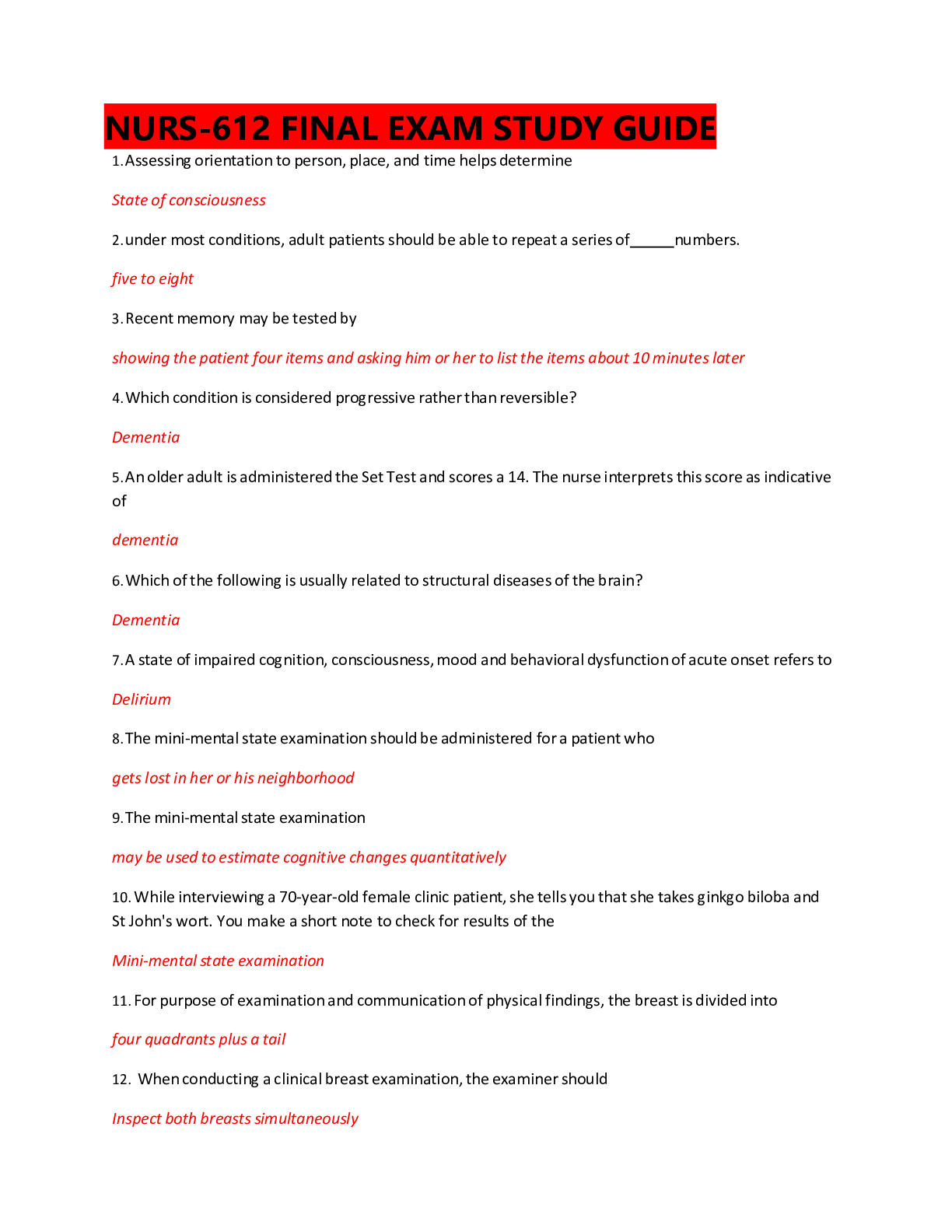
NURS 612- FINAL EXAM STUDY GUIDE
1. Assessing orientation to person, place, and time helps determine
State of consciousness
2. under most conditions, adult patients should be able to repeat a series of numbers.
five to eight
3. Recent memory may be tested by
showing the patient four items and asking him or her to list the items about 10 minutes later
4. Which condition is considered progressive rather than reversible?
Dementia
5. An older adult is administered the Set Test and scores a 14. The nurse interprets this score as indicative of
dementia
6. Which of the following is usually related to structural diseases of the brain?
Dementia
7. A state of impaired cognition, consciousness, mood and behavioral dysfunction of acute onset refers to
Delirium
8. The mini-mental state examination should be administered for a patient who
gets lost in her or his neighborhood
9. The mini-mental state examination
may be used to estimate cognitive changes quantitatively
10. While interviewing a 70-year-old female clinic patient, she tells you that she takes ginkgo biloba and St John's wort. You make a short note to check for results of the
Mini-mental state examination
11. For purpose of examination and communication of physical findings, the breast is divided into
four quadrants plus a tail
12. When conducting a clinical breast examination, the examiner should
Inspect both breasts simultaneously
13. Which breast change is typical after menopause?
thickening of the inframammary ridge
14. in a woman complaining of a breast lump, it is most important to ask about
its relationship to menses
15. A 50 year old woman presents as a new patient. which finding in her personal and social history would increase her risk profile for developing breast cancer?
nulliparity
16. To begin the clinical breast examination for a man, ask him to
sit with his arms hanging at his sides.
17. Inspection of the breasts usually begins with the patient in which position?
Sitting
18. Which finding, found on inspection, is related to fibrotic tissue changes that occur with breast carcinoma?
Skin dimpling or retraction
19. Venous patterns on breasts are suggestive of pathology when they are
unilateral
20. In a patient with breast cancer, pau d'orange skin is often first evident
on or around the nipple
21. Recent unilateral inversion of a previously everted nipple suggests
cancer
22. You are conducting a clinical breast exam for a 30 year old patient. Her breasts are symmetrical with bilateral, multiple tender masses that are freely moveable with well-defined borders. You recognize that these symptoms and assessment findings are consistent with
fibrocystic changes
23. When palpating breast tissue, the examiner should use the at each site.
finger pads
24. The largest amount of glandular breast tissue lies in the
upper outer quadrant
25. The tail of spence extends
into the axillae
26. When examining axillary lymph nodes, the patient's arm is
flexed at the elbow
27. Lymphatic flow of the breast primarily drains
radially
28. The greatest concern for breast cancer is when you palpate nodes
supraclavicular
29. You are performing a clinical breast examination for a 55-year-old woman. While palpating the supraclavicular area, you suspect that you felt a node. To improve your hooked technique, you should
ask the patient to turn her head toward that side
30. What structures are located at the 5 and 7 o'clock positions of the vaginal orifice and open onto the sides of the vesibule in the groove between the labia minora and the hymen?
Bartholin glands
31. Which factor is associated with an increased risk of cervical cancer?
Early parity
32. The risk of ovarian cancer is increased by a history of
nulliparity
33. During digital examination of the vagina, the cervix is noted to be positioned posteriorly. Upon bimanual examination of this woman, you would expect to palpate a(n) uterus.
Anteverted
34. The presence of cervical motion tenderness may indicate
pelvic inflammatory disease
35. During a routine vaginal examination, you insert the speculum and visualize the cervix. the cervix projection into the vaginal vault is approximately 5 cm. Upon bimanual examination, you would expect to find the uterus
CONTINUED...DOWNLOAD FOR BEST SCORES
[Show More]














 BMAL 590- QUANTITATIVE RESEARCH TECHNIQUES AND STATISTICS TEST WITH SUMMARIZED STUDY GUIDE.png)