Linguistics > GCSE MARK SCHEME > GCSE - FRENCH - 8658/RF - Paper 3 - Reading foundation Tier (All)
GCSE - FRENCH - 8658/RF - Paper 3 - Reading foundation Tier
Document Content and Description Below
Last updated: 3 years ago
Preview 1 out of 13 pages
Instant download
.png)
Buy this Document to get the Full Access Instantly
Provided by Students Who Aced it
We Verify Document Content to Gurantee Accuracy
Reviews( 0 )
Document information
Connected school, study & course
About the document
Uploaded On
Jun 06, 2022
Number of pages
13
Written in
All

Additional information
This document has been written for:
Uploaded
Jun 06, 2022
Downloads
0
Views
177
Topic Tags
Recommended For You
Get more on GCSE MARK SCHEME »
GCSE - FRENCH - 8658/RF - Paper 3 - Reading Foundation Tier...

Test Bank for A Concise Introduction to Linguistics, 6th Editi...

Contemporary Logistics, 12e Paul Murphy, Michael Knemeyer (Sol...
Contemporary Logistics, (Global Edition), 12e Paul Murphy, Mic...

AQA GCSE FRENCH HIGHER TIER PAPER 1 LISTENING JUNE 2021 QUESTI...

AQA GCSE FRENCH HIGHER TIER PAPER 3 READING JUNE 2021 QUESTION...

AQA GCSE FRENCH HIGHER TIER PAPER 4 WRITING JUNE 2021 QUESTION...
Contemporary Linguistic Analysis_An Introduction 9th Edition b...
Test Bank for Language in Mind 2nd Edition An Introduction to...
.png)
.png)

2023 AQA GCSE FRENCH 8658/RF Paper 3 Reading Foundation Tier Q...
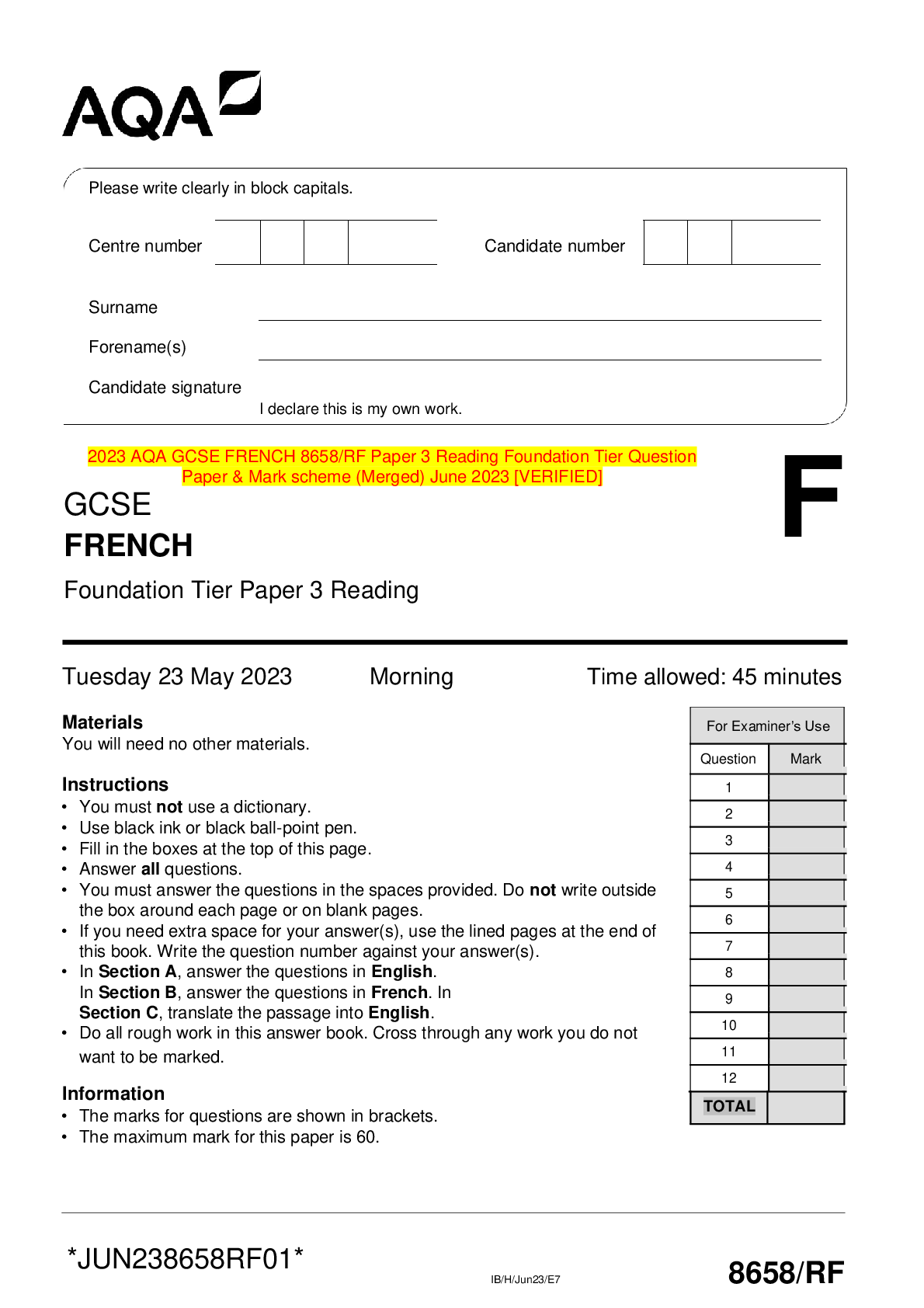
2023 AQA GCSE FRENCH 8658/RF Paper 3 Reading Foundation Tier Q...

2023 AQA GCSE FRENCH 8658/RF Paper 3 Reading Foundation Tier Q...
Test Bank for A Concise Introduction to Linguistics 3rd Editio...

Fundamentals of Nursing NCLEX Test Bank Quiz #2: 75 Questions-...
Solution Manual for A Concise Introduction to Linguistics 3rd...
NUR 410V Test Bank - Pathophysiology The Biologic Basis for Di...

.png)
.png)

