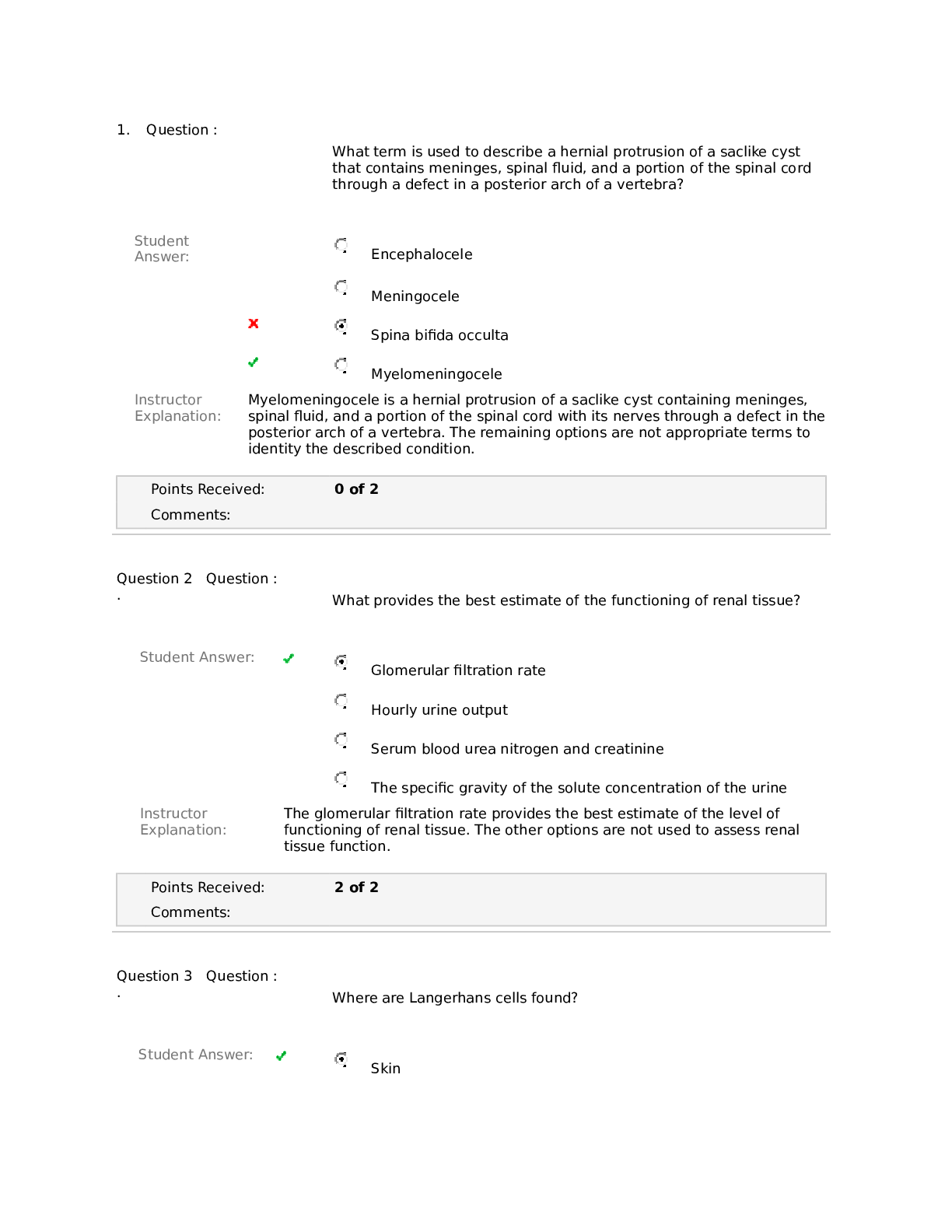
What term is used to describe a hernial protrusion of a saclike cyst that contains meninges, spinal fluid, and a portion of the spinal cord through a defect in a posterior arch of a vertebra?
Student
Answer: Enc
...
What term is used to describe a hernial protrusion of a saclike cyst that contains meninges, spinal fluid, and a portion of the spinal cord through a defect in a posterior arch of a vertebra?
Student
Answer: Encephalocele
Meningocele
Spina bifida occulta
Instructor Explanation:
Myelomeningocele
Myelomeningocele is a hernial protrusion of a saclike cyst containing meninges, spinal fluid, and a portion of the spinal cord with its nerves through a defect in the posterior arch of a vertebra. The remaining options are not appropriate terms to identity the described condition.
Question 2
.
Question :
What provides the best estimate of the functioning of renal tissue?
Student Answer:
Glomerular filtration rate Hourly urine output
Serum blood urea nitrogen and creatinine
Instructor Explanation:
The specific gravity of the solute concentration of the urine
The glomerular filtration rate provides the best estimate of the level of functioning of renal tissue. The other options are not used to assess renal tissue function.
Question 3
.
Question :
Where are Langerhans cells found?
Student Answer:
Skin
Intestinal lining Kidney
Instructor Explanation:
Thyroid
Of the available options, only the skin is the location for Langerhans cells.
Question 4
.
Question :
Where in the lung does gas exchange occur?
Student Answer:
Trachea Segmental bronchi
Alveolocapillary membrane
Instructor Explanation:
Main bronchus
Gas exchange occurs only across the alveolocapillary membrane.
Question 5
.
Question :
The tonic neck reflex observed in a newborn should no longer be obtainable by:
Student Answer:
2 years
1 year
10 months
Instructor Explanation:
5 months
The tonic neck reflex should be unobtainable by 5 months of age.
Question 6
.
Question :
When renin is released, it is capable of which action?
Student Answer:
Inactivation of autoregulation Direct activation of angiotensin II
Direct release of antidiuretic hormone (ADH)
Instructor Explanation:
Formation of angiotensin I
When renin is released, it cleaves an ?-globulin (angiotensinogen produced by liver hepatocytes) in the plasma to form angiotensin I.
Question 7
.
Question :
The portion of the antigen that is configured for recognition and binding is referred to as what type of determinant?
Student
Answer: Immunotope
Paratope Epitope
Instructor Explanation:
Antigenitope
The precise portion of the antigen that is configured for recognition and binding is called its antigenic determinant or epitope. The other options are not used to identify this portion of the antigen.
Question 8
.
Question :
Which sexually transmitted infection frequently coexists with gonorrhea?
Student Answer:
Syphilis
Herpes simplex virus Chlamydia
Instructor Explanation:
Chancroid
The coexistence of chlamydial infection with gonorrhea frequently occurs. No coexistence exists with the other options.
Question 9
.
Question :
How is the effectiveness of vitamin B12 therapy measured?
Student
Answer: Reticulocyte count
Serum transferring Hemoglobin
Instructor Explanation:
Serum vitamin B12
The effectiveness of cobalamin replacement therapy is determined by a rising reticulocyte count. The other options are not used as indicators of the effectiveness of vitamin B12 therapy
Question 10
.
Question :
Carcinoma refers to abnormal cell proliferation originating from which tissue origin?
Student Answer:
Blood vessels Epithelial cells Connective tissue
Instructor Explanation:
Glandular tissue
Only cancers arising from epithelial cells are called carcinomas.
Question 11
.
Question :
Which type of microorganism reproduces on the skin?
Student Answer:
Viruses
Bacteria and fungi Protozoa and Rickettsiae
Instructor Explanation:
Mycoplasma
Only bacteria and fungi have the capacity to reproduce on the skin.
Question 12
.
Question :
An infant has a crescendo-decrescendo systolic ejection murmur located between the second and third intercostal spaces along the left sternal border. A wide fixed splitting of the second heart sound is also found. These clinical findings are consistent with which congenital heart defect?
Student
Answer: Atrial septal defect (ASD)
Ventricular septal defect (VSD) Patent ductus arteriosus (PDA)
Instructor Explanation:
Atrioventricular canal (AVC) defect
Because most children with ASD are asymptomatic, diagnosis is usually made during a routine physical examination by the auscultation of a crescendo- decrescendo systolic ejection murmur that reflects increased blood flow through the pulmonary valve. The location of the murmur is between the second and third intercostal spaces along the left sternal border. A wide fixed splitting of the second heart sound is also characteristic of ASD, reflecting volume overload to the right ventricle and causing prolonged ejection time and a delay of pulmonic valve closure. The presentations of other congenital heart defects are not consistent with the described symptoms.
Question 13
.
Question :
An infant diagnosed with a small patent ductus arteriosus (PDA) would likely exhibit which symptom?
Student Answer:
Intermittent murmur Lack of symptoms Need for surgical repair
Instructor Explanation:
Triad of congenital defects
Infants with a small PDA usually remain asymptomatic; the other options are incorrect.
Question 14
.
Question :
What is the function of erythrocytes?
Student Answer:
Tissue oxygenation Hemostasis Infection control
Instructor Explanation:
Allergy response
Erythrocytes are solely responsible for tissue oxygenation.
Question 15
.
Question :
Which terms represent the correct nomenclature for benign and malignant tumors of adipose tissue, respectively?
Student
Answer: Liposarcoma, lipoma
Lipoma, liposarcoma Adisarcoma, adipoma
Instructor Explanation:
Adipoma, adisarcoma
In general, cancers are named according to the cell type from which they originate (e.g., lip for cancers that originate in adipose or fat tissue), whereas benign tumors use the suffix -oma. Cancers arising from connective tissue usually have the suffix sarcoma.
Question 16
.
Question :
What is the chance with each pregnancy that a child born to two parents with the sickle trait will have sickle cell disease (SCD)?
Student
Answer: 20%
25%
33%
Instructor Explanation:
50%
A 25% chance exists with each pregnancy that a child born to two parents with sickle cell trait will have SCD. Genetic counseling enables people with SCD or with the sickle cell trait to make informed decisions about transmitting this genetic disorder to their offspring.
Question 17
.
Question :
What pulmonary defense mechanism propels a mucous blanket that entraps particles moving toward the oropharynx?
Student
Answer: Nasal turbinates
Alveolar macrophages Cilia
Irritant receptors on the nares
Instructor Explanation:
The submucosal glands of the bronchial lining produce mucus, contributing to the mucous blanket that covers the bronchial epithelium. The ciliated epithelial cells rhythmically beat this mucous blanket toward the trachea and pharynx, where it can be swallowed or expectorated by coughing. This selection is the only option that accurately identifies the pulmonary defense mechanism described.
Question 18
.
Question :
The concentration of the final urine is determined by antidiuretic hormone (ADH), which is secreted by which gland?
[Show More]