NR 566 Week 2 Respiratory Treatments Discussion: Asthma (Original Post, Peer Responses)
Asthma
There are several subjective symptoms found in patients who present to the clinic with asthma. Some of the subjective fin
...
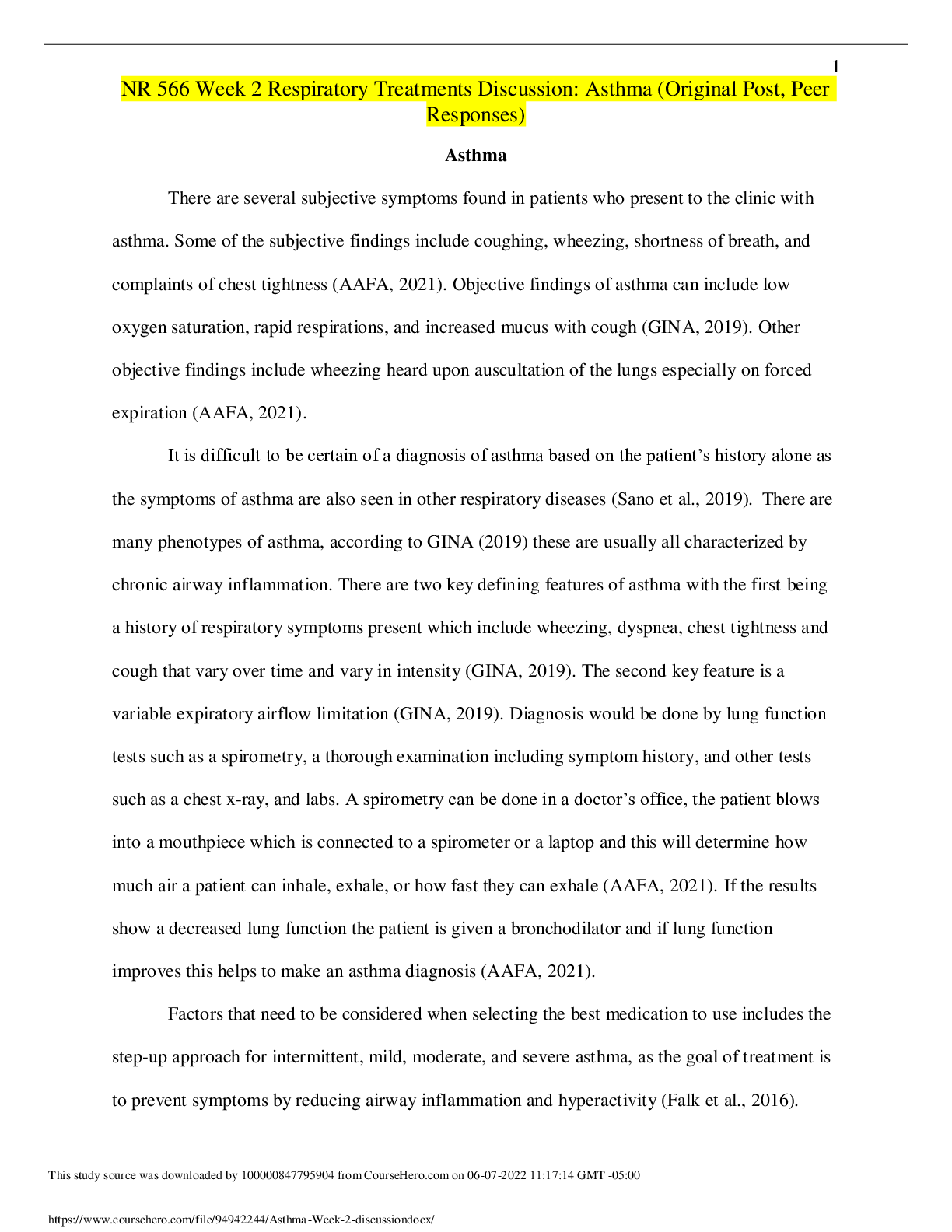
NR 566 Week 2 Respiratory Treatments Discussion: Asthma (Original Post, Peer Responses)
Asthma
There are several subjective symptoms found in patients who present to the clinic with asthma. Some of the subjective findings include coughing, wheezing, shortness of breath, and complaints of chest tightness (AAFA, 2021). Objective findings of asthma can include low oxygen saturation, rapid respirations, and increased mucus with cough (GINA, 2019). Other objective findings include wheezing heard upon auscultation of the lungs especially on forced expiration (AAFA, 2021).
It is difficult to be certain of a diagnosis of asthma based on the patient’s history alone as the symptoms of asthma are also seen in other respiratory diseases (Sano et al., 2019). There are many phenotypes of asthma, according to GINA (2019) these are usually all characterized by chronic airway inflammation. There are two key defining features of asthma with the first being a history of respiratory symptoms present which include wheezing, dyspnea, chest tightness and cough that vary over time and vary in intensity (GINA, 2019). The second key feature is a variable expiratory airflow limitation (GINA, 2019). Diagnosis would be done by lung function tests such as a spirometry, a thorough examination including symptom history, and other tests such as a chest x-ray, and labs. A spirometry can be done in a doctor’s office, the patient blows into a mouthpiece which is connected to a spirometer or a laptop and this will determine how much air a patient can inhale, exhale, or how fast they can exhale (AAFA, 2021). If the results show a decreased lung function the patient is given a bronchodilator and if lung function improves this helps to make an asthma diagnosis (AAFA, 2021).
Factors that need to be considered when selecting the best medication to use includes the step-up approach for intermittent, mild, moderate, and severe asthma, as the goal of treatment is to prevent symptoms by reducing airway inflammation and hyperactivity (Falk et al., 2016).
Treatment would be chosen on the severity of the asthma using the step-up approach through GINA guidelines. Previous guidelines were recommendations that patients with mild asthma should be treated with an as-needed SABA (short acting beta agonist), however in 2019 GINA changed its guidelines to include ICS-containing (inhaled corticosteroid) controller treatment with a SABA (GINA 2019). This guideline change was done because a SABA-only treatment is associated with an increased risk of exacerbations and lower lung functioning in patients and severe exacerbations can lead to an increased risk of death (GINA, 2019). To prevent asthma exacerbations and to help to control symptoms GINA now recommends that every adult and adolescent with asthma should receive ICS-containing controller medication to reduce their risks of exacerbations and this is to include patients with infrequent symptoms (GINA, 2019).
Treatment options will be beta agonist and corticosteroid combination, Advair Diskus (fluticasone propionate/salmeterol xinafoate) or generic, 50mcg/500mcg, inhale 1 actuation every 12 hours for prevention of asthma exacerbations (Micromedex, 2021). For a rescue inhaler treatment options would be a Ventolin HFA (albuterol sulfate inhalation aerosol) 90mcg 2 puffs/oral inhalations every 4 to 6 hours as needed for shortness of breath (Micromedex, 2021).
For patients with compliance issues or concerns Breo Ellipta (fluticasone furoate 100mcg and vilanterol 25mcg inhalation powder) inhale one actuation once daily (Micromedex, 2021).
Breo is a combination of ICS and a LABA (long-acting beta2-adrenergic agonist) medication (Micromedex, 2021). Breo can be used as a once daily option for compliance in concerns with patients who will not take an inhaler twice a day. Every patient diagnosed with asthma should be prescribed a rescue inhaler (Falk et al., 2016).
There is a wide variety of treatment options for asthma, some of these medications can also be included are medications such as anticholinergics such as Spiriva Respimate and
Leukotriene modifiers are oral medications that include montelukast along with the above mentioned medications (AAAAI, 2021).
Advair- Fluticasone propionate is a synthetic trifluorinated corticosteroid with anti- inflammatory effects, it is a human glucocorticoid receptor agonist that helps to inhibit multiple cell and mediator types that are involved in asthmatic responses in the body (Micromedex, 2021). Salmeterol xinafoate is a LABA which increases cyclic AMP levels which then aides in the relaxation of the bronchial smooth muscle and helps to inhibit the release of mediators of instantaneous hypersensitivity that occurs in the mast cells (Micromedex, 2021). Adverse effects include pharyngitis, throat irritation, cardiac dysrhythmia, pneumonia, exacerbation of asthma, and osteoporosis (Micromedex, 2021). Do not use a spacer with the Diskus (Micromedex, 2021). The powder medicine is in a foil blister package, place the capsule in the Diskus inhaler and close it, this pokes a hole in each blister one at a time when you push the lever (Micromedex, 2021). This medication will not stop an asthma attack that has already started, use a rescue inhaler in the case of an acute asthma attack (Falk et al., 2016).
Ventolin-The mechanism of action for albuterol sulfate, a sympathomimetic amine, is a beta-adrenergic agonist that selectively acts on the beta 2 adrenergic receptors of the intracellular adenyl cyclase, the catalyst for conversion of ATP to AMP and results in bronchial smooth muscle relaxation and inhibition of release of immediate hypersensitivity mediators from mast cells (Micromedex, 2021). Common adverse reactions include pharyngitis, upper respiratory infection, bronchitis, and nausea (Falk et al., 2016). Advise patients on proper inhalation technique (Falk et al., 2016). If taking more than one puff, wait 1 to 2 minutes before inhaling the second puff (Falk et al., 2016). Instruct patients to report symptoms of paradoxical
bronchospasm, which is increased trouble breathing right after the use of the inhaler (AAFA, 2021).
Breo- The mechanism of action for fluticasone furoate which is a synthetic trifluorinated corticosteroid with anti-inflammatory effects which have a wide range of actions on multiple cell types and mediator involved in inflammation (Micromedex, 2021). Vilanterol trifenatate is a LABA which increases cyclic AMP levels which then aides in the relaxation of the bronchial smooth muscle and helps to inhibit the release of mediators of instantaneous hypersensitivity that occurs in the mast cells (Micromedex, 2021). Three adverse reactions to Breo include Cushing’s syndrome, decreased bone mineral density, paradoxical bronchospasm, and pneumonia (Micromedex, 2021). Do not take Breo if you have had an allergic reaction to fluticasone, vilanterol, or milk proteins (Micromedex, 2021). Prior to taking the medication, open the cover of the inhaler and hear a click, the inhaler is then ready to use, and do not close the cover again until after you have taken your dose (AAFA, 2021). After finishing inhaling, rinse your mouth out with water, do not swallow the water after rinsing (AAFA, 2021).
References
American Academy of Allergy Asthma & Immunology. (AAAAI). (2021). Conditions and treatments: Asthma. https://www.aaaai.org/conditions-and-treatments/asthma
Asthma and Allergy Foundation of America. (AAFA). (2021). What are the symptoms of asthma? https://www.aafa.org/asthma-symptoms/
Falk, N. P., Hughes, S. W., & Rodgers, B. C. (2016). Medications for Chronic Asthma. American Academy of Family Physicians, 94(6), 454–462. https://www.aafp.org/afp/2016/0915/p454.html
Global Initiative for Asthma. (GINA). (2019). GINA implementation guide for asthma. https://ginasthma.org/gina-implementation-guide/
Micromedex. (2021). Fluticasone/Vilanterol (inhalation) powder. https://www-
micromedexsolutions-
com.chamberlainuniversity.idm.oclc.org/carenotes/librarian/ssl/true/CS/6561DC/ND_P/
Main/DUPLICATIONSHIELDSYNC/3FF41B/ND_PG/CNotesInfoHelpAndPrintReady/
ND_B/CNotes/ND_T/CNotes/PFActionId/carenotes.SaveSelectedTitles
Sano, H., Tomita, K., Sano, A., Saeki, S., Nishikawa, Y., Nishiyama, O., Iwanaga, T., & Tohda,
Y. (2019). Accuracy of objective tests for diagnosing adult asthma in symptomatic patients: A systematic literature review and hierarchical bayesian latent-class meta- analysis. Allergology International, 68(2), 191–198. https://doi.org/10.1016/j.alit.2018.08.013
[Show More]