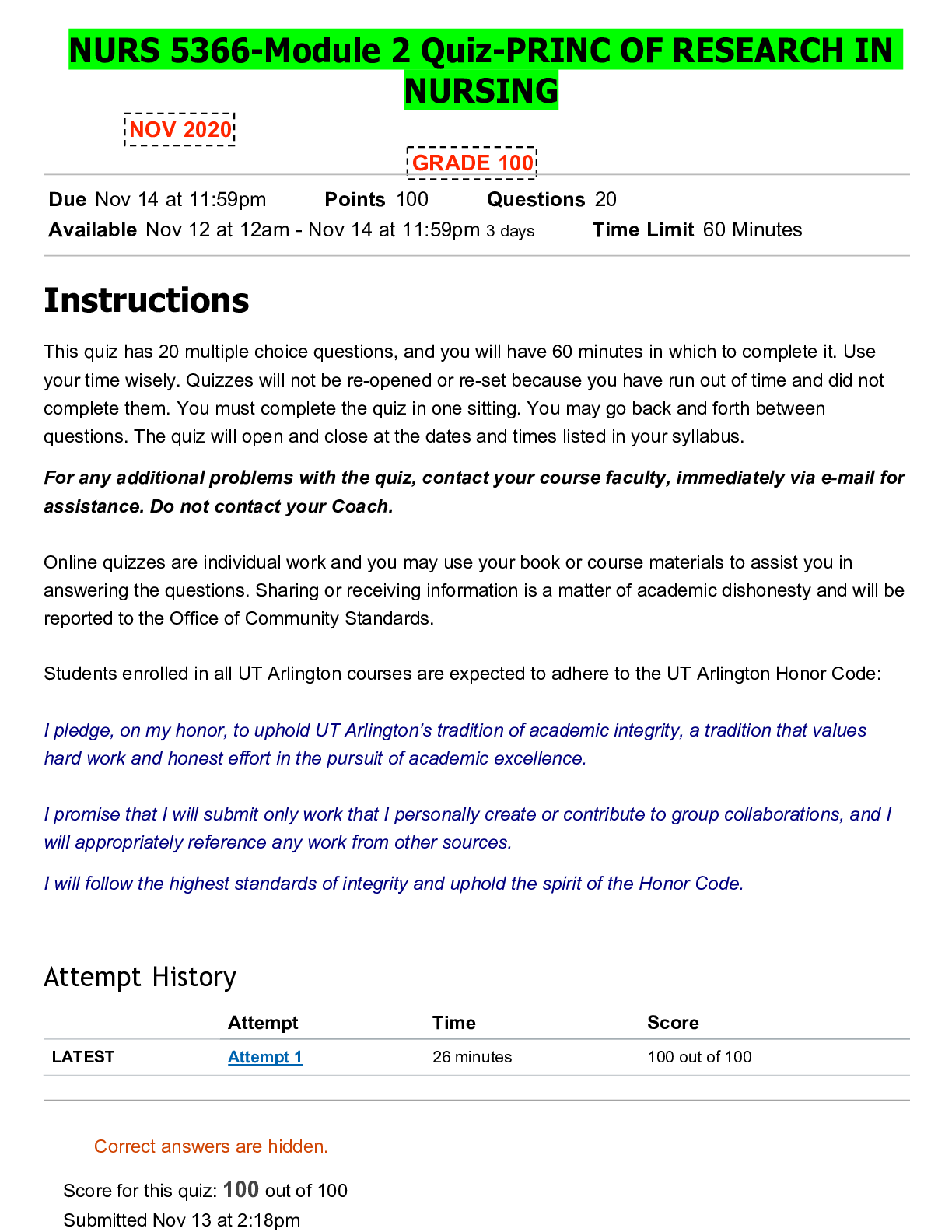
Module 2 Quiz
Due Apr 18 at 11:59pm
Points 100
Questions 20
Available Apr 16 at 8am - Apr 18 at 11:59pm 3 days
Time Limit 60 Minutes
Instructions
This quiz has 20 multiple choice questions, and you will
...
Module 2 Quiz
Due Apr 18 at 11:59pm
Points 100
Questions 20
Available Apr 16 at 8am - Apr 18 at 11:59pm 3 days
Time Limit 60 Minutes
Instructions
This quiz has 20 multiple choice questions, and you will have 60 minutes in which to
complete it. Use your time wisely. Quizzes will not be re-opened or re-set because you
have run out of time and did not complete them. You must complete the quiz in one
sitting. You may go back and forth between questions. The quiz will open and close at
the dates and times listed in your syllabus.
For any additional problems with the quiz, contact your course faculty, immediately
via e-mail for assistance. Do not contact your Coach.
Online quizzes are individual work and you may use your book or course materials to
assist you in answering the questions. Sharing or receiving information is a matter of
academic dishonesty and will be reported to the Office of Community Standards.
Students enrolled in all UT Arlington courses are expected to adhere to the UT
Arlington Honor Code:
I pledge, on my honor, to uphold UT Arlington’s tradition of academic integrity, a
tradition that values hard work and honest effort in the pursuit of academic
excellence.
I promise that I will submit only work that I personally create or contribute to group
collaborations, and I will appropriately reference any work from other sources.
I will follow the highest standards of integrity and uphold the spirit of the Honor
Code.
Attempt History
Attempt Time
LATEST Attempt 1 17 minutes
Correct answers are hidden.
Score for this quiz: 100 out of 100
Submitted Apr 16 at 8:56pm
This attempt took 17 minutes.
Question 1
5 / 5 pts
A stimulus or activity that is measured to examine the effect created by the independent
variable best describes a(n) _____ variable.
Extraneous
Demographic
Independent
Dependent
In quantitative research, the independent variable (intervention, treatment, or
experimental variable) is manipulated or varied by the researcher to cause an effect on
the dependent variable. The dependent variable (response or outcome variable) is
measured to examine the effect created by the independent variable. An independent
variable is a stimulus or activity that is manipulated or varied by the researcher to create
an effect on the dependent variable. A dependent variable is the response behavior or
outcome that the researcher wants to predict or explain. Extraneous variables exist in all
studies and can affect the measurement of study variables and the relationships among
them. Extraneous variables are of primary concern in quantitative studies, because they
can obscure one’s understanding of the relational or causal dynamics within the studies.
Demographic variables are attributes of the subjects that are measured during the study
and used to describe the sample.
Question 2
5 / 5 pts
A study’s hypothesis that a new surgical approach produces safer outcomes in
immunosuppressed patients is tested in a fourteen-site research study across the United
States. Subjects at all sites are randomly selected and randomly assigned to
experimental versus control groups. What study design is used in this research project?
Model testing design
Randomized controlled trial
Counterbalanced design
Quasi-experimental design
A randomized clinical trial (RCT) contains random assignment to experimental
and clinical groups and very often is multi-site. A fully randomized design
contains both random selection and random assignment. Quasi-experimental
designs facilitate the search for knowledge and examination of causality in
situations in which complete control is not possible. Such designs lack a
control group, or lack random assignment to group. The model-testing
design requires that all variables relevant to the model be measured, using
correlational statistics. A large, heterogeneous sample is required. Crossover,
or counterbalancing, is a strategy designed to guard against possible
erroneous conclusions resulting from carryover effects. With counterbalancing,
subjects are randomly assigned to a specific sequencing of treatment
conditions. This approach distributes the carryover effects equally throughout
all the conditions of the study, thus canceling them out. To prevent an effect
related to time, the same amount of time must be allotted to each treatment,
and the crossover point must be related to time, not to the condition of the
subject.
Question 3
5 / 5 pts
The director of a major hospital conducts a study to discover the types of critical
incidents that have occurred in the the hospital over the past 5 years. She compiles a list
of all the critical incidents that occurred during that time. In this study, critical incidents
serve as the___________.
dependent variable.
extraneous variable.
study sample.
In quantitative research, the independent
variable (intervention, treatment, or experimental variable) is
manipulated or varied by the researcher to cause an effect on the
dependent variable. The dependent variable (response or outcome
variable) is measured to examine the effect created by the
independent variable. An independent variable is a stimulus or
activity that is manipulated or varied by the researcher to create an
effect on the dependent variable. A dependent variable is the
response behavior or outcome that the researcher wants to predict
or explain. Extraneous variables exist in all studies and can affect
the measurement of study variables and the relationships among
them. Extraneous variables are of primary concern in quantitative
studies, because they can obscure one’s understanding of the
relational or causal dynamics within the studies. Demographic
variables are attributes of the subjects that are measured during the
study and used to describe the sample.
Question 4
5 / 5 pts
How does a comparative descriptive design differ from a typical descriptive design?
It examines the relationship between multiple variables, whereas a typical
descriptive design only evaluates the effect of one independent variable on
one dependent variable.
It describes data from two different groups, whereas a typical descriptive
design focuses on a single group.
It differs in name only; they are essentially the same design.
It compares changes in phenomenon over time, whereas the typical
descriptive design focuses on only one time period.
The commonly used descriptive study design examines characteristics of a
single sample. It identifies a phenomenon of interest and the variables within
the phenomenon, develops conceptual and operational definitions of the
variables, and describes the variables. The comparative descriptive design
examines and describes differences in variables in two or more groups that
occur naturally in the setting. Descriptive statistics and inferential statistical
analyses may be used to examine differences between or among groups.
Question 5
5 / 5 pts
In the following hypothesis, what is the independent variable?
There is no measurable difference in incidence of acne in 15-year-olds who are placed
on a chocolate-free diet.
Acne
Fifteen-year-olds
Chocolate-free diet
A dependent variable is the response behavior or outcome that the researcher
wants to predict or explain. An independent variable is a stimulus or activity
that is manipulated or varied by the researcher to create an effect on the
dependent variable. In this example, acne is the dependent variable and
removal of chocolate from the diet is the independent variable.
Question 6
5 / 5 pts
In the following purpose statement, what kind of variable is number of days absent from
class?
The purpose of this study was to examine the effects of a generous weekly allowance
and twice-weekly text messages from parents on number of days absent from class, in
freshman college students.
Extraneous variable
Independent variable
Dependent variable
A dependent variable is the response behavior, or outcome that the researcher wants to
predict or explain. In this example, number of days absent from class is the dependent
variable. An independent variable is a stimulus or activity that is manipulated or varied
by the researcher to create an effect on the dependent variable. The independent
variable is also called an intervention, treatment, or experimental
variable. Demographic variables are attributes of the subjects that are measured during
the study and used to describe the sample. Extraneous variables exist in all studies and
can affect the measurement of study variables and the relationships among them.
Question 7
5 / 5 pts
In the following research question, what is the independent variable?
Can diabetics on oral antiglycemic medications achieve better control of blood sugar, as
measured by Hgb A1C, if they meditate on a daily basis?
Blood sugar
Hgb A1C
Meditation
Oral antiglycemic medications
An independent variable is a stimulus or activity that is manipulated or varied by the
researcher to create an effect on the dependent variable. The independent variable is
also called an intervention, treatment, or experimental variable. In this example, nausea
and vomiting are dependent variables and guided imagery and relaxation techniques
are independent variables.
Question 8
5 / 5 pts
Which of the following sources would not be an appropriate source to include in a
literature review for a research proposal?
A Website developed by a governmental agency
a blog post on vaccination side effects retrieved from www.parents.com
research study published in an online journal
scholarly paper presented at a professional conference
Blog posts would not be considered appropriate sources for research proposal
development.
Question 9
5 / 5 pts
The intervention that the researcher manipulates is the _____ variable.
Extraneous
Independent
Dependent
Confounding
In quantitative research, the independent variable (intervention, treatment, or
experimental variable) is manipulated or varied by the researcher to cause an effect on
the dependent variable. The dependent variable (response or outcome variable) is
measured to examine the effect created by the independent variable. An independent
variable is a stimulus or activity that is manipulated or varied by the researcher to create
an effect on the dependent variable. A dependent variable is the response behavior or
outcome that the researcher wants to predict or explain. Extraneous variables exist in all
studies and can affect the measurement of study variables and the relationships among
them. Extraneous variables are of primary concern in quantitative studies, because they
can obscure one’s understanding of the relational or causal dynamics within the studies.
The extraneous variables that are not recognized until the study is in process or are
recognized before the study is initiated but cannot be controlled are referred to as
confounding variables. Demographic variables are attributes of the subjects that are
measured during the study and used to describe the sample.
Question 10
5 / 5 pts
There is no measurable difference in incidence of incarceration for adolescent children
whose mothers work outside the home in comparison with those whose mothers do not
work outside the home.
The above statement is an example of which of the following?
Null hypothesis
Research question
Research objective
Aim of the study
A hypothesis is a formal statement of the expected relationship or
relationships between two or more variables in a specified
population. The null hypothesis, also referred to as a statistical hypothesis, is
used for statistical testing and interpretation of statistical outcomes. The null
hypothesis can be simple or complex and associative or causal. The null
hypothesis states that there is no relationship between two or more
variables. Extraneous variables exist in all studies and can affect the
measurement of study variables and the relationships among them. Research
objectives or aims are clear, concise, declarative statements that are
expressed in the present tense, focus on one or two variables (or
concepts), and indicate whether the variables are to be identified or
described. A research question is a concise, interrogative statement that is
worded in the present tense and includes one or more variables (or concepts).
Question 11
5 / 5 pts
Which of the following could serve as a primary source of information that might be
available to someone writing a biography of Jonas Salk who died in 1995?
A previous history of his work written about him
A published interview with one of his lab technicians
A diary written by Dr. Salk.
An article about Dr. Salk in a 1960's journal.
The published literature contains primary and secondary sources. A primary
source is written by the person who originated, or is responsible for
generating, the ideas published. A research publication published by the
person or people who conducted the research is a primary source. A
theoretical book or paper written by the theorist who developed the theory or
conceptual content is a primary source. A secondary source summarizes or
quotes content from primary sources. Thus, authors of secondary sources
paraphrase the works of researchers and theorists. The problem with a
secondary source is that the author has interpreted the works of someone
else, and this interpretation is influenced by that author’s perception and
bias. Authors have sometimes spread errors and misinterpretations by using
secondary sources rather than primary sources. You should use mostly
primary sources to write literature reviews. Secondary sources are used only if
primary sources cannot be located or if a secondary source contains creative
ideas or a unique organization of information not found in a primary source.
Question 12
5 / 5 pts
Which of the following is a properly stated research hypothesis?
If a child is homeless, that child is likely to have poor verbal skills, more difficulty
separating from parents, and a longer hospital stay.
Homelessness in children is associated with length of hospital stay, verbal skills, and
fear of separation from parents.
There is no relationship between children’s homelessness and length of hospital stay,
verbal skills, and fear of separation from parents.
A hypothesis is a formal statement of the expected relationship or relationships between
two or more variables in a specified population. The hypothesis translates the problem
and purpose into a clear explanation or prediction of the expected results or outcomes
of the study. A hypothesis (1) specifies the variables the researcher will manipulate or
measure, (2) identifies the population the researcher will examine, (3) indicates the type
of research, and (4) directs the conduct of the study. Hypotheses are described using
the terms in the following four categories: (1) associative versus causal, (2) simple
versus complex, (3) directional versus nondirectional, and (4) null versus research.
Question 13
5 / 5 pts
Which of the following represents a concise, clear statement of the specific goal or aim
of a research study?
The purpose of the project was to define changes in blood pressure over time
with the four most prevalent treatment modalities prescribed by primary care
physicians in the greater Chicago area.
The problem that prompted the study was ignorance surrounding the
causation and diagnosis of meningococcal meningitis, especially among
soldiers in uniform, and this constituted a significant gap in the literature.
The phenomenon of depression experienced by school-aged children is an
under-researched topic in light of recent research demonstrating
the correlation between childhood obesity and depression.
Despite the fact that studying the disease, especially from standpoints of
prevention and early detection, is costly and time-consuming, it represents a
clear priority, since treatment itself is remarkably costly and those affected are
not likely to experience even short remissions without early intervention.
The research purpose is a concise, clear statement of the specific goal or aim
of the study that is generated from the research problem. A research problem
is an area of concern where there is a gap in the knowledge base needed for
nursing practice. Research topics are concepts, phenomena of interest, or
broad problem areas that researchers can focus on to enhance evidencebased nursing. One source of research problems is research priorities
identified by funding agencies and specialty groups.
Question 14
5 / 5 pts
Which of the following would be landmark research?
A description of the importance of injecting immunizations in the proper
location of the deltoid
The discovery that during pancreatitis, the pancreas is actually digested by its
own enzymes
The third in a series of four papers describing patterns of emergency room
use in vacation communities
The first paper on the effect of using insulin for type I diabetes in humans
Seminal studies are the first studies that prompted the initiation of the field of
research. Landmark studies are the studies that led to an important
development or a turning point in the field of research.
Question 15
5 / 5 pts
The report of a research study on a new medication to treat hypertension included this
statement: “There was no significant difference in gender or age between the treatment
and control groups.” Based on the statement, the reader of the report recognizes that
gender and age were
moderator variables
Environmental variables
confounding variables
demographic variables
Age and Gender are demographic variables
Question 16
5 / 5 pts
A researcher wishes to conduct a correlational study to determine whether there is a
relationship between stress levels and relapse rates among patients who have chronic
conditions. In order to determine the existence of a relationship between these two
variables, the researcher will attempt to:
manipulate the level of stress in study subjects.
provide lengthy descriptions of subject's behaviors.
obtain a large range of possible scores.
randomly assign subjects to groups
Question 17
5 / 5 pts
A nurse researcher wishes to identify rates of pertussis infection in children less than
one year of age and then again at 6 years of age to examine the relationship of
immunization status on infection rates in this population. This is an example of which
type of study design?
Quasi - experimental, longitudinal
Correlational, cross-sectional
Correlational, longitudinal
Descriptive, cross-sectional
Question 18
5 / 5 pts
Which of the following study designs focuses on finding a cause and effect relationship
among variables, but uses a lower level of control?
Quasi-experimental
Experimental
Descriptive
Phenomenology
Question 19
5 / 5 pts
A conceptual map is defined as ________.
A set of highly abstract, related constructs
A relational statement connecting objects, phenomena, or ideas
An integrated set of defined concepts, existence statements, and relational
statements that can be used to describe, explain, predict, or control that
phenomenon
A diagram that expresses the interrelationships of concepts and statements in
a framework
A framework is the abstract, logical structure of meaning that guides the
development of the study and enables the researcher to link the findings to
nursing’s body of knowledge. A concept is a term that abstractly describes and
names an object, a phenomenon, or an idea, thus providing it with a separate
identity or meaning. A construct is a concept at a high level of abstraction with
a very general meaning. A theory consists of an integrated set of defined
concepts, existence statements, and relational statements that can be used to
describe, explain, predict, or control that phenomenon. A conceptual map is a
diagram that expresses the interrelationships of the concepts and statements
in a framework. A conceptual model is a set of highly abstract, related
constructs. It broadly explains phenomena of interest, expresses assumptions,
and reflects a philosophical stance.
Question 20
5 / 5 pts
Which of the following is the practicing nurse’s most important source of researchable
problems?
The nurse’s own clinical practice
Review of the literature
Nursing theories
Administrative mandates to conduct clinical research on every hospital unit
The practice of nursing must be based on knowledge or evidence generated
through research. Thus, clinical practice is an extremely important source for
research problems. Problems can evolve from clinical observations. A review
of patient records, treatment plans, and procedure manuals might reveal
concerns or raise questions about practice that could be the basis for research
problems.
Quiz Score: 100 out of 100
[Show More]











.png)




.png)


