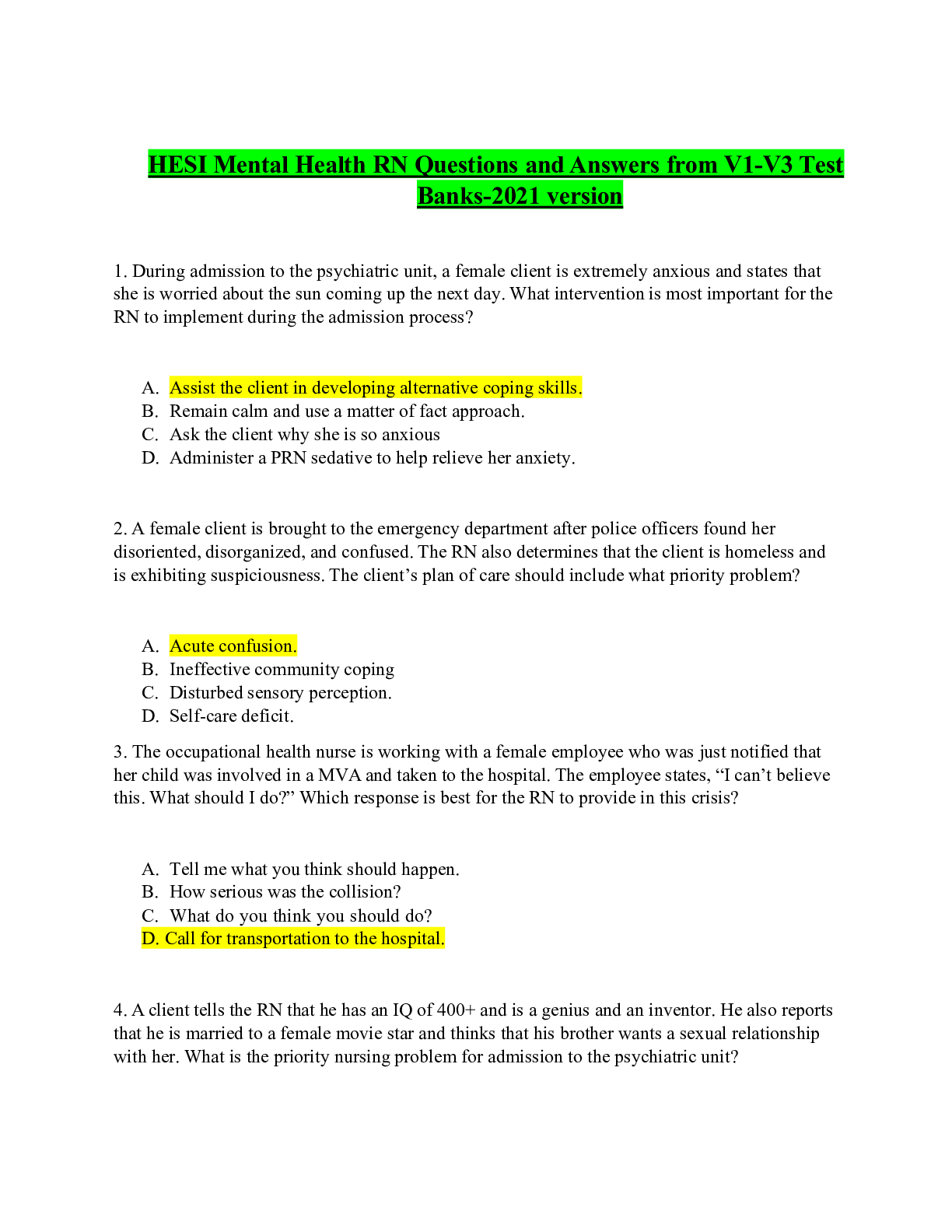
HESI exam review-Florida International University-2022
Document Content and Description Below
Which nursing action is the priority when administering chelation therapy for a toddler-age client?
- Monitoring urine output
Rationale: Adequate urinary output must be ensured with administration of calcium EDTA, the
...
[Show More]
Last updated: 4 years ago
Preview 1 out of 17 pages
Instant download
Buy this Document to get the Full Access Instantly
Provided by Students Who Aced it
We Verify Document Content to Gurantee Accuracy
Reviews( 0 )
Document information
Connected school, study & course
About the document
Uploaded On
Jun 10, 2022
Number of pages
17
Written in
All

Additional information
This document has been written for:
Uploaded
Jun 10, 2022
Downloads
0
Views
72
Topic Tags
Recommended For You
Get more on HESI »
$18.5
93 Pages
HESI RN 2025 Exit NGN Exam – Verified Questions & Answers Upda...
.png)
$18.5
24 Pages
HESI Entrance Exam Questions with Correct Verified Answers ||...
$29
961 Pages
HESI RN COMPREHENSIVE EXIT EXAM Compiled 14 Versions Answers...
.png)
$25.5
396 Pages
NGN Nursing Med-Surg HESI Exit Exam – Latest 2025 Test Bank wi...
$22.5
307 Pages
TEST BANK for Davis Advantage for Psychiatric Mental Health Nu...
$17
588 Pages
Test Bank For Fundamentals of Nursing 11th Edition Potter Perr...
$16
496 Pages
TEST BANK for Essentials of Psychiatric Mental Health Nursing:...
$19
553 Pages
Essentials of Psychiatric Nursing 2nd Edition Boyd TEST BANK
$16
554 Pages
TEST BANK for Essentials of Psychiatric Nursing 2nd Edition by...
$16
276 Pages
Eat Right Prep Exam 2026/2027 Latest Update | Complete Study...
More related documents below