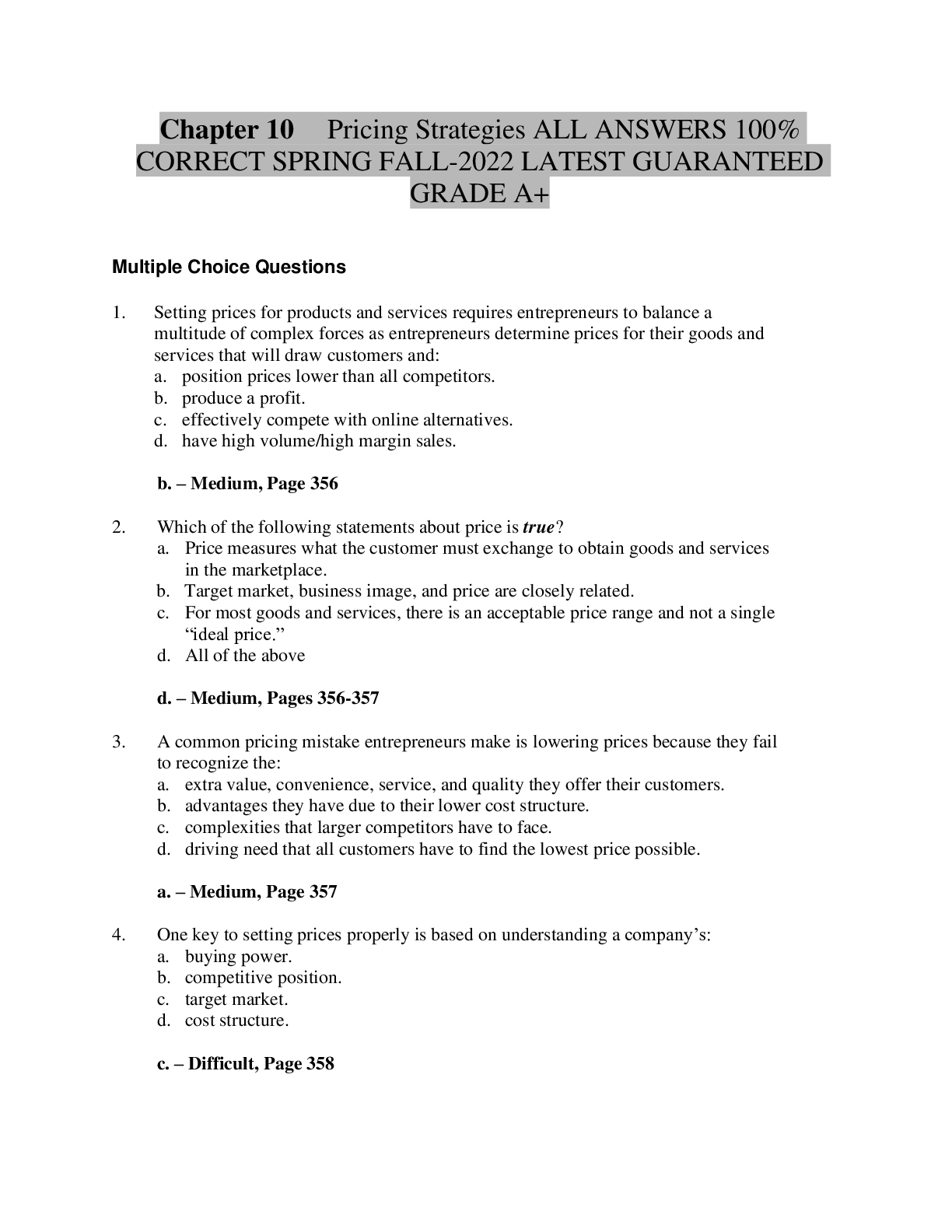
1. Setting prices for products and services requires entrepreneurs to balance a multitude of complex forces as entrepreneurs determine prices for their goods and services that will draw customers and:
a. position prices
...
1. Setting prices for products and services requires entrepreneurs to balance a multitude of complex forces as entrepreneurs determine prices for their goods and services that will draw customers and:
a. position prices lower than all competitors.
b. produce a profit.
c. effectively compete with online alternatives.
d. have high volume/high margin sales.
b. – Medium, Page 356
2. Which of the following statements about price is true?
a. Price measures what the customer must exchange to obtain goods and services in the marketplace.
b. Target market, business image, and price are closely related.
c. For most goods and services, there is an acceptable price range and not a single “ideal price.”
d. All of the above
d. – Medium, Pages 356-357
3. A common pricing mistake entrepreneurs make is lowering prices because they fail to recognize the:
a. extra value, convenience, service, and quality they offer their customers.
b. advantages they have due to their lower cost structure.
c. complexities that larger competitors have to face.
d. driving need that all customers have to find the lowest price possible.
a. – Medium, Page 357
4. One key to setting prices properly is based on understanding a company’s:
a. buying power.
b. competitive position.
c. target market.
d. cost structure.
c. – Difficult, Page 358
Chapter 10 14
5. value is the price customers would be willing to pay if they perfectly understood the benefits offered while value is what determines the price they are willing to pay.
a. Objective; perceived
b. Perceived, objective
d. Objective; quantitative
d. Perceived; real
a. – Medium, Page 359
6. Generally, entrepreneurs should avoid head-to-head price competition with other firms that can more easily achieve lower prices through:
a. offering lower value products and services.
b. a better designed Web site.
c. geographic advantages.
d. lower cost structures.
d. – Medium, Page 359
7. Ultimately, the “right” price for a product or service depends on one factor:
a. the lowest price possible.
b. premium prices.
c. the value that it provides for a customer.
d. the most effective advertising campaign.
c. – Easy, Page 359
8. One of the most important determinants of customers’ response to a price is whether they perceive the price to be a fair exchange:
a. compared to what they have paid in the past.
b. regardless of their actual experience with the product.
c. based on their expectation, not reality.
d. for the value they receive from the product or service.
d. – Medium, Page 360
9. The acceptable price range of a product or service is the area between the
defined by customers in the market and the established by the company’s cost structure.
a. price floor; price ceiling
b. image; quality
c. price ceiling; price floor
d. price floor; value
c. – Medium, Page 361
Chapter 10 15
10. The final price a business owner sets within the acceptable price range depends on:
a. the cost of the product or service.
b. the desired “image” he wants to create in the customer’s mind.
c. the maximum price customers are willing to pay.
d. all of the above.
d. – Easy, Page 361
[Show More]