Pediatric Nursing
Respiratory
Cystic Fibrosis - Pancreatic Enzymes
Test Id: 52270385
Question Id: 30371 (729561)
1 of 36
A A A
The mother of a 6-year-old child with cystic fibrosis (CF) ha
...
Pediatric Nursing
Respiratory
Cystic Fibrosis - Pancreatic Enzymes
Test Id: 52270385
Question Id: 30371 (729561)
1 of 36
A A A
The mother of a 6-year-old child with cystic fibrosis (CF) has received instruction on the use of pancreatic enzymes. Which statement made by the mother indicates a need for further teaching?
Unordered Options Ordered Response
1. "I need to monitor the total amount of this medication that I give to my child every day."
2. "I should give this medication with or just before my child has a meal or snack."
3. "It is okay for my child to chew this medication."
4. "It is okay to open the capsule and sprinkle the medicine on a tablespoon of applesauce."
You answered this question incorrectly.
Time Spent: 74 Seconds
62% of people answered this question correctly.
Last Updated: 10/31/2015
Explanation
In CF, unusually thick mucus obstructs the pancreatic ducts, preventing pancreatic enzymes (amylase, trypsin, and lipase) from reaching the small intestine. The result is malabsorption of carbohydrates, fats, and proteins; the inability to absorb fat-soluble vitamins (A, D, E, and K) is of particular concern. Gastrointestinal signs and symptoms of CF include flatulence, abdominal cramping, ongoing diarrhea, and/or steatorrhea.
Nutritional therapy includes the administration pancreatic enzyme supplements with or just before every meal or snack (Option 2). These enzymes are enteric-coated beads designed to dissolve only in an alkaline environment similar to that of the small intestine. They must not be mixed with a substance that would cause them to dissolve prior to reaching the jejunum. Capsule contents may be sprinkled on applesauce, yogurt, or acidic, soft, room-temperature foods with pH <4.5. Capsules should be swallowed whole and not crushed or chewed; chewing the capsules could cause irritation of the oral mucosa. Excessive intake of pancreatic enzymes can result in fibrosing colonopathy (Option 1).
(Option 4) This is a true statement; some children have difficulty taking a whole capsule. Capsule contents can be sprinkled in acidic substances such as applesauce. Capsules should not be taken with milk as they can cause it to curdle.
Educational objective:
Pancreatic enzyme supplements are used to aid the absorption of carbohydrates, fats, and proteins in a child with CF. They are taken with or just before every meal (not as needed); should be swallowed whole or sprinkled on an acidic food; and should not be crushed or chewed. They should not be taken with milk. Excessive intake could result in fibrosing colonopathy.
Neurologic
Priority Peds Clogged Shunt
Test Id: 52270385
Question Id: 32143 (729561)
2 of 36
A A A
The emergency department triage nurse is assessing 4 pediatric clients. Which client is a priority for further diagnostic workup and definitive care?
Unordered Options Ordered Response
1. 1-year-old with ventriculoperitoneal shunt who has "lethargy" and pulse of 78/min
2. 3-year-old with history of meningocele who has unilateral ear pain and urinary incontinence
3. 6-year-old with muscular dystrophy who has "flu-like" symptoms and temperature of 100.4 F (38 C)
4. 8-year-old with history of cerebral palsy who has foot injury and spastic clonus
You answered this question correctly.
Time Spent: 183 Seconds
72% of people answered this question correctly.
Last Updated: 8/31/2015
Explanation
A ventriculoperitoneal shunt is used to treat hydrocephalus and is usually placed at age 3-4 months. Blockage and infection are complications of shunt placement. Blockage results in signs of increased intracranial pressure (ICP). The normal pulse range for a 1-year-old is 100-160/min. A pulse of 78/min is considered bradycardia, a part of Cushing's triad (bradycardia, slowed respiration, widened pulse pressure).
(Option 2) Meningocele is a saclike protrusion through a bony defect that contains meninges and cerebrospinal fluid; it is corrected with surgery. In some children, residual bowel and bladder incontinence can result despite surgery. If bowel and bladder control is obtained but incontinence reoccurs, the child should be evaluated for infection (a common complication). Although the child with ear pain (eg, otitis media) may need antibiotics, this is not urgent and the client with neurological signs is the priority.
(Option 3) Muscular dystrophy is an inherited condition of muscle fiber degeneration and muscle wasting. Respiratory and cardiac problems are the leading causes of mortality. These clients should take precautions to prevent respiratory infections (eg, pneumococcal and influenza vaccination, avoiding contact with infected individuals). This client is the second priority after the client with increased ICP and possible brain herniation.
(Option 4) Cerebral palsy is a permanent disorder of movement, with abnormal muscle tone, lack of physical coordination, spasticity, and compromised posture development causing activity limitation. Clonus is a series of involuntary, rhythmic, muscular contractions and relaxations. Spasticity/clonus is an expected finding in a client with cerebral palsy. Foot injury in this client is not a priority.
Educational objective:
A ventriculoperitoneal shunt is used to treat hydrocephalus. Complications include blockage (with signs of increased intracranial pressure [ICP]) and infection. The normal pulse range for a 1-year-old is 100-160/min; bradycardia can be a sign of increased ICP.
Gastrointestinal/Nutrition
Infant Feeding – Most Concerning – Honey
Test Id: 52270385
Question Id: 32403 (729561)
3 of 36
A A A
The clinic nurse interviews the parents of a 6-month-old about the child's diet and feeding schedule. Which parent statement causes the nurse the most concern?
Unordered Options Ordered Response
1. "Apples are a healthy food, so we often make apple pie for our child."
2. "Chopped pears are one of our child's favorite foods."
3. "Oatmeal with fresh honey is our child's favorite breakfast."
4. "We have found TV dinners to be convenient as they have both meat and vegetables."
You answered this question correctly.
Time Spent: 178 Seconds
57% of people answered this question correctly.
Last Updated: 8/28/2015
Explanation
Although more than one of these parent comments are concerning, the most concerning is feeding honey to a child under age 1 year. Honey (especially raw or wild) is not recommended for children under age 1 due to the risk for infant botulism. An infant under age 1 has an immature gut system that can allow Clostridium botulinum spores contaminated in honey to colonize the gastrointestinal tract and release toxin that causes botulism.
Botulinum toxin produces muscle paralysis by inhibiting the release of acetylcholine at the neuromuscular junction. Infants often present with constipation, diminished deep tendon reflexes, and generalized weakness. Additional symptoms are lack of head control, difficulty in feeding, and decreased gag reflex, which can progress to respiratory failure. Isolation of the organism from the child's stool can take several days; therefore, diagnosis is usually made by history, and treatment with botulism immune globulin is started before laboratory results are known.
(Option 1) Apple pie is not the best way to serve apples to a 6-month-old as the other ingredients add too much fat and sugar. This would need to be addressed but is not a priority over the use of honey.
(Option 2) Raw fruits are appropriate for a 6-month-old.
(Option 4) Although TV dinners contain meat and vegetables, they are not the best source of food for an infant due to the high sodium content. This would need to be addressed after the use of honey is addressed.
Educational objective:
Due to the risk of infant botulism, honey should not be given to children under age 1 year.
Infectious Disease
Preschool Psychosocial Integrity
Test Id: 52270385
Question Id: 33431 (729561)
4 of 36
A A A
The nurse is caring for a 4-year-old who was hospitalized with influenza. Which nursing action would be most effective to maintain psychosocial integrity?
Unordered Options Ordered Response
1. Encouraging use of puzzles for play
2. Offering the child stacking blocks for diversion
3. Providing crayons to draw noses on facemasks
4. Suggesting that playmates visit the child
You answered this question correctly.
Time Spent: 18 Seconds
54% of people answered this question correctly.
Last Updated: 11/16/2015
Explanation
Clients with influenza are maintained on droplet precautions, and anyone entering the room must wear a facemask. Medical play during the preschool period (age 3-6 years) facilitates psychosocial integrity. Crayons are age-appropriate toys. Drawing noses on facemasks will help the child feel more comfortable with procedures and provides a developmentally appropriate diversion.
(Option 1) Puzzles would be more appropriate for the school-age child (6-12 years).
(Option 2) Stacking blocks would be more appropriate for the toddler (age 1-3 years).
(Option 4) Maintaining contact with peers would be more appropriate for the adolescent (age 12-19 years).
Educational objective:
Maintaining psychosocial integrity is a priority when a child is hospitalized. This is achieved by integrating age-appropriate diversions (eg, medical play for a preschooler) in the nursing care.
Hematological/Oncological
Leukemia - Infection Precautions
Test Id: 52270385
Question Id: 30904 (729561)
5 of 36
A A A
A nurse is admitting a child who has leukemia. Several rooms are available on the pediatric unit. Which client could share a room with this child?
Unordered Options Ordered Response
1. A client recovering from a ruptured appendix
2. A client with cystic fibrosis
3. A client with minimal change nephrotic syndrome
4. A client with rheumatic fever
You answered this question correctly.
Time Spent: 7 Seconds
46% of people answered this question correctly.
Last Updated: 1/22/2016
Explanation
Leukemia is characterized by unrestricted proliferation of abnormal white blood cells (lymphoblasts), resulting in depression of normal bone marrow activity. This disorder is the most common form of childhood cancer. Infection is a major concern due to neutropenia. In addition, anemia occurs due to decreased red blood cell production, and bleeding is common as a result of decreased platelet production.
It would be appropriate for this client with leukemia to share a room with a client with minimal change nephrotic syndrome (MCNS). MCNS is a non-infectious condition of the glomeruli and poses no risk to a client with leukemia.
(Option 1) Appendicitis is a result of viral or infectious processes and can lead to rupture of the appendix. A client recovering from a ruptured appendix poses a threat of infection to the child who has leukemia.
(Option 2) A client with cystic fibrosis has pulmonary complications due to thick mucus that traps bacteria. The tracheobronchial tree is colonized with bacteria and respiratory infections are a lifelong problem. This client poses a threat of infection to the child with leukemia.
(Option 4) Rheumatic fever occurs following pharyngitis caused by group A β-hemolytic Streptococcus. A client with this condition poses a threat of infection to the child with leukemia.
Educational objective:
Leukemia is a cancer of the blood and organs involved in hematologic function. Due to myelosuppression, clients are at risk for problems related to infection, anemia, and bleeding.
Cardiovascular
Pedi Heart Failure
Test Id: 52270385
Question Id: 31564 (729561)
6 of 36
A A A
The home health nurse is visiting an infant who recently had surgery to repair tetralogy of Fallot. The nurse should teach the parents to report which findings indicative of heart failure to the health care provider (HCP)? Select all that apply.
Unordered Options Ordered Response
1. Cool extremities
2. Increase in appetite
3. Puffiness around the eyes
4. Reduction in number of wet diapers
5. Weight loss
You answered this question correctly.
Time Spent: 26 Seconds
53% of people answered this question correctly.
Last Updated: 8/24/2015
Explanation
Heart failure may develop after surgical repair of tetralogy of Fallot, and infants and children can quickly decompensate hemodynamically when it occurs. Clinical manifestations are grouped into 3 primary categories— impaired myocardial pumping, pulmonary congestion, and systemic venous congestion.
(Option 2) The infant would have a decrease in appetite with heart failure symptoms.
(Option 5) The infant would more likely have experienced weight gain due to fluid retention.
Educational objective:
The nurse should teach parents of an infant or child with a repaired congenital heart defect to recognize and report signs and symptoms of heart failure to the HCP. These may include rapid breathing rate; rapid heart rate at rest; dyspnea; activity intolerance (especially during feeding in infants); pale, cool extremities; weight gain; reduction in wet diapers; and puffiness around the eyes.
Cardiovascular
Kawasaki Disease - Followup
Test Id: 52270385
Question Id: 32115 (729561)
7 of 36
A A A
The nurse is providing discharge instructions to the parent of a child with Kawasaki disease. The nurse informs the parent that the presence of which symptom should be immediately reported to the health care provider?
Unordered Options Ordered Response
1. Fever
2. Irritability
3. Knee pain
4. Skin peeling
You answered this question correctly.
Time Spent: 5 Seconds
45% of people answered this question correctly.
Last Updated: 1/10/2016
Explanation
Kawasaki disease (KD) is a systemic vasculitis of childhood that presents with ≥5 days of fever, nonexudative conjunctivitis, lymphadenopathy, mucositis, hand and foot swelling, and a rash. First-line treatment consists of IV immunoglobulin and aspirin to prevent coronary artery aneurysms.
When children with KD are discharged home, parents are instructed to monitor them for fever by checking the temperature (orally or rectally) every 6 hours for the first 48 hours following the last fever. Temperature should also be checked daily until the follow-up appointment. If the child develops a fever, the health care provider should be notified as this may indicate the acute phase of KD recurrence. The child may require additional treatment with IV immunoglobulin to prevent development of coronary artery aneurysms and occlusions.
(Option 2) Irritability is a hallmark finding in a child with KD, especially during the acute phase (due to fever and inflammation). Parents should be advised that irritability can last up to 2 months.
(Option 3) Temporary joint pain and other manifestations of arthritis (eg, stiffness, decreased range of motion) may occur and persist for several weeks. Parents should be informed that range of motion exercises and warm baths will help reduce these symptoms and minimize discomfort.
(Option 4) Desquamation (skin peeling) of the hands and feet is an expected finding in KD. Parents should be informed that the peeling itself is not painful but that the new skin underneath may be red and sore.
Educational objective:
Once children with KD are discharged home, parents should be instructed to check their temperature every 6 hours for the first 48 hours following the last fever and then daily until the follow-up visit. The health care provider should be notified if the child has fever as this may indicate a need for further treatment.
Neurologic
Myelomeningocele
Test Id: 52270385
Question Id: 31423 (729561)
8 of 36
A A A
A newborn has a large myelomeningocele. What nursing intervention is priority?
Unordered Options Ordered Response
1. Assess the anus for muscle tone
2. Cover the area with a sterile, moist dressing
3. Measure the occipital frontal circumference
4. Place the newborn supine with the head of the bed elevated
You answered this question correctly.
Time Spent: 69 Seconds
81% of people answered this question correctly.
Last Updated: 1/30/2016
Explanation
Myelomeningocele occurs when the neural tube fails to fuse properly during fetal development. An outpouching of spinal fluid, spinal cord, and nerves covered by only a thin membrane occurs, typically in the lumbar area. The newborn is at high risk for infection at this area. A priority nursing intervention is to cover the area with a sterile, moist dressing to decrease the risk of infection until surgical repair can occur.
(Option 1) Assessing for an anal wink will assist in the assessment of the level of neurologic deficit but is not a priority intervention.
(Option 3) Myelomeningocele may decrease the absorption of cerebrospinal fluid, which would place the newborn at risk for hydrocephalus from the excess cerebrospinal fluid. An occipital frontal circumference is needed as a baseline measurement but is not a priority.
(Option 4) The newborn would be placed in the prone position (with face turned to the side) to prevent rupture of the myelomeningocele.
Educational objective:
The newborn with a myelomeningocele is at risk for infection. Covering the myelomeningocele with a sterile, moist dressing is indicated to decrease the risk of infection at the site. The infant should be placed on the abdomen (prone) with the face turned to the side.
Gastrointestinal/Nutrition
TEF Intervention
Test Id: 52270385
Question Id: 31931 (729561)
9 of 36
A A A
A nurse in the neonatal intensive care unit discovers a cyanotic newborn with excessive frothy mucus in the mouth. What should be the nurse's first action?
Unordered Options Ordered Response
1. Administer 100% oxygen
2. Auscultate the lungs
3. Place infant in knee-chest position
4. Suction the infant's mouth
You answered this question correctly.
Time Spent: 97 Seconds
75% of people answered this question correctly.
Last Updated: 12/10/2015
Explanation
The initial nursing action for a client experiencing cyanosis and excess oral secretions is suctioning the mouth (ie, oropharynx) to clear the airway (Option 4). Excessive frothy mucus and cyanosis in a newborn could be due to esophageal atresia (EA) and tracheoesophageal fistula (TEF). If EA/TEF is suspected, the infant should be kept supine with the head elevated at least 30 degrees to prevent aspiration. A nasogastric tube should be inserted and connected to continuous or intermittent suction until surgical repair.
(Option 1) Oxygen cannot be delivered to the lungs if secretions obstruct the airway. Therefore, suctioning is a priority.
(Option 2) This infant is aspirating and in immediate distress, which should be addressed without delay. After suctioning the excess saliva and ensuring a clear airway, the nurse may perform further assessments.
(Option 3) This infant's cyanosis is a result of aspirating secretions and does not indicate a circulatory problem. The knee-chest position is appropriate to increase pulmonary blood flow in infants with a cyanotic heart defect (eg, tetralogy of Fallot).
Educational objective:
The initial nursing action for a client experiencing cyanosis and excess oral secretions is oropharyngeal suctioning to ensure airway patency.
Musculoskeletal
Fracture - Cast Care
Test Id: 52270385
Question Id: 30753 (729561)
10 of 36
A A A
A child in the emergency department had a cast placed on the right arm for a nondisplaced fracture. The client is being discharged home with pain medications. Which statement by the parent indicates that additional teaching is required?
Unordered Options Ordered Response
1. "A tingling or burning sensation within the first 24-48 hours is not a concern."
2. "An itching sensation under the cast for the first 24-48 hours is not a concern."
3. "I will call the doctor if pain is severe despite medications for the first 24 hours."
4. "My child should elevate the arm for the first 24-48 hours."
You answered this question correctly.
Time Spent: 269 Seconds
89% of people answered this question correctly.
Last Updated: 8/10/2015
Explanation
Parents of children with casts are taught to check for emergency signs of circulatory impairment, including changes in sensation and motor function, which could indicate early signs of compartment syndrome due to swelling within the confined space of the cast. However, some swelling is expected, so this symptom alone is not indicative of compartment syndrome.
The 6 Ps of compartment syndrome include:
1. Pain: Increasing despite elevation, analgesics, and ice. Pain will also increase with passive stretching/movement. Increasing pain is an early sign and indicates muscle ischemia (Option 3).
2. Pressure: Affected extremity or digits are firm and tense; skin is tight and appears shiny.
3. Paresthesia: Tingling, numbness, or burning sensation, which is also an early sign and indicates nerve ischemia (Option 1).
4. Pallor: Skin appears pale; capillary refill is >3 seconds. These indicate poor perfusion.
5. Pulselessness: Pulse distal to injury or compartment is impalpable. Absent pulses are a late sign.
6. Paralysis: Loss of function or inability to move extremity or digits. Muscle weakness occurs before paralysis which is also a late sign and indicates dead muscle tissue.
(Option 2) An itching sensation under the cast is expected, clients and parents are taught to avoid inserting anything into the cast to scratch the skin. Instead, they should use a hair dryer on the cold setting.
(Option 4) Arm elevation is indicated for the first 48 hours after cast placement to reduce edema. However, if compartment syndrome develops, the arm should be kept at torso level (not high or low).
Educational objective:
Compartment syndrome is a serious complication due to neurovascular compromise from swelling and increased pressure in a confined space. The characteristics (6 Ps) of compartment syndrome include: pain, pressure, paresthesia, pallor, pulselessness, and paralysis.
Cardiovascular
Pediatric – Priority
Test Id: 52270385
Question Id: 32658 (729561)
11 of 36
A A A
The nurse has received report on 4 pediatric clients. Which client should the nurse assess first?
Unordered Options Ordered Response
1. Client with coarctation of the aorta and diminished femoral pulses
2. Client with patent ductus arteriosus and a loud machinery-like murmur
3. Client with tetralogy of Fallot and oxygen saturation of 80% on room air
4. Client with ventricular septal defect; tachypnea and diaphoresis during feedings
You answered this question incorrectly.
Time Spent: 172 Seconds
18% of people answered this question correctly.
Last Updated: 9/18/2015
Explanation
Ventricular septal defect is an acyanotic congenital heart defect causing blood to shunt from the left side of the heart to the right (left-sided heart has higher pressure than right-sided). An increase in pulmonary blood flow causes an increase in workload of the right heart and pulmonary arteries, resulting in pulmonary hypertension. Eventually, blood does not go to the lungs, but instead the pressure on the right side of the heart increases, resulting in shunt reversal. This causes more blood to be shunted to the left ventricle, followed by the left atrium, and then back into the lungs (heart failure). Tachypnea is due to pulmonary volume overload. Diaphoresis is an indication that an infant is expending too much energy during feeding. This client should be assessed first and evaluated for other signs of congestive heart failure (CHF).
(Option 1) Coarctation of the aorta (COA) is an obstructive congenital heart defect resulting in decreased cardiac output. Children with COA will have stronger pulses in the upper extremities and diminished pulses in the lower extremities. This is expected until the obstruction is repaired surgically.
(Option 2) A patent ductus arteriosus (PDA) occurs when fetal circulation persists after birth. A continuous machinery-like murmur is a normal finding with a PDA.
(Option 3) Tetralogy of Fallot (TOF) is a cyanotic congenital heart defect. Right-sided (venous) blood is shunted through the left ventricle via the ventricular septal defect due to the resistance at the pulmonary artery (pulmonary stenosis, one of the components of TOF). This will cause abnormally low oxygen saturation (often in the range of 65%-85%), which is expected until the defect is repaired surgically.
Educational objective:
All left-to-right cardiac shunts (eg, ventricular septal defect, atrial septal defect) will cause an increase in pulmonary blood flow. Shunt reversal can eventually result in heart failure. Children should be kept in an upright position and offered small, frequent feedings to decrease workload of the heart and lungs.
Growth & Development
Autism Spectrum Disorders – Clinical Manifest...
Test Id: 52270385
Question Id: 32223 (729561)
12 of 36
A A A
The parent of a 2-year-old tells the nurse at the well-child clinic, "I am concerned because my child does not like to be cuddled, does not respond when called by name, and does not make eye contact when being fed." What is the priority question for the nurse to ask when completing the health history?
Unordered Options Ordered Response
1. "How many words can your child say?"
2. "Is your child potty trained?"
3. "What are your child's favorite foods?"
4. "What kind of toys does your child like to play with?"
You answered this question correctly.
Time Spent: 606 Seconds
75% of people answered this question correctly.
Last Updated: 12/8/2015
Explanation
The concerns presented by this child's parent are suggestive of a developmental delay and very possibly autism spectrum disorder (ASD).
ASD is a complex neurodevelopmental disorder characterized by the onset of abnormal functioning before age 3. The 2 core symptoms of ASD are abnormalities in social interactions and communication (verbal and nonverbal), and patterns of behavior, interests, or activities that can be restricted and repetitive. Social skills, especially communication, are delayed more significantly than other developmental functioning and are the focus during client assessment.
The vast majority of children diagnosed with ASD lack the acquisition of communication skills during the first 2 years of life. A healthy 2-year-old should have a vocabulary of about 300 words and should be able to string 2 or more words together in a meaningful phrase. Assessing this child's language abilities would be the priority.
(Option 2) Assessing any 2-year-old's progress in toilet training is appropriate. However, it is not the priority assessment given the parent's concerns.
(Option 3) A nutrition assessment is part of every well-child visit, but it is not the priority in this situation.
(Option 4) Although not the priority assessment, it would be important to ask the parent about the child's play activities. Children with ASD often have a restricted interest in and preoccupation with a single toy, exhibit repetitive behaviors when playing with the toy, and insist on the same play routine.
Educational objective:
The 2 core symptoms of autism spectrum disorder are abnormalities in social interactions and communication (verbal and nonverbal), and patterns of behavior, interests, or activities that can be restricted and repetitive. Social skills, especially communication, are delayed more significantly than other developmental functioning.
Gastrointestinal/Nutrition
Encopresis - Behavior Modification
Test Id: 52270385
Question Id: 32161 (729561)
13 of 36
A A A
The registered nurse is teaching the parent of a 6-year-old about behavioral strategies for treating fecal incontinence due to functional constipation. Which statement by the parent indicates a need for further teaching?
Unordered Options Ordered Response
1. "I will give my child a picture book to look at during toilet time."
2. "I will give my child a reward for each bowel movement while sitting on the toilet."
3. "I will keep a log of my child's bowel movements, laxative use, and episodes of soiling."
4. "I will schedule regular toilet sitting time for my child."
You answered this question incorrectly.
Time Spent: 90 Seconds
34% of people answered this question correctly.
Last Updated: 1/11/2016
Explanation
Fecal incontinence (ie, encopresis, soiling) refers to the repeated passage of stool in inappropriate places by children age ≥4 years. In more than 80% of cases, it is due to functional constipation (retentive type); in about 20% of cases, it may be caused by psychosocial triggers (nonretentive type).
Management of fecal incontinence/constipation primarily includes 3 components: Disimpaction followed by prolonged laxative therapy, dietary changes (increased fiber and fluid intake), and behavior modification. Behavioral strategies are used to promote and restore regular toileting habits and to gain the child's cooperation and participation in the treatment program.
Behavioral interventions include the following:
• Regularly schedule toilet sitting times 5-10 minutes after meals for 10-15 minutes (Option 4)
• Provide a quiet activity for the child during toilet sitting, which will help pass the time and make the experience more "enjoyable" (Option 1)
• Initiate a reward system to boost the child's participation in the treatment program; the reward would be given for effort, not for success of evacuation in the toilet (children with retentive encopresis have dysfunctional anal sphincters and little control over bowel movements; giving a reward for something the child has no control over would not be effective) (Option 2)
• Keep a diary or log of toilet sitting times, stooling, medications, and episodes of soiling to evaluate the success of the treatment (Option 3)
Educational objective:
A reward system is one of the behavioral strategies used in the treatment of functional incontinence (due to constipation). The reward is given to encourage the child's involvement in the treatment to restore normal bowel function. Rewards are given for the child's effort and participation, not for having bowel movements while sitting on the toilet.
Gastrointestinal/Nutrition
Didorders Of The Oral Cavity
Test Id: 52270385
Question Id: 30486 (729561)
14 of 36
A A A
The nurse is discussing feeding and eating practices with the mother of a 1-year-old. Which statement made by the mother indicates a need for further instruction?
Unordered Options Ordered Response
1. "I give my child chopped fruit rather than juice."
2. "I make sure my child drinks plenty of water between meals."
3. "My child is fussy at bedtime so I put him to sleep with a bottle of milk."
4. "When I give my child a new food, I wait a week before trying a second new food."
You answered this question correctly.
Time Spent: 139 Seconds
80% of people answered this question correctly.
Last Updated: 10/31/2015
Explanation
Putting a child to bed with a bottle of milk or other beverage containing sugar leads to extensive and rapid dental caries in the developing teeth, a condition known as baby bottle tooth decay. The carbohydrate-rich fluid pools around the teeth and nourishes decay, producing bacteria (Streptococcus mutans). Sucking on a bottle for extended periods can also push the jawline out of shape. Bottles containing milk or sugary beverages should not be used as bedtime pacifiers.
(Option 1) Whole fruit chopped in small pieces is a better choice than juice. Fruit juice is higher in sugar, has no fiber, promotes tooth decay, and can affect the child's appetite for other non-sugary foods.
(Option 2) Providing water to a child between meals has several benefits:
• It accustoms the child to the taste of water, and the child will be more likely drink water than a sugary beverage when thirsty
• It helps reduce the risk of constipation and urinary tract infections
• It helps the child maintain a healthy weight
(Option 4) Spacing the introduction of new foods by several days to a week allows for detection of a food intolerance or allergic reaction.
Educational objective:
The practice of using a bottle with milk to calm a child at bedtime should be discouraged. A child who falls asleep drinking a fluid high in carbohydrates will likely develop extensive dental caries, a condition known as baby bottle tooth decay
Neurologic
Hydrocephalus - Prioritizing Care
Test Id: 52270385
Question Id: 30711 (729561)
15 of 36
A A A
The following 4 clients are brought to the emergency department triage nurse. The client with which of these signs should be a priority to be seen for immediate care?
Unordered Options Ordered Response
1. A 2-year-old has sclera visible above the iris (sunset eyes)
2. A 3-year-old has a single transverse crease across the entire palm of the hand
3. A 6-month-old breastfed client had 8 wet diapers in the last 24 hours
4. A 9-month-old client's toes fan out and the big toe dorsiflexes when the foot sole is stroked
You answered this question incorrectly.
Time Spent: 171 Seconds
64% of people answered this question correctly.
Last Updated: 10/27/2015
Explanation
This is a sign of 6th cranial nerve palsy (paralysis of upward gaze) as a result of increased intracranial pressure/hydrocephalus. This is an acute, delayed sign and requires timely priority diagnosis and treatment. This sign is more likely to be noted after the fontanels have closed (posterior by 2 months and anterior by 18 months) and the pressure increases.
(Option 2) This is the Simian crease that is seen in a client with Down syndrome. This is a chronic condition, and the acute condition in Option 1 is a priority.
(Option 3) The normal range for the number of wet diapers is 6-10/day, or approximately 1 every 4 hours. Infants create 2 mL/kg/hr normal urine output. The number of wet diapers/day is one of the best indications of adequate fluid intake (hydration).
(Option 4) This is a description of the Babinski reflex, which is present in children up to age 1 year. Its presence beyond age 1 can indicate neurologic disease.
Educational objective:
The presence of sunset eyes (sclera above iris) is a late sign of increased intracranial pressure and a priority. Simian crease is an expected finding in Down syndrome. The normal diaper count for a 6-month-old is 6-10 diapers/day. Infants have a positive Babinski reflex until age 1.
Skills/Procedures
Isolation Room
Test Id: 52270385
Question Id: 33395 (729561)
16 of 36
A A A
The triage nurse has one isolation room left in the emergency department. Which priority client should be assigned to this room?
Unordered Options Ordered Response
1. Child with chickenpox for the past 14 days; all lesions are crusted and dried
2. Child with impetigo who has been on antibiotics for 3 days
3. Child with leg rash secondary to poison ivy exposure
4. Child with suspected pertussis who has paroxysms of coughing
You answered this question correctly.
Time Spent: 49 Seconds
86% of people answered this question correctly.
Last Updated: 10/29/2015
Explanation
Paroxysms of rapid coughing that lead to vomiting are a key feature of pertussis infection. Pertussis is a highly contagious disease and requires droplet precautions. It can be deadly if contracted in infancy before vaccination is started. This client should be placed in isolation immediately to prevent the spread of disease.
(Option 1) Chickenpox is no longer contagious after the lesions have crusted and dried, but this process can take as long as 3 weeks. This client would not require isolation.
(Option 2) Impetigo is no longer contagious after 24 hours of antibiotics. This client would not require isolation.
(Option 3) Poison ivy rash is not considered contagious. A person develops the rash only on contact with the urushiol oil itself. The pustules do not contain this oil, and therefore the rash cannot be spread via person-to-person contact.
Educational objective:
Chickenpox is no longer contagious after the lesions have crusted and dried. Pertussis is a highly contagious disease that requires droplet precautions.
Growth & Development
Developmental Surveillance - Toddler
Test Id: 52270385
Question Id: 31480 (729561)
17 of 36
A A A
The registered nurse has completed a well-baby assessment of an 18-month-old. Which assessment findings prompted the nurse to make a referral for a formal developmental screening test?
Unordered Options Ordered Response
1. Cannot climb steps by self, pulls a toy, turns the pages of a book
2. Is bottle fed, can hold a spoon, creeps down stairs
3. Throws a ball, is able to point to 2 or 3 body parts, cannot draw a picture
4. Uses 2 words, cannot hold a cup, can seat self in a small chair
You answered this question incorrectly.
Time Spent: 92 Seconds
68% of people answered this question correctly.
Last Updated: 12/14/2015
Explanation
An 18-month-old should have a vocabulary of 10 or more words and be able to hold and drink from a cup. Both of these types of delays (communication and language development, and fine motor skills) may be more apparent at age 18 months than at earlier ages. Either finding should prompt the nurse that further evaluation is needed.
(Option 1) An 18-month-old can climb stairs with assistance, use a pull-toy, and turn the pages of a book.
(Option 2) An 18-month-old may continue to be bottle fed at times, can hold and clumsily use a spoon, and can creep down stairs.
(Option 3) An 18-month-old might be able to scribble but would not be able to draw a picture; an 18-month-old can throw a ball and point to body parts.
Educational objective:
An 18-month-old should have a vocabulary of at least 10 words and be able to use a spoon.
Newborn
Neonatal Abstinence Syndrome Treatment
Test Id: 52270385
Question Id: 32267 (729561)
18 of 36
A A A
After giving birth to a full-term neonate, the client informs the nurse that she has been taking hydrocodone on a regular basis for several years. What should the nurse plan as part of the neonate's care?
Unordered Options Ordered Response
1. Feed newborn while swaddled
2. Keep newborn close to the nurse's station
3. Position newborn supine after feeding
4. Stimulate newborn with light regularly
You answered this question correctly.
Time Spent: 28 Seconds
32% of people answered this question correctly.
Last Updated: 9/9/2015
Explanation
A neonate born to an opioid-dependent mother (eg, heroin, methadone, hydrocodone) is at high risk for neonatal abstinence syndrome, in which the newborn experiences opioid withdrawal typically within 24-48 hours after birth. Clinical manifestations of withdrawal in infants include irritability, jitteriness, high-pitched cry, sneezing, diarrhea, vomiting, and poor feeding.
Hypersensitivity can make feeding difficult; the newborn should be placed in a side-lying position while swaddled to minimize stimulation and promote nutritive sucking (Option 1). Between feedings, a pacifier may be used to soothe the infant and help establish an organized sucking pattern.
Excessive movement places the newborn at high risk for skin excoriation; the infant should be tightly swaddled with arms flexed to minimize irritation and prevent damage to the skin. Hand mittens and barrier skin protection to the knees, elbows, and heels may also be used.
(Options 2 and 4) Stimulation should be avoided due to the newborn's hypersensitive state; the newborn should be placed in a quiet, dim-lit section of the nursery. The nurse should also organize tasks ("cluster care") to minimize stimulation.
(Option 3) The newborn should be placed on the right side after feeding to promote gastric emptying and reduce the risk of vomiting.
Educational objective:
An infant born to an opioid-dependent mother is at risk for neonatal abstinence syndrome. Withdrawal symptoms affect primarily the central nervous (eg, jitteriness, irritability), gastrointestinal (eg, poor feeding, diarrhea), and autonomic nervous (eg, stuffy nose, sweating) systems. Nursing care is focused on reducing stimulation and promoting nutrition and comfort.
Visual/Auditory
Recurrent Otitis Media
Test Id: 52270385
Question Id: 31810 (729561)
19 of 36
A A A
A nurse is assessing a 12-month-old who has recurrent otitis media. Which risk factors should the nurse discuss with the infant's parents? Select all that apply.
Unordered Options Ordered Response
1. Frequency of pacifier use
2. Frequent visits to the wading pool
3. History of a foreign body in the ear
4. Infant's immunization status
5. Infant's position while drinking from a bottle
You answered this question incorrectly. Correct answer is: 1,4,5
Time Spent: 64 Seconds
11% of people answered this question correctly.
Last Updated: 11/2/2015
Explanation
Otitis media (OM) is inflammation or infection of the middle ear. The eustachian tubes in infants and young children are short, wide, and fairly horizontal, which results in ineffective draining of respiratory secretions and a potential for recurrent infections. Episodes of OM often follow a respiratory tract infection, such as influenza or respiratory syncytial virus (RSV). OM risk also increases when fluid pools in the mouth and then reaches the eustachian tubes (eg, drinking from a bottle while lying down).
Established family patterns that can play a role in recurrent OM should be assessed and include:
• Recurring exposure to tobacco smoke
• Regular pacifier use, particularly after age 6 months
• Drinking from a bottle while lying down
• Lack of immunizations, particularly the pneumococcal vaccine series
(Option 2) Excess water in the ears from bathing or swimming can alter the protective environment of the external ear and contribute to otitis externa, also known as swimmer's ear. However, this does not contribute to OM. Fluid to the middle ear enters from the mouth through the eustachian tubes.
(Option 3) Damage due to a foreign body in the ear places the client at risk for otitis externa, but it is not associated with an increase in recurrent OM.
Educational objective:
In clients with recurrent OM, assessment should include established family patterns, such as the client's position when drinking from a bottle, pacifier use, exposure to tobacco smoke, and lack of immunizations (particularly the pneumococcal vaccine series
Cardiovascular
Tet Spell
Test Id: 52270385
Question Id: 31520 (729561)
20 of 36
A A A
A nurse is assisting a new mother as she is breastfeeding her infant. The infant has been diagnosed with tetralogy of Fallot. During feeding, the infant becomes cyanotic and is having difficulty breathing. What should be the nurse's first action?
Unordered Options Ordered Response
1. Administer morphine to the infant
2. Administer oxygen via mask
3. Assess infant's vital signs and pulse oximetry
4. Place the infant in the knee-chest position
You answered this question correctly.
Time Spent: 54 Seconds
73% of people answered this question correctly.
Last Updated: 8/13/2015
Explanation
Tetralogy of Fallot is a congenital cardiac defect that typically has 4 characteristics: pulmonary stenosis, right ventricular hypertrophy, overriding aorta, and ventricular septal defect.
This infant is experiencing a hypercyanotic episode, or "tet spell," which is an exacerbation of tetralogy of Fallot that can happen when a child cries, becomes upset, or is feeding. The child should first be placed in a knee-to-chest position. Flexion of the legs provides relief of dyspnea as this angle improves oxygenation by reducing the volume of blood that is shunted through the overriding aorta and the ventricular septal defect.
(Option 1) Morphine may be considered if the dyspnea is not relieved by the knee-to-chest position.
(Option 2) If oxygen saturation remains low, oxygen may need to be administered.
(Option 3) Vital signs and pulse oximetry may be checked after the infant has been placed in the knee-chest position.
Educational objective:
To relieve a hypercyanotic episode, or "tet spell," the nurse should place the infant or child in the knee-chest position.
Copyright © UWorld. All rights reserved.
Respiratory
Cystic Fibrosis-Home Care
Test Id: 52270385
Question Id: 32092 (729561)
21 of 36
A A A
The nurse has provided teaching about home care management for the parents of a child diagnosed with cystic fibrosis. Which statements by the parents indicate a need for further teaching? Select all that apply.
Unordered Options Ordered Response
1. "Administering the pancreatic enzymes every morning and evening is important."
2. "Bronchodilator breathing treatment should be given right after chest physiotherapy."
3. "Loss of appetite and weight loss could mean that our child has developed a lung infection."
4. "Our child will need to follow a high-fat, high-protein diet."
5. "We will limit the number of sports activities our child participates in."
You answered this question incorrectly. Correct answer is: 1,2,5
Time Spent: 95 Seconds
9% of people answered this question correctly.
Last Updated: 9/2/2015
Explanation
In cystic fibrosis (CF), a defective protein responsible for transporting sodium and chloride causes the secretions from the exocrine glands to be thicker and stickier than normal. The sticky respiratory secretions lead to inability to clear the airway and a chronic cough. The client eventually develops chronic lung disease, which predisposes to recurrent lung infections. Some children with CF may not have typical fever, tachypnea, and chest pain with lung infection in early stages. Presence of anorexia, weight loss, and decreased activity levels may be the only clue for underlying lung infection and should be notified to the health care provider for early intervention (eg, antibiotics, airway clearance therapy).
In clients with CF, the thick respiratory secretions block pancreatic ducts, resulting in too few pancreatic enzymes entering the bowel to aid in digestion and nutrient absorption. These clients require multiple vitamin supplements (especially fat-soluble vitamins A, D, E, and K) and supplemental pancreatic enzymes that should be administered with meals. A diet high in calories, fat, and protein is required to meet growth needs.
(Option 1) Pancreatic enzymes need to be given to the child at the beginning of all meals and with snacks.
(Option 2) Bronchodilators and nebulizers are more effective when administered before chest physiotherapy (percussion, vibration, and postural drainage) to open airways and break up loosened secretions.
(Option 5) Physical exercise is encouraged for its positive effects on cardiovascular and muscular function; mucus thinning is also enhanced by activity.
Educational objective:
A child with cystic fibrosis requires bronchodilators prior to chest physiotherapy; monitoring for signs of lung infections; a high-fat, high-protein diet; pancreatic enzyme supplements with each meal; and physical activity within the child's limitations
Infectious Disease
Pediculosis Capitis-Parent Teaching
Test Id: 52270385
Question Id: 32176 (729561)
22 of 36
A A A
The nurse plans to teach the parents of a child diagnosed with pediculosis capitis. Which instructions should the nurse include in the teaching plan? Select all that apply.
Unordered Options Ordered Response
1. It is not necessary to treat your other children
2. Soak your child's comb and hair accessories in boiling water for 10 minutes
3. The family pet will need treatment with a pediculicide
4. Use a nit comb daily for 2 weeks after pediculicide treatment
5. Vacuum your furniture, carpets, and mattresses every few days
You answered this question correctly.
Time Spent: 87 Seconds
33% of people answered this question correctly.
Last Updated: 12/31/2015
Explanation
Pediculosis capitis (head lice) is a contagious parasitic infestation that is often seen in school-age children. The female louse lays eggs (nits) on the hair shaft close to the scalp that hatch in 7-10 days. The adult louse cannot survive away from the host's head for >48 hours. However, the nits can live away from the host (eg, on hairbrushes, carpets, hats) for up to 10 days. The infestation can spread between children when they share lice-infested items.
Treatment involves applying a pediculicide (usually permethrin 1% cream) to the head and removing nits with a nit comb or by hand. After diagnosis, it is advised to use the nit comb at least every 2-3 days for 2 weeks. Carpets, rugs, and upholstered furniture must be vacuumed frequently to remove any lice or nits that might be present. The client's bedding should be washed in hot water and dried on the hottest dryer setting. Non-washable items can be sealed in a plastic bag for 2 weeks to kill lice. All hairbrushes, combs, and ornaments should be soaked in boiling water for 10 minutes or lice-killing products for 1 hour (Options 2, 4, and 5).
(Option 1) The affected child's siblings may need treatment with a pediculicide. Children who share a bedroom and items such as combs, brushes, hair ornaments, hats, and towels are at risk for acquiring head lice.
(Option 3) Household pets do not transmit human lice; treating them is not necessary.
Educational objective:
Pediculosis capitis (head lice) is a parasitic infestation that is seen often in school-age children. Measures to control the spread and reinfestation include using nit combs, soaking hair brushes and accessories in boiling water, and vacuuming rugs/carpets frequently.
Copyright © UWorld. All rights
Newborn
Newborn Vomit
Test Id: 52270385
Question Id: 33544 (729561)
23 of 36
A A A
A newborn client is seen in the emergency department for vomiting. Which assessment finding indicates a possible emergency?
Unordered Options Ordered Response
1. Frequent vomiting since birth
2. Tiny blood streaks in the vomit
3. Vomit that is green
4. Vomiting through the nose
You answered this question incorrectly.
Time Spent: 29 Seconds
29% of people answered this question correctly.
Last Updated: 12/11/2015
Explanation
Bile made by the liver is green and is released into the duodenum on eating to aid digestion. When there is an obstruction in the intestines and stool cannot pass, it may come back up as green vomit. A bowel obstruction is an emergency that can lead to bowel rupture, peritonitis, and sepsis.
(Option 1) Newborns vomit or spit up frequently as they adjust to eating and digesting food. They also have a loose lower esophageal sphincter that allows food to come up from the stomach easily. Hydration status and weight gain should be monitored.
(Option 2) Tiny blood streaks may be noted due to rupture of pressured esophageal veins from frequent vomiting. This is not a cause for concern unless the vomit contains a large amount of blood or blood-streaked vomiting persists. Scant amounts seen in vomit can be normal.
(Option 4) It is not uncommon for a newborn to have vomiting through the nose because the esophagus is connected to the nose and mouth. The vomit comes up through the esophagus and, if forceful enough, will come out of both orifices.
Educational objective:
It is common for newborns to vomit frequently as they learn to eat and digest. Hydration status and weight gain should be monitored. Green vomit represents bile from the intestine, which could indicate a bowel obstruction.
Growth & Development
Mandatory Reporting
Test Id: 52270385
Question Id: 30436 (729561)
24 of 36
A A A
Which pediatric presentation in the emergency department should the nurse follow up for possible abuse and mandatory reporting?
Unordered Options Ordered Response
1. A 2-month-old who rolled off the changing table and is now lethargic
2. A 3-month-old with flat bluish discoloration on the buttock that the mother says has been present since birth
3. A 3-year-old with forehead bruises that the mother says come from running into a table
4. A 4-year-old who pulled boiling water off the stove and has splattered burns on the arms
You answered this question incorrectly.
Time Spent: 89 Seconds
51% of people answered this question correctly.
Last Updated: 1/31/2016
Explanation
Infants do not start rolling until age 4 months and normally roll front to back at 5 months. This explanation for the injury does not fit the growth capacity of the child. Because lethargy is present, head injury must be ruled out.
(Option 2) Congenital dermal melanocytosis (Mongolian spots) are an expected finding. These are seen on the lower back and/or buttock more often in African American, Asian, Hispanic, and Native American infants. Although they can be mistaken for bruising and the size and location should be documented, they are not a concerning finding and usually disappear by school age.
(Option 3) A toddler's forehead is the height of many tables. Due to toddlers' lack of coordination, this explanation is plausible in the absence of other concerning findings (eg, child is afraid of caregiver, multiple bruises of various ages over other parts of the body, malnourished).
(Option 4) Due to the child's short height, this is a credible explanation. A child can pull water down from a higher-level stove top. Burns that are suspicious for abuse include scalds without splash marks; scalds with a clear line of demarcation/immersion ("dunking"); scalds involving the perineum, genitalia, and buttocks; burns on the back (versus the front) of the child; mirror-image burn injury of the extremities; and cigarette burns.
Educational objective:
Infants begin to roll at age 4–5 months. History that does not match growth and development is a concern for abuse. Burns with splash, bruises from areas typically hit when falling, and Mongolian spots are expected findings.
Respiratory
Asthma
Test Id: 52270385
Question Id: 30495 (729561)
25 of 36
A A A
Which pediatric respiratory presentation in the emergency department is a priority for nursing care?
Unordered Options Ordered Response
1. Client with an acute asthma exacerbation but no wheezing
2. Client with bronchiolitis with low-grade fever and wheezing
3. Client with runny nose with seal-like barking cough
4. Cystic fibrosis client with fever and yellow sputum
You answered this question correctly.
Time Spent: 43 Seconds
49% of people answered this question correctly.
Last Updated: 10/31/2015
Explanation
When an acute asthma exacerbation occurs, the child has rapid, labored respirations using accessory muscles. The child often appears tired due to the ongoing effort. In the case of severe obstruction (from airway narrowing as a result of bronchial constriction, airway swelling, and copious mucus), wheezing/breath sounds are not heard due to lack of airflow. This "silent chest" is an ominous sign and an emergency priority. In this situation, the onset of wheezing will be an improvement as it shows that air is now moving in the lungs.
(Option 2) Bronchiolitis is associated with the respiratory syncytial virus (RSV). Cell debris clumps and clogs the airways. Air can get in but has difficulty getting out. Mild symptoms include low-grade fever, wheezing, tachypnea, and poor feeding; severe infections have more serious distress, including signs of hypoxia. Treatment is supportive. This child should be isolated and will receive supportive care, but the child with no air movement/wheezing is a priority.
(Option 3) Croup or laryngotracheobronchitis is a viral inflammation and edema of the epiglottis and larynx. Symptoms include runny nose, tachypnea, inspiratory stridor, and a seal-like barking cough. The child will be treated with medications and oxygen (if needed). The child is still moving air.
(Option 4) In clients with cystic fibrosis, fever with yellow or green sputum can be indicative of an infection. The child will receive antibiotics but is not a priority as there are no signs of respiratory distress.
Educational objective:
Inability to hear any breath sounds or wheezing in an acute asthma client ("silent chest") is an ominous sign and requires emergency intervention.
Neurologic
Rapid Response 1 Year
Test Id: 52270385
Question Id: 31525 (729561)
26 of 36
A A A
The nurse is caring for an 11-month-old child in the pediatric hospital. Which of these child's findings would be a common criterion to activate the rapid response team? Select all that apply.
Unordered Options Ordered Response
1. New-onset right-sided paralysis of extremities
2. Pulse rate sustained at 120/min
3. Respirations continued at 38/min
4. Sudden inability to be aroused to an awake state
5. Temperature of 101.3 F (38.5 C)
You answered this question incorrectly. Correct answer is: 1,4
Time Spent: 78 Seconds
44% of people answered this question correctly.
Last Updated: 8/13/2015
Explanation
Rapid response teams are formed as a means to get critical care specialists to the bedside of clients who are not in a critical care unit when acute, significant changes occur in their condition. Each institution sets its own criteria, but it usually includes acute changes in heart rate, systolic blood pressure, respiratory rate, oxygen saturation, level of consciousness, and/or urine output.
Although strokes occur more commonly in adults, they can occur in children. Symptoms found in both groups can be similar, such as unilateral paralysis, which is usually found with vessel abnormalities or a hematologic complication (eg, sickle cell, cancer) (Option 1). Just as in adults, emergency treatment for children should be activated. A sudden loss of consciousness is emergent in any client (Option 4).
(Option 2) Normal heart rate for an infant (1-12 months) is 100-160/min.
(Option 3) Normal respiration rate for an infant (1-12 months) is 30-60/min.
(Option 5) A fever is ordinarily not an emergency situation that meets the criteria to activate the rapid response team. It can signal a serious condition in infants who are age <1 month or in children age <2 years who have a temperature >104 F (40 C) without a localized source (due to an immature immune system). However, in this case, it would probably be more effective to call a health care provider to prescribe appropriate diagnostic tests (eg, complete blood count, cultures) and treatment (eg, antibiotics). A fever does not usually require immediate life-saving intervention.
Educational objective:
Rapid response teams are formed as a means to get critical care assistance to the bedside of clients (not in intensive care) with acute significant changes in their condition. Common criteria include sudden, significant changes in pulse rate, respiration rate, systolic blood pressure, oxygen saturation, level of consciousness, and/or urine output.
Growth & Development
School Age Growth And Development
Test Id: 52270385
Question Id: 32158 (729561)
27 of 36
A A A
The nurse is caring for a 10-year-old diagnosed with osteomyelitis. What is the best activity the nurse can suggest to promote age-specific growth and development during hospitalization?
Unordered Options Ordered Response
1. Fantasy play with puppets
2. Invite friends to come visit
3. Provide missed schoolwork
4. Watch favorite movies
You answered this question incorrectly.
Time Spent: 49 Seconds
33% of people answered this question correctly.
Last Updated: 9/29/2015
Explanation
According to Erikson's stages of psychosocial development, school-age children deal with the conflict of industry versus inferiority. Attaining a sense of industry (competence) is the most significant developmental goal for children age 6-12. Parents should therefore be encouraged to provide a hospitalized child with missed school work on a regular basis. This will help the child keep up with school demands, learn new skills, cope with the stressors of hospitalization, and avoid a sense of inferiority.
(Option 1) Fantasy play with puppets is more appropriate for a preschool-age child as imaginary play and magical thinking peak during this stage of development.
(Option 2) Although school-age children enjoy spending time with friends, peer relationships are significantly more important during the adolescent period.
(Option 4) Watching television is a good diversion for all hospitalized children, but it does not promote age-specific growth and development.
Educational objective:
According to Erikson's stages of psychosocial development, school-age children deal with the conflict of industry versus inferiority. During this stage, unlike other developmental stages, learning is a priority and completing school work provides a sense of accomplishment and satisfaction. It is therefore important that parents provide hospitalized school-age children with missed school work on a regular basis.
Growth & Development
Preschooler Assessment
Test Id: 52270385
Question Id: 30955 (729561)
28 of 36
A A A
A nurse is planning to complete a physical examination of a toddler. Which approach is an appropriate intervention by the nurse?
Unordered Options Ordered Response
1. Encourage the parent to be involved with the child
2. Engage in physical contact by removing the toddler's outer clothing first
3. Have medical equipment lying on a counter within view
4. Perform an examination in a head-to-toe order
You answered this question incorrectly.
Time Spent: 69 Seconds
82% of people answered this question correctly.
Last Updated: 1/30/2016
Explanation
The nurse should plan to assess the toddler client in a nonthreatening environment, taking time to develop rapport prior to beginning the examination. This can be achieved by talking to the toddler about favorite objects and slowly initiating contact. Parent involvement, such as holding the child and assisting the child with examination activities, reduces anxiety and encourages cooperation in toddler clients. Age-appropriate games or toys may be used if needed to gain the client's cooperation.
(Option 2) Use minimal physical contact initially, and have the parent remove the outer clothing.
(Option 3) Medical equipment may appear frightening to a toddler and should remain out of sight until needed. It may also be beneficial to allow the child to inspect and touch new pieces of equipment as they are used.
(Option 4) It is best to order a physical examination for a toddler from least to most invasive, which commonly means assessing ears, nose, and mouth toward the end of a visit. Head-to-toe ordered assessments are more appropriate for school-age children.
Educational objective:
The nurse should allow a parent to interact with the toddler and assist with the examination process to encourage client cooperation. Examination of a toddler should proceed from least to most invasive, allowing the client to inspect pieces of equipment before use. Use minimal physical contact initially.
Hematological/Oncological
Iron Deficiency Anemia Causes
Test Id: 52270385
Question Id: 31739 (729561)
29 of 36
A A A
An overweight toddler is diagnosed with iron deficiency anemia. Which is the most likely explanation for the anemia?
Unordered Options Ordered Response
1. Excessive intake of meat products
2. Excessive intake of milk
3. Gastrointestinal blood loss
4. Impaired iron transfer from the mother
You answered this question incorrectly.
Time Spent: 32 Seconds
64% of people answered this question correctly.
Last Updated: 9/30/2015
Explanation
Iron deficiency anemia is the most common chronic nutritional disorder in children. There are many risk factors for iron deficiency, including insufficient dietary intake, premature birth, delayed introduction of solid food, and consumption of cow's milk before age 1 year. One common cause in toddlers is excessive milk intake, over 24 oz/day. In addition to becoming overweight, toddlers who consume too much milk develop iron deficiency due to the likely exclusion of iron-rich foods in favor of milk, a poor source of available iron.
Treatment of iron deficiency anemia includes oral iron supplementation and increased consumption of iron-rich foods (eg, leafy green vegetables, red meats, poultry, dried fruit, fortified cereal). It is also important to limit milk intake (16-24 oz/day) in toddlers to ensure a balanced diet.
(Option 1) Red meat and other meat products are considered good sources of dietary iron. However, clients may be at risk for obesity if meat consumption exceeds protein and caloric needs.
(Option 3) Gastrointestinal blood loss, which can occur if infants under age 1 year are fed cow's milk, is a potential cause of iron deficiency anemia. However, excessive milk intake is a more common cause, particularly in clients over age 1 year.
(Option 4) Impaired or decreased iron transfer is a potential cause of iron deficiency anemia, particularly in preterm infants or infants born in multiples. However, iron stores received from the mother are typically depleted by age 5-6 months (2-3 months for preterm infants); after this point, iron must be acquired through dietary sources. Because this client is a toddler (age 1-3 years), impaired iron transfer is not a likely cause of the current anemia.
Educational objective:
Iron deficiency anemia is the most common nutritional disorder in children. Risk factors include premature birth, cow's milk before age 1 year, and excessive milk intake in toddlers. Prevention and treatment are achieved through proper nutrition (eg, meat, leafy green vegetables, fortified cereal) and supplementation.
Visual/Auditory
Otitis Media Prevention
Test Id: 52270385
Question Id: 31806 (729561)
30 of 36
A A A
A 1-year-old child who goes to day care is recovering from an episode of otitis media. Which intervention is most important for the nurse to recommend to the parents in order to prevent recurrence?
Unordered Options Ordered Response
1. Exclusive breastfeeding
2. Not sending the child to day care
3. Preventing water from entering the ear
4. Smoking cessation by the parents
You answered this question correctly.
Time Spent: 29 Seconds
48% of people answered this question correctly.
Last Updated: 10/30/2015
Explanation
Otitis media (OM) is the inflammation or infection of the middle ear resulting from dysfunction of the eustachian tube. OM typically occurs in infants and children under age 2, sometimes following a respiratory tract infection. The eustachian tubes in infants and young children are short, straight, and fairly horizontal, which results in ineffective drainage and protection from respiratory secretions. Infants with exposure to tobacco smoke are at risk for OM due to the resulting respiratory inflammation. OM risk is also higher with activities such as using a pacifier or drinking from a bottle when lying down as these allow fluid to pool in the mouth and then reach the eustachian tubes.
Key preventive measures include eliminating exposure to smoke, obtaining routine immunizations to prevent infection, and reducing or eliminating use of a pacifier after age 6 months.
(Option 1) Breast-fed infants have a decreased risk for OM, possibly due to the semivertical position used when breastfeeding, which reduces reflux to the eustachian tubes. Exclusive breastfeeding is recommended for the first 6 months. However, this client is age 1 and should be receiving a varied, healthy intake of solid food at this time.
(Option 2) Day care attendance is a significant risk factor to the development of OM. However, the recommendation to avoid day care is usually not practical as many parents must work outside of the home.
(Option 3) Excess water in the ears from bathing or swimming can alter the protective environment of the external ear and contribute to otitis externa, known as swimmer's ear; however, this does not contribute to OM.
Educational objective:
Otitis media, inflammation of the middle ear, commonly occurs in children under age 2. Key interventions for prevention include avoiding exposure to tobacco smoke, obtaining routine immunizations, and discontinuing use of a pacifier after age 6 months.
Gastrointestinal/Nutrition
Lead Poisoning
Test Id: 52270385
Question Id: 32001 (729561)
31 of 36
A A A
A 12-month-old has a high blood lead level of 18 mcg/dL. The nurse educates the parents about lead poisoning. Which statements made by the parent indicate that teaching has been successful? Select all that apply.
Unordered Options Ordered Response
1. "I should get our home inspected for the source of lead."
2. "I will vacuum our hard-surface floors daily."
3. "I will wash my child's hands often, especially before eating."
4. "We should use hot water from the tap for cooking."
5. "We will have to return for a follow-up lead level."
You answered this question incorrectly. Correct answer is: 1,3,5
Time Spent: 69 Seconds
65% of people answered this question correctly.
Last Updated: 12/29/2015
Explanation
Lead poisoning still occurs in the United States, although not as often as in previous decades. Two common sources of exposure are lead-based paints and contaminated soil found in or around houses built before 1978, when these paints were banned. Other sources include water from old pipes, glazed pottery, and imported toys. Blood lead level (BLL) screenings are recommended at ages 1 and 2, and up to age 6 if the child has not been screened previously. Children with elevated BLLs (≥5 mcg/dL) require close monitoring and follow-up blood work to ensure that levels decrease (Option 5). If BLLs are not reduced with home interventions, chelation therapy may be needed.
The priority intervention is to prevent continued lead exposure. Parents should have their home evaluated for lead sources (eg, old paint, lead pipes) (Option 1). If renovations are required, children and pregnant women should not live in the home until this work is complete. Frequent handwashing is important to remove lead residue, particularly before eating (Option 3). Proper intake of iron and vitamin C decreases lead absorption.
(Option 2) Vacuuming in an older home can spread lead-containing dust into the air that can be inhaled. Hard-surfaces should be wet dusted or mopped at least weekly.
(Option 4) Hot water can dissolve lead from older pipes; therefore, only cold water should be used for cooking if contaminated pipes are a concern. Taps should be flushed for several minutes to clear out contaminated water before use.
Educational objective:
In children with elevated BLLs, the priority intervention is to prevent exposure to lead. Key interventions include having the home evaluated for a source, frequent handwashing, and wet dusting or mopping hard-surfaces. These children require monitoring and follow-up blood work until BLLs are normal.
Neurologic
Intra-Cranial Pressure With VP Shunt
Test Id: 52270385
Question Id: 31425 (729561)
32 of 36
A A A
The nurse taught the caregiver of a child with a ventriculoperitoneal (VP) shunt about when to contact the health care provider (HCP). The caregiver shows understanding of the instructions by contacting the HCP about which symptom?
Unordered Options Ordered Response
1. A temperature of 99 F (37 C) that occurs during the evening
2. The child cannot recall items eaten for lunch the previous day
3. The child vomits after awakening from a nap and 1 hour later
4. The VP shunt is palpated along the posterior-lateral portion of the skull
You answered this question correctly.
Time Spent: 93 Seconds
78% of people answered this question correctly.
Last Updated: 12/13/2015
Explanation
The caregiver of a child with a VP shunt must understand symptoms of increased intracranial pressure (ICP), which indicate shunt malfunction. Vomiting may be a sign of increased ICP and would require that the HCP be contacted.
(Option 1) Fever may indicate shunt infection, but a temperature of 99 F (37 C) remains within acceptable parameters. Contacting the HCP is not indicated.
(Option 2) Memory lapse or changes in mental status may indicate increased ICP. The inability to remember one meal would not indicate a change of mental status.
(Option 4) A VP shunt is tunneled under the scalp and can be palpated.
Educational objective:
Increased ICP may occur with VP shunt malfunctions. The caregiver must recognize symptoms of vomiting, headaches, vision changes, and changes in mental status. Early intervention by the HCP will decrease the risk of damage to the brain tissue
Infectious Disease
Immunization Reaction - MMRV
Test Id: 52270385
Question Id: 31880 (729561)
33 of 36
A A A
The parent of a 15-month-old calls the nurse and says that the child developed a rash and mild fever after receiving a routine measles, mumps, rubella, and varicella (MMRV) vaccine in the pediatric clinic 5 days ago. What is the best response by the nurse?
Unordered Options Ordered Response
1. "Apply over-the-counter hydrocortisone cream to the rash."
2. "Bring your child to the clinic this afternoon."
3. "This is a common reaction to the MMRV vaccine."
4. "What is your child's temperature right now?"
You answered this question incorrectly.
Time Spent: 25 Seconds
52% of people answered this question correctly.
Last Updated: 11/12/2015
Explanation
Some children have a mild reaction to the MMRV vaccine within 5-12 days after the first dose. Problems include low-grade fever, mild rash, swelling and erythema at the injection site, irritability, and restlessness.
Although rare, fever after MMRV vaccination can lead to febrile seizures. Therefore, it is important for the nurse to determine the child's temperature to evaluate the risk for a febrile convulsion. It would also be important for the nurse to instruct the parent to monitor the child's temperature and administer acetaminophen for a fever above 102 F (38.9 C).
Children with a history of seizures should be vaccinated with separate MMR and varicella vaccines instead of the combination MMRV vaccine.
(Option 1) This is not an appropriate intervention. The rash should disappear in 2-3 days.
(Option 2) The child seems to be experiencing a normal reaction to the vaccine; a clinic visit is not necessary.
(Option 3) Although this is an appropriate response, it is most important for the nurse to first determine the child's temperature and the extent of the fever.
Educational objective:
The normal MMRV vaccine reactions that occur within 5-12 days after vaccination include mild fever and rash, irritability and restlessness, and swelling and erythema at the injection site. Febrile seizure is a rare but more serious reaction to the vaccine.
Copyright © UWorld. All rights reserved
Visual/Auditory
Otitis Media Treatment
Test Id: 52270385
Question Id: 31804 (729561)
34 of 36
A A A
The health care provider (HCP) prescribes a 10-day course of amoxicillin for a 1-year-old diagnosed with acute otitis media (AOM). Which instruction is most important for the nurse to review with the child's parents?
Unordered Options Ordered Response
1. Return to the office if the child does not improve within 48-72 hours
2. Stop the antibiotic if the child develops diarrhea
3. Stop the antibiotic if the child feels better after 72 hours
4. Use over-the-counter decongestants to help with recovery
You answered this question incorrectly.
Time Spent: 46 Seconds
64% of people answered this question correctly.
Last Updated: 10/30/2015
Explanation
AOM is an infection of the middle ear. Potential complications of AOM include hearing loss and spread of the infection. To prevent permanent damage, severe cases of AOM are treated with antibiotics. Amoxicillin is the standard treatment in most cases. However, if AOM symptoms do not improve within 48-72 hours of initiating antibiotic therapy, the client should return for further assessment. The HCP will then assess for other causes of persistent symptoms and determine if a different antibiotic is required to treat drug-resistant organisms.
Following treatment with antibiotics, clients with AOM should be evaluated for complete infection resolution and screened for hearing impairment.
(Option 2) Diarrhea is a frequent side effect of amoxicillin therapy that does not warrant treatment discontinuation. If the client develops fever and abdominal pain associated with diarrhea, it may indicate Clostridium difficile superinfection; this should be reported to the HCP. The medication is stopped immediately if the child develops an allergic reaction (eg, rash, shortness of breath, throat tightness).
(Option 3) Ear pain and fever often subside within the first few days of antibiotic treatment. However, the entire course should be completed as prescribed to treat the infection completely and prevent antibiotic resistance.
(Option 4) Over-the-counter decongestants are ineffective for AOM treatment and may even delay the recovery process.
Educational objective:
If AOM symptoms do not improve within 48-72 hours of starting antibiotics, a follow-up visit is required to determine if a different antibiotic is necessary.
Copyright © UWorld
Respiratory
Bronchiolitis Care Plan
Test Id: 52270385
Question Id: 31194 (729561)
35 of 36
A A A
The nurse in a clinic is caring for an 8-month-old with a new diagnosis of bronchiolitis due to respiratory syncytial virus (RSV). Which instructions can the nurse anticipate reviewing with the parent?
Unordered Options Ordered Response
1. Administering a cough suppressant and antihistamine
2. Prophylactic treatment of family members
3. Temporary cessation of breastfeeding
4. Use of saline drops and a bulb syringe to suction nares
You answered this question incorrectly.
Time Spent: 41 Seconds
54% of people answered this question correctly.
Last Updated: 9/28/2015
Explanation
Bronchiolitis is a common viral illness of childhood that is usually caused by RSV. It typically begins with viral upper respiratory symptoms (eg, rhinorrhea, congestion) that progress to lower respiratory tract symptoms such as tachypnea, cough, and wheezing.
Bronchiolitis is a self-limited illness and supportive care is the mainstay of treatment. Most children can be managed in the home environment. Breastfeeding should be continued and additional fluids offered if there is a risk of dehydration due to frequent coughing and vomiting (Option 3). Parents should be instructed to use saline nose drops and then suction the nares with a bulb syringe to remove secretions prior to feedings and at bedtime (Option 4).
(Option 1) Medications such as cough suppressants, antihistamines, bronchodilators (eg, albuterol), and corticosteroids have not been found to be effective and are not recommended.
(Option 2) Prophylactic treatment of family members is recommended for pertussis infection but not for RSV bronchiolitis.
Educational objective:
Bronchiolitis is a common viral illness of childhood that is usually caused by RSV. The focus of home care is on monitoring respiratory status and periodic nasal suctioning using saline nose drops to ease breathing. Additional fluids should be offered.
Copyright © UWorld. All rights reserved.
Growth & Development
Assessment Of The Toddler
Test Id: 52270385
Question Id: 32009 (729561)
36 of 36
A A A
The nurse is performing a physical assessment on a 2-year-old with cold symptoms and a fever at home of 101.7 F (38.7 C). The parent is concerned about the child's ability to cooperate during the examination. Place the components of assessment in the order the nurse would perform them. All options must be used.
Your Response/Incorrect Response Correct Response
Play with the child using a finger puppet
Auscultate the child's heart and lungs
Take the child's vital signs
Measure the child's height and weight
Interact with the parent in a friendly manner
Interact with the parent in a friendly manner
Play with the child using a finger puppet
Measure the child's height and weight
Auscultate the child's heart and lungs
Take the child's vital signs
You answered this question incorrectly.
Time Spent: 73 Seconds
26% of people answered this question correctly.
Last Updated: 1/11/2016
Explanation
Always complete the assessment by performing the least invasive parts first and then progressing to the most invasive. By first establishing a rapport with the parent (Option 2), the nurse will elicit the child's trust and cooperation. Playing with the child will help the child relax and perceive the nurse as less of a threat (Option 4). Measuring the child's height and weight should be performed next (Option 3). Auscultation of the heart and lungs should then be performed. Allowing the child to play with the equipment first will make this part of the assessment easier (Option 1).
Taking vital signs can be difficult as a blood pressure cuff can be perceived as painful (Option 5); once the child is upset, it becomes difficult to continue with the assessment. A temperature of 101.7 F (38.7 C) is not serious in a child, especially if there are signs and symptoms of an upper respiratory infection.
Educational objective:
Performing a physical assessment in a toddler can be challenging. The nurse should establish a rapport with the parent and then attempt to gain the child's trust. Playing with the child can make the experience easier on the nurse, parents, and child. The nurse should always perform the least invasive procedures first, explain them in simple terms, and praise the child throughout the assessment.
Musculoskeletal
Duchenne Muscular Dystrophy
Test Id: 52259296
Question Id: 30502 (729561)
1 of 20
A A A
A 4-year-old boy is diagnosed with Duchenne muscular dystrophy. Which nursing teaching is most appropriate for this child?
Unordered Options Ordered Response
1. Increase intake of foods high in iron
2. Lift weights to strengthen weak muscles
3. Remove throw rugs
4. Take the muscle relaxant baclofen on time
You answered this question correctly.
Time Spent: 145 Seconds
61% of people answered this question correctly.
Last Updated: 1/6/2016
Explanation
Duchenne muscular dystrophy (DMD) is the most common form of childhood MD. The condition is X-linked recessive (ie, carried by females and affects males) and is due to lack of a protein called dystrophin needed for muscle stabilization. Disease onset is age 2–5 years. Muscles of the proximal lower extremities and pelvis are affected first. Calf muscles hypertrophy (pseudohypertrophy) initially in response to proximal muscle weakness and are later replaced by fat and connective tissue. The Gower sign involves the use of one's hands to rise from a squat or from a chair to compensate for proximal muscle weakness.
There is no effective cure. Most children are wheelchair bound by adolescence and die by age 20–30 from respiratory failure. It is important to avoid floor clutter (eg, throw rugs) and prevent falls/injury (Option 3).
(Option 1) Iron deficiency is not related to MD. Diet should be assessed to ensure adequate fluid, whole grains, fruits, and vegetables to maintain bowel function to reduce the risk for constipation from immobility.
(Option 2) Clients are encouraged to participate in regular gentle recreation-based exercises and swimming to avoid disuse muscle atrophy and social isolation. Overexertion such as weight lifting is not recommended due to the risk of muscle injury.
(Option 4) Skeletal muscle relaxants such as baclofen (along with benzodiazepines) are used in cerebral palsy to control spasticity and seizures. Cerebral palsy is characterized by abnormal muscle tone and lack of coordination with spasticity. MD is characterized by weak muscles from the muscle tissue being replaced by connective tissue.
Educational objective:
MD is the replacement of muscle fibers with connective tissue, resulting in lower-extremity weakness. It is important to eliminate floor clutter to prevent injury. Clients are encouraged to participate in regular gentle recreation-based exercises and swimming to avoid disuse muscle atrophy and social isolation.
Growth & Development
Puberty In Male
Test Id: 52259296
Question Id: 31047 (729561)
2 of 20
A A A
A nurse in a clinic is talking with a parent about the onset of puberty in boys. What is the first sign of pubertal change that occurs?
Unordered Options Ordered Response
1. Appearance of upper lip hair
2. Increase in height
3. Presence of axillary hair
4. Testicular enlargement
You answered this question incorrectly.
Time Spent: 93 Seconds
38% of people answered this question correctly.
Last Updated: 1/17/2016
Explanation
Testicular enlargement, including scrotal changes, is the first manifestation of puberty and sexual maturation. This typically occurs at age 9½-14. It is followed by the appearance of pubic, axillary, facial, and body hair. The penis increases in size and the voice changes. Some boys also experience an increase in breast size. Growth spurt changes of increased height and weight may not be apparent until mid-puberty.
Educational objective:
Sexual maturation in boys begins with an increase in testicular size, followed by changes in the scrotum, appearance of pubic, axillary, facial, and body hair, and voice changes.
Gastrointestinal/Nutrition
Celiac Disease
Test Id: 52259296
Question Id: 31994 (729561)
3 of 20
A A A
The school nurse creates a cafeteria menu for a newly enrolled child with celiac disease. Which lunches would be appropriate for this child? Select all that apply.
Unordered Options Ordered Response
1. Beef barley soup with mixed vegetables and French bread
2. Grilled chicken, baked potato, and strawberry yogurt
3. Mexican corn tacos with ground beef and cheese
4. Peanut butter and jelly on rice cakes with an oatmeal cookie
5. Rice noodles with chicken and broccoli
You answered this question incorrectly. Correct answer is: 2,3,5
Time Spent: 109 Seconds
41% of people answered this question correctly.
Last Updated: 1/25/2016
Explanation
Celiac disease (celiac sprue) is an autoimmune disorder in which the body is unable to process gluten, a protein found in most grains. Gluten consumption will damage the villi of the small intestine; this results in malabsorption of fats (steatorrhea, foul-smelling stools) and other nutrients, which can lead to malnutrition and failure to thrive. The child will need to adhere to a gluten-free diet for life. Rice, corn, and potatoes are gluten free and are allowed in the diet (Options 2, 3, and 5).
A child with celiac disease cannot eat barley, rye, oats, or wheat (mnemonic - BROW).
(Option 1) A child with celiac disease cannot consume barley or French bread as both contain gluten.
(Option 4) Peanut butter and jelly on rice cakes are permitted but not the oatmeal cookie.
Educational objective:
Celiac disease is an autoimmune disorder in which an individual cannot tolerate gluten, a protein found in barley, rye, oats, and wheat (BROW). Rice, corn, and potatoes are allowed in the diet and can be used as grain substitutes. Affected individuals must adhere to a gluten-free diet for life.
Growth & Development
Childhood Obesity - Treatment
Test Id: 52259296
Question Id: 32377 (729561)
4 of 20
A A A
A 10-year-old weighs 99 lb (44.9 kg) and has a BMI of 24.8 kg/m2 (>95th percentile). Which is the most important assessment for the nurse to make before initiating a weight loss plan?
Unordered Options Ordered Response
1. Child's pattern of daily physical activity
2. Family's eating habits
3. Family's financial resources for purchasing healthy foods
4. Family's readiness for change
You answered this question incorrectly.
Time Spent: 80 Seconds
52% of people answered this question correctly.
Last Updated: 8/18/2015
Explanation
Before initiating a treatment plan for weight loss, it is most important to make certain that the child and family are ready for change. Attempting to engage the family and child in weight loss strategies and dietary changes before they are ready could easily result in frustration, treatment failure, and reluctance to try new approaches in the future. The nurse needs to explore the reasons and desire for weight loss by assessing:
• Motivation and confidence
• Willingness to change behaviors and food choices
• Perceived importance of a weight loss treatment plan
• Confidence in ability to take on healthier eating habits
(Option 1) Physical activity is an important component of a weight loss treatment plan, but it is not the priority nursing assessment.
(Option 2) The family's eating habits will have a strong influence on the child's ability to make changes and need to be assessed. However, it is more important to assess the family's readiness for change.
(Option 3) Assessing the family's financial resources is important in planning education about healthy food choices, but it is not the priority nursing action.
Educational objective:
Before initiating a treatment program that requires a client and family to make major lifestyle and behavior changes, the nurse needs to assess readiness for change. Motivation and a desire for change are the keys to successful weight loss.
Growth & Development
Pain Assessment – School Age Child
Test Id: 52259296
Question Id: 31820 (729561)
5 of 20
A A A
As the nurse begins to assist with ambulation of a 9-year-old who is one day post appendectomy, the child cries out, "It hurts too much. I can't do it." What is the first action by the nurse?
Unordered Options Ordered Response
1. Administer an analgesic
2. Assess the child's level of pain using a numeric rating scale
3. Come back later in the day
4. Tell the child, "Get up and walk if you want to go home soon."
You answered this question correctly.
Time Spent: 67 Seconds
87% of people answered this question correctly.
Last Updated: 10/20/2015
Explanation
Postoperative pain control is a priority intervention for a child of any age. However, the nurse needs to first perform an assessment of the child's pain to determine the appropriate pharmacological or non-pharmacological measure to implement. This assessment will also provide a baseline against which the effectiveness of the chosen pain relief method can be evaluated.
A numeric pain scale can be used with most children who can count and understand the concept of numbers, generally at around age 5. The scale uses a straight line with divisions marked in units from 0-10; 0 is identified as no pain, 5 as moderate pain, and 10 as worst pain.
(Option 1) Analgesics (opiates and nonsteroidal antiinflammatory drugs), along with adjuvant analgesics, are appropriate pain control measures in children. However, pain should be assessed before medications are administered.
(Option 3) Returning later in the day allows the child to rest but does nothing to relieve current pain.
(Option 4) This non-therapeutic response ignores the child’s expressed pain and poses a threat that could be upsetting to the child.
Educational objective:
When a client is in pain, assessment is the first necessary nursing action. The pain assessment helps to determine the appropriate relief measure and serves as a baseline for evaluating the effectiveness of the chosen pharmacological or non-pharmacological measure.
Hematological/Oncological
Hemophilia - Long-Term Complication
Test Id: 52259296
Question Id: 32401 (729561)
6 of 20
A A A
The nurse planning teaching for the parents of a child newly diagnosed with hemophilia will include information about which long-term complication?
Unordered Options Ordered Response
1. Heart valve injury
2. Intellectual disability
3. Joint destruction
4. Recurrent pneumonia
You answered this question incorrectly.
Time Spent: 62 Seconds
55% of people answered this question correctly.
Last Updated: 8/19/2015
Explanation
Hemophilia is a bleeding disorder caused by a deficiency in coagulation proteins. Clients with classic hemophilia, or hemophilia A, lack factor VIII. Clients with hemophilia B (Christmas disease) lack factor IX. When injured, clients with hemophilia should be monitored closely for external as well as internal bleeding. The most frequent sites of bleeding are the joints (80%), especially the knee. Hemarthrosis can occur with minimal or no trauma, with episodes beginning during toddlerhood when the child is active and ambulatory. Over time, chronic swelling and deformity can occur.
(Option 1) Heart valve injury is common with rheumatic heart disease not hemophilia.
(Option 2) Intellectual disability in children is commonly seen with fetal alcohol syndrome, Down syndrome, hypothyroidism, and lead poisoning. In rare cases, hemophilia can cause life-threatening intracranial bleeding. However, isolated intellectual disability is not seen.
(Option 4) Recurrent pneumonia is commonly seen with cystic fibrosis not hemophilia.
Educational objective:
Clients with hemophilia are at risk for permanent joint destruction due to frequent bleeds into the joint spaces. Assisting clients with decreasing the incidence of bleeding episodes and prompt treatment when bleeding occurs can help minimize joint destruction.
Newborn
Abnormal Newborn Assessment
Test Id: 52259296
Question Id: 31852 (729561)
7 of 20
A A A
Which findings in a newborn are considered abnormal and should be reported to the health care provider (HCP)? Select all that apply.
Unordered Options Ordered Response
1. Cyanosis of the hands and feet
2. Decreased muscle tone
3. Heart rate of 150/min
4. Sacral dimple
5. Single artery in the umbilical cord
You answered this question incorrectly. Correct answer is: 2,4,5
Time Spent: 125 Seconds
42% of people answered this question correctly.
Last Updated: 11/2/2015
Explanation
Initial newborn assessments performed by the nurse are helpful in identifying anomalies that require further investigation by the HCP.
Hypotonia, or decreased muscle tone, may be related to hypoxia, Down syndrome, or a muscular/neurologic disorder (Option 2).
A sacral dimple may be a sign of spina bifida occulta, a defect where the bones that protect the meninges and spinal cord fail to close during gestation (Option 4). Although many clients with spina bifida occulta have no other disturbances or impairment, the HCP must assess for the extent of any neurologic involvement.
A normal umbilical cord contains 2 arteries and 1 vein. The presence of a single umbilical artery is sometimes associated with congenital defects, particularly of the kidneys and heart (Option 5).
(Option 1) Acrocyanosis is cyanosis of the hands and feet that results from poor peripheral blood perfusion as an initial mechanism to reduce heat loss and stabilize temperature. It is considered normal during the first day of life or up to 7-10 days after birth if the infant becomes cold.
(Option 3) The normal heart rate for a newborn ranges from 110/min to 160/min.
Educational objective:
Abnormal findings in a newborn assessment, such as decreased muscle tone, a sacral dimple, or a single artery in the umbilical cord, should be reported to the HCP for further evaluation.
Copyright © UWorld
Infectious Disease
Viral Infections
Test Id: 52259296
Question Id: 30510 (729561)
8 of 20
A A A
A mother brings a child to the emergency department with itching and the rash shown in the exhibit. The child continues to scratch the lesions. What action should the nurse take first? Click on the exhibit button for additional information.
Unordered Options Ordered Response
1. Administer antihistamine and closely crop the fingernails
2. Ask about the child's vaccination status
3. Place a mask on the child
4. Place the child in positive airflow room
You answered this question correctly.
Time Spent: 110 Seconds
27% of people answered this question correctly.
Last Updated: 1/30/2016
Explanation
This child has chicken pox (varicella), given the vesicular lesions. Chicken pox is transmitted primarily by airborne spread of secretions from the nasopharyngeal secretions of an infected individual and through direct contact of open lesions. It is most contagious 1–2 days before the rash until shortly after onset of rash (until all lesions are crusted over). Supportive care is usually adequate, and most children recover fully. Children who are immunocompromised are at risk for complications. Contact and airborne precautions are used. A mask will help prevent the spread of infection until the child is placed in an isolation negative airflow room.
(Option 1) Antihistamines help relieve itching and acetaminophen helps reduce fever. Fingernails should be cut short to prevent excoriation and secondary bacterial infection. However, these are not the first priority actions.
(Option 2) Vaccination history is important but not the first priority.
(Option 4) A positive air pressure room pushes air out of the room by increasing the rate of flow. It is used for immunosuppressed clients to prevent the organisms of a normal environment from entering the room. A negative air pressure room is a ventilation system that removes more exhaust air from the room than air allowed into the room. It prevents the infection from spreading out into the environment. A negative air pressure flow room would be required to prevent the airborne spread of the disease.
Educational objective:
The priority for a child with chicken pox is isolation (airborne, contact). Supportive care includes antihistamines for itching and acetaminophen (NOT aspirin) for fever. Fingernails should be cut short to prevent excoriation and secondary bacterial infection
Growth & Development
General Principles Of Nursing Assessment
Test Id: 52259296
Question Id: 30650 (729561)
9 of 20
A A A
The nurse is performing a well-child assessment on a 2-month-old sleeping client. Organize the assessment in the correct order based on the developmental age of the client. All options must be used.
Your Response/Incorrect Response Correct Response
Auscultate heart and lungs
Percuss the abdomen
Palpate fontanels
Inspect the eyes
Elicit Moro reflex
Auscultate heart and lungs
Palpate fontanels
Percuss the abdomen
Inspect the eyes
Elicit Moro reflex
You answered this question incorrectly.
Time Spent: 96 Seconds
9% of people answered this question correctly.
Last Updated: 9/20/2015
Explanation
Correct order of assessment in infants includes the following:
1. Auscultation is performed first while the infant is quiet. This allows the nurse to clearly hear heart and lung sounds, and also efficiently count the heart rate and respirations.
2. Next, palpation and percussion are performed together in a head-to-toe direction when the infant is still relatively calm. This allows the nurse to assess the abdominal muscles while the area is still relaxed.
3. Traumatic procedures (eg, eyes, ears, mouth [while crying]) should be performed near the end of the assessment.
4. General reflexes (eg, grasping, Babinski) can be tested as the corresponding body part (eg, hands, feet) is examined. The last step in an infant assessment is testing of the Moro reflex, as by that time the infant is usually awake and moving around. The expected response to a sudden dropping or jarring motion is a reflexive startle and crying.
Educational objective:
When assessing an infant, the correct order is auscultation, palpation and percussion in head-to-toe direction, traumatic procedures, and elicitation of the Moro reflex.
Musculoskeletal
DDH Infant Assessment
Test Id: 52259296
Question Id: 31897 (729561)
10 of 20
A A A
The nurse is assessing a 4-week-old infant during a routine office visit. Which assessment finding is most likely to alert the nurse to the presence of right hip developmental dysplasia?
Your Response/Incorrect Response Correct Response
1. Decreased right hip adduction
2. Presence of extra gluteal folds on right side
3. Right leg longer than the left leg
4. Right pelvic tilt with lordosis
You answered this question incorrectly.
Time Spent: 844 Seconds
51% of people answered this question correctly.
Last Updated: 10/21/2015
Explanation
Developmental dysplasia of the hip (DDH) is a set of hip abnormalities ranging from mild dysplasia of the hip joint to full dislocation of the femoral head. Because it is much easier to treat during infancy, DDH screening is a standard assessment for newborns and infants. Manifestations in infants age <2-3 months include:
1. The presence of extra inguinal or thigh folds
2. Laxity of the hip joint on the affected side. Hip laxity/instability is tested through the Barlow and Ortolani maneuvers. However, these tests must only be performed by an experienced health care provider to avoid further hip injury. If DDH is not treated, these signs disappear after age 2-3 months due to the development of muscle contractures.
(Option 1) Limited hip abduction occurs as contractures develop, particularly once the infant is age >3 months.
(Option 3) In children with one-sided DDH, the affected leg may be shorter than the opposite leg. However, this is also apparent after age 3 months.
(Option 4) If DDH is not corrected in infancy, additional manifestations develop when the child learns to walk. These signs include a notable limp, walking on the toes, and a positive Trendelenburg sign (pelvis tilts down on unaffected side when standing on the affected leg). In the case of bilateral DDH, the child may also develop a waddling gait and severe lordosis.
Educational objective:
Screening for developmental dysplasia of the hip is a standard part of infant assessment. Manifestations in infants age <2-3 months include the presence of extra inguinal or thigh folds and laxity of the hip joint on the affected side. After age 3 months, limited hip abduction and limb shortening on the affected side are evident. A pelvic tilt is noted once the child learns to walk.
Growth & Development
Nocturnal Enuresis - Medication
Test Id: 52259296
Question Id: 32222 (729561)
11 of 20
A A A
A 10-year-old is implementing behavioral strategies to manage nocturnal enuresis. The client tells the nurse, "I want to go to sleep-away camp during the summer, but if I have an 'accident,' I'm afraid that other kids will tease me." What is the best response by the nurse?
Your Response/Incorrect Response Correct Response
1. "Don't worry. Your problem will be resolved by then."
2. "It would be better if you thought about going to day camp instead."
3. "We can ask your health care provider about a medication trial that may help."
4. "You could always wear a pull-up just in case."
You answered this question incorrectly.
Time Spent: 187 Seconds
56% of people answered this question correctly.
Last Updated: 1/24/2016
Explanation
Pharmacological interventions are often used as second-line treatment for nocturnal enuresis in children age >5 years; this is done when there has been little or no response to behavioral approaches and/or when short-term improvement of enuresis is desired for attending sleepovers or overnight camp. A trial run is usually done at least 6 weeks before camp to determine the appropriate drug dose and effectiveness. However, there is a high risk of relapse once the drug is discontinued.
Medications used to treat nocturnal enuresis include the following:
1. Desmopressin reduces urine production during sleep.
2. Tricyclic antidepressants such as imipramine, amitriptyline, and desipramine improve functional bladder capacity.
(Option 1) This statement gives the client false reassurance. Although nocturnal enuresis resolves eventually, there is no guaranteed time frame.
(Option 2) This response ignores the child's desire to go to overnight camp and dismisses any possibility of helpful treatment.
(Option 4) Wearing a pull-up could embarrass the child at overnight camp.
Educational objective:
Pharmacological interventions such as desmopressin and tricyclic antidepressants are often used for nocturnal enuresis treatment in children age >5 years when there has been little or no response to behavioral approaches and/or when short-term improvement of enuresis is desired for attending sleepovers or overnight camp.
Growth & Development
Childhood Safety – Prevention Of Choking
Test Id: 52259296
Question Id: 31443 (729561)
12 of 20
A A A
The registered nurse is attending an end-of-year school family picnic. Which situation needs an immediate intervention?
Your Response/Incorrect Response Correct Response
1. A 2-year-old eating a hot dog unsupervised
2. A 3-year-old playing alone in a wading pool
3. A 4-year-old tossing a beach ball
4. A 5-year-old climbing on monkey bars
You answered this question incorrectly.
Time Spent: 198 Seconds
56% of people answered this question correctly.
Last Updated: 10/12/2015
Explanation
Foreign body aspiration is one of the most common causes of accidental injury and death in children under age 5. Of the objects commonly ingested by children (coins, toys, food), it is food that is the most common cause of aspiration. The trachea of a child is much smaller than that of an adult, placing the child at higher risk for choking on food. In addition, young children have underdeveloped swallowing mechanisms, including lack of muscle tone and immature teeth, and are still learning to chew correctly.
Food items that are round and slippery, such as hot dogs, hard candies, whole grapes, and cherries, are particularly risky for young children. They can wedge tightly in the trachea, completely blocking the airway and causing death within a few minutes. The 2-year-old is at high risk of choking with every bite of the hot dog.
(Option 2) All children need supervision when in and around water, no matter what the depth. However, this child is in no immediate danger.
(Option 3) A beach ball could be a bit bulky for a 4-year-old, but it is lightweight and poses no danger.
(Option 4) Climbing on monkey bars is an appropriate outdoor activity for a 5-year-old and will help develop motor coordination and upper-body strength.
Educational objective:
Foreign body aspiration is a leading cause of accidental injury and death in small children due to tracheal anatomy and underdeveloped swallowing mechanisms. Food items that are particularly risky for a toddler include those that are round and slippery, sticky, or hard and rough.
Gastrointestinal/Nutrition
Dehydration - Interventions
Test Id: 52259296
Question Id: 30873 (729561)
13 of 20
A A A
A 2-month-old infant is brought to the pediatric emergency department due to vomiting and diarrhea for 4 days. Assessment findings include lethargy, poor feeding, sunken fontanel, temperature 100.4 F (38 C), heart rate 134/min, and respiratory rate 28/min. Which prescription from the health care provider would be the priority?
Your Response/Incorrect Response Correct Response
1. Acetaminophen elixir 50 mg by mouth every 6 hours
2. Intravenous (IV) ampicillin 240 mg every 12 hours
3. IV normal saline bolus 20 mL/kg over 1 hour
4. Obtain a stool culture
You answered this question correctly.
Time Spent: 94 Seconds
91% of people answered this question correctly.
Last Updated: 11/28/2015
Explanation
Infants and young children have a higher body water percentage than older children and adults. As a result, they become dehydrated quickly with fluid losses caused by vomiting and diarrhea. Signs of severe dehydration include lethargy, sunken fontanel, poor feeding, increased heart rate, and increased respiratory rate.
When an infant's basic vital signs are intact and there is severe dehydration, the priority is to rehydrate. Normal saline is the fluid of choice for a bolus in an infant. Electrolytes may be added to the maintenance IV fluids if needed.
(Option 1) A temperature of 100.4 F (38 C) is a mild fever in an infant and may indicate the need for acetaminophen. However, hydration of the infant takes priority over this action.
(Option 2) Antibiotics may be indicated due to the infant's increased temperature. The fluid bolus is of higher priority due to the severe dehydration.
(Option 4) The history of vomiting and diarrhea for 4 days would indicate a stool culture to determine a causative agent. This may be obtained after administration of the fluid bolus.
Educational objective:
Severe dehydration occurs more rapidly in infants and young children than in adults due to increased body water percentage. When severe dehydration occurs in an infant, the priority is to rehydrate as appropriate.
Visual/Auditory
Toddler Hearing Loss
Test Id: 52259296
Question Id: 31171 (729561)
14 of 20
A A A
A nurse is speaking with the parent of a toddler who believes the child has a hearing deficit. Which findings support this suspected diagnosis? Select all that apply.
Your Response/Incorrect Response Correct Response
1. Behavior appears withdrawn
2. Intelligible speech began at age 12 months
3. Monotone speech
4. Seems attentive, nods, and smiles when given directions
5. Speaks with a loud voice
You answered this question incorrectly. Correct answer is: 1,3,5
Time Spent: 137 Seconds
46% of people answered this question correctly.
Last Updated: 11/10/2015
Explanation
Hearing impairment in children may be related to family history, an infection, use of certain medications, or a congenital disorder. Toddlers with hearing deficits may appear shy, timid, or withdrawn, often avoiding social interaction. They may seem extremely inattentive when given directions and appear "dreamy." Speech is usually monotone, difficult to understand, and loud. Increased use of gestures and facial expressions is also common.
(Option 2) Children typically begin to use well-formed syllables such as "mama" and "dada" by approximately age 7 months. A referral for a hearing test should be made if there is an absence of well-formed syllables by age 11 months or intelligible speech is not present by 24 months.
(Option 4) Lack of attentiveness and appropriate response when given a direction is characteristic of a toddler who has a hearing impairment.
Educational objective:
Hearing impairment in infants delays development of intelligible speech. As these infants become toddlers, they often have a loud voice and monotone speech that is difficult to understand. They appear shy, timid, and inattentive.
Growth & Development
Thumb Sucking - Malocclusion - Parent Teaching
Test Id: 52259296
Question Id: 33800 (729561)
15 of 20
A A A
The clinic nurse is asked by the mother of a 15-month-old, "I am worried about my child's thumb sucking and its effects on tooth alignment. What should I do?" What is the nurse's best response?
Your Response/Incorrect Response Correct Response
1. "As long as your child's thumb sucking stops by age 2-3 years when all of the primary teeth have erupted, there is little concern."
2. "Because your child already has teeth, it is important to implement a plan to stop the thumb sucking as soon as possible."
3. "Newer research shows that thumb sucking has little effect on a child's teeth."
4. "The risk for misaligned teeth occurs when thumb sucking persists after eruption of permanent teeth."
You answered this question correctly.
Time Spent: 197 Seconds
44% of people answered this question correctly.
Last Updated: 1/15/2016
Explanation
Rooting and sucking are a part of an infant's natural reflexes. Nonnutritive sucking assists in helping the infant to feel secure. Some parents become very concerned about their infants sucking fingers, thumbs, or a pacifier and try to stop the behavior. As a rule, if thumb sucking stops before the permanent teeth begin to erupt, misalignment of the teeth and malocclusion can be avoided. Parents should be taught that teasing and punishing a child for using a pacifier or sucking the thumb is not an effective method for getting the child to stop. This can increase the child's anxiety and cause the child to increase the behavior.
(Options 1, 2, and 3) These options are incorrect. Use of a pacifier or thumb sucking prior to eruption of the permanent teeth does not tend to cause dental issues such as teeth misalignment or malocclusion.
Educational objective:
The risk of teeth misalignment and malocclusion occurs when a child uses a pacifier or sucks the thumb after the eruption of the permanent teeth.
Critical Care Concepts
Tooth Avulsion
Test Id: 52259296
Question Id: 33750 (729561)
16 of 20
A A A
Several clients check into the emergency department at the same time. Which client should be seen first?
Your Response/Incorrect Response Correct Response
1. 6-year-old with blood-streaked stools
2. 10-year-old with epilepsy who had a short seizure at home and is asleep
3. 15-year-old with dental trauma and tooth avulsion
4. Newborn who spits up after every feed
You answered this question incorrectly.
Time Spent: 190 Seconds
20% of people answered this question correctly.
Last Updated: 1/19/2016
Explanation
At age 15, clients should have their permanent teeth. If tooth avulsion occurs, there is limited time (≤1 hour, longer if placed in cold milk) until death of the tooth. This is a time-sensitive condition and the client should be seen first to avoid loss of a permanent tooth.
(Option 1) This client needs to be assessed for the cause of blood in the stool. However, this is not considered a medical emergency as long as only streaks and not large volumes of blood are present. Large volumes can represent a gastrointestinal bleed, which is an emergency.
(Option 2) A client who is not currently seizing is considered stable. It is normal for a child to be sleepy following a seizure. The child should be assessed to ensure that air exchange is appropriate.
(Option 4) It is normal for newborns to spit up after every feed as they are still adapting to eating. The client should be assessed for hydration status and appropriate weight gain.
Educational objective:
In tooth avulsion, there is a limited amount of time (≤1 hour) before death of the affected tooth. These clients need prompt treatment to save a permanent tooth.
Growth & Development
Pseudomenstruation
Test Id: 52259296
Question Id: 31349 (729561)
17 of 20
A A A
A distraught parent informs the nurse of bleeding in a 1-day-old girl. What is an appropriate response by the nurse after assessing a small amount of bloody mucus in the newborn's diaper?
Your Response/Incorrect Response Correct Response
1. "Laboratory work will need to be completed to determine your newborn's hormone levels."
2. "The health care provider will prescribe a dose of medication to stop the bleeding."
3. "We will continue to monitor the amount, color, and consistency of the drainage."
4. "What visitors have been present since the baby was born?"
You answered this question incorrectly.
Time Spent: 578 Seconds
75% of people answered this question correctly.
Last Updated: 1/5/2016
Explanation
Mammary gland enlargement, non-purulent vaginal discharge (leukorrhea), and mild uterine withdrawal bleeding (pseudomenstruation) are benign transient findings commonly seen in newborns; these are physiologic responses to transplacental maternal estrogen exposure. Reassurance should be provided. Monitoring the amount, color, and consistency is the appropriate action (Option 3).
(Options 1 and 2) The blood-tinged mucus will cease within a few days after birth when hormone levels return to normal. No additional workup or medications are indicated.
(Option 4) Pseudomenstruation is a physiological process and is not caused by trauma or abuse.
Educational objective:
Mammary gland enlargement, non-purulent vaginal discharge (leukorrhea), and mild uterine withdrawal bleeding (pseudomenstruation) are benign transient findings commonly seen in newborns; they are physiologic responses to transplacental maternal estrogen exposure. Reassurance should be provided.
Respiratory
Epiglottitis
Test Id: 52259296
Question Id: 30496 (729561)
18 of 20
A A A
A 1-year-old child is brought to the emergency department for a severe sore throat and fever of 102.9 F (39.4 C). The nurse notes that the child is drooling with distressed respirations and inspiratory stridor. What action should the nurse take first?
Your Response/Incorrect Response Correct Response
1. Assess an accurate temperature with a rectal thermometer
2. Directly examine the throat for the presence of exudates
3. Obtain intravenous access for anticipated steroid administration
4. Position the child in tripod position on the parent's lap
You answered this question correctly.
Time Spent: 89 Seconds
69% of people answered this question correctly.
Last Updated: 9/17/2015
Explanation
This is a classic description of epiglottitis (supraglottitis). It is an inflammation by bacteria of the tissues surrounding the epiglottis, a long, narrow structure that closes off the glottis during swallowing. Edema can develop rapidly (as quickly as a few minutes) and obstruct the airway by occluding the trachea. There has been a 10-fold decrease in its incidence due to the widespread use of the Hib (Haemophilus influenzae type B) vaccine.
The classic symptoms include a high-grade fever with toxic appearance, severe sore throat, and the 4 Ds - dysphonia (muffled voice), dysphagia (difficulty swallowing), drooling, and distressed respiratory effort. The tripod position opens the airway and helps air flow. The child should be allowed to assume a position of comfort (usually sitting rather than lying down). The priority nursing response is to protect the airway.
(Option 1) No invasive procedure should be done that could cause the child to cry until the airway is secure. Knowing the temperatures is not a priority.
(Options 2 and 3) When drooling is present, the airway becomes the primary concern. No visual inspection, invasive procedure, or anxiety-provoking activity should be done until the airway is secure due to the risk of laryngospasm and respiratory arrest.
Educational objective:
Children with potential epiglottis should be allowed a position of comfort without any invasive or anxiety-provoking procedures (eg, phlebotomy, pharyngeal examination, epiglottal cultures) until the airway is secure with intubation or a surgical airway.
Copyright © UWorld. All rights reserved.
Growth & Development
Separation Anxiety
Test Id: 52259296
Question Id: 31096 (729561)
19 of 20
A A A
The nurse on a pediatric unit is caring for a preschooler who exhibits separation anxiety when the parents go to work. Which interventions should the nurse implement? Select all that apply.
Your Response/Incorrect Response Correct Response
1. Encourage the parents to leave the child's favorite stuffed animal
2. Establish a daily schedule similar to the child's home routine
3. Give the child time to calm down alone when visibly upset
4. Provide frequent opportunities for play and activity
5. Remove visual reminders of the parents from the room
You answered this question incorrectly. Correct answer is: 1,2,4
Time Spent: 324 Seconds
58% of people answered this question correctly.
Last Updated: 2/3/2016
Explanation
Some of the first stressors faced by children from infancy through the preschool years are related to illness and hospitalization. Separation anxiety, also known as anaclitic depression, particularly affects children age 6-30 months. There are 3 stages of separation anxiety: protest, when the child refuses attention from others, screams for the parent to return, and cries inconsolably; despair, when the child is withdrawn, quiet, uninterested in activities or meals, and displays younger behavior (eg, use of pacifier, wetting the bed); and detachment, when the child suddenly appears happy and interested in building relationships.
Nursing care of hospitalized clients experiencing separation anxiety focuses on maintaining a calm environment and a supportive demeanor to build trust between the nurse and the child, and encouraging connection with family and familiar environments, even when they are absent. Key interventions include:
• Encouraging the parents to leave favorite toys, books, and pictures from home
• Establishing a daily schedule that is similar to the child's home routine
• Maintaining a close, calming presence when the child is visibly upset
• Facilitating phone or video calls when parents are available
• Providing opportunities for the child to play and participate in activities
(Option 3) When the child is visibly upset, it is important to provide a calming presence and implement strategies to reduce the child's anxiety. Leaving the child alone at such times can further increase stress.
(Option 5) Providing pictures of the child's family is actually beneficial, as it reminds the child of something familiar and safe.
Educational objective:
Toddlers and preschool-age children experience separation anxiety in response to the stress of illness and hospitalization. Key nursing interventions to alleviate separation anxiety include encouraging the presence of favorite items, establishing a daily routine, providing opportunities for play, facilitating phone calls with the parents, and providing support when the child is
Growth & Development
Infant Assessment- Weight
Test Id: 52259296
Question Id: 32307 (729561)
20 of 20
A A A
The nurse assesses 4 infants. Which assessment finding would require follow-up by the health care provider?
Your Response/Incorrect Response Correct Response
1. 3-week-old whose anterior fontanelle bulges with crying
2. 4-week-old whose posterior fontanelle is soft
3. 6-month-old with birth weight of 7 lb 3 oz (3.3 kg) who now weighs 12 lb (5.4 kg)
4. 12-month-old with birth weight of 6 lb 4 oz (2.8 kg) who now weighs 20 lb (9.1 kg)
You answered this question correctly.
Time Spent: 76 Seconds
46% of people answered this question correctly.
Last Updated: 9/1/2015
Explanation
Infant growth is fast paced during the first year of life, with birth weight doubling by age 6 months and tripling by age 12 months. During the first year, birth length increases by approximately 50%. At birth, head circumference is slightly more than chest circumference, but these equalize by age 12 months.
(Options 1 and 2) At birth, the infant has non-ossified membranes called fontanelles; these "soft spots" lie between the bones of the cranium. The 2 most noticeable are the anterior and posterior fontanelles, which are soft and non-fused. Fontanelles should be flat, but slight pulsations noted in the anterior fontanelle are normal as is temporary bulging when the infant cries, coughs, or is lying down. The posterior fontanelle fuses by age 2 months, and the anterior fontanelle fuses by age 18 months.
(Option 4) This assessment shows tripling of the birth weight by age 12 months, a normal finding.
Educational objective:
Infants should double in birth weight by age 6 months and triple in birth weight by age 12 months. At birth, head circumference is slightly more than chest circumference, but these equalize by age 12 months. The posterior fontanelle fuses by age 2 months, and the anterior fontanelle fuses by age 18 months.
Gastrointestinal/Nutrition
Intussusception
Test Id: 52256259
Question Id: 33116 (729561)
1 of 20
A A A
The nurse assesses a child with intussusception. Which assessment findings require priority intervention?
Unordered Options Ordered Response
1. Abdominal rigidity with guarding
2. Absence of tears in crying child with IV start
3. Blood-streaked mucous stool in diaper
4. Sausage-shaped right-sided mass on palpation
You answered this question incorrectly.
Time Spent: 35 Seconds
41% of people answered this question correctly.
Last Updated: 10/7/2015
Explanation
Intussusception occurs when part of the intestine telescopes into another adjacent part and causes a blockage. This leads to swelling and decreased blood supply to the intestine. Tissue death as well as perforation to the bowel may result. If perforation occurs, the client could develop peritonitis in which the peritoneum in the abdomen becomes inflamed due to infection. This can quickly lead to sepsis and multiple organ failure. Peritonitis is characterized by fever, abdominal rigidity, guarding, and rebound tenderness. This condition can be fatal if it is not treated quickly.
(Option 2) Absence of tears in a painful procedure during which the client is crying is a sign of dehydration. This is very common in clients with intussusception and should be treated. IV fluids should be started, and the client's hydration status (vital signs, mucus membranes, capillary refill) should be assessed frequently.
(Option 3) A classic sign of intussusception is blood-streaked mucous stool, sometimes referred to as "currant jelly-like" stool. This is expected with intussusception. Treatment is an enema of either air or barium to unfold the intestine.
(Option 4) A "sausage-shaped" right-sided mass is commonly felt on palpation in clients with intussusception. This is an expected finding for this condition.
Educational objective:
Intestinal perforation and peritonitis are common complications of intestinal obstruction (eg, intussusception). Peritonitis is characterized by fever, abdominal rigidity, guarding, and rebound tenderness and is a surgical
Gastrointestinal/Nutrition
Intussusception Assessment
Test Id: 52256259
Question Id: 31918 (729561)
2 of 20
A A A
A 2-year-old in the emergency department is suspected of having intussusception. Which assessment finding should the nurse expect?
Unordered Options Ordered Response
1. Black, sticky stools
2. Greasy, foul-smelling stools
3. Stools mixed with blood and mucus
4. Thin, "ribbon-like" stools
You answered this question correctly.
Time Spent: 31 Seconds
54% of people answered this question correctly.
Last Updated: 12/30/2015
Explanation
Intussusception is an intestinal obstruction that occurs when a segment of the bowel folds (ie, telescopes) into another segment. Pressure gradually increases within the bowel, causing ischemia and leakage of blood and mucus into the lumen, which produces the characteristic stool mixed with blood and mucus (ie, red, "currant jelly"). Initially, some infants may have only general symptoms (eg, irritability, diarrhea, lethargy). Subsequently, episodes of sudden abdominal pain (cramping), drawing the knees up to the chest, and inconsolable crying are seen. After an episode, the infant may vomit and then appear otherwise normal. Assessment may show a sausage-shaped abdominal mass.
(Option 1) Melena (dark red or black, sticky stool) is an indication of an upper gastrointestinal (UGI) bleed. Gastritis is a common cause of UGI bleeding in infants and toddlers.
(Option 2) Oily or bulky, foul-smelling stool is an indication of excess fat in the stool (steatorrhea) from malabsorption. This is characteristic of pancreatic insufficiency, cystic fibrosis, or celiac disease.
(Option 4) Thin, ribbon-like stool is characteristic of Hirschsprung disease (congenital aganglionic megacolon). Bowel obstruction is caused by failure of the internal sphincter to relax.
Educational objective:
The classic symptom triad of intussusception is abdominal pain, "currant jelly" stools, and a sausage-shaped abdominal mass. However, it is more common for clients to have episodes of sudden abdominal pain, inconsolable crying, and vomiting followed by periods of normal behavior.
Urinary/Renal
Wilms Tumor
Test Id: 52256259
Question Id: 31998 (729561)
3 of 20
A A A
The nurse is admitting a 4-year-old diagnosed with Wilms tumor. The child is scheduled for a right nephrectomy in the morning. Which action is a priority in the preoperative care plan?
Unordered Options Ordered Response
1. Assessment of the child's emotional maturity level
2. Auscultating for adventitious breath sounds
3. Instructions not to palpate the abdomen
4. Monitoring blood pressure closely
You answered this question correctly.
Time Spent: 54 Seconds
72% of people answered this question correctly.
Last Updated: 12/17/2015
Explanation
Wilms tumor (nephroblastoma) is a kidney tumor that usually occurs in children age <5. Most often it involves only one kidney, and the prognosis is good if the tumor has not metastasized. Wilms tumor is usually diagnosed after caregivers observe an unusual contour in the child's abdomen. Once the diagnosis is suspected or confirmed, the abdomen should not be palpated, as this can disrupt the encapsulated tumor. It is important to post the sign "DO NOT PALPATE ABDOMEN" at the bedside. It is also essential that the child be handled carefully during bathing.
(Option 1) Assessment of a child's development level and emotional maturity will help determine the appropriate approach to use during the many painful procedures that the child will undergo in rapid succession. However, this assessment is not a priority.
(Option 2) If the tumor has metastasized, adventitious sounds may be present. Auscultating for them is not a priority.
(Option 4) Some clients may have hypertension due to excess production of renin, and this will require monitoring. However, it is not as important as ensuring that the abdomen is not palpated.
Educational objective:
Wilms tumor is discovered when caregivers note an unusual bulging/swelling on one side of a child's abdomen. The abdomen should not be palpated until after the diagnosis is suspected or confirmed as this can disrupt the tumor and cause dissemination of tumor cells.
Infectious Disease
Immunizations – HIV+ Child
Test Id: 52256259
Question Id: 31479 (729561)
4 of 20
A A A
The most recent laboratory results for a 12-month-old who is HIV-positive show a CD4 lymphocyte count of 500/mm3 and a CD4 lymphocyte percentage of 10%. The nurse anticipates administering which immunizations? Select all that apply.
Unordered Options Ordered Response
1. Haemophilus influenzae type b (Hib)
2. Hepatitis A (Hep A)
3. Measles, mumps, rubella (MMR)
4. Pneumococcal conjugate vaccine (PCV)
5. Varicella
You answered this question incorrectly. Correct answer is: 1,2,4
Time Spent: 269 Seconds
30% of people answered this question correctly.
Last Updated: 9/8/2015
Explanation
Routine immunization is particularly beneficial to children who are HIV-positive as they are more susceptible to preventable diseases due to a compromised immune system. The standard vaccine schedule for a 12-month-old includes Hib, PCV (PVC13), MMR, varicella, and Hep A. HIV-positive children who are asymptomatic and not extremely immunocompromised can receive the appropriate age-specific immunizations as recommended.
However, live vaccine preparations (eg, MMR, varicella) are contraindicated in the presence of marked immunosuppression, as determined by CD4 lymphocyte percentages and/or counts (Options 3 and 5). An individual with a CD4 lymphocyte percentage <15% is considered to be severely immunocompromised. Low CD4 lymphocyte counts vary slightly by age due to the normal occurrence of elevated CD4 counts during infancy and early childhood. Low CD4 counts are defined as <750/mm3 for infants 12 months or younger, <500/mm3 for children between age 1-5 years, and <200/mm3 for children age >5 years and adults.
Educational objective:
Children who are HIV-positive and not severely immunocompromised can receive routine childhood immunizations. Children with severe immunosuppression as indicated by CD4 lymphocyte counts and/or percentages should not receive any live vaccines, including MMR and varicella.
Visual/Auditory
Testing Visual Acuity Beyond Infancy
Test Id: 52256259
Question Id: 31157 (729561)
5 of 20
A A A
A nurse is planning to test the visual acuity of a 7-year-old. Which is the best way to test visual acuity in this child?
Unordered Options Ordered Response
1. Have the child focus on a bright object and follow the target
2. Have the child view a set of cards one at a time
3. Position the child at a distance of 10 ft (3 m) from a chart
4. Shine a light into the child's eyes at a distance of 16 in (40.6 cm)
You answered this question incorrectly.
Time Spent: 75 Seconds
73% of people answered this question correctly.
Last Updated: 1/14/2016
Explanation
Visual acuity testing in children ages 6 and older is generally assessed by use of the Snellen letter chart. The child is positioned 10 ft (3 m) from the chart and asked to read the letters, beginning with the lines of large text to small text. Standard testing for visual acuity is at 20 ft (6 m); however, the American Academy of Pediatrics recommends testing at 10 ft as it is easier to maintain the child's attention and provides a more accurate result. If the child wears glasses, they remain in place. Both eyes should remain open while one eye at a time is covered to read the chart. The child must identify 4 of 6 letters in each line before moving to the next. A referral to an ophthalmologist is made if a child is unable to identify 4 correct letters on the 10/15 line (equivalent to 20/30 vision) with either eye.
(Option 1) Following a target, usually a bright-colored object or a human face, is a method of testing visual acuity and fixation in infants. If visual fixation and following are not present by age 3-4 months, referral to a formal ophthalmic examination is needed.
(Option 2) Viewing a set of cards one at a time is a test of color vision deficits, not visual acuity.
(Option 4) The corneal light reflex is tested by shining a light held 16 in (40.6 cm) from the child's eyes. Although this is not the best option, it can be used to test vision in newborns. The nurse observes blink response, alertness, and following the light to the middle.
Educational objective:
Distance visual acuity of children age 6 or older is best assessed by asking the child to read letters from the Snellen letter chart using one eye at a time. The child should be able to identify 4 out of 6 letters on the 10/15 line (equivalent to 20/30 vision) with both eyes. In infancy, visual fixation should be present by age 3-4 months and is assessed by following a target.
Copyright © UWorld. All rights reserved.
Neurologic
Absence Seizures
Test Id: 52256259
Question Id: 31127 (729561)
6 of 20
A A A
A nurse is teaching the parent of a child who has a new diagnosis of absence seizures. Which statement by the parent indicates understanding of the teaching?
Unordered Options Ordered Response
1. "My child may experience incontinence."
2. "My child may seem confused afterwards."
3. "My child may stare and seem inattentive."
4. "My child will notice unusual odors prior to the event."
You answered this question correctly.
Time Spent: 46 Seconds
83% of people answered this question correctly.
Last Updated: 8/12/2015
Explanation
Absence seizures occur in children age 4-12 and usually disappear at puberty. Clinical manifestations include a brief loss of consciousness and an appearance of inattention or daydreaming (the absence attack) without loss of postural body tone. However, slight loss of tone may lead to dropping objects held in hands. Most absence seizures last less than 10 seconds and often go unrecognized. Following an attack, behavior and awareness return immediately to normal. The child does not experience a postictal period but usually has no recollection that a seizure has occurred. A child may have multiple absence seizures each day. Treatment includes the use of anticonvulsant medication(s).
(Options 1, 2, and 4) Altered sensory perceptions (eg, awareness of odors [aura]), postictal confusion, and incontinence are clinical manifestations of complex partial or tonic-clonic seizures.
Educational objective:
Absence seizures are characterized by a brief loss of consciousness and an appearance of inattention or daydreaming without loss of postural tone. Most absence seizures last less than 10 seconds. The seizures occur in children age 4-12, and multiple seizures may occur daily.
Cardiovascular
Complications Of TOF
Test Id: 52256259
Question Id: 32283 (729561)
7 of 20
A A A
The nurse who is caring for a 1-month-old with Tetralogy of Fallot will report which finding to the health care provider as a priority?
Unordered Options Ordered Response
1. Hemoglobin level of 24.9 g/dL (249 g/L)
2. Murmur on heart auscultation
3. Oxygen saturation of 82% on room air
4. Poor weight gain
You answered this question incorrectly.
Time Spent: 47 Seconds
18% of people answered this question correctly.
Last Updated: 9/30/2015
Explanation
The normal range for hemoglobin in a 1-month-old is 12.5-20.5 g/dL (125-205 g/L). Hemoglobin of 24.9 g/dL (249 g/L) is diagnostic of polycythemia (elevated hemoglobin levels). Infants with cyanotic cardiac defects can develop polycythemia as a compensatory mechanism due to prolonged tissue hypoxia. Polycythemia will increase blood viscosity, placing an infant at risk for stroke or thromboembolism (Option 1). Clubbing is another manifestation of prolonged hypoxia.
(Option 2) Cardiac murmur is expected in heart defects. This is not a priority to report.
(Option 3) Tetralogy of Fallot (TOF) is a cyanotic cardiac defect. Infants with TOF will normally maintain oxygen saturations of 65%-85% until the defect is surgically corrected.
(Option 4) Poor weight gain is common with congenital heart defects. This finding is not a priority. Feeding intolerance, tachypnea, and dyspnea usually indicate severe hypoxemia.
Educational objective:
Poor oxygenation can cause elevated levels of hemoglobin (polycythemia), which increase blood viscosity. Thickened serum puts infants at risk for stroke or thromboembolism. An infant with polycythemia must stay hydrated.
Hematological/Oncological
Iron Deficiency Anemia
Test Id: 52256259
Question Id: 30456 (729561)
8 of 20
A A A
Several children seen at a local pediatric clinic are found to have a hemoglobin level of 10–11 g/dL. Which strategy would most likely help increase the hemoglobin levels in these clients?
Unordered Options Ordered Response
1. Encouraging intake of milk and other dairy products
2. Ensuring adequate intake of meat, fish, poultry, and legumes
3. Increasing consumption of fruits and vegetables
4. Using orange juice fortified with vitamin D
You answered this question correctly.
Time Spent: 53 Seconds
79% of people answered this question correctly.
Last Updated: 10/31/2015
Explanation
Iron deficiency (ID) is the most common nutritional deficiency of children and adolescents in the United States and worldwide. In most individuals with ID, the cause is inadequate intake of foods high in iron. In this type of anemia, the red blood cells are small (microcytes) and have reduced hemoglobin, appearing paler (hypochromic) under a microscope.
The richest dietary sources of iron include meat, fish, poultry, eggs, and legumes. Iron occurs as heme iron in these foods and is better absorbed than the non-heme iron found in plant foods. Heme iron sources also contain a factor that promotes the absorption of iron, including iron from other foods eaten at the same time.
Other dietary sources of iron include dried fruits, nuts, green leafy vegetables, and whole grains. However, the iron from these sources is not absorbed as completely as heme iron. Fruit and fruit juices high in vitamin C may enhance the absorption of both heme and non-heme iron and should be included in a meal.
(Option 1) Milk and milk products are poor sources of dietary iron. Overconsumption of milk along with little or no consumption of other foods is a leading cause of iron deficiency (milk anemia) in young children.
(Option 3) Fruits and vegetables are not the best sources of dietary iron.
(Option 4) Vitamin D is not a common nutritional deficiency in children and adolescents, and the deficiency does not result in anemia.
Educational objective:
A diet rich in iron can prevent iron deficiency anemia (hypochromic and microcytic) in children and adolescents. The best sources of iron are those that contain heme iron, which has a higher bioavailability; these foods include meat, fish, poultry, eggs, and legumes. Fruit and fruit juices high in vitamin C may enhance the absorption of both heme and non-heme iron and should be included in a meal.
Respiratory
Epiglottitis
Test Id: 52256259
Question Id: 30015 (729561)
9 of 20
A A A
The triage nurse is assessing an unvaccinated 4-month-old infant for fever, irritability, and open-mouthed drooling. After the infant is successfully treated for epiglottitis, the parents wonder how this could have been avoided. Which response by the nurse would be most appropriate?
Unordered Options Ordered Response
1. "It's impossible to know for sure what could have caused this episode."
2. "Most cases of epiglottitis are preventable by standard immunizations."
3. "We are still waiting for the formal report from the microbiology laboratory."
4. "There is nothing you could have done; the important thing is that your child is safe now."
You answered this question correctly.
Time Spent: 83 Seconds
70% of people answered this question correctly.
Last Updated: 10/31/2015
Explanation
The majority of cases of epiglottitis are caused by Haemophilus influenza type B (HiB), which is covered under the standard vaccinations given during the 2- and 4-month visits. Epiglottitis is rarely seen in vaccinated children.
(Option 1) This statement is technically true, but it is not helpful to the parents and misses a critical teaching moment for them.
(Option 3) It is reasonable to attribute the cause of the infant's epiglottitis to missing the vaccinations for Haemophilus influenza type B.
(Option 4) This statement is both unhelpful and inaccurate as the child is still at risk for further preventable illness.
Educational objective:
Cases of epiglottitis are preventable, and parents should always be educated on the risks of foregoing vaccinations for their children.
Immune
Kawasaki Disease IVIG - Live Vaccines
Test Id: 52256259
Question Id: 32114 (729561)
10 of 20
A A A
A 12-month-old with Kawasaki disease received IV immunoglobulin (IVIG) 2 months ago. The child is in the clinic for follow-up and scheduled immunizations. Which vaccine should be delayed? Select all that apply.
Unordered Options Ordered Response
1. Haemophilus influenzae type b (Hib)
2. Hepatitis B (Hep B)
3. Measles, mumps, rubella (MMR)
4. Pneumococcal conjugate (PCV)
5. Varicella
You answered this question incorrectly. Correct answer is: 3,5
Time Spent: 49 Seconds
36% of people answered this question correctly.
Last Updated: 1/11/2016
Explanation
Kawasaki disease is treated with aspirin and IVIG to prevent coronary artery aneurysms. Antibodies acquired from the IVIG therapy will remain in the body for up to 11 months and may interfere with the desired immune response to live vaccines. Therefore, live vaccines (eg, varicella, MMR) should be delayed for 11 months after IVIG administration as this therapy may decrease the child's ability to produce the appropriate amount of antibodies to provide lifelong immunity (Options 3 and 5).
(Option 1) Hib vaccine is not a live vaccine, and final dose (fourth) is recommended between age 12-15 months, according to the Centers for Disease Control and Prevention (CDC).
(Option 2) Hep B vaccine is not a live vaccine; the CDC recommends that the final dose (third) be administered between age 6-18 months.
(Option 4) PCV is also not a live vaccine, and the final dose (fourth) is recommended between age 12-15 months, according to the CDC.
Educational objective:
Live vaccines (eg, varicella, MMR) should be delayed for up to 11 months after IVIG administration as IVIG therapy may decrease the child's ability to produce the appropriate amount of antibodies to provide lifelong immunity.
Integumentary
School Age Child - Frostbite
Test Id: 52256259
Question Id: 31555 (729561)
11 of 20
A A A
The parent of a 6-year-old calls the nurse and reports that the child was playing outside in the snow and the child's feet now appear red and swollen. What is the best response by the nurse?
Unordered Options Ordered Response
1. "Bring the child to the health care provider's (HCP) office immediately."
2. "Give your child something warm to drink."
3. "Massage the child's feet gently until they warm up."
4. "Place the child's feet in warm water immediately."
You answered this question incorrectly.
Time Spent: 146 Seconds
47% of people answered this question correctly.
Last Updated: 8/19/2015
Explanation
The clinical indications of a cold injury include redness and swelling of the skin (chilblains or pernio) and blanched skin with hardness of the affected area (frostbite). For any cold injury, it is important to re-warm the area as soon as possible to restore blood flow and reduce the risk of permanent tissue damage.
The recommendation for re-warming is immersion of the affected area in warm water (104 F [40 C]) for about 30 minutes or until the area turns pink in cases of frostbite. The face and ears can be re-warmed with the application of warm facecloths (Option 4).
Once re-warming has been effective, the child should be seen by an HCP as soon as possible (Option 1).
(Option 2) Giving the child something warm to drink is an appropriate intervention; however, re-warming the child's feet in warm water is the priority action.
(Option 3) Massaging a body part that has sustained a cold injury is contraindicated due to the risk of tissue injury.
Educational objective:
The most important treatment for suspected chilblains/pernio or frostbite is re-warming of the affected area by immersion in warm (104 F [40 C]) water. The individual can also be given a warm liquid to drink and should be seen by an HCP as soon as possible
Visual/Auditory
Acute Otitis Media Assessment
Test Id: 52256259
Question Id: 31807 (729561)
12 of 20
A A A
Which assessment findings should the nurse anticipate in a child with suspected acute otitis media (AOM)? Select all that apply.
Unordered Options Ordered Response
1. Frequent pulling on the affected ear
2. Refusal to eat
3. Restlessness and irritability
4. Retracted tympanic membranes
5. Severe pain with pressure on the tragus
You answered this question incorrectly. Correct answer is: 1,2,3
Time Spent: 35 Seconds
32% of people answered this question correctly.
Last Updated: 10/30/2015
Explanation
AOM is an infection of the middle ear resulting from dysfunction of the Eustachian tube. OM typically occurs in infants and children age <2, often following a respiratory tract infection. Clinical manifestations of AOM include high fever (up to 104 F [40 C]), ear pain, irritability/restlessness, loss of appetite, and pulling on the affected ear. In AOM, the tympanic membrane will typically be bulging and very red. If the tympanic membrane ruptures from the buildup of fluid, the client will experience immediate pain relief and a gradually decreasing fever; purulent drainage may be observed in the external ear canal.
(Option 4) Retracted tympanic membranes occur when there is negative pressure in the middle ear, which can occur with a blocked Eustachian tube or as a complication of chronic infections. In acute otitis media, pus/fluid inside the ear produces bulging and red membranes.
(Option 5) Severe pain experienced with direct pressure on the tragus or with pulling on the pinna is a manifestation of otitis externa, an infection of the outer ear. The pain associated with AOM is not affected by manipulation of the outer ear.
Educational objective:
Clinical manifestations of AOM include high fever; ear pain; irritability; pulling on the affected ear; and bulging, red tympanic membranes.
Infectious Disease
Scabies-Parent Education
Test Id: 52256259
Question Id: 32138 (729561)
13 of 20
A A A
The clinic nurse prepares to teach the parent of a child who has been diagnosed with scabies. Which instructions should the nurse include in the teaching plan? Select all that apply.
Unordered Options Ordered Response
1. All persons in contact with the child need treatment
2. Apply permethrin to all body areas below the head
3. Discard the child's stuffed animals
4. Fumigate all the living areas
5. Wash the child's bedding in hot water
You answered this question incorrectly. Correct answer is: 1,2,5
Time Spent: 80 Seconds
26% of people answered this question correctly.
Last Updated: 10/20/2015
Explanation
Scabies is a skin infestation caused by the Sarcoptes scabiei mite. It spreads easily via direct person-to-person contact (eg, nursing homes, day cares, prisons). The pregnant female mite burrows into the outer skin layer (dead layer) to lay eggs and feces, leaving a superficial burrow track. Intense itching, especially at night, occurs due to the body's inflammatory response to the mite's eggs and feces.
The lengthy 30-60 day incubation period (timeframe between infestation and appearance of symptoms) makes it necessary to treat all persons who have had contact with the infested child during that time. Those age >2 months can receive one-time treatment with scabicide cream (1% permethrin is used most often), which is applied to all body areas below the head. It is important to inform the parents and child that itching will continue for several weeks after proper treatment is given (Options 1 and 2).
Scabies mites do not survive away from human skin for more than 2-3 days. Therefore, disinfecting the client's clothes, linens and stuffed animals involves placing these in a plastic bag (for a minimum of 3 days) or machine washing them in hot water and drying them on the hottest dryer cycle. Fumigation of living areas is also not needed for the same reason (Options 3, 4, and 5).
Educational objective:
Scabies is spread easily via direct skin-to-skin contact. Due to the lengthy incubation period of scabies, all who have been in contact with the infested child must be treated. This involves a one-time application of a scabicide (typically 1% topical permethrin). The child's bedding and clothing should be placed in plastic bags (for a minimum of 3 days) or washed in hot water and dried on the hottest dryer cycle.
Gastrointestinal/Nutrition
Infant Output – Weigh Diapers
Test Id: 52256259
Question Id: 32404 (729561)
14 of 20
A A A
The nurse cares for an 11-lb (5-kg) infant admitted with dehydration and prepares to calculate intake and output over an 8-hour shift. Using the data in the exhibit, calculate the total output in milliliters for the 8-hour shift. Record your answer as a whole number. Click on the exhibit button for additional information.
Answer: (mL)
Unordered Options Ordered Response
You answered this question incorrectly. Correct answer is: 178
Time Spent: 273 Seconds
48% of people answered this question correctly.
Last Updated: 8/31/2015
Explanation
To measure the urinary output of an infant in diapers, subtract the weight of the diaper when dry from its weight when wet. One (1) gram of weight is equal to one (1) milliliter of fluid. Adequate urinary output for an infant is 2 mL/kg/hr.
Calculation:
Urine output in diapers:
Diaper 1: 50 − 30 = 20 g
Diaper 2: 52 − 30 = 22 g
Diaper 3: 46 − 30 = 16 g
Total mg of urine:
58 g = 58 mL
Total output:
(Emesis) + (Urine) = 120 mL + 58 mL = 178 mL
Educational objective:
Urinary output for a child in diapers is calculated by subtracting the dry weight of the diaper from its weight when wet. One (1) gram of weight is equal to one (1) milliliter of fluid.
Growth & Development
Pediatric Health History - Communication
Test Id: 52256259
Question Id: 31244 (729561)
15 of 20
A A A
What communication strategies would the nurse have in place when establishing rapport with the caregiver and an 8-year-old during a health history interview? Select all that apply.
Unordered Options Ordered Response
1. Ask only closed-ended questions to obtain information
2. Allow the child to describe their current issue
3. Isolate the child from the parents and interview them separately
4. Maintain an eye level position when speaking with the child
5. Use language that both the child and caregiver can understand
You answered this question correctly.
Time Spent: 183 Seconds
82% of people answered this question correctly.
Last Updated: 8/10/2015
Explanation
The first step in effective communication is to establish trust between the nurse, the child, and the parent. By actively including a school-age child in the health history interview, the nurse shows respect to that child and obtains valuable insight into their health status. Allowing the child to describe how they feel or where they hurt gives the nurse a better understanding of the issue. Using clear, age-appropriate explanations will enhance communication with the child while maintaining the participation of the caregiver. Open-ended questions allow the child or caregiver to elaborate on the question, giving the nurse detailed information to guide further assessment. Non-verbal cues also play an important role in communication (eg, staying at eye level with the child to ease any potential nervousness).
(Option 1) Closed-ended questions usually result in a "yes" or "no" answer. There are times in an interview that closed-ended questions are appropriate to gather specific information, but broader, more descriptive answers are generally desired when conducting a health history interview.
(Option 3) The nurse should interview a school-age child together with their caregiver unless there is an indication of child abuse. The child may feel more at ease, and a more complete assessment may be obtained through answers from both the child and caregiver.
Educational objective:
It is important for the nurse to develop a rapport with the child and the caregiver based on mutual trust and respect. Strategies for building this relationship include actively including the child in the interview, using age-appropriate explanations, maintaining an eye level position, and asking open-ended questions.
Infectious Disease
NCLEX Peds Medication Administration
Test Id: 52256259
Question Id: 33425 (729561)
16 of 20
A A A
The nurse is caring for a 2-year-old who is refusing oral antibiotics. What is the nurse's next action?
Unordered Options Ordered Response
1. Ask the health care provider to switch to IV antibiotics
2. Hide the antibiotic in the child's favorite food or beverage
3. Offer the child a choice of orange or apple juice with the antibiotic
4. Tell the child that the medication tastes just like candy
You answered this question incorrectly.
Time Spent: 36 Seconds
71% of people answered this question correctly.
Last Updated: 11/18/2015
Explanation
Toddlers (age 1-3) begin to demand autonomy and have a strong desire for independence. Negativistic behavior is common, and questions requiring a yes or no response should not be used. Offering limited choices will give the toddler a sense of control. Allowing the toddler to choose between orange or apple juice should improve cooperation.
(Option 1) The nurse should not call the health care provider without trying other age-appropriate techniques first.
(Option 2) Medications should never be hidden in foods or beverages. Pancreatic enzymes, given for cystic fibrosis, can be mixed in applesauce.
(Option 4) Medication should not be referred to as candy as this increases the risk for a toxic ingestion. The child might decide to eat the medication thinking that it is candy.
Educational objective:
The need for control is common during the toddler stage of psychosocial development, and administering oral medications can be challenging. The nurse should offer the toddler limited choices and avoid questions that require a yes or no response.
Gastrointestinal/Nutrition
Lead Poisoning Complications
Test Id: 52256259
Question Id: 32102 (729561)
17 of 20
A A A
A 12-month-old is found to have a moderately elevated blood lead level. Which of the following is the most serious concern for this child?
Unordered Options Ordered Response
1. Gastrointestinal bleeding
2. Growth retardation
3. Neurocognitive impairment
4. Severe liver injury
You answered this question incorrectly.
Time Spent: 61 Seconds
68% of people answered this question correctly.
Last Updated: 1/25/2016
Explanation
Lead poisoning still occurs in the United States, although not as often as in previous decades. A common source of exposure is lead-based paints found in houses built before 1978, when such paint was banned. Blood lead level (BLL) screenings are recommended at ages 1 and 2, and up to age 6 if not previously tested.
Because lead poisoning particularly affects the neurological system, elevated BLLs (≥5 mcg/dL [0.24 µmol/L]) are dangerous in young children due to immature development of the brain and nervous system. A mild to moderate increase in BLL can manifest with hyperactivity and impulsiveness; prolonged low-level exposure can cause developmental delays, reading difficulties, and visual-motor issues. Extremely elevated BLLs can lead to permanent cognitive impairment, seizures, blindness, or even death.
(Option 1) Gastrointestinal bleeding is a concern for clients with iron poisoning but has no link to lead toxicity.
(Option 2) Although delays in physical growth can result from chronic lead toxicity, the danger of permanent damage to the neurological system is a higher priority, particularly for young children. Growth retardation more commonly occurs with chronic anemia or pituitary disorders.
(Option 4) Lead poisoning is most threatening to the kidneys and neurological system; liver injury typically does not occur. Severe liver damage is closely associated with acetaminophen overdose or Reye syndrome.
Educational objective:
Lead poisoning can lead to many severe complications of the neurological system (eg, developmental delays, cognitive impairment, seizures). Elevated blood lead levels are particularly dangerous in young children due to immature development of the brain and nervous system.
Cardiovascular
PDA
Test Id: 52256259
Question Id: 32279 (729561)
18 of 20
A A A
The nurse is caring for a newborn with patent ductus arteriosus. Which assessment finding should the nurse expect?
Unordered Options Ordered Response
1. Harsh systolic murmur
2. Loud machine-like murmur
3. Soft diastolic murmur
4. Systolic ejection murmur
You answered this question incorrectly.
Time Spent: 64 Seconds
47% of people answered this question correctly.
Last Updated: 9/10/2015
Explanation
Patent ductus arteriosus (PDA) is an acyanotic congenital defect more common in premature infants. When fetal circulation changes to pulmonary circulation outside the womb, the ductus arteriosus should close spontaneously. This closure is caused by increased oxygenation after birth. If a PDA is present, blood will shunt from the aorta back to the pulmonary arteries via the opened ductus arteriosus. Many newborns are asymptomatic except for a loud, machine-like systolic and diastolic murmur. The PDA will be treated with surgical ligation or IV indomethacin to stimulate duct closure.
(Option 1) A harsh systolic murmur is heard in the setting of ventricular septal defect, an opening between the ventricles of the heart. Ventricular septal defect is an acyanotic defect.
(Option 3) A diastolic murmur is heard in mitral stenosis and aortic regurgitation but not in PDA.
(Option 4) A systolic ejection murmur is heard in pulmonic stenosis. Right ventricular hypertrophy will develop if this defect is not repaired. In adults, systolic ejection murmur is usually due to aortic stenosis.
Educational objective:
The ductus arteriosus of a newborn should close spontaneously when fetal circulation changes to pulmonary circulation. If the ductus arteriosus remains open, blood will shunt from the aorta to the pulmonary arteries. The child will be acyanotic but will have a machine-like murmur heard on both systole and diastole.
Infectious Disease
Reye Syndrome
Test Id: 52256259
Question Id: 31100 (729561)
19 of 20
A A A
A nurse on a pediatric unit is admitting a school-aged child with suspected Reye syndrome. Which information obtained during the history taking is most consistent with this condition?
Unordered Options Ordered Response
1. No history of varicella vaccine administration
2. Recent exposure to bats
3. Recent influenza infection
4. Recent use of acetaminophen for fever
You answered this question incorrectly.
Time Spent: 48 Seconds
37% of people answered this question correctly.
Last Updated: 8/13/2015
Explanation
Children who develop Reye syndrome often have had a recent viral infection, especially varicella (chicken pox) or influenza. Clinical manifestations include fever, lethargy, acute encephalopathy, and altered hepatic function. Elevated serum ammonia levels are an expected laboratory finding. Acute encephalopathy manifests with vomiting and a severely altered level of consciousness; it can rapidly progress to seizures and/or coma. The risk of developing Reye syndrome increases if aspirin therapy is used to treat the fever associated with varicella or influenza. As a result of this awareness, there has been a significant increase in the use of acetaminophen or ibuprofen for fever management in children.
(Option 1) Although a child who has not received the varicella vaccine may have an increased risk of developing chicken pox, this evidence alone is not enough to substantiate suspected Reye syndrome.
(Option 2) Recent exposure to bats would place the child at risk for rabies, a severe infection affecting the nervous system. This finding would not be indicative of Reye syndrome.
(Option 4) The use of aspirin to treat fever, especially in clients with Kawasaki disease, can be associated with Reye syndrome. Acetaminophen is an appropriate antipyretic choice to reduce the risk of Reye syndrome.
Educational objective:
Reye syndrome is characterized by fever, acute encephalopathy, and altered hepatic function. It often develops following a viral infection, especially varicella or influenza. The risk of developing Reye syndrome increases if aspirin therapy is used to treat fever.
Copyright
Respiratory
Epiglottitis
Test Id: 52256259
Question Id: 30016 (729561)
20 of 20
A A A
The nurse is assessing a 3-year-old client in the emergency department and finds dyspnea, high fever, irritability, and open-mouthed drooling with leaning forward. The parents report that the symptoms started rather abruptly. The client has not received age-appropriate vaccinations. Which set of actions should the nurse anticipate?
Unordered Options Ordered Response
1. 20-gauge needle insertion at the mid-axillary line for pleural aspiration
2. 4 L oxygen at 100% per nasal cannula with bilevel positive airway pressure (BPAP) ventilation standing by
3. Intubation in the operating room with a prepared tracheotomy kit standing by
4. Nebulized racemic epinephrine with pediatric anesthesiologist standing by
You answered this question incorrectly.
Time Spent: 179 Seconds
46% of people answered this question correctly.
Last Updated: 9/20/2015
Explanation
Epiglottitis should be considered first in a 3-7-year-old child with acute respiratory distress, toxic appearance (eg, sitting up, leaning forward, drooling), stridor, and high-grade fever. Tachycardia and tachypnea are also present. This is a pediatric emergency and should be managed with endotracheal intubation; however, intubation of such clients is difficult, and preparation for possible tracheostomy is also standard. The complications of epiglottitis are serious and include sudden airway obstruction.
(Option 1) This is a recommended therapy for spontaneous tension pneumothorax, which is demonstrated by tracheal deviation; absent lung sounds; and severe, abrupt hypotension and dyspnea.
(Option 2) Neither oxygenation nor BPAP is acceptable in acute epiglottitis as the trachea can close completely from edema.
(Option 4) This is the appropriate therapy for croup, not epiglottitis. Croup is notably distinct for the hacking cough, which does not occur in epiglottitis.
Educational objective:
When assessing a client with symptoms suggestive of epiglottitis (eg, acutely ill, drooling, leaning forward, dyspnea), the nurse should prepare for an emergency airway.
Copyright ©
Gastrointestinal/Nutrition
Prioritization - ED Triage
Test Id: 52252412
Question Id: 30962 (729561)
1 of 20
A A A
The registered nurse is performing triage at a pediatric emergency department. Which client should be seen first?
Unordered Options Ordered Response
1. Child with history of cystic fibrosis (CF) has new yellow sputum and cough today
2. Crying infant with fiery redness and moist papules in the diaper region
3. Grade-school client with swollen ecchymotic ankle after playing basketball
4. Adolescent client with abdominal pain, heart rate 120/min, and respirations 26/min
You answered this question correctly.
Time Spent: 84 Seconds
70% of people answered this question correctly.
Last Updated: 12/26/2015
Explanation
The client with abdominal pain has abnormal vital signs, which is a sign of a systemic condition. Adult criteria apply to adolescent clients in terms of physiological signs/symptoms. A pulse of 120/min signals dehydration and this client's respirations are above normal. This is the most serious acuity.
(Option 1) The client with a history of CF would be treated second as clients with CF have chronic respiratory issues related to the thick mucus plugging the airways. This client will probably need antibiotics but is stable and can wait. The severity of the situation is considered when prioritizing client care based on airway, breathing, and circulation (ABC). The seriousness of the adolescent client's condition related to "C" (dehydration) is a priority over a relatively stable "B." There is nothing indicating that this client is in respiratory distress.
(Option 2) The infant has diaper dermatitis from irritation of urine and stool on the skin. A secondary infection with Candida albicans can occur. Diaper dermatitis is most common in infants age 9-12 months. Ointment will be provided. Mild diaper dermatitis is treated with a topical water-impermeable barrier (eg, zinc oxide). If the infant has an infection with Candida albicans, an antifungal topical medication is also used. When care must be prioritized, young children do not automatically go first. Prioritization is decided by the client's acuity.
(Option 3) The grade-school client has a limited extremity injury and the priority principle is always "life before limb." Therefore, the client with abdominal pain is more important.
Educational objective:
In prioritization, the severity of ABC is more important than absolute order. As a result, a severe "C" client comes before a stable "B" client. The priority principle is to take "life before limb" in this order. When care must be prioritized, young children do not automatically go first.
Gastrointestinal/Nutrition
Didorders Of The Oral Cavity
Test Id: 52252412
Question Id: 30513 (729561)
2 of 20
A A A
The nurse is teaching a group of new parents about oral hygiene for their children. One of the parents asks, "When should I take my daughter to the dentist?" What would be the best response from the nurse?
Unordered Options Ordered Response
1. "It is recommended that your child's first dental visit be at age 1 year."
2. "The first visit should be when all of your child's baby teeth have come in."
3. "The initial visit to the dentist should be when the first tooth erupts, around 6 months."
4. "You will need to take your child to the dentist before she starts preschool."
You answered this question incorrectly.
Time Spent: 55 Seconds
45% of people answered this question correctly.
Last Updated: 10/31/2015
Explanation
The recommendation from pediatric professional organizations, including the American Dental Association and the American Academy of Pediatrics, is that children have their first visit to the dentist at or near age 1. The purpose of the first visit includes the following:
• Assess risk for dental disease
• Provide dental care and treatment of dental caries
• Provide anticipatory guidance about dental hygiene, fluoride, diet and dietary habits, and non-nutritive sucking
• Establish a dental home and schedule future visits
Taking a child to the dentist at an early age also helps to accustom the child to the dentist's office, oral examinations, and care.
(Option 2) Most children have all of their primary teeth at age 2–3. They need dental care at a much earlier age.
(Option 3) The pediatric primary health care provider can perform a dental screening and risk assessment soon after the child's first tooth erupts. Children at high risk for developing periodontal disease may be referred for a dental visit before age 1. Examples of high-risk factors include use of a bottle at bedtime, exposure to secondary tobacco smoke, frequent intake of sugary beverages, extended use of liquid medication, children with special needs, and insufficient exposure to fluoride.
(Option 4) Most children start preschool around age 4. A routine of regular dental visits and care needs to be established at an earlier age.
Educational objective:
Regular visits to the dentist, starting at around age 1 (by the first birthday), are recommended by professional pediatric organizations. Early assessment, dental care, and education about periodontal disease prevention will facilitate good oral health for the child.
Respiratory
Oxygen Therapy
Test Id: 52252412
Question Id: 31173 (729561)
3 of 20
A A A
A nurse is assuming care for a child who is being administered oxygen at 2 L/min by nasal cannula and has an oxygen saturation of 85% according to the continuous monitoring probe. Which intervention should be the nurse's initial action?
Unordered Options Ordered Response
1. Auscultate the child's lungs
2. Change the rate of oxygen administration to 3 L/min
3. Have the child take slow, deep breaths
4. Verify correct positioning of the finger probe
You answered this question correctly.
Time Spent: 76 Seconds
74% of people answered this question correctly.
Last Updated: 9/2/2015
Explanation
When using the nursing process, the first action is assessment. A loose, damaged, or misapplied probe could result in inaccurate monitor readings. Ensuring that the monitoring probe has been properly applied and positioned to provide an accurate reading of oxygen saturation is an appropriate first action. Subsequently, a thorough assessment of client status can determine if any further interventions will be required.
(Option 1) This may be an appropriate assessment measure after checking the placement and functionality of the pulse oximeter probe.
(Options 2 and 3) Although these may be appropriate interventions, the nurse's initial action should be to verify proper placement and functionality of the pulse oximeter probe and to fully assess current client status. Further interventions may then be completed as necessary. The nurse should have the client sit in full Fowler's position and encourage taking slow, deep breaths to promote lung expansion. Increasing the oxygen flow rate to an appropriate level may then be needed.
Educational objective:
The priority nursing action when providing oxygen therapy and monitoring oxygen saturation is to verify the accuracy of the saturation reading. Additional actions may then be taken, which may involve auscultating the child's lungs. Interventions to improve oxygenation include increasing the rate of oxygen flow and having the child sit in full Fowler's position and take slow, deep breaths.
Growth & Development
4-Year-Old Appropriate Toys – Bed Rest
Test Id: 52252412
Question Id: 32180 (729561)
4 of 20
A A A
The nurse cares for a 4-year-old who is on long-term, strict bed rest. Which toy is most appropriate to provide diversion and minimize developmental delays?
Unordered Options Ordered Response
1. Board games
2. Puppets
3. Soap bubbles
4. Stacking and nesting toys
You answered this question incorrectly.
Time Spent: 193 Seconds
44% of people answered this question correctly.
Last Updated: 8/31/2015
Explanation
Play is an integral part of a child's mastery of emotional, social, and physical development. When a child is hospitalized, play can also serve as a diversion and a way to express stress and anxiety. Preschoolers enjoy play that enables them to imitate others and be dramatic. They have rich imaginations and enjoy make-believe. Their play often centers on imitating adult behaviors by playing dress up and using housekeeping toys, telephones, medical kits, dolls, and puppets. Quiet play appropriate for the preschooler includes finger paints, crayons, illustrated books, puzzles with large pieces, and clay. Through playing with objects such as dolls or puppets, preschoolers can often process fears and anxieties that are difficult for them to express.
(Option 1) Board games are appropriate for children of school age, when play becomes more complex and competitive.
(Option 3) Soap bubbles are appropriate for toddlers, who learn from tactile play and environmental exploration.
(Option 4) Stacking and nesting toys are appropriate for toddlers who are developing fine motor skills.
Educational objective:
Play serves as an important part of children's emotional, social, and physical development. It is important that they be provided with toys that can help them achieve developmental tasks. Appropriate toys for preschoolers are those that encourage imitation of adults, such as dolls, puppets, imaginative toys, dress-up clothing, medical kits, cars, and planes.
Cardiovascular
Pedi Heart Cath Bleed
Test Id: 52252412
Question Id: 31612 (729561)
5 of 20
A A A
A nurse is caring for a 6-year-old who had a cardiac catheterization. During assessment of the groin site, the nurse notices that the dressing is saturated with blood and a small trickle leaks down the child's leg. What should the nurse's first action be?
Unordered Options Ordered Response
1. Apply a new pressure dressing to the catheterization site
2. Call the health care provider (HCP)
3. Check the peripheral pulse distal to the catheterization site
4. Remove the dressing and apply direct pressure above the puncture site
You answered this question correctly.
Time Spent: 183 Seconds
46% of people answered this question correctly.
Last Updated: 8/31/2015
Explanation
A child can become hemodynamically unstable very quickly with blood loss. The nurse should remove the saturated dressing so that direct pressure can be applied to the vessel puncture site which is about 2.5 cm (1") above the skin puncture site.
(Option 1) A new pressure dressing should be applied after hemostasis has been achieved and the bleeding has stopped.
(Option 2) The nurse can have someone else call the HCP.
(Option 3) The distal pulse should be palpated while pressure is being applied to the site to ensure that blood flow is not being occluded to the extremity.
Educational objective:
If bleeding occurs at a catheterization site in the groin, the nurse should apply direct pressure approximately 2.5 cm (1") above the insertion site.
Copyright
Newborn
Neonatal Abstinence Syndrome Signs
Test Id: 52252412
Question Id: 32266 (729561)
6 of 20
A A A
A client denies illicit drug use but has some suspicious behaviors. The client's neonate has a low birth weight. What other signs would lead the nurse to suspect neonatal abstinence syndrome? Select all that apply.
Unordered Options Ordered Response
1. Irritability and restlessness
2. Meconium ileus and floppy tone
3. Microencephaly and cleft palate
4. Poor feeding and loose stools
5. Stuffy nose and frequent sneezing
You answered this question incorrectly. Correct answer is: 1,4,5
Time Spent: 133 Seconds
27% of people answered this question correctly.
Last Updated: 8/10/2015
Explanation
A pregnant client's repeated use of illicit drugs will cause dependence in the neonate. The abrupt withdrawal from the drug due to delivery can cause abstinence syndrome in the neonate. This is most commonly seen with opioid use, although other central nervous system depressant drug use (eg, benzodiazepines) can contribute.
Manifestations include:
• Autonomic nervous system symptoms – stuffy nose, sweating, frequent yawning and sneezing, tachycardia, and tachypnea. Treatment includes swaddling and keeping nasal passages clear (Option 5).
• Central nervous system symptoms – irritability, restlessness, high-pitched crying, abnormal sleep pattern, and hypertonicity/hyperactive primitive reflexes. Treatment includes medication and protecting the skin (Option 1).
• Gastrointestinal symptoms – poor feeding, vomiting, and diarrhea. These are treated with small, frequent feedings (Option 4).
(Option 2) Meconium ileus is classic for cystic fibrosis, a genetic disorder. Floppy muscle tone is typical for Down's syndrome, a genetic disorder.
(Option 3) These signs are from exposure to teratogenic agents, especially during the first 8 weeks of gestation. Microcephaly is an effect of fetal alcohol syndrome or cytomegalovirus infection. Craniofacial defects, including cleft lip and palate (eg, congenital anomalies), can be caused by maternal anticonvulsant use (eg, valproic acid). Opioids are not teratogenic.
Educational objective:
Prenatal exposure to maternal illicit drug use results in abstinence syndrome in the neonate. Neonatal abstinence syndrome affects the autonomic nervous system (stuffy nose, frequent yawning), gastrointestinal tract (poor feeding, diarrhea), and central nervous system (irritability, restlessness, high-pitched cry).
Growth & Development
Adolescent Growth And Development - Identity
Test Id: 52252412
Question Id: 31821 (729561)
7 of 20
A A A
A 14-year-old is scheduled for surgery to treat scoliosis. The child will be hospitalized for about a week and then discharged home to recuperate for 3-4 weeks before returning to school. What is the best activity the nurse can recommend to promote age-specific growth and development during this time?
Unordered Options Ordered Response
1. Attending selected after-school events and social activities
2. Keeping up with schoolwork
3. Reading teen magazines
4. Visits from friends
You answered this question correctly.
Time Spent: 251 Seconds
68% of people answered this question correctly.
Last Updated: 10/20/2015
Explanation
During adolescence, being with a peer group is part of the process of achieving individual identity, the most important developmental task at this age. An adolescent's friends have more influence than parents, teachers, or any other adults. Social relationships and activities help to provide a sense of belonging, acceptance, and approval. Having face-to-face visits and spending time with friends will help counteract feelings of isolation and loneliness during the client's recuperative period.
In addition, the client is at risk for body image disturbance related to the scoliosis and surgery. The client may be particularly sensitive about body image and needs understanding and acceptance from peers.
(Option 1) The client can attend school functions or social activities with friends when off all pain medication and when the spine has healed sufficiently.
(Option 2) It is important for the client to keep up with schoolwork, but it is not a priority for recovery.
(Option 3) Reading teen magazines can be a diversionary activity and may help distract the client from any pain, but it is not a priority.
Educational objective:
Friends play a significant role in the adolescent's quest for identity and provide a source of support, belonging, and understanding. Interacting with friends during recuperation after surgery is important to help counteract feelings of loneliness and isolation.
Respiratory
Asthma MDI Instructions
Test Id: 52252412
Question Id: 31378 (729561)
8 of 20
A A A
The nurse is teaching a 9-year-old child with asthma how to use a metered-dose inhaler (MDI). Place the instructions in the appropriate order. All options must be used.
Your Response/Incorrect Response Correct Response
Shake MDI and attach it to spacer
Deliver one puff of medication into spacer
Place lips tightly around the mouth piece
Take a slow deep breath and hold for 10 seconds
Exhale completely
Rinse mouth with water
Shake MDI and attach it to spacer
Exhale completely
Place lips tightly around the mouth piece
Deliver one puff of medication into spacer
Take a slow deep breath and hold for 10 seconds
Rinse mouth with water
You answered this question incorrectly.
Time Spent: 296 Seconds
34% of people answered this question correctly.
Last Updated: 1/25/2016
Explanation
The proper method of delivering a dose via MDI includes the following steps:
1. First shake MDI and attach it to the spacer.
2. Exhale completely to optimize inhalation of the medication.
3. Place lips tightly around the mouth piece.
4. Deliver a single puff of medication into spacer.
5. Take a slow, deep breath and hold it for 10 seconds to allow for effective medication distribution.
6. After the dose, rinse mouth with water to remove any left-over medication from oral mucous membranes. Spit out the water to ensure no medication is swallowed.
Educational objective:
Any child under age 12 should use a spacer with the MDI to ensure the entire dose is inhaled appropriately.
Copyright © UWorld. All rights reserved.
Infectious Disease
Parent Teaching-Fifth Disease
Test Id: 52252412
Question Id: 33423 (729561)
9 of 20
A A A
The nurse is providing teaching for parents of a child diagnosed with fifth disease. Which statement by a parent indicates a need for further teaching?
Your Response/Incorrect Response Correct Response
1. "Our child should be feeling much better in 7-10 days."
2. "Our child's condition is communicable until the rash disappears."
3. "We will ensure our child covers the mouth and nose when coughing or sneezing."
4. "We will give our child ibuprofen to treat the joint pain."
You answered this question correctly.
Time Spent: 832 Seconds
37% of people answered this question correctly.
Last Updated: 11/12/2015
Explanation
Fifth disease ("slapped face," or erythema infectiosum) is a viral illness caused by the human parvovirus and affects mainly school-age children. The virus spreads via respiratory secretions, and the period of communicability occurs before onset of symptoms. The child will have a distinctive red rash on the cheeks that gives the appearance of having been slapped. The rash spreads to the extremities and a maculopapular rash develops, which then progresses from the proximal to distal surfaces. The child may have general malaise and joint pain that are typically well controlled with nonsteroidal anti-inflammatory drugs such as ibuprofen. Affected children typically recover quickly, within 7-10 days.
Once these children develop symptoms (eg, rash, joint pains), they are no longer infectious. Isolation is not usually required unless the child is hospitalized with aplastic crisis or immunocompromising condition.
(Options 1, 3, and 4) These statements indicate that parent teaching regarding fifth disease was effective.
Educational objective:
Children with fifth disease are communicable only prior to onset of symptoms (eg, rash, joint pains). The causative agent, human parvovirus, spreads via respiratory secretions. Fifth disease is self-limiting and short-lived; treatment is given to alleviate symptoms. Isolation is not usually required for a non-hospitalized child.
Respiratory
Asthma Exacerbation - Prioritization
Test Id: 52252412
Question Id: 31206 (729561)
10 of 20
A A A
The school nurse assesses an 8-year-old with a history of asthma. The nurse notes mild wheezing and coughing. Which action should the nurse perform first?
Your Response/Incorrect Response Correct Response
1. Assess the client's peak expiratory flow
2. Call the health care provider (HCP)
3. Educate the client about avoiding triggers
4. Notify the client's parents
You answered this question correctly.
Time Spent: 38 Seconds
85% of people answered this question correctly.
Last Updated: 12/10/2015
Explanation
Symptoms of an asthma exacerbation include wheezing, chest tightness, dyspnea, cough (may be nocturnal, dry, or productive), and retractions. A cough is often the earliest sign of an asthma exacerbation in children. Bronchospasm leads to CO2 trapping and retention. The bronchospasm forces the client to work harder to exhale and the expiratory phase becomes prolonged.
The nurse needs to further assess this client to validate the severity of the exacerbation before implementing an intervention. By assessing the client's peak expiratory flow, the nurse can determine the severity of the symptoms. The nurse will also need to assess the client's respiratory rate and lung sounds.
(Option 2) Additional information is needed before notifying the HCP to determine the severity of the client's current condition.
(Options 3 and 4) The client's parents do need to be notified and discuss asthma triggers with the nurse. However, these are not a priority as the client is currently symptomatic.
Educational objective:
The nurse must determine the severity of a client's condition before implementing an intervention. By assessing this client's peak expiratory flow, the nurse can determine the severity of the asthma symptoms.
Copyright © UWorld. All rights reserved.
Skills/Procedures
Febrile Seizure
Test Id: 52252412
Question Id: 33554 (729561)
11 of 20
A A A
A 15-month-old begins to seize during assessment for a high-grade fever. What is the most appropriate nursing action?
Your Response/Incorrect Response Correct Response
1. Administer aspirin to lower the client's body temperature
2. Prepare client for administration of anti-seizure medication
3. Stay with the client and monitor oxygen saturation levels
4. Use a bag valve mask to ensure proper ventilation
You answered this question correctly.
Time Spent: 92 Seconds
82% of people answered this question correctly.
Last Updated: 12/17/2015
Explanation
This client likely has febrile seizures. It is important to never leave seizing clients alone as the goal is to prevent them from causing self-injury. The nurse should call out for help if needed. The main objective is to ensure that seizing clients maintain their airway; therefore, it is important to monitor their oxygen saturation levels. If these levels begin to drop or cyanosis occurs, prompt intervention is needed, which may be as simple as a head tilt or jaw thrust.
(Option 1) Aspirin should not be used in children to treat fever, except in a setting such as Kawasaki disease; this is because aspirin use is associated with Reye syndrome (swelling of the liver and brain). Fever in children is treated with ibuprofen or acetaminophen.
(Option 2) Most clients experiencing a febrile seizure do not require anti-seizure medications to stop convulsions. Once seizing has stopped, the fever needs to be treated. If seizing is continuous, medication administration may be necessary.
(Option 4) Many clients experiencing a febrile seizure are able to maintain their own airway with no intervention needed. It would not be necessary to bag mask this client if there are no signs of hypoxia or distress.
Educational objective:
Most clients experiencing a febrile seizures remain stable but still need continuous monitoring for hypoxia. They usually do not require anti-seizure medication. Ensuring client safety is important; therefore, the nurse should never leave a seizing client alone and stay to monitor oxygen saturation levels.
Respiratory
Asthma - Evaluation Treatment Effectiveness
Test Id: 52252412
Question Id: 32264 (729561)
12 of 20
A A A
The nurse assesses a child who has been treated for an acute asthma exacerbation. Which client assessment is the best indicator that treatment has been effective?
Your Response/Incorrect Response Correct Response
1. Episodes of spasmodic coughing have decreased
2. No wheezes are audible on chest auscultation
3. Oxygen saturation has increased from 88% to 93%
4. Peak expiratory flow rate has dropped from 212 L/min to 127 L/min
You answered this question correctly.
Time Spent: 112 Seconds
53% of people answered this question correctly.
Last Updated: 11/2/2015
Explanation
Asthma is a chronic condition characterized by inflammation, swelling, and narrowing of the airways in the lungs. The client having an acute attack will experience chest tightness, wheezing, uncontrollable coughing, rapid respirations, retractions, and anxiety and panic. Treatment of an acute attack can include nebulized breathing treatment with a short-acting beta-agonist medication such as albuterol, and oral or IV corticosteroids. Oxygen saturation is the best indicator of treatment effectiveness as it reflects gas exchange.
(Option 1) Decreased coughing may indicate improvement, but it is more subjective than measurement of oxygen saturation. In addition, it may be a sign of client exhaustion and worsening asthma.
(Option 2) The absence of wheezes may indicate resolution of the attack or progression of airway swelling to the point of little air flowing through the lungs.
(Option 4) Peak expiratory flow rate, by measuring how much air a person can exhale, indicates the amount of airway obstruction. Following treatment for an acute asthma attack, an increase, not a decrease, in peak expiratory flow would be expected.
Educational objective:
Improvements in oxygen saturation and peak expiratory flow are the best indicators of treatment effectiveness during an acute asthma attack.
Musculoskeletal
DDH Pavlik Teaching
Test Id: 52252412
Question Id: 31895 (729561)
13 of 20
A A A
A 3-month-old child with developmental dysplasia of the hip (DDH) is being fitted for a Pavlik harness. Which statement made by the parent indicates a need for further instruction?
Your Response/Incorrect Response Correct Response
1. "I should leave the harness on during diaper changes."
2. "I will adjust the harness straps every 3-5 days."
3. "I will inspect the skin under the straps 2-3 times daily."
4. "The harness should keep my baby's legs bent and spread apart."
You answered this question correctly.
Time Spent: 96 Seconds
67% of people answered this question correctly.
Last Updated: 11/19/2015
Explanation
DDH is instability or dislocation of the hip joint that may be present at birth or develop during the first few years of life. Nonsurgical treatment methods such as the Pavlik harness are most successful when initiated during the first 6 months of life. After this time, surgery is generally required.
The Pavlik harness is the most common tool used to treat early DDH. It maintains the infant's hips in a slightly flexed and abducted position (ie, legs bent and spread apart), allowing for proper hip development (Option 4). Pavlik harnesses are typically worn for 3-5 months or until the hip joint is stable.
The straps are assessed every 1-2 weeks by the health care provider (HCP) and adjusted as necessary to account for infant growth. However, parents should not alter the strap placements at home as incorrect positioning can lead to damage to the nerves or vascular supply of the hip (Option 2).
Care of the infant wearing a Pavlik harness includes the following:
• Assess skin 2-3 times daily for redness or breakdown under the straps (Option 3)
• Dress the child in a shirt and knee socks under the harness to protect the skin
• Apply diapers underneath the straps to keep the harness clean and dry
• Leave the harness on at all times, unless otherwise indicated by the HCP (Option 1)
Educational objective:
The Pavlik harness is used in the treatment of DDH; it maintains the infant's hips in a slightly flexed and abducted position to allow for proper joint development. Strap adjustments should be performed by the HCP to allow for proper positioning and avoid nerve or vascular damage.
Gastrointestinal/Nutrition
SBAR
Test Id: 52252412
Question Id: 31061 (729561)
14 of 20
A A A
The parent of a 7-month-old reports that the child has been crying and vomiting with a distended belly for the past 4 hours. The infant is now lying quietly in the parent's arms with a pulse of 200/min and respirations of 60/min. Which of the following components of SBAR (situation, background, assessment, recommendation/read-back) communication is most important for the nurse to report to the health care provider?
Your Response/Incorrect Response Correct Response
1. Client has been ill for approximately 4 hours
2. Client has improved from apparent earlier distress
3. Client is now lethargic with abnormal vital signs
4. Does the health care provider want to order a laxative?
You answered this question correctly.
Time Spent: 193 Seconds
87% of people answered this question correctly.
Last Updated: 1/31/2016
Explanation
SBAR (situation, background, assessment, recommendation/read-back) is an established reporting format used to communicate with the health care provider (HCP). Use of SBAR ensures that the HCP receives the necessary information to make a clinical judgment regarding treatment or need for immediate assessment.
In this situation, the client's presentation indicates worsening symptoms that require immediate intervention. The client's lethargy represents a declining level of consciousness. The client also has significantly abnormal vital signs (normal infant pulse rate is 110-160/min, respirations generally around 40/min). These are ominous signs that should be reported immediately (Option 3).
(Option 1) Although it is helpful to know that the change is fairly recent, it is most important to report the current concerning change in the client's clinical presentation and vital signs.
(Option 2) Abnormal vital signs with a decreased level of consciousness are not improvements; rather, these findings indicate deterioration.
(Option 4) It would not be appropriate to assume and treat potential constipation in this client without further assessment and diagnostic procedures. The nurse needs to assess additional aspects, including bowel sounds, abdominal characteristics, and temperature. Vital signs this significantly abnormal would not be caused by constipation.
Educational objective:
SBAR (situation, background, assessment, recommendation/read-back) is used to transmit complete essential information to the health care provider. Any abnormal vital signs or current deterioration should be communicated immediately.
Immune
Appendicitis/Medical Surgical Nursing
Test Id: 52252412
Question Id: 33487 (729561)
15 of 20
A A A
A school-age child is brought to the emergency department due to nausea, vomiting, and severe right lower quadrant pain. The child's white blood cell count is 17,000/mm3 (17.0 x 10⁹/L). Which statement by the child is of most concern to the nurse?
Your Response/Incorrect Response Correct Response
1. "I am hungry and they will not let me eat."
2. "I don't like hospitals and I want to go home."
3. "I'm so tired."
4. "My belly doesn't hurt anymore."
You answered this question correctly.
Time Spent: 99 Seconds
74% of people answered this question correctly.
Last Updated: 12/18/2015
Explanation
A child with acute-onset right lower quadrant abdominal pain, nausea, and vomiting and a high white blood cell count likely has acute appendicitis. Appendicitis is a serious condition that usually requires emergency surgery due to the risk of appendix rupture. The pain results from swelling and inflammation of the appendix. However, once the appendix ruptures, pain is relieved only temporarily and will return with full-blown peritonitis and sepsis.
(Option 1) Clients diagnosed with appendicitis often need immediate surgery. The client will be placed NPO until surgery is performed to remove the appendix.
(Option 2) This is a normal statement that will be made by many children.
(Option 3) Tiredness is nonspecific and could be due to many reasons (eg, pain medication).
Educational objective:
Appendicitis is an acute condition that needs immediate surgical intervention to prevent appendix rupture and subsequent peritonitis and sepsis.
Respiratory
Respiratory Distress - Assessment
Test Id: 52252412
Question Id: 31204 (729561)
16 of 20
A A A
In the emergency department, a pediatric client is placed on mechanical ventilation by means of an endotracheal tube. Several hours later, the nurse enters the room and finds the client in respiratory distress. It is most important for the nurse to take which of these actions?
Your Response/Incorrect Response Correct Response
1. Assess the client for intercostal retractions
2. Assess the client's blood pressure in both arms
3. Auscultate the client's lung sounds
4. Observe the color of the client's fingernail beds
You answered this question incorrectly.
Time Spent: 138 Seconds
70% of people answered this question correctly.
Last Updated: 1/3/2016
Explanation
A client experiencing respiratory distress while receiving mechanical ventilation should be assessed for proper ventilation first. The nurse needs to determine if the mechanical ventilation equipment is still properly placed in the trachea. An endotracheal tube (ET) can become displaced with movement. By assessing the client's lung sounds, the nurse can quickly determine if ET placement has been compromised (Option 3).
Airway is the priority for this client. By auscultating the client's lung sounds, the nurse can determine if the client has an open airway.
(Option 1) This is an assessment of the client's breathing, which is not the priority at this time.
(Option 2) This is an assessment of the client's circulation, which is not the priority at this time.
(Option 4) This is an assessment of the client's circulation, which is not the priority at this time.
Educational objective:
Clients with respiratory distress should be assessed for a patent airway first. The nurse should assess the client's airway to determine if it is present or needs to be established.
Copyright © UWorld
Growth & Development
Pediatric Growth & Development - Toddler
Test Id: 52252412
Question Id: 31435 (729561)
17 of 20
A A A
The nurse is conducting a psychosocial developmental checkup on a 2-year-old child. What is the priority assessment finding that should be reported to the primary health care provider?
Your Response/Incorrect Response Correct Response
1. Does not talk or respond to being talked to or read to
2. Likes to imitate others by playing house and talking on the telephone
3. Rides a Big Wheel and plays with a softball and bat
4. Says "no" to everything and throws temper tantrums
You answered this question correctly.
Time Spent: 136 Seconds
93% of people answered this question correctly.
Last Updated: 1/23/2016
Explanation
Toddlers experience a phenomenal growth of language skills. They have many ways of communicating, some of them nonverbal, but they enjoy and learn by being talked to and read to. When toddlers do not enjoy these interactions or are not expressing themselves verbally, speech and hearing deficits should be explored. Many deficits in speech and hearing are correctable, or therapy may enhance quality of life.
(Option 2) Imitating others is a normal pattern of psychosocial development for toddlers. They adapt to their role in the family unit and society by imitating the same-sex parent.
(Option 3) Riding a Big Wheel as fast as possible and hitting a softball with a soft bat helps the toddler to relieve stress in a constructive and learning environment.
(Option 4) Toddlers are trying to express themselves and gain independence over their own bodies and actions. Temper tantrums are also a way of relieving stress. They say "no" to express their independence.
Educational objective:
If toddlers are not expressing themselves verbally and do not enjoy being talked to or read to, speech and hearing deficits should be explored.
Hematological/Oncological
Nurses Caring For Dying Children
Test Id: 52252412
Question Id: 31108 (729561)
18 of 20
A A A
A nurse manager on a pediatric oncology unit is leading a discussion about personal coping strategies that nurses can use to remain effective when caring for dying children. What should be included in the discussion?
Your Response/Incorrect Response Correct Response
1. Attending a child's memorial service can be helpful
2. Avoid expressing personal feelings of grief or loss directly with the family
3. Personal contact with the family of the deceased should end after they leave the hospital
4. The length of daily exercise routines should be increased
You answered this question correctly.
Time Spent: 132 Seconds
46% of people answered this question correctly.
Last Updated: 1/25/2016
Explanation
Nurses who care for dying children experience many of the same feelings that the child's family does, resulting in stress that may lead to compassion fatigue. To remain positive in the caring role, nurses must implement appropriate coping strategies to enhance self-care and grief resolution. Attending a memorial service can demonstrate care for the grieving family while also providing closure for the nurse. Other helpful strategies for coping include: taking time off from work if distancing is needed, utilizing personal and professional support systems (eg, spouse, employee assistance programs, experienced mentors), and maintaining good health through adequate rest, regular exercise, and proper nutrition.
(Option 2) The nurse should maintain a level of objectivity to make effective care decisions, but it is sometimes appropriate to share personal emotions of loss or sadness with the family of a dying child. Honesty and personal connection support the coping process for the nurse and the family.
(Option 3) Personal contact with the family of the deceased child for an extended period after their loss is helpful for the nurse and the family during the grieving process, particularly if a close relationship was established during hospitalization.
(Option 4) Although exercise is an important part of maintaining overall health, there is no evidence that increasing the length of daily exercise routines is an effective coping strategy.
Educational objective:
Nurses who care for dying children experience many of the same feelings that the family of the dying child does, resulting in stress that may lead to compassion fatigue. To remain effective in the care-giving role, nurses should utilize professional and personal support systems, share in end-of-life celebration rituals, and take time off from work when distancing is needed. The family and the nurse can gain support by remaining in contact during the grieving process.
Infectious Disease
Group A Streptococcal Pharyngitis
Test Id: 52252412
Question Id: 32072 (729561)
19 of 20
A A A
Which discharge teaching instructions should the nurse provide to the parents of a 2-year-old with group A streptococcal pharyngitis? Select all that apply.
Your Response/Incorrect Response Correct Response
1. Complete all the antibiotics even if your child is feeling better
2. Cool liquids and soft diet are recommended
3. Keep your child home from daycare for at least a week
4. Replace your child's toothbrush 24 hours after starting antibiotics
5. Throat lozenges may soothe your child's sore throat
You answered this question incorrectly. Correct answer is: 1,2,4
Time Spent: 173 Seconds
27% of people answered this question correctly.
Last Updated: 1/6/2016
Explanation
Pharyngitis caused by group A β-hemolytic Streptococcus is a contagious bacterial throat infection that can lead to renal (glomerulonephritis) or cardiac complications (rheumatic fever) if not treated.
Children may refuse to eat due to pain. A soft diet and cool liquids (ice chips) should be offered rather than solid foods (Option 2). It is important to complete the full course of antibiotics to prevent reinfection and complications (Option 1). Toothbrushes should be replaced 24 hours after starting antibiotics; the bristles can harbor the bacteria and reinfection may occur (Option 4).
Young children may have minor cold symptoms and still be infected. The health care provider should test siblings age <3.
(Option 3) Children with streptococcal pharyngitis may return to school or daycare after they have completed 24 hours of antibiotics and are afebrile.
(Option 5) Throat lozenges can be given to older children but are a choking hazard in younger children. Acetaminophen or ibuprofen (liquid preparations) should be given for pain.
Educational objective:
Pharyngitis caused by group A β-hemolytic Streptococcus is a bacterial throat infection that can cause renal or cardiac complications if not treated. It is important to discard the child's toothbrush 24 hours after starting antibiotics, test siblings age <3 years, and complete the full course of prescribed antibiotics.
Growth & Development
Anticipatory Guidance - Toddler
Test Id: 52252412
Question Id: 30981 (729561)
20 of 20
A A A
The nurse is teaching the parents of a toddler about health promotion. Which statement by one parent requires clarification?
Your Response/Incorrect Response Correct Response
1. "If my child refuses a meal, I will wait a few minutes and try again."
2. "If bedtime brings on a temper tantrum, I will use a time-out."
3. "I will plan the evening meal at least 15 minutes after a play period."
4. "I will offer my child options rather than asking yes or no questions."
You omitted this question.
Time Spent: 7 Seconds
15% of people answered this question correctly.
Last Updated: 1/27/2016
Explanation
Toddlers exhibit behaviors associated with negativism and ritualism as they seek autonomy. Limiting opportunities for children to express a negative response ("no") helps them learn self-control and behavior modification. For example, the parent can avoid asking, "Do you want to have dinner?" and instead offer food options or say, "It's time for dinner." (Option 4)
If the child refuses a meal, the parents should wait to offer food until the next snack time or mealtime; days of low intake are common as toddlers experience a slowing growth rate. It is important not to force the child to eat (Option 1).
(Option 2) Bedtime temper tantrums are common in toddlers as they become more independent. Parents should learn to ignore the behavior, remain in the child's presence, and consider using time-outs as a management technique.
(Option 3) When toddlers have been physically active immediately before mealtime, they may have difficulty sitting at the table and can be disruptive. Offering a 15- to 30-minute period to calm down promotes better eating habits.
Educational objective:
Toddlers display behaviors associated with negativism and ritualism as they seek autonomy. When teaching about toddler health promotion, the nurse should tell parents to avoid giving options that allow toddlers to say "no", refrain from forcing toddlers to eat, allow toddlers a 15- to 30-minute period to calm down before meals, and use time-outs for management of temper tantrums.
Neurologic
Infant Meningitis Treatment
Test Id: 52239256
Question Id: 31658 (729561)
1 of 20
A A A
A 6-month-old is admitted with bacterial meningitis. Which action is the priority of care?
Unordered Options Ordered Response
1. Administering antibiotics
2. Avoiding environmental stimuli
3. Initiating seizure precautions
4. Measuring head circumference
You answered this question correctly.
Time Spent: 59 Seconds
46% of people answered this question correctly.
Last Updated: 9/24/2015
Explanation
Bacterial meningitis occurs when infection causes inflammation in the meninges of the brain and spinal cord. This inflammation may lead to hydrocephalus and increased intracranial pressure (ICP). Due to the risk for severe complications from meningitis and increased ICP (eg, hearing loss, permanent brain damage, death), the priority of care is immediate antibiotic therapy. Lumbar puncture (LP) with cerebrospinal fluid culture is performed to determine the causative organism. Antibiotic choice may be adjusted later based on LP results. The client should remain on isolation precautions for a minimum of 24 hours following initiation of antibiotic therapy.
(Option 2) Clients with meningitis are often very sensitive to stimuli (eg, bright lights, noise). Although environmental stimuli should be reduced as much as possible, the priority of care is initiating antibiotic therapy.
(Option 3) Seizures may occur in infants with bacterial meningitis and are often accompanied by a shrill, high-pitched cry. There is no indication that this client has experienced a seizure. The nurse should carefully monitor for seizure activity and place the client on seizure precautions if necessary. However, antibiotic therapy is the most critical intervention in treating bacterial meningitis.
(Option 4) Although obtaining an initial head circumference is necessary to monitor for changes related to increasing ICP, the priority is obtaining blood cultures and administering antibiotics as soon as they are prescribed.
Educational objective:
Due to the risk for severe complications (eg, hearing loss, permanent brain damage) associated with bacterial meningitis, the most critical intervention is initiation of antibiotic therapy. The causative organism is confirmed through LP and blood cultures.
Growth & Development
Toddler Toilet Training Readiness
Test Id: 52239256
Question Id: 31778 (729561)
2 of 20
A A A
The parent of a 1-year-old says to the nurse, "I would like to start toilet training my child as soon as possible." What information does the nurse provide to the parent that correctly describes a child's readiness for toilet training?
Unordered Options Ordered Response
1. "A good time to start toilet training is when your child can dress and undress autonomously."
2. "When your child can sit on the toilet until urination occurs, you can start toilet training."
3. "Your child may be ready to start toilet training when able to communicate and follow directions."
4. "Your child will be ready to start toilet training at about age 15 months."
You answered this question incorrectly.
Time Spent: 123 Seconds
46% of people answered this question correctly.
Last Updated: 12/7/2015
Explanation
Toilet training is a major developmental achievement for the toddler. The degree of readiness progresses relative to development of neuromuscular maturity with voluntary control of the anal and urethral sphincters occurring at age 18-24 months. Bowel training is less complex than bladder training; bladder training requires more self-awareness and self-discipline from the child and is usually achieved at age 2½-3½ years.
In addition to physiological factors, developmental milestones rather than the child's chronological age signal a child's readiness for toilet training. These include the ability to:
• Ambulate to and sit on the toilet
• Remain dry for several hours or through a nap
• Pull clothes up and down
• Understand a two-step command
• Express the need to use the toilet (urge to defecate or urinate)
• Imitate the toilet habits of adults or older siblings
• Express an interest in toilet training
(Option 1) In order to achieve toilet training, the child will need to be able to pull clothing up and down but not necessarily dress and undress autonomously.
(Option 2) Having the child sit on the toilet until urination occurs is not appropriate and will not facilitate bladder control; any urination that occurs is accidental and not due to sphincter control. However, the child should have the ability to remain on the toilet for about 5 – 8 minutes without getting off or crying.
(Option 4) Age 15 months is too early to begin toilet training; voluntary control of the anal and urethral sphincters does not occur until age 18-24 months.
Educational objective:
Readiness for toilet training is dependent on the child's ability to voluntarily control the anal and urethral sphincters, which usually occurs at age 18-24 months. Other developmental and behavioral indicators of toilet training readiness include the child's ability to express the urge to defecate or urinate, understand simple commands, pull clothing up and down, and walk to and sit on the toilet.
Gastrointestinal/Nutrition
Diarrhea Child-Appropriate Home Management
Test Id: 52239256
Question Id: 32175 (729561)
3 of 20
A A A
The clinic nurse supervises a graduate nurse who is teaching the parents of a 2-year-old with acute diarrhea about home management. The nurse would need to intervene when the graduate nurse provides which instruction?
Unordered Options Ordered Response
1. "Do not administer antidiarrheal medications to your child."
2. "Follow the bananas, rice, applesauce, and toast diet for the next few days."
3. "Record the number of wet diapers and return to the clinic if you notice a decrease."
4. "Use a skin barrier cream such as zinc oxide in the diaper area until diarrhea subsides."
You answered this question incorrectly.
Time Spent: 81 Seconds
33% of people answered this question correctly.
Last Updated: 1/14/2016
Explanation
During bouts of acute diarrhea and dehydration, treatment focuses on maintaining adequate fluid and electrolyte balance. The first-line treatment is oral rehydration therapy, using oral rehydration solutions (ORSs) to increase reabsorption of water and sodium. Even if the diarrhea is accompanied by vomiting, ORS should still be offered in small amounts at frequent intervals. Continuing the child's normal diet (solid foods) is encouraged as it shortens the duration and severity of the diarrhea. The BRAT (bananas, rice, applesauce, and toast) diet is not recommended as it does not provide sufficient protein or energy.
(Option 1) Use of antidiarrheal medications is discouraged as these have little effect in controlling diarrhea and may actually be harmful by prolonging some bacterial infections and causing fatal paralytic ileus in children.
(Option 3) Parents should be taught to monitor their child for signs of dehydration by checking the amount of fluid intake, number of wet diapers, presence of sunken eyes, and the condition of the mucous membranes.
(Option 4) Protecting the perineal skin from breakdown during bouts of diarrhea can be accomplished by using skin barrier creams (eg, petrolatum or zinc oxide).
Educational objective:
When a child is experiencing acute diarrhea, the priority is to monitor for dehydration. Treatment is accomplished with oral rehydration solutions and early reintroduction of the child's normal diet (usual foods).
Growth & Development
Nursing Care – Child With ADHD
Test Id: 52239256
Question Id: 31966 (729561)
4 of 20
A A A
The nurse is planning care for an 11-year-old admitted for surgical treatment of a fractured femur. The child also has attention-deficit hyperactivity disorder, predominantly inattentive type. What is the priority nursing action?
Unordered Options Ordered Response
1. Encourage the child to keep up with school work
2. Give the child a written schedule of daily activities
3. Limit the number of visitors
4. Provide verbal explanations of what to expect during hospitalization
You answered this question incorrectly.
Time Spent: 123 Seconds
54% of people answered this question correctly.
Last Updated: 12/22/2015
Explanation
Children with attention-deficit hyperactivity disorder (ADHD), predominantly inattentive type, have trouble holding attention on tasks or play activities, experience difficulty organizing tasks and activities, and are easily distracted/side-tracked. They cannot give close attention to detail and dislike and/or avoid tasks that require mental effort over a long period.
The key nursing intervention to help the child with ADHD adjust to hospitalization is providing a calm, structured, organized, and consistent environment. A written chart or list of daily activities will help remind the child of what to expect and what will happen at any given time. A structured environment helps these children organize their thoughts and activities.
(Option 1) It is important for the child to keep up with school work to the fullest extent possible so the child does not fall behind. Catching up will be more difficult for a child with ADHD than for a child without the diagnosis. A structured environment can help the child plan time for school work.
(Option 3) It is important that children with ADHD have visitors as they will likely have impaired social skills and may feel socially isolated. However, the number of visitors may need to be limited to avoid an overly distracting environment.
(Option 4) Verbal explanations of what to expect during hospitalization can be provided in a clear, concise manner that allows the child to ask questions. However, because this child will be easily distracted, will not seem to listen when spoken to directly, and is often forgetful, verbal instructions may not be the most effective communication approach.
Educational objective:
The most important nursing intervention in caring for a child with ADHD is providing a structured, consistent, and organized environment. A written schedule of activities will remind the child what to expect at any given time.
Infectious Disease
Rotavirus-Parents-Home Management
Test Id: 52239256
Question Id: 32184 (729561)
5 of 20
A A A
The nurse has provided instructions about home care management for the parents of a child diagnosed with rotavirus infection. Which statements by the parents indicate that teaching has been effective? Select all that apply.
Unordered Options Ordered Response
1. "Hand washing is extremely important in slowing the spread of rotavirus."
2. "I will observe my child for decreased urination and dry mucous membranes."
3. "I will resume breastfeeding as soon as the diarrhea subsides."
4. "I will use commercial baby wipes that contain alcohol."
5. "My child can spread the infection with contaminated hands, toys, and food."
You answered this question correctly.
Time Spent: 66 Seconds
75% of people answered this question correctly.
Last Updated: 1/20/2016
Explanation
Rotavirus is a contagious virus and the leading cause of diarrhea in children less than 5 years old; it is also the cause of many nosocomial infections each year. Rotavirus is spread via the fecal-oral route. Because the virus lives easily outside a human host, transmission can occur through contact with food, toys, diapers, and hands. Meticulous handwashing and proper diaper disposal prevent the spread of the virus (Options 1 and 5).
Symptoms include foul-smelling, watery diarrhea that lasts 5-7 days and is often accompanied by fever and vomiting. Vaccination is available and must be given before the child is 8 months old. However, vaccinated children can still acquire Rotavirus as many strains are not covered by the vaccine. Antibiotics are not effective against this viral agent.
Because the virus can easily lead to dehydration, parents should be taught the symptoms (eg, lack of tears when crying, extremely fussy or sleepy, decreased urination, dry mucous membranes). Oral rehydration solutions should be used to combat dehydration (Option 2).
(Option 3) Breastfeeding and normal diet should be maintained. There is no evidence that these are harmful.
(Option 4) Parents should change the child's diapers more frequently and wash the perianal area with mild soap and water. Commercial baby wipes containing alcohol should not be used as they are irritating. Protective zinc oxide can be applied instead.
Educational objective:
Rotavirus is a contagious infection that is easily spread via the fecal-oral route by touching contaminated objects, food, and hands. It is not treated with antibiotics as it is a viral infection. Vaccination is available for children less than 8 months old. Children with rotavirus are at risk for dehydration.
Growth & Development
Separation Anxiety
Test Id: 52239256
Question Id: 31348 (729561)
6 of 20
A A A
What is the most therapeutic intervention the nurse should complete when admitting a 10-month-old to the pediatric unit?
Unordered Options Ordered Response
1. Allow the child to sit on the primary caregiver's lap while auscultating breath sounds
2. Instruct the primary caregiver to restrain the child's arm while obtaining intravenous access
3. Provide the option for the child to complete the admission in the room or the designated play area
4. Request that the primary caregiver leave the child's room during the physical assessment
You answered this question correctly.
Time Spent: 91 Seconds
88% of people answered this question correctly.
Last Updated: 1/5/2016
Explanation
Separation anxiety is common during infancy and toddlerhood. Allowing the child to be with the primary caregiver when appropriate will decrease the stress caused by separation.
(Option 2) It is not recommended that caregivers restrain a child for a procedure. Medical personnel are most appropriate for this duty. The caregiver can be a source of comfort after the procedure is complete.
(Option 3) A 10-month-old is not at an appropriate age to make this decision. The assessment should be completed in a quiet environment with the caregiver present to promote calmness. Health history should be obtained in a private area to avoid violations of the Health Insurance Portability and Accountability Act.
(Option 4) It is appropriate for the caregiver to remain with the child during the physical assessment as a source of comfort.
Educational objective:
Separation anxiety is common during infancy and toddlerhood and may be very stressful for the child. Allowing the child to remain with the caregiver when appropriate will promote calmness and decrease the child's stress.
Cardiovascular
Pedi Chest Tube Output
Test Id: 52239256
Question Id: 31617 (729561)
7 of 20
A A A
A 3-month-old who weighs 8.8 lb (4 kg) has just returned to the intensive care unit after surgical repair of a congenital heart defect. Which finding by the nurse should be reported immediately to the health care provider (HCP)?
Unordered Options Ordered Response
1. Chest tube output of 30 mL in the past hour
2. Heart rate of 180/min
3. Temperature of 97.5 F (36.4 C)
4. Urine output of 12 mL in the past hour
You answered this question incorrectly.
Time Spent: 131 Seconds
18% of people answered this question correctly.
Last Updated: 9/16/2015
Explanation
Chest tube drainage >3 mL/kg/hr for 3 consecutive hours or 5-10 mL/kg in 1 hour should be reported immediately to the HCP. This could indicate postoperative hemorrhage and needs immediate intervention. Cardiac tamponade can develop rapidly in children and can be life-threatening. This child weighs 4 kg and an output of 30 mL in 1 hour is excessive.
(Option 2) For infants age 1-12 months, the normal heart rate is 100-160/min. However, this can be increased slightly with crying or surgery.
(Option 3) Hypothermia is common after surgery and warmers are often used.
(Option 4) Hourly urine output should be measured in the postoperative infant. A urinary catheter is often placed during surgery. Urine output should be between 1-2 mL/kg/hr.
Educational objective:
The nurse should immediately report chest tube drainage >3 mL/kg/hr over 3 consecutive hours or 5-10 mL/kg over 1 hour. This could indicate postoperative hemorrhage. Cardiac tamponade can occur rapidly in children and can be life-threatening.
Copyright © UWorld. All rights reserved.
Gastrointestinal/Nutrition
Physiologic Anorexia - Teaching
Test Id: 52239256
Question Id: 30925 (729561)
8 of 20
A A A
During a routine assessment of a developmentally normal 18-month-old, the parent expresses concern about the small amount of food the child consumes. What is the nurse's priority intervention?
Unordered Options Ordered Response
1. Check the child for parasitic infections
2. Consult a pediatric nutritionist for suspected eating disorder
3. Educate the parent about physiologic anorexia
4. Notify the primary health care provider
You answered this question incorrectly.
Time Spent: 52 Seconds
41% of people answered this question correctly.
Last Updated: 12/2/2015
Explanation
Physiologic anorexia occurs when the very high metabolic demands of infancy slow down to keep pace with the moderate growth of toddlerhood. During this phase, toddlers are increasingly picky about their food choices and schedules. Although to the parents it may appear that the child is not consuming enough calories, intake over several days actually meets nutritional and energy needs. Parents should be educated concerning what constitutes a healthy diet for toddlers and which foods they are more likely to consume.
Some strategies for dealing with a toddler during a stage of physiologic anorexia and pickiness include:
• Set and enforce a schedule for all meals and snacks
• Offer the child 2 or 3 choices of food items
• Do not force the child to eat
• Keep food portions small
• Expose the child repeatedly to new foods on several separate occasions
• Avoid TV and games during meals or snacks
(Options 1 and 2) Parasitic infection can cause malnutrition (eg, failure to thrive). There is no indication that the child is suffering from any malnutrition. Therefore, an evaluation for parasites or referral to a nutritionist is not necessary.
(Option 4) Evaluation of a toddler's nutritional status is a routine assessment and within the nurse's scope of practice.
Educational objective:
Physiologic anorexia is a normal period of decreased appetite that occurs in toddlers around age 18 months as a result of decreased metabolic needs. Parents should be taught to provide multiple food options, set a schedule for meals/snacks, and avoid watching TV or playing games during meal time; toddlers should not be forced to eat.
Gastrointestinal/Nutrition
General Principles Of Nursing Assessment
Test Id: 52239256
Question Id: 30651 (729561)
9 of 20
A A A
The nurse is performing a physical examination on a 10-year-old client with abdominal discomfort. Which actions would be appropriate during the examination? Select all that apply.
Unordered Options Ordered Response
1. Ask the accompanying parent to rate and describe the client's pain
2. Ask the client to describe the chief symptom
3. Conduct a head-to-toe assessment in the same manner as an adult assessment
4. Explain the outcome of the examination to the parent without the child present
5. Honor the client's request to be examined without a parent present
You answered this question incorrectly. Correct answer is: 2,3,5
Time Spent: 101 Seconds
54% of people answered this question correctly.
Last Updated: 11/2/2015
Explanation
Assessment based on the client's developmental age includes the following:
• Clients as young as 3 can tell and/or show the examiner where they hurt or how they feel in their own terms
• 10-year-olds are capable of understanding and assisting in their physical examination. In fact, school-age clients are usually quite interested in equipment and how it works.
• 10-year-olds are becoming modest and do not want a parent, especially of the opposite sex, in the room with them during a physical examination
(Option 1) Pain is the fifth vital sign and is subjective data. A 10-year-old can describe and rate pain accurately.
(Option 4) 10-year-olds will think there is something seriously wrong with them if the nurse and parent will not explain the results of the examination to them.
Educational objective:
When performing a physical assessment on a child, it is imperative that the examiner understand the developmental age so that the child will be more comfortable and cooperative during the examination.
Visual/Auditory
Strabismus Intervention
Test Id: 52239256
Question Id: 31156 (729561)
10 of 20
A A A
A nurse is caring for a 2-year-old with a new diagnosis of strabismus. Which intervention should the nurse anticipate?
Unordered Options Ordered Response
1. Eye drops in the abnormal eye
2. Measurement of intraocular pressure (IOP)
3. Patching the stronger eye
4. Correction with laser surgery
You answered this question correctly.
Time Spent: 53 Seconds
69% of people answered this question correctly.
Last Updated: 9/28/2015
Explanation
Strabismus (crossed eyes) is a disorder involving misalignment of the eyes caused by a congenital defect or acquired weakness of an eye muscle. One eye may appear deviated inward (esotropia) or outward (exotropia). When the visual axes are not in alignment, the brain perceives 2 images (diplopia) and suppresses the weaker image to compensate. If left untreated by age 4-6, permanent reduction or loss of visual acuity in the affected eye (amblyopia) can occur. Initial treatments vary depending on the underlying cause. One common treatment is to strengthen the muscles of the weaker eye by wearing a patch over the stronger eye or using special corrective lenses. If nonsurgical methods are unsuccessful, surgical intervention to shorten or reposition an eye muscle for more effective movement may be required.
(Option 1) The use of eye drops in the abnormal eye is not an effective treatment for strabismus. Some uncommon treatments of strabismus may include drops in the normal/stronger eye to blur the vision and increase use of the weaker eye. Eye drops are more commonly used to treat glaucoma.
(Option 2) Monitoring of IOP would be necessary in a client with glaucoma. Strabismus is not associated with abnormal IOP.
(Option 4) Surgical repair of strabismus involves changes to the muscles controlling the eye and does not utilize a laser. Laser surgery is an appropriate treatment for refractive errors, such as myopia, hyperopia, or astigmatism.
Educational objective:
Strabismus is a disorder involving misalignment of the eyes (eg, one eye deviated inward or outward) caused by a congenital or acquired defect of an eye muscle. Treatment of strabismus may include wearing a patch over the stronger eye to develop strength in the weaker eye.
Growth & Development
Ill Toddler Behavior
Test Id: 52239256
Question Id: 31128 (729561)
11 of 20
A A A
A nurse on a pediatric unit is reviewing interventions for a toddler with a practical nurse who will be caring for this child. Which of the following are appropriate activities to minimize the effect of hospitalization on a toddler? Select all that apply.
Unordered Options Ordered Response
1. Integrate preferred snack foods in the day's routine
2. Plan quiet play prior to usual nap time
3. Point out body changes that may occur
4. Post a daily schedule by the child's bed
5. Provide 1 or 2 options when choosing toys
You answered this question incorrectly. Correct answer is: 1,2,5
Time Spent: 225 Seconds
49% of people answered this question correctly.
Last Updated: 8/12/2015
Explanation
Toddlers (age 1-3) display an egocentric approach as they strive for autonomy. They attempt to control their experiences through intense emotional displays, such as temper tantrums or forceful negative responses (eg, "no!"). Hospitalization results in loss of a toddler's usual routines and rituals, often resulting in regressive behavior. The toddler may also be frequently separated from the parents, leading to separation anxiety.
Nursing care activities should be similar to home routines, such as providing preferred snacks and anticipating nap time. The toddler should be given options rather than asked yes/no questions to limit the potential negative responses. It is also important to encourage participation and presence of the parents whenever possible.
(Option 3) This is an appropriate activity when working with an adolescent. Adolescents are often very concerned with outward changes that may occur as a result of illness or surgery.
(Option 4) This is an appropriate activity when working with school-age children after they have grasped the concept of time. Toddlers have not yet reached this level of cognition.
Educational objective:
Toddlers react to the experience of hospitalization with a display of intense emotions, regressive behaviors, and manifestations of separation anxiety. Nursing care centers on integrating home routines into planned activities
Hematological/Oncological
Sickle Cell Anemia
Test Id: 52239256
Question Id: 30612 (729561)
12 of 20
A A A
A client admitted with sickle cell crisis has a hemoglobin level of 9 g/dL. The client reports severe pain in the back and leg joints. The nurse would anticipate which of the following? Select all that apply.
Unordered Options Ordered Response
1. Folic acid supplements
2. Foods high in iron
3. Ice packs to painful joints
4. Intravenous hydration
5. Intravenous morphine
You answered this question incorrectly. Correct answer is: 1,4,5
Time Spent: 40 Seconds
10% of people answered this question correctly.
Last Updated: 1/24/2016
Explanation
SCD is a hereditary hemoglobinopathy in which normal hemoglobin is replaced with abnormal hemoglobin S in red blood cells. The cells change to a sickle shape with triggers (eg, dehydration, infection, high altitude, extremes in temperature). This causes occlusion of small blood vessels with ischemia and damage to organs.
Management of sickle cell crisis focuses on the following:
1. Pain control with narcotics - analgesics are provided around the clock or with patient-controlled analgesia, rather than as needed, to prevent breakthrough pain. Clients with SCD often need large doses of narcotics.
2. Hydration - aggressive intravenous and oral hydration is recommended (to reduce the viscosity of the blood)
3. Oxygenation - to prevent pulmonary complications and provide comfort
4. Infection prevention – age-appropriate vaccination plus pneumococcal, influenza, and meningococcal vaccination
5. Diet - the client is encouraged to have a high-protein, high-calorie diet with folic acid and a multivitamin without iron
6. Folic acid - given to help in the creation of the new red blood cells needed due to the hemolysis
(Option 2) The anemia in SCD is related to the destruction of red blood cells from sickling, not a deficiency in iron. Increased iron intake is not needed. Clients often require blood transfusions and run the risk of iron overload from multiple transfusions.
(Option 3) Cold promotes sickling and should be avoided. Ice packs are used on joints with bleeding in hemophilia to promote vasoconstriction.
Educational objective:
Treatment of SCD crisis is narcotic analgesia; aggressive hydration; oxygenation; and folic acid, not iron, supplementation. Hydration reduces the viscosity of the blood and prevents sickling. Ice packs should not be applied to swollen joints.
Gastrointestinal/Nutrition
Cystic Fibrosis – Appropriate Diet
Test Id: 52239256
Question Id: 32093 (729561)
13 of 20
A A A
The nurse teaching the parents of a child diagnosed with cystic fibrosis will advise the parents to choose foods that satisfy which recommended diet?
Unordered Options Ordered Response
1. Gluten-free with added protein
2. High calorie, high protein, high fat
3. High protein, low fat, low phosphate
4. High protein, low fat, low sodium
You answered this question incorrectly.
Time Spent: 59 Seconds
54% of people answered this question correctly.
Last Updated: 1/17/2016
Explanation
In cystic fibrosis (CF), a protein responsible for transporting sodium and chloride is defective and causes the secretions from the exocrine glands to be thicker and stickier than normal. These abnormal secretions plug smaller airway passages and ducts in the gastrointestinal (GI) tract. The thick secretions block pancreatic ducts, resulting in a deficient amount of pancreatic enzymes entering the bowel to aid in digestion and nutrient absorption. Clients require multiple vitamin supplements and supplemental pancreatic enzymes that are administered with meals. To meet the growth needs of clients with CF, a diet high in calories, fat, and protein is required.
(Options 1, 3, and 4) A gluten-free diet is required for clients with celiac disease who cannot tolerate barley, rye, oats, or wheat (mnemonic: BROW). Low-phosphate diets are indicated for clients with certain kidney disorders. Low-sodium diets are indicated for volume overload states (eg, heart failure, ascites) and hypertension.
Educational objective:
Cystic fibrosis causes damage to the GI tract and pancreas, leading to impaired absorption of nutrients and resulting growth deficits. Clients must consume a diet high in calories, fat, and protein.
Growth & Development
Growth And Development - Toddler
Test Id: 52239256
Question Id: 30979 (729561)
14 of 20
A A A
A nurse in a pediatric clinic is performing a physical examination of a 30-month-old child. Which finding requires further evaluation?
Unordered Options Ordered Response
1. Bladder and bowel control achieved
2. Chest circumference is greater than abdominal circumference
3. Current weight is 6 times greater than birth weight
4. Head circumference increased by 1 in (2.5 cm) in the past year
You answered this question incorrectly.
Time Spent: 80 Seconds
34% of people answered this question correctly.
Last Updated: 12/17/2015
Explanation
Weight gain slows during the toddler years with an average yearly weight gain of 4-6 lb (1.8-2.7 kg). By age 30 months, current weight should be approximately 4 times greater than birth weight. A toddler weighing 6 times the initial birth weight requires further evaluation. Family nutrition and meal habits should be discussed.
(Option 1) A toddler achieves bowel and bladder sphincter control by age 24 months as bladder capacity increases.
(Option 2) Chest circumference exceeds abdominal circumference after age 2, resulting in a taller and more slender appearance.
(Option 4) Head circumference increases by 1 in (2.5 cm) during the second year and then slows to a growth rate of 0.5 in (1.25 cm) per year until age 5.
Educational objective:
Weight gain slows during the toddler years. By age 30 months, a toddler's weight should be approximately 4 times greater than the birth weight.
Skills/Procedures
Epiglottitis - Priority
Test Id: 52239256
Question Id: 33391 (729561)
15 of 20
A A A
The nurse receives change of shift report on 4 clients. Which client should the nurse assess first?
Unordered Options Ordered Response
1. 6-month-old with respiratory syncytial virus and pulse oximetry of 90%
2. 1-year-old with otitis media and a temperature of 102.5 F (39.2 C) rectally
3. 2-year-old with suspected epiglottitis
4. 3-year-old who has a barking-type cough
You answered this question incorrectly.
Time Spent: 53 Seconds
73% of people answered this question correctly.
Last Updated: 11/16/2015
Explanation
Epiglottitis, a sudden-onset medical emergency due to Haemophilus influenzae, causes severe inflammatory obstruction above and around the glottis. The affected child will typically progress from having no symptoms to having a completely occluded airway within hours. Sitting in a tripod position (upright and leaning forward with the chin and tongue sticking out) is a classic presentation. The child will likely drool and be very restless and anxious secondary to airway obstruction and hypoxia. Throat inspection should not be done until emergency intubation is readily available (if necessary).
(Option 1) Oxygen saturation ≥90% is the treatment goal for bronchiolitis caused by respiratory syncytial virus.
(Option 2) This temperature is an expected finding in the setting of otitis media and does not carry the urgency of airway impairment.
(Option 4) A barking-type cough is seen in viral croup syndromes. The resonant hoarse cough is secondary to narrowed airways. Croup is typically mild but can become life-threatening if the airway swells excessively. This child would need to be assessed next.
Educational objective:
Epiglottitis is a medical emergency as the child can rapidly progress from being asymptomatic to having a completely occluded airway. Emergency intubation equipment should be readily available.
Immune
Varicella Immunization
Test Id: 52239256
Question Id: 31468 (729561)
16 of 20
A A A
A child received the varicella immunization. The day after the injection, the parent calls the nurse to say that the child has discomfort, slight redness, and 2 vesicles at the injection site. What instruction would be appropriate for the nurse to provide to this parent?
Unordered Options Ordered Response
1. Administer aspirin to decrease discomfort
2. Cover the vesicles with a small bandage until they are dry
3. Isolate the child from other children for 21 days to avoid exposure
4. Make an appointment with the health care provider (HCP) as soon as possible
You answered this question incorrectly.
Time Spent: 273 Seconds
41% of people answered this question correctly.
Last Updated: 1/26/2016
Explanation
The varicella immunization is administered to prevent infection of varicella zoster, commonly known as chickenpox. Side effects of the immunization include discomfort, redness, and a few vesicles at the injection site. Covering the vesicles with clothing or a small bandage will reduce the risk of transmission from any exudate. Once the vesicles have dried, or crusted, a dressing is no longer necessary.
(Option 1) Acetaminophen is the appropriate medication to reduce the discomfort of the injection. Aspirin should be avoided in children due to the risk of Reye syndrome.
(Option 3) Unless the rash becomes widespread, isolation of the child is unnecessary. It is unlikely that the infection will be transmitted by the 2 vesicles, but covering them with clothing or a small bandage will decrease the risk of transmission.
(Option 4) Discomfort, redness, and a few vesicles at the injection site are common side effects of the varicella immunization and do not require the attention of an HCP.
Educational objective:
Discomfort, redness, and vesicles at the injection site are common side effects of the varicella immunization. Covering the vesicles with clothing or a small bandage will reduce the risk of transmission from any exudate.
Musculoskeletal
Pediatrics Normal Physical Variations
Test Id: 52239256
Question Id: 31247 (729561)
17 of 20
A A A
The nurse is performing well-child examinations in a pediatric clinic. Which finding requires further evaluation?
Unordered Options Ordered Response
1. Bilateral bowlegs (genu varum) in a 15-month-old
2. Chest rounded with the anteroposterior diameter equal to the lateral diameter in an infant
3. Lateral curvature to the spine noted on examination of a 10-year-old girl
4. Presence of an S3 heart sound in a 2-year-old
You answered this question incorrectly.
Time Spent: 103 Seconds
55% of people answered this question correctly.
Last Updated: 9/8/2015
Explanation
Lateral curvature to the spine of this 10-year-old girl may indicate scoliosis, which is one of the most commonly diagnosed spinal deformities and is characterized by lateral curvature of the spine and spinal rotation. Although scoliosis may result from congenital or pathologic conditions, it is most often determined to be idiopathic (of unknown cause). It is commonly first noticed during periods of rapid growth, particularly during early adolescence in girls. Screenings may occur in schools or at well-child office visits for girls age 10-12 and for boys age 13-14. Early detection and prompt treatment may reduce the need for surgical intervention.
(Option 1) Genu varum (bowlegs), the lateral bowing of the legs, is common in toddlers as they learn to walk. The condition resolves by 18-24 months after they develop strength in their legs and lower back. After 2 years, normal alignment will again progress to valgus deformity until age 4 and then will return to normal adult alignment by age 7. All of this is a normal physiologic alignment.
(Option 2) A rounded, nearly circular chest shape with the front-to-back (anteroposterior) diameter approximately equal to the side-to-side (lateral) diameter is an expected finding in a healthy infant. The chest is more oval and the lateral diameter is greater than the anteroposterior diameter by age 2.
(Option 4) An S3 heart sound, reflecting rapid filling of the left ventricle, is considered normal when heard in children. This sound is heard in diastole immediately after S2 as a dull, low-pitched sound. S3 is heard louder in the mitral or apical area, which distinguishes it from a split S2 that is heard best in the pulmonic area.
Educational objective:
An S3 heart sound is a normal finding in children. Bowlegs are common until age 18 months. Scoliosis is always abnormal. Early detection and prompt treatment of scoliosis may reduce the need for surgical intervention.
Infectious Disease
Infection With C Albicans
Test Id: 52239256
Question Id: 30885 (729561)
18 of 20
A A A
A nurse is assessing a newborn with an infection due to Candida albicans. Which assessment data support this diagnosis?
Unordered Options Ordered Response
1. Diffuse skin rash that resembles flea bites
2. Small, white cysts on the hard palate
3. Vesicles on the skin surrounding the lips
4. White, adherent patches on the tongue and palate
You answered this question correctly.
Time Spent: 554 Seconds
87% of people answered this question correctly.
Last Updated: 8/18/2015
Explanation
Manifestations of oral candidiasis (thrush) include white patches on the oral mucosa, palate, and tongue. The patches are nonremovable and tend to bleed when touched. The affected infant may have difficulty sucking or feeding due to the associated pain. Thrush is generally linked to antibiotic therapy or poor caregiver hand hygiene. The infection is usually self-limiting, but treatment with a fungicide (eg, nystatin) may hasten recovery.
(Option 1) Erythema toxicum neonatarum is characterized by firm, white or yellow papules or pustules surrounded by erythema. This idiopathic rash, which closely resembles flea bites, appears in the first few days after birth and resolves within 5-7 days. There are no additional systemic effects, and the rash requires no treatment.
(Option 2) Epstein pearls are small, white cysts found on the hard palate of newborns. These cysts are considered common findings, and they disappear a few weeks after birth.
(Option 3) Vesicular skin lesions could be from an infection caused by varicella-zoster virus (chickenpox) or Staphylococcus aureus (impetigo). These lesions are not associated with a fungal infection.
Educational objective:
Oral candidiasis (thrush) is a fungal infection. Manifestations include white patches on the oral mucosa, palate, and tongue, and difficulty sucking or feeding. The patches are nonremovable and tend to bleed when touched.
owth & Development
Pediatrics Pain Assessment
Test Id: 52239256
Question Id: 33426 (729561)
19 of 20
A A A
A 5-year-old child is receiving morphine sulfate for pain. Which statement by the caregiver indicates that further teaching is necessary?
Unordered Options Ordered Response
1. "I will call the nurse if my child begins to act aggressively."
2. "I'm concerned that my child thinks the pain is punishment."
3. "My child is playing and so does not need pain medication."
4. "The FACES pain scale seems to be working very well."
You answered this question incorrectly.
Time Spent: 265 Seconds
76% of people answered this question correctly.
Last Updated: 11/13/2015
Explanation
The child who is playing or sleeping might still be experiencing pain but is using distraction as a coping mechanism. This statement by the caregiver indicates that further teaching is needed.
(Option 1) Preschool-age children may become physically or verbally aggressive when in pain.
(Option 2) The preschool-age child experiences magical thinking and might feel that pain is a punishment for wrongdoing.
(Option 4) Age-appropriate pain scales can be used to assess pain in children. The FACES pain rating scale consists of 6 cartoon faces with expressions from no pain to worst pain.
Educational objective:
A child's expression of pain varies based on developmental stage and past experiences with pain. The nurse should use age-appropriate pain scales. A child who is asleep or playing may be experiencing pain.
Musculoskeletal
DDH Prevention
Test Id: 52239256
Question Id: 31871 (729561)
20 of 20
A A A
The parent of a newborn is concerned about the possibility of the child developing hip dysplasia. Which intervention should the nurse encourage to help reduce the risk in this newborn?
Unordered Options Ordered Response
1. Choose an infant carrier with a narrow seat
2. Place 2 diapers on the infant at all times
3. Swaddle the infant with hips flexed and abducted
4. Use an infant swing that keeps both legs straight
You answered this question correctly.
Time Spent: 362 Seconds
64% of people answered this question correctly.
Last Updated: 1/26/2016
Explanation
Developmental dysplasia of the hip (DDH) is a range of various hip abnormalities that may be present at birth or develop during the first few years of life. There are many risk factors, including breech birth, large infant size, and family history. Although all cases cannot be prevented, several interventions have been shown to help reduce the risk of DDH development.
Key measures include:
• Proper swaddling technique - infants should be swaddled with their hips bent up (flexion) and out (abduction), allowing room for hip movement (Option 3)
• Choosing infant carriers or car seats with wide bases - infant seats should allow for proper hip positioning in an abducted manner
• Avoiding any positioning device, seat, or carrier that causes hip extension with the knees straight and together
(Option 1) Narrow infant carriers prevent proper hip abduction, putting a strain on the hip ligaments and possibly leading to DDH.
(Option 2) Double/triple diapering is no longer recommended as a preventive measure for DDH. This practice can cause extension of the hip, leading to abnormal development.
(Option 4) Infant swings, bouncers, wraps, and other similar items can cause the legs to be positioned straight and together, which can increase the risk for DDH.
Educational objective:
DDH is a range of hip abnormalities that may be present at birth or develop in early childhood. Preventive measures include proper swaddling with hips bent up and out, and avoiding seats or carriers that hold the legs straight and together.
The clinic nurse cares for a 4-year-old who has been diagnosed with a pinworm infection. Which client symptom supports this diagnosis?
Unordered Options Ordered Response
1. Anal itching that is worse at night
2. Intestinal bleeding with anemia
3. Poor appetite with weight loss
4. Red, scaly, blistered rings on skin
You answered this question correctly.
Time Spent: 72 Seconds
77% of people answered this question correctly.
Last Updated: 1/11/2016
Explanation
The most common worm infection in the United States is pinworm, which is easily spread by inhaling or swallowing microscopic pinworm eggs, which can be found on contaminated food, drink, toys, and linens. Once eggs are ingested, they hatch in the intestines. During the night, the female pinworm lays thousands of microscopic eggs in the skinfolds around the anus, resulting in anal itching and troubled sleep. When the infected person scratches, eggs are transferred from the fingers and fingernails to other surfaces. Pinworm infection is treated with anti-parasitic medications.
(Option 2) Hookworms (eg, Ancylostoma) are parasitic bloodsucking roundworms that are contracted from larvae in contaminated soil. They can infect the intestines, causing intestinal bleeding and anemia.
(Option 3) Poor appetite, inadequate absorption of nutrients from food, and weight loss are symptoms associated with tapeworm infection (eg, Taenia solium). Tapeworm larvae are ingested when a person eats food that is contaminated with feces or undercooked meat from an infected animal.
(Option 4) Ringworm is a skin infection caused by a fungus. It leads to red, scaly, blistered rings on the skin or scalp that grow outward as infection spreads. The fungus is easily spread by sharing hair care instruments and hats or via towels, linens, clothing, and sports equipment.
Educational objective:
The most common worm infection is pinworm, which is spread by inhaling or swallowing microscopic pinworm eggs, which travel to and hatch in the intestines. During the night, the female pinworm lays eggs in the skinfolds around the anus, resulting in anal itching and disturbed sleep.
Growth & Development
Failure To Thrive - One-Year-Old
Test Id: 52221987
Question Id: 31444 (729561)
2 of 20
A A A
The public health nurse has received a referral to make a follow-up home visit to a 1-year-old recently diagnosed with failure to thrive (FTT). Which intervention is the priority nursing action for this child?
Unordered Options Ordered Response
1. Assess overall parenting skills
2. Complete a 24-hour dietary intake
3. Measure the child's height, weight, and head circumference
4. Observe the child feeding
You answered this question incorrectly.
Time Spent: 65 Seconds
30% of people answered this question correctly.
Last Updated: 1/23/2016
Explanation
FTT is generally defined as weight less than 80% of ideal for age and/or depressed weight for length, correcting for gestational age, sex, and special medical conditions. The underlying cause of FTT is inadequate dietary intake; contributing factors include a disturbance in feeding behavior and psychosocial factors.
Observing the child feeding or when hungry will provide the nurse the opportunity to identify potential factors contributing to insufficient intake. The nurse can observe the type of food being offered, the quantity of food consumed, how the child is held or positioned while being fed, the amount of time for feeding, the parent's response to the child's cues, the tone of the feeding, and the interaction between the child and the parent.
(Option 1) As part of the home visit, the nurse will assess overall parenting skills. It is most important for the focus of the visit to be on the nutritional intake of the child and the feeding experience.
(Option 2) A 24-hour dietary intake is an assessment tool to obtain information regarding nutritional intake. However, because the child's intake would be reported by the parent, it may not be accurate and does not provide information about what takes place during the feeding itself.
(Option 3) This is an appropriate nursing action, but it provides no information about the factors contributing to the child's insufficient intake.
Educational objective:
FTT is generally defined as weight less than 80% of ideal for age and/or depressed weight for length, correcting for gestational age, sex, and special medical conditions. Observation of the child while being fed may provide information related to the cause of inadequate dietary intake, including disturbances in feeding behavior and psychosocial factors.
espiratory
Cystic Fibrosis - Manifestations
Test Id: 52221987
Question Id: 30969 (729561)
3 of 20
A A A
Which is a management concern for a male teenage client with cystic fibrosis (CF)? Select all that apply.
Unordered Options Ordered Response
1. Diabetes insipidus
2. Frequent respiratory infections
3. Infertility
4. Obesity
5. Vitamin A deficiency
You answered this question incorrectly. Correct answer is: 2,3,5
Time Spent: 67 Seconds
31% of people answered this question correctly.
Last Updated: 12/6/2015
Explanation
CF is an autosomal recessive disorder. There is a mutation of a gene that impairs chloride transport and sodium absorption, resulting in thickened secretions. Other manifestations include:
1. Recurrent sinus and pulmonary infections - the thickened mucus inhibits normal ciliary action and cough clearance. The resulting airway obstruction can lead to frequent infections and eventual bronchiectasis. Respiratory failure is the leading cause of mortality. Frequent sinus infections are also common.
2. Pancreatic insufficiency - mucus plugs in the pancreas obstruct the release of pancreatic enzymes, leading to malabsorption of fat-soluble vitamins (A, D, E, K). Because of malabsorption and an increased metabolic rate associated with frequent infection, children with CF have difficulty maintaining adequate weight and growth (Option 4).
3. Infertility - Cystic fibrosis causes congenital absence of vas deferens in male clients, resulting in low sperm levels and infertility. Female clients have thick cervical secretions that can obstruct sperm entry.
(Option 1) Diabetes insipidus is a disorder of the posterior pituitary gland and is an inability of the kidneys to concentrate urine. It is not related to the pathophysiology of CF. Pancreatic damage in CF will cause some clients to develop diabetes mellitus but not insipidus.
Educational objective:
CF is an autosomal recessive disorder resulting in thickened mucus that causes plugging of ducts. Major manifestations include recurrent sinus and pulmonary infections, pancreatic malabsorption, deficiency of fat-soluble vitamins, and infertility.
The parents of a hospitalized preschooler are concerned because their toilet-trained child has started wetting the bed. Which response by the nurse is most helpful?
Unordered Options Ordered Response
1. "Discipline your child by taking away playroom privileges."
2. "It is normal for your child to regress while hospitalized."
3. "Restricting fluids at nighttime will solve this problem."
4. "Your child is acting out due to the hospitalization."
You answered this question correctly.
Time Spent: 83 Seconds
90% of people answered this question correctly.
Last Updated: 1/17/2016
Explanation
Regression during hospitalization is a normal response to the stress of an unfamiliar environment, the fear and pain of invasive procedures, and the change in a child's normal routine. Toilet-trained children may start bed-wetting, and children who gave up the bottle or pacifier may ask for it. It is important for the nurse to explain that this behavior is completely normal and that the child will gain back previous milestones after discharge.
(Option 1) Firm discipline would be counterproductive at this time. Punishment by restricting playtime would create more stress for the child.
(Option 3) Limiting fluids at nighttime, voiding before bedtime, and involving the child in planning (eg, changing wet linens) are all appropriate interventions for enuresis. However, the first step is to reassure the parents and then teach them therapeutic interventions.
(Option 4) Misbehaving is not an unusual behavior for a preschooler. Acting out would not be due exclusively to the hospitalization.
Educational objective:
Hospitalization can be very stressful for a child. Regressive behaviors during hospitalization are a normal response to changes in routine. The nurse should inform the caregivers that this behavior is temporary and that the child will regain lost milestones rapidly after discharge.
Copyright © UWorld. All rights reserved.
Hematological/Oncological
Hemophilia - Parent Teaching SATA
Test Id: 52221987
Question Id: 32384 (729561)
5 of 20
A A A
The nurse provides discharge teaching for the parents of a child newly diagnosed with hemophilia A. Which statements by the parents indicate that teaching has been effective? Select all that apply.
Unordered Options Ordered Response
1. "A high-calorie, high-protein diet is best for our child."
2. "It is extremely important that we do not allow our child to become dehydrated."
3. "Our child should wear a medical alert bracelet at all times."
4. "We should avoid giving our child over-the-counter medicine containing aspirin."
5. "We should encourage a noncontact sport such as swimming."
You answered this question incorrectly. Correct answer is: 3,4,5
Time Spent: 107 Seconds
25% of people answered this question correctly.
Last Updated: 8/19/2015
Explanation
Hemophilia is a hereditary bleeding disorder caused by a deficiency in coagulation proteins. Treatment consists of replacing the missing clotting factor and teaching the client about injury prevention, including:
• Avoid medications such as ibuprofen and aspirin that have platelet inhibition properties (Option 4).
• Avoid intramuscular injections; subcutaneous injections are preferred.
• Avoid contact sports and safety hazards; noncontact activities (eg, swimming, jogging, tennis) and use of protective equipment (eg, helmets, padding) are encouraged (Option 5).
• Dental hygiene is necessary to prevent gum bleeding, and soft toothbrushes should be used.
• MedicAlert bracelets should be worn at all times (Option 3).
(Option 1) Malnutrition is not commonly associated with hemophilia; a regular diet is indicated. Clients with cystic fibrosis are at risk for malnutrition and need a high-calorie diet.
(Option 2) Dehydration is not commonly associated with hemophilia. Avoiding dehydration is important for those with sickle cell anemia.
Educational objective:
Parents of a child with hemophilia should encourage noncontact sports, avoid giving medications that inhibit platelet aggregation, know how to control bleeding when it occurs, and ensure that the child wears a MedicAlert bracelet at all times.
Growth & Development
Developmental Milestones—10-Month-Old
Test Id: 52221987
Question Id: 30975 (729561)
6 of 20
A A A
A nurse is discussing the fine motor abilities of a 10-month-old infant with the infant's parent. Which are developmentally appropriate skills for an infant of this age? Select all that apply.
Unordered Options Ordered Response
1. Grasps a small doll by the arm
2. Stacks 3 wooden blocks
3. Transfers small objects from hand to hand
4. Turns single pages in a book
5. Uses a basic pincer grasp
You answered this question incorrectly. Correct answer is: 1,3,5
Time Spent: 107 Seconds
45% of people answered this question correctly.
Last Updated: 1/18/2016
Explanation
Fine motor skills of infants develop around the ability to grasp and pick up objects. By 3 months, infants will reflexively grasp a rattle placed in their hand. At 5 months, they are able to voluntarily clasp it with their palm. Around 7 months, infants are able to transfer an object from one hand to the other. By 8-10 months, infants have replaced the palmar grasp with a crude pincer grasp (use of thumb, index, and other fingers) to pick up round oat cereal and other finger foods. By 11 months, this develops into a neat pincer grasp (use of thumb and index finger).
(Options 2 and 4) By 12 months, infants may attempt to turn multiple book pages at once, and they also begin attempts to stack 2 blocks. These skills require finer muscle control than is expected of a 10-month-old.
Educational objective:
Fine motor skills of infants develop around the ability to grasp objects. Voluntary grasping with the palm begins around 5 months, followed by the ability to transfer an object between hands by 7 months and the development of a crude pincer grasp (using the thumb, index, and other fingers) around 8-10 months.
Growth & Development
Infant Iron Fortification
Test Id: 52221987
Question Id: 31809 (729561)
7 of 20
A A A
Which infant is most likely to require oral iron supplementation at this time?
Unordered Options Ordered Response
1. 2-month-old born at 34 weeks gestation who is bottle-fed with breast milk
2. 4-month-old born at term who is breast-fed exclusively
3. 6-month-old born at term who is formula-fed
4. 7-month-old who is breast-fed and was recently started on solid foods
You answered this question incorrectly.
Time Spent: 64 Seconds
26% of people answered this question correctly.
Last Updated: 10/22/2015
Explanation
Iron is necessary for adequate hemoglobin production. Chronic iron deficiency can lead to anemia, decreased immune function, and delays in growth and development. During gestation, iron received from the mother is stored in the hemoglobin, liver, spleen, and bone marrow of the fetus. Although iron stores typically last 5-6 months in term infants, preterm infants and infants born in multiples exhaust their iron stores by 2-3 months. Iron must then be acquired through dietary sources (eg, iron-fortified formula) or oral supplements. Exclusively breast-fed infants can receive supplements of oral iron drops as breast milk contains low levels of iron. After transitioning to solid foods, infants can obtain iron from fortified infant cereal and iron-rich foods.
(Option 2) Infants born at term who are exclusively breast-fed do not typically require additional iron until about age 6 months, which is when many are started on solid foods fortified with iron.
(Option 3) Current recommendations state that all infants fed exclusively with formula should receive iron-fortified formula, so it is unlikely that this infant needs further supplementation.
(Option 4) Infants often begin the transition to solid foods with fortified infant cereal. Although adequate intake should be confirmed, this infant is not likely to require supplements at this time.
Educational objective:
Premature infants require iron supplementation by age 2-3 months, which is when maternal iron stores are depleted. Appropriate sources include oral iron drops if breastfeeding or iron-fortified formula.
Urinary/Renal
Acute Glomerulonephritis – Prioritization
Test Id: 52221987
Question Id: 30947 (729561)
8 of 20
A A A
A nurse is caring for a child with acute glomerulonephritis. Frequent monitoring/assessment of which of the following is a priority?
Unordered Options Ordered Response
1. Blood pressure
2. Hematuria
3. Intake and output
4. Peripheral edema
You answered this question incorrectly.
Time Spent: 45 Seconds
29% of people answered this question correctly.
Last Updated: 11/26/2015
Explanation
Acute glomerulonephritis (AGN) in children is most commonly an immune complex disease induced by prior group A beta-hemolytic streptococcal infection of the skin or throat. A latent period of 2-3 weeks occurs between the streptococcal infection (eg, pharyngitis) and the symptoms of AGN. Clinical manifestations of AGN include periorbital and facial/generalized edema, hypertension, and oliguria, which are due primarily to fluid retention (decreased kidney filtration). The urine is tea-colored and cloudy due to the presence of protein and blood.
Although most clients recover spontaneously within days, severe hypertension is an anticipated complication that must be identified early. Monitoring and control of blood pressure are most important as these prevent further progression of kidney injury and development of hypertensive encephalopathy or pulmonary edema.
(Option 2) Hematuria is common with acute glomerulonephritis. It is usually minimal and resolves spontaneously. Monitoring is important but not a priority.
(Option 3) The most important measure of fluid status is a daily weight as it identifies fluid retention and response to treatment. Monitoring intake and output is important but is not the priority action over hypertension monitoring and control.
(Option 4) Monitoring for edema is important but not the priority. Moderate sodium restriction is needed, especially if hypertension and edema are present. Otherwise, avoiding high-sodium foods and having no added salt in the diet may be adequate measures.
Educational objective:
Acute glomerulonephritis is most often caused by recent streptococcal infection. Nursing care is focused on monitoring vital signs (particularly blood pressure), assessing fluid status, avoiding salt in the diet, and conserving energy
Gastrointestinal/Nutrition
Intussusception
Test Id: 52221987
Question Id: 30462 (729561)
9 of 20
A A A
A parent brings a 6-month-old child to the primary health care provider after the child abruptly started crying and grabbing intermittently at the abdomen. The client's stool has a red, currant jelly appearance. What intervention does the nurse anticipate?
Unordered Options Ordered Response
1. Administer epoetin alfa (erythropoietin)
2. Give air (pneumatic) enema
3. Have the parent give 2 ounces of extra juice a day for constipation
4. Perform hemoccult test on stool
You answered this question incorrectly.
Time Spent: 154 Seconds
31% of people answered this question correctly.
Last Updated: 10/31/2015
Explanation
Intussusception is a process in which one part of the intestine prolapses and then telescopes into another part. It is one of the most frequent causes of intestinal obstruction during infancy. Initially, the telescoping is intermittent, resulting in periodic pain in association with the legs drawn up toward the abdomen. Pain is severe, progressive, and associated with inconsolable crying. Ongoing obstruction can compromise circulation, causing mucosal ischemia, occult bleeding, and, if untreated, grossly bloody "currant jelly" stools (mixture of blood and mucus).
A contrast enema is used for diagnostic purposes and often reduces the intussusceptions. An air enema is considered safer than a barium enema.
(Option 1) Human recombinant erythropoietin (epoetin alfa [Epogen, Procrit]) stimulates bone marrow to form red blood cells and is used to combat the effects of chemotherapy (due to bone marrow suppression) and/or kidney disease (erythropoietin is secreted by the kidneys). Human recombinant erythropoietin is not indicated in this client.
(Option 3) Constipation during infancy usually can be corrected by increasing fluids or adding 2 ounces of pear or apple juice to the daily diet. In addition, eliminating constipating foods and increasing high-fiber foods can help. In this client, it is more important to treat the intussusception as there is no evidence of constipation.
(Option 4) A hemoccult test is performed typically when occult (hidden) blood is suspected due to a dark and tarry stool. Blood is evident in intussusception, and so the priority in this client is to treat the cause of the bloody mucus stool.
Educational objective:
Intussusception (the intestine telescoping into itself) causes intermittent cramping and progressive abdominal pain, inconsolable crying, and currant jelly stool (from blood or mucus). It is often treated successfully with an air enema.
Cardiovascular
Pedi Cath Lab/Diaper Rash
Test Id: 52221987
Question Id: 31560 (729561)
10 of 20
A A A
An 8-month-old infant is scheduled for a balloon angioplasty of a congenital pulmonic stenosis in the cardiac catheterization laboratory. Which finding should the nurse report to the health care provider (HCP) that could possibly delay the procedure?
Unordered Options Ordered Response
1. Auscultation of a loud heart murmur
2. Infant has been NPO for 4 hours
3. Infant has polycythemia
4. Infant has severe diaper rash
You answered this question correctly.
Time Spent: 92 Seconds
30% of people answered this question correctly.
Last Updated: 8/20/2015
Explanation
The presence of severe diaper rash should be reported to the HCP. This could potentially delay the procedure if the rash is in the groin area where access is planned for arterial cannulation. Candida, yeast, or bacteria may be present on the rash and could be introduced into the bloodstream with the arterial stick.
(Option 1) A loud heart murmur can be an expected finding in a child with pulmonic stenosis.
(Option 2) Children are allowed nothing by mouth for 4-6 hours or longer before the procedure. Younger children and infants may have a shorter period of NPO status and should be feed right up to the time recommended by the HCP.
(Option 3) Infants and children with polycythemia may need IV fluids to prevent dehydration and hypoglycemia. Polycythemia will not cause a delay in the procedure.
Educational objective:
The nurse should report the presence of severe diaper rash to the HCP in an infant who has an interventional catheterization procedure planned. If the rash is near the groin area, the procedure may be delayed due to possible contamination at the insertion site.
Growth & Development
Separation Anxiety
Test Id: 52221987
Question Id: 32073 (729561)
11 of 20
A A A
The parents of a hospitalized 3-month-old have to leave the infant while they work. One parent fears that the baby will cry as soon as they walk out. The nurse teaches both parents about separation anxiety. Which statement by the parent indicates that the teaching has been effective?
Unordered Options Ordered Response
1. "At this age, my baby will not cry because we are leaving."
2. "I know my baby will feel abandoned when we leave."
3. "My baby is too young to sense my anxiety about leaving."
4. "My baby understands that we will return later in the day."
You answered this question incorrectly.
Time Spent: 209 Seconds
53% of people answered this question correctly.
Last Updated: 12/27/2015
Explanation
Separation or stranger anxiety occurs when the primary caregivers leave the child in the care of others who are not familiar to the child. This behavior starts around age 6 months, peaks at age 10-18 months, and can last until age 3 years. Separation anxiety produces more stress than any other factor (eg, pain, injury, change in surroundings) for children in this age range. However, this reaction is normal and resolves as the child approaches age 3 years.
A 3-month-old can be soothed by any comforting voice (Option 1).
(Option 2) A 3-month-old is not developmentally capable of fearing abandonment.
(Option 3) A 3-month-old might sense a parent's anxiety but is cognitively unable to process it.
(Option 4) A 3-month-old cannot tell time and would not understand the concept of returning later in the day.
Educational objective:
Separation anxiety starts around age 6 months, peaks at age 10-18 months, and can last until age 3 years. It produces more stress than any other factor (eg, pain, injury, change in surroundings) for children in this age range. However, separation anxiety is normal and resolves by age 3 years.
Growth & Development
Developmental Milestones - 2-Yr-Old Toddler
Test Id: 52221987
Question Id: 30980 (729561)
12 of 20
A A A
A nurse is discussing parallel play with the parent of a 2-year-old. Which statement by the parent indicates understanding of the discussion?
Unordered Options Ordered Response
1. "I encourage working in a group to build towers with large blocks."
2. "I have a chalk board available to teach the alphabet and numbers."
3. "I set out a basket of various balls in the backyard when other children come to play."
4. "I try to organize games that involve a team approach."
You answered this question correctly.
Time Spent: 97 Seconds
76% of people answered this question correctly.
Last Updated: 1/31/2016
Explanation
Parallel play is typical behavior of a toddler and involves activities focused on improving motor skills, imitative efforts, and the use of multiple senses. Toddlers play alongside, rather than with, other children. Having a variety of different balls for a group of children allows each child to be present with others and participate as they desire. Other examples of parallel play activities include pushing and pulling large toys; smearing paint; playing with dolls or toy cars; and digging in a sandbox.
(Option 1) Working in groups is an appropriate play activity for children in the preschooler period.
(Option 2) The classroom approach does not promote parallel play. Using large chalk to draw allows the child creative expression in an unstructured manner.
(Option 4) A toddler is challenged by the concept of team games, which requires attention to the group's effort.
Educational objective:
Toddlers engage in parallel play, which involves playing alongside, not with, other children. Activities such as playing with dolls or toy cars, pushing and pulling large toys, smearing paint, and digging in a sandbox encourage parallel play.
Neurologic
Infant Meningitis Assessment
Test Id: 52221987
Question Id: 31657 (729561)
13 of 20
A A A
A 7-month-old infant is admitted to the unit with suspected bacterial meningitis after receiving an initial dose of antibiotics in the emergency department. Frequent assessment of which of the following is most important in the plan of care?
Unordered Options Ordered Response
1. Babinski reflex
2. Fontanel assessment
3. Pulse pressure
4. Pupillary light response
You answered this question correctly.
Time Spent: 50 Seconds
50% of people answered this question correctly.
Last Updated: 9/28/2015
Explanation
Bacterial meningitis is inflammation of the meninges of the brain and spinal cord caused by infection. General manifestations in infants and children age <2 include fever, restlessness, and a high-pitched cry. One common acute complication of bacterial meningitis is hydrocephalus, an increase in intracranial pressure (ICP) resulting from obstruction of cerebrospinal fluid flow. Increased ICP can progress to permanent hearing loss, learning disabilities, and brain damage. Bulging/tense fontanels and increasing head circumference are important early indicators of increased ICP in children. Frequent assessment for developing complications is vital for any client with suspected bacterial meningitis.
(Option 1) The Babinski reflex can be present up to age 1-2 years and is a normal, expected finding; it does not indicate meningitis.
(Option 3) Pulse pressure is the difference between systolic and diastolic blood pressures. Widening of pulse pressure is one of the signs of Cushing's triad (systolic hypertension with widened pulse pressure, bradycardia, respiratory depression). These signs occur very late if increased ICP is not treated. Fontanel assessment provides an earlier indication of increased ICP.
(Option 4) Because meningitis clients are sensitive to light (photophobia), frequent assessment of pupillary light response will be uncomfortable. Severely increased ICP may alter pupillary response; however, this is a late complication of hydrocephalus. Fontanel assessment provides an earlier indication of a developing problem.
Educational objective:
Infants with bacterial meningitis can develop hydrocephalus. Bulging/tense fontanels and increasing head circumference are important early indicators of increased ICP in children and should be monitored to prevent long-term complications.
Growth & Development
Child Abuse - Shaken Baby Syndrome
Test Id: 52221987
Question Id: 31335 (729561)
14 of 20
A A A
A 2-month-old infant has been admitted to the hospital with suspected shaken baby syndrome (abusive head trauma). In reviewing the infant's chart, the nurse expects to encounter which of these clinical findings?
Unordered Options Ordered Response
1. A reported history of recent trauma
2. Abdominal bruising
3. External signs of trauma
4. Irritability and vomiting
You answered this question correctly.
Time Spent: 81 Seconds
76% of people answered this question correctly.
Last Updated: 1/20/2016
Explanation
Shaken baby syndrome (SBS) is a type of abusive head injury and is defined by the Centers for Disease Control and Prevention (CDC) as severe physical child abuse resulting from violent shaking of an infant by the arms, legs, or shoulders. The impact of the shaking causes bleeding within the brain or the eyes.
It is not uncommon for the diagnosis of SBS to be missed as the clinical findings are often vague and nonspecific—vomiting, irritability, lethargy, inability to suck or eat, seizures, and inconsolable crying. Usually, there are no external signs of trauma except for occasional small bruises on the chest or upper arms where the child was held during the shaking episode.
The most common reasons that caregivers seek medical attention for children with SBS are breathing difficulty, apnea, seizures, and lifelessness. Caregivers typically do not offer a history of trauma nor do they report the episodes of shaking. By contrast, children who have sustained unintentional head injury are typically brought for treatment out of concern by their caregivers even when the children are asymptomatic.
(Option 1) Typically, a history of physical trauma is not reported by the parent or caregiver.
(Option 2) Abdominal bruising is not an expected clinical finding of SBS.
(Option 3) External signs of trauma are usually absent on physical examination of an infant with SBS. Minimal bruising on the extremities or chest may be present.
Educational objective:
Shaken baby syndrome is a form of child physical abuse resulting from violent shaking of an infant by the extremities or shoulder that causes bleeding within the brain and/or eyes. The clinical findings of shaken baby syndrome are nonspecific and include lethargy, vomiting, seizures, irritability, inability to eat, and inconsolable crying. Multiple and severe shaking episodes can result in breathing difficulty and lifelessness. Caregivers typically do not report a history of trauma.
Immune
Immunization/Vaccination
Test Id: 52221987
Question Id: 30497 (729561)
15 of 20
A A A
A 12-month old infant is brought to the clinic for routine immunizations. Which conditions would cause the nurse to question administration? Select all that apply.
Unordered Options Ordered Response
1. Flu shot and a history of anaphylactic reaction to eggs
2. Haemophilus influenzae type b vaccine and local redness/swelling after last immunization
3. Hepatitis A vaccine and current "cold" with temperature of 99 F (37.2 C)
4. Measles, mumps, rubella vaccine and exposure to chicken pox (varicella-zoster) recently
5. Pneumococcal vaccine and allergy to penicillins
6. Varicella-zoster vaccine and diagnosed with leukemia
You answered this question incorrectly. Correct answer is: 1,6
Time Spent: 176 Seconds
12% of people answered this question correctly.
Last Updated: 2/3/2016
Explanation
Vaccines should be administered at specific ages and intervals as passive placental immunity decreases and the child's immune system is developed enough to produce antibodies in response to the vaccine. Severely immunocompromised children (eg, corticosteroid therapy, chemotherapy, AIDS) generally should not receive live vaccines (eg, measles, mumps, rubella; rotavirus; intranasal influenza; yellow fever; varicella-zoster vaccine). Passive immunization may be the only option for children with severe immunosuppression or those unable to mount an antibody immune response (Option 6).
Giving a vaccine to a child who has allergies to a vaccine component (eg, eggs, neomycin, gelatin, yeast) is contraindicated. The child should also be screened for an allergy to latex (eg, lips swell with bananas, kiwis, or latex balloons) (Option 1).
Common misperceptions of contraindications to immunization:
• Mild illness (with or without an elevated temperature) (Option 3)
• Currently taking antibiotics
• Mild site reactions (eg, swelling, erythema, soreness) (Option 2)
• Recent infection exposure (Option 4)
• Penicillin allergy (Option 5)
Educational objective:
Clients cannot receive a vaccine if allergic to its components. Immunocompromised clients should not receive live vaccines. Local reactions, minor illness, exposure to an infectious source, and allergies to nonvaccine components are not contraindications to immunization.
Infectious Disease
Measles Exposure – MMR Vaccine
Test Id: 52221987
Question Id: 31536 (729561)
16 of 20
A A A
The parent of an 11-month-old child calls the pediatric outpatient clinic and tells the nurse that the child was exposed to measles 2 days ago during a family trip to a theme park. What is the best response by the nurse?
Unordered Options Ordered Response
1. Bring the baby into the clinic for the measles, mumps, rubella (MMR) vaccine
2. Check the baby's temperature twice a day
3. Do not allow the child to have contact with other children
4. Does your child have a fever or rash?
You answered this question incorrectly.
Time Spent: 35 Seconds
14% of people answered this question correctly.
Last Updated: 8/13/2015
Explanation
The Centers for Disease Control and Prevention (CDC) recommends that the first dose of MMR vaccine be given to children between age 12-15 months to ensure optimal vaccine response. However, the vaccine is safe for children age <12 months; it could provide some protection or modify the clinical course of the disease if administered within 72 hours of the child's initial measles exposure. Immunoglobulin, if administered within 6 days of exposure, is also utilized as post-exposure prophylaxis.
A child who receives the MMR vaccine prior to the first birthday will need to be revaccinated at age 12-15 months and again between age 4-6 years.
(Option 2) Because a fever is one of the first emerging signs of a measles infection, it would be appropriate to advise the parent to check the child's temperature. However, this is not the most important action.
(Option 3) This is not the most important instruction to give to the parent. After receiving the MMR vaccine, the child can be around other children. If the child does not receive the MMR vaccine, exposure to other children would not be advised.
(Option 4) Although fever and rash are 2 of the clinical signs of measles, the measles incubation period is 7-21 days. The clinical indicators of measles would not be seen only 2 days after exposure.
Educational objective:
As advised by the CDC, a child age <12 months can and should receive the MMR vaccine when there is an outbreak of measles and the child risks contracting the illness due to an exposure. The child will need to be revaccinated between age 12-15 months and between age 4-6 years.
Growth & Development
Nocturnal Enuresis – Parent Teaching
Test Id: 52221987
Question Id: 32137 (729561)
17 of 20
A A A
The nurse provides teaching for the parents of a 6-year-old diagnosed with nocturnal enuresis. What instructions will the nurse include? Select all that apply.
Unordered Options Ordered Response
1. "Allow your child to wear a diaper at bedtime for emotional security."
2. "Have your child assist with wet linen changes."
3. "Prepare a calendar with your child for logging wet and dry nights."
4. "Restrict oral fluids to 8 ounces with each meal."
5. "Wake your child at a specified time each night to void."
You answered this question correctly.
Time Spent: 166 Seconds
36% of people answered this question correctly.
Last Updated: 1/17/2016
Explanation
Involuntary bed-wetting at night in a child beyond the age of expected bladder control is known as nocturnal enuresis. Primary enuresis is bed-wetting in children who have never had bladder control. Secondary enuresis occurs in a child who has had a previous period of bladder control. Pharmacologic and nonpharmacologic interventions can be used in the treatment of enuresis. Parents should be educated on the following therapeutic techniques for nocturnal enuresis:
1. Encourage fluids during the day but restrict after the evening meal
2. Have the child void before going to bed
3. Use bed alarms that waken the child when voiding begins
4. Use positive reinforcement and motivation (eg, a calendar showing wet and dry nights) (Option 3)
5. Avoid punishing, scolding, or ridiculing the child
6. Avoid the use of Pull-Ups and diapers at bedtime
7. Have the child assist with wet linen changes but reassure that this is not a punishment (Option 2)
8. Awaken the child at a specified time each night to void (Option 5)
(Option 1) The routine use of diapers/Pull-Ups should be avoided as these discourage the motivation to get up to void.
(Option 4) Fluids are encouraged during the day but limited at the evening meal and afterward. Sips of water can be offered at bedtime if requested. Drinks high in sugar or that contain caffeine should be avoided.
Educational objective:
Nocturnal enuresis, or involuntary bed-wetting at night, is managed with a variety of nonpharmacologic measures that nurses should teach parents. These include use of positive reinforcement and bed alarms, restricting fluids after the evening meal, avoiding scolding or ridiculing, awakening the child at a specified time to void, and having the child assist with wet linen changes.
Respiratory
Pediatric Health History
Test Id: 52221987
Question Id: 31245 (729561)
18 of 20
A A A
What information would the nurse consider a priority when conducting a health history on a 2-year-old? Select all that apply.
Unordered Options Ordered Response
1. Below 5th percentile on the growth chart
2. Family history of type 2 diabetes
3. History of respiratory problems
4. Mother and father are age 23
5. Vaginal birth at 34 weeks
You answered this question incorrectly. Correct answer is: 1,3,5
Time Spent: 73 Seconds
47% of people answered this question correctly.
Last Updated: 1/20/2016
Explanation
At 34 weeks gestation (preterm birth) the lungs are not fully developed, increasing the risk for acute and chronic respiratory illnesses. Such children may also be considered low birth weight. This may cause delays in growth patterns as children born before 38 weeks must "catch up" in their developmental milestones.
(Option 2) Family history of type 1 diabetes is very important as the onset occurs in childhood. Type 2 diabetes usually has a delayed onset (after age 40) and is not a priority for a 2-year-old at this time.
(Option 4) The children of adolescent mothers are at an increased risk for health and cognitive disorders. This child's parents are not adolescents, and it is not a priority.
Educational objective:
Premature birth and recurrent respiratory infections are risk factors for growth and developmental delays in children.
Growth & Development
Diabetes/Growth And Development
Test Id: 52221987
Question Id: 32070 (729561)
19 of 20
A A A
A 15-year-old client with type 1 diabetes mellitus (DM) is admitted to the pediatric intensive care unit with a blood glucose level of 460 mg/dL (25.5 mmol/L). The nurse understands that which factor is contributing to this client's noncompliant behavior?
Unordered Options Ordered Response
1. Client is depressed and wants to die
2. Client's psychosocial developmental stage
3. Lack of supervision by the client's caregivers
4. Limited understanding of the disease process
You answered this question incorrectly.
Time Spent: 48 Seconds
52% of people answered this question correctly.
Last Updated: 1/25/2016
Explanation
Certain behaviors are common in the adolescent period, ages 11 (early adolescence) to 20 (late adolescence). Teenagers engage in risk-taking behaviors and want to be just like their peers. Adolescents with chronic disease may have difficulty managing their illness due to a false sense of security and the belief that nothing bad can happen to them.
(Option 1) Although the client may not be managing the disease well currently, there is nothing to indicate that the child is suicidal.
(Option 3) It is unrealistic to expect the parents of an adolescent with DM to monitor the child's diet. Teenagers have developed their own code of behavior and need independence.
(Option 4) An adolescent is fully able to understand disease management, including risks of noncompliance, but may choose to ignore the issue out of a desire to be like peers.
Educational objective:
Adolescence in psychosocial development is marked by risk-taking behaviors, a sense of invincibility, the need for independence, and a strong connection to peers.
Respiratory
Prioritization - Respiratory Problems
Test Id: 52221987
Question Id: 30937 (729561)
20 of 20
A A A
A nurse receives report on a group of clients. Which client should the nurse assess first?
Unordered Options Ordered Response
1. A preschool-age child with a harsh cough, expiratory wheezes, and mild intercostal retractions
2. A toddler playing with small toys who appears in distress, has circumoral cyanosis, and cannot speak
3. A toddler with a barking cough, infrequent inspiratory stridor, and oxygen saturation of 94% on room air
4. An infant with an axillary temperature of 100.1 F (37.8 C) who is tugging at the left ear
You answered this question correctly.
Time Spent: 67 Seconds
89% of people answered this question correctly.
Last Updated: 10/30/2015
Explanation
Aspiration of a foreign body occurs most often in the toddler age group. Swallowing of objects such as buttons, small parts of toys, or food particles can be life-threatening and result in airway obstruction due to the small diameter of the airway. Manifestations include choking, gagging, cyanosis, and inability to speak when the object is lodged in the larynx.
(Option 1) Although the client has mild retractions with wheezing and a harsh cough, a patent airway is present. This client may be experiencing expected manifestations of asthma, but this is not a life-threatening condition.
(Option 3) The client's manifestations are consistent with laryngotracheobronchitis (croup), which is generally caused by a parainfluenza virus. There is no respiratory challenge indicated by a 94% oxygen saturation on room air, and this not an emergency situation.
(Option 4) Otitis media is an infection or inflammation of the middle ear with the highest incidence at age 6-36 months; it occurs during the winter months. Acute onset presents with ear pain, irritability, fever, and pulling on the affected ear. Fluid can accumulate in the middle ear and create an environment for bacterial growth. Respiratory distress is not seen.
Educational objective:
Using the priorities of airway, breathing, and circulation, maintenance of airway function requires immediate intervention by a nurse.
Gastrointestinal/Nutrition
TEF Assessment
Test Id: 52219691
Question Id: 31930 (729561)
1 of 20
A A A
A newborn is being evaluated for possible esophageal atresia with tracheoesophageal fistula. Which assessment finding is the nurse most likely to observe?
Unordered Options Ordered Response
1. Choking and cyanosis during feeding
2. Concave (scaphoid) abdomen
3. Diminished lung sounds
4. Projectile vomiting after feeding
You answered this question incorrectly.
Time Spent: 37 Seconds
75% of people answered this question correctly.
Last Updated: 12/14/2015
Explanation
Esophageal atresia (EA) and tracheoesophageal fistula (TEF) consist of a variety of congenital malformations that occur when the esophagus and trachea do not properly separate or develop. In the most common form of EA/TEF, the upper esophagus ends in a blind pouch and the lower esophagus connects to the primary bronchus or the trachea through a small fistula. EA/TEF can usually be corrected with surgery.
Clinical manifestations of EA/TEF include frothy saliva, coughing, choking, and drooling. Clients may also develop apnea and cyanosis during feeding (Option 1). Aspiration is the greatest risk for clients with EA/TEF, and newborns who demonstrate signs of the condition are immediately placed on nothing by mouth (NPO) status.
(Option 2) A newborn with EA/TEF may have a distended abdomen due to the buildup of air in the stomach via the fistula from the trachea to the lower esophagus. A concave (ie, scaphoid) abdomen is associated with a congenital diaphragmatic hernia due to the migration of abdominal organs to the thoracic space.
(Option 3) Diminished lung sounds are not an ordinary sign of EA/TEF unless aspiration pneumonia develops. These may be an indication of a diaphragmatic hernia or pneumothorax.
(Option 4) A newborn with EA/TEF may experience apnea, choking, and cyanosis due to aspiration of fluid while eating. Projectile vomiting after feeding is a classic manifestation of hypertrophic pyloric stenosis.
Educational objective:
Clinical manifestations of EA/TEF include frothy saliva, coughing, choking, drooling, and a distended abdomen. Clients may also develop apnea and cyanosis while feeding. These findings must be reported to the health care provider for further evaluation.
Growth & Development
Risk Factors - Failure To Thrive
Test Id: 52219691
Question Id: 31438 (729561)
2 of 20
A A A
The student nurse is reviewing the medical record of a 4-year-old diagnosed with failure to thrive (FTT). The nurse correctly identifies which clinical and psychosocial factors that have likely contributed to the child's condition? Select all that apply.
Unordered Options Ordered Response
1. Child has 3 older siblings
2. Child is bottle fed 4 times a day and at bedtime
3. Child's parent is incarcerated for spousal abuse
4. Parent works part time as a teacher's aide
5. Parent worries about having enough money to buy food
6. The children eat at various times of the day in front of the television
You answered this question correctly.
Time Spent: 226 Seconds
19% of people answered this question correctly.
Last Updated: 1/23/2016
Explanation
FTT in a child is characterized by a low weight/height ratio and/or falling below the 5th percentile on the growth curve due to inadequate caloric intake, inadequate absorption of calories, or excess caloric expenditure. Most children with a diagnosis of FTT have inadequate caloric intake caused by multiple behavioral or psychosocial factors, including disturbances in child-parent interaction. Risk factors for FTT include:
• Young parent age
• Unplanned or unwanted pregnancy
• Lower levels of parental education
• Single-parent home
• Social isolation
• Chronic life stresses/anxiety in the home
• Disordered feeding techniques
o Prolonged breast or bottle feeding
o Unstructured meal times
o Negative or difficult interactions at meal time
o Poor parental feeding skills
o Negative attitudes toward food – fear of obesity or an overweight child
• Substance abuse
• Domestic violence and/or parental history of child abuse
• Poverty, food insecurity
• Parents who have a negative perception of the child
(Option 1) Having siblings is not a risk factor for FTT.
(Option 4) A parent working outside the home is not a risk factor for FTT.
Educational objective:
Risk factors for FTT include poverty, lack of structured meal times, negative attitudes toward food, domestic violence, and substance abuse.
Integumentary
Eczema (Atopic Dermatitis)
Test Id: 52219691
Question Id: 30773 (729561)
3 of 20
A A A
What is the priority when caring for a 6-month-old diagnosed with atopic dermatitis?
Unordered Options Ordered Response
1. Encouraging use of humidifier
2. Exploration of family feelings
3. Instruction regarding hypoallergenic diet
4. Prevention of scratching
You answered this question correctly.
Time Spent: 59 Seconds
81% of people answered this question correctly.
Last Updated: 9/1/2015
Explanation
Atopic dermatitis, also known as eczema, is a chronic skin disorder characterized by pruritus, erythema, and dry skin. In infants, red, crusted, scaly lesions may also be present. It is commonly first diagnosed before age 1 year. The exact cause is unknown, although it is associated with an impaired skin barrier that allows penetration of allergens, leading to an immune response.
The primary goals of management are to alleviate pruritus and keep the skin hydrated to prevent scratching. Scratching leads to the formation of new lesions and predisposes to secondary infections. Important measures to prevent scratching include cutting and filing nails short, placing gloves or cotton stockings over the hands, not wearing rough fabrics or woolen clothing, and applying moisturizer. These measures would have an immediate effect in preventing scratching.
(Option 1) A room humidifier may improve skin hydration and comfort in clients with excessively dry skin. However, comfort measures are not as crucial as immediate prevention of scratching (eg, gloves or cotton stockings placed over the hands).
(Option 2) Having an infant with severe atopic dermatitis may be a source of anxiety or stress for parents. Although it may be beneficial to explore the psychosocial effects on the family, prevention of scratching is a higher priority as it can lead to secondary infection.
(Option 3) Many clients with atopic dermatitis are also diagnosed with food sensitivities that aggravate the condition and require a hypoallergenic diet. However, nutritional education is a lower priority than infection prevention.
Educational objective:
Atopic dermatitis (eczema) is a chronic skin disorder manifested in infants by pruritus, dry skin, and red, crusted, scaly lesions. The priority management is to prevent scratching as this would promote formation of new lesions and predispose to secondary infections.
Gastrointestinal/Nutrition
Intussusception Treatment
Test Id: 52219691
Question Id: 31919 (729561)
4 of 20
A A A
The nurse is caring for a 2-year-old who is receiving a saline enema for treatment of intussusception. Reporting which client finding to the health care provider (HCP) is most important?
Unordered Options Ordered Response
1. Passed a normal brown stool
2. Passed a stool mixed with blood
3. Stopped crying
4. Vomited a third time
You answered this question incorrectly.
Time Spent: 213 Seconds
30% of people answered this question correctly.
Last Updated: 12/9/2015
Explanation
Most cases of intussusception are successfully treated without surgery using hydrostatic (saline) or pneumatic (air) enema. The nurse will monitor for passage of normal brown stool, indicating reduction of intussusception. If this occurs, the HCP should be notified immediately to modify the plan of care and stop all plans for surgery.
(Option 2) In intussusception, the stools are mixed with blood and mucus, giving a characteristic "currant jelly" appearance. This is an expected finding.
(Option 3) Pain in intussusception is typically intermittent. It occurs every 15-20 minutes, along with screaming and drawing up of the knees. Therefore, if a child stops crying, it may not be due to reduction of intussusception.
(Option 4) Intense pain causes spasms of the pyloric muscle that lead to vomiting after each episode. Vomiting tends to resolve once the intussusception is reduced.
Educational objective:
Reduction of intussusception is often performed with a saline or air enema. The HCP should be notified if there is passage of a normal stool as this indicates reduction of the intussusception. All plans for surgery should be stopped and the plan of care should be modified.
Respiratory
Tonsillectomy
Test Id: 52219691
Question Id: 31780 (729561)
5 of 20
A A A
The nurse is caring for a child who had a tonsillectomy and adenoidectomy. Which are appropriate nursing actions? Select all that apply.
Unordered Options Ordered Response
1. Apply an ice collar to the child's neck
2. Encourage the child to drink cold liquids through a straw
3. Notify the health care provider (HCP) if the child's throat is white or has an odor
4. Teach the parents to administer acetaminophen for analgesia
5. Teach the parents to be aware of frequent, increased swallowing
You answered this question incorrectly. Correct answer is: 1,4,5
Time Spent: 56 Seconds
13% of people answered this question correctly.
Last Updated: 10/11/2015
Explanation
Nursing measures after tonsillectomy/adenoidectomy include:
1. An ice collar around the neck to help with pain and bleeding risk (Option 1).
2. Analgesics are given either rectally or via IV route. Acetaminophen is used instead of aspirin or nonsteroidal antiinflammatory drugs as these affect platelet aggregation and can contribute to bleeding. In addition, aspirin is avoided as it has been linked to Reye syndrome (Option 4).
3. Do not perform routine suctioning. Until they awaken fully, children should be placed on their abdomen or in a side-lying position to facilitate secretion drainage.
Parents/caregivers should also be taught that:
• A low-grade fever is expected (call the HCP if it is >102 F [38.9 C]).
• The child may also report ear pain when swallowing for 5-10 days afterward; this is just referred pain.
• Chewing gum can reduce spasms in the muscles around the throat.
• Observe for signs of postoperative bleeding such as restlessness, frequent swallowing, or clearing of throat (Option 5).
(Option 2) Adequate fluids are essential to prevent dehydration but should be cool and served without a straw. A straw can cause localized pressure and contribute to bleeding. Citrus juice should not be given as it can cause a burning sensation. Soft food (such as gelatin, applesauce, or mashed potatoes) can be added as tolerated.
(Option 3) It is an expected finding for the back of the throat to appear white or have an odor for the first 5-10 days after surgery.
Educational objective:
After a tonsillectomy, serve cool liquids without a straw, apply an ice collar, and watch for frequent, increased swallowing (a sign of bleeding). Expected findings include a white or odorous throat cavity, a low-grade fever (treat this with acetaminophen), and/or pain referred to the ear.
Infectious Disease
Bacterial Conjunctivitis
Test Id: 52219691
Question Id: 32221 (729561)
6 of 20
A A A
A nurse is giving instructions related to antibiotic eye drops to the parent of a 5-year-old with bacterial conjunctivitis. Which instruction is most important?
Unordered Options Ordered Response
1. Discard tissues used to blot excess medication from the eye immediately
2. Have your child lie down before you instill the eye drops
3. Use warm, moist compresses to remove crusting on eyelids
4. Wash hands before and after eye drop instillation
You answered this question correctly.
Time Spent: 66 Seconds
93% of people answered this question correctly.
Last Updated: 1/24/2016
Explanation
Bacterial conjunctivitis (pink eye) is highly contagious. The hands must be washed properly before and after instilling eye drops and after cleaning away eye drainage or crusting; this is the single best method to prevent the spread of infection to the other eye, the parents, other family members, or anyone else. Therefore, parents should ensure that affected children wash their hands frequently and discourage them from rubbing their eyes. Tissues used to clean the eye should be discarded. The child's washcloths and towels should be kept separate. Many schools and day care centers require that children be kept at home during the time when they are most contagious.
(Option 1) These tissues should be thrown away immediately, but this step is not as critical as frequent and appropriate hand washing. Gentle wiping should be done from the inner canthus downward and outward, away from the other eye.
(Option 2) Eye drops are easiest instilled in the eye when the child is lying down or sitting with the head tilted back.
(Option 3) Warm, moist compresses help remove the crusting present on the eyelid and in the lashes. However, the compress should not be left for long periods as it may promote bacterial growth.
Educational objective:
Frequent and proper hand washing is necessary to prevent the spread of bacterial conjunctivitis to the other eye or to other individuals. Tissues used to wipe eye medication should be discarded, towels and washcloths should be kept separate, and the child should be discouraged from rubbing the affected eye.
Gastrointestinal/Nutrition
Hirschsprung's Disease Post Op
Test Id: 52219691
Question Id: 31377 (729561)
7 of 20
A A A
A newborn had a bowel resection with temporary colostomy for Hirschsprung's disease. The nurse should alert the health care provider (HCP) for which assessment finding postoperatively?
Unordered Options Ordered Response
1. Moderate amount of blood-tinged mucus from the stoma on postoperative day 2
2. Small amount of non-formed stool in the colostomy bag on postoperative day 6
3. Stoma bleeds a small amount during colostomy bag change on postoperative day 3
4. Stoma is gray-tinged at the edges but pink at the center on postoperative day 5
You answered this question correctly.
Time Spent: 55 Seconds
81% of people answered this question correctly.
Last Updated: 9/29/2015
Explanation
In Hirschsprung's disease, a portion of the colon has no innervation and must be removed. Some children require a temporary colostomy. The stoma created from the surgery should remain beefy red in the immediate postoperative period. Any paleness or graying of the stoma indicates decreased blood supply to that area.
(Option 1) Due to irritation of the intestinal mucosa during surgery, blood-tinged mucus would be expected the first few days after surgery.
(Option 2) By postoperative day 6, stool would be expected from the colostomy as part of the fluid-absorbing portion of the large intestine has been removed.
(Option 3) It is not uncommon for a stoma to bleed a small amount with manipulation in the postoperative period.
Educational objective:
The colostomy stoma should be beefy red in the immediate postoperative period. Any discoloration to the stoma could indicate decreased blood supply to the area; the nurse should notify the HCP.
Copyright © UWorld. All rights reserved
Growth & Development
Toddler Safety - Walking
Test Id: 52219691
Question Id: 31784 (729561)
8 of 20
A A A
The nurse is discussing child safety with the parents of a 12-month-old who is just beginning to walk. Which statement by the parents indicates a need for further instruction?
Unordered Options Ordered Response
1. "Our swimming pool is fenced in with a lock on the gate."
2. "We have installed childproof gates at the top and bottom of our stairs."
3. "We need to lower the mattress in our child's crib."
4. "When we can't be watching, we put our child in a mobile child walker."
You answered this question correctly.
Time Spent: 110 Seconds
88% of people answered this question correctly.
Last Updated: 10/6/2015
Explanation
Due to the relatively high incidence of injuries associated with child walkers, the American Academy of Pediatrics has recommended a ban on the manufacture and sale of mobile infant walkers.
Accidents associated with child walkers include:
• Rolling down stairs (the most common cause of injury)
• Burns – children can reach high in a walker, enabling them to grab hot pot handles, reach heaters and fireplaces, or grab a hot cup of liquid off a counter or table
• Drowning – a child can fall into a bathtub or pool while in a mobile walker
• Poisoning – the child can reach higher objects
Even if a parent is close by and watching a child in a walker, an accident may not be preventable. Children can move quickly and the parent or caregiver may not be able to respond quickly enough.
Safer alternatives to mobile baby walkers include stationary walkers (no wheels) and play areas. If parents or caregivers insist on using a baby walker, they should be advised to choose one that meets the American Society for Testing and Materials safety standards. Walkers with braking mechanisms stop if at least one wheel drops off the riding surface.
(Option 1) This is an appropriate action; swimming pools should be surrounded by fences with childproof locks to prevent accidental drowning. Wading pools and all water containers should be emptied after each use.
(Option 2) This is an appropriate action; childproof gates should be installed on stairs and at the entrances to rooms that could pose danger to a child.
(Option 3) This is an appropriate action; as children grow taller and can stand, they may be able to crawl over the crib rails and fall.
Educational objective:
Mobile baby walkers are associated with injuries such as falls and drowning as they can easily tip over. Children can also reach higher places while in a baby walker, enabling them to pull hot objects and dangerous substances off counters and tables.
Copyright © UWorld. All rights reserved.
Critical Care Concepts
Hemophilia - First Action
Test Id: 52219691
Question Id: 32402 (729561)
9 of 20
A A A
The nurse receives 4 prescriptions for a child diagnosed with hemophilia A who was brought to the emergency department following an injury on the school playground. The child has vomited once and has a headache. Which prescription should the nurse carry out first?
Unordered Options Ordered Response
1. Administer IV factor VIII
2. Administer IV ondansetron
3. Blood draw for hemoglobin
4. CT scan of the head
You answered this question correctly.
Time Spent: 47 Seconds
40% of people answered this question correctly.
Last Updated: 8/31/2015
Explanation
Hemophilia is a bleeding disorder caused by a deficiency in coagulation proteins. Treatment consists of replacing the missing clotting factor and teaching the client about injury prevention. Clients with hemophilia who are injured should be monitored closely for bleeding (eg, intracranial bleeds, bleeding into joints). Signs of an intracranial bleed include lethargy, headache, irritability, and vomiting. An intracranial bleed is lethal if unchecked, so administration of factor VIII to a client with hemophilia A is the first order of action, followed by a CT scan.
(Option 2) Ondansetron (Zofran) can be given to treat nausea/vomiting, but administration of factor VIII is the priority.
(Option 3) Laboratory studies, particularly hemoglobin and hematocrit levels, are necessary, but the priority is to administer factor VIII.
(Option 4) A CT scan should be performed for diagnostic purposes, but the bleeding must be stopped emergently. Even if bleeding is evident on CT scan and the client is taken to the operating room, surgery cannot be performed without simultaneous factor VIII replacement.
Educational objective:
A client with hemophilia A and a head injury is at risk for intracranial bleeding (which sometimes occurs spontaneously). When intracranial or another form of bleeding is suspected, administration of factor VIII is a priority as the client's body cannot form a clot without it.
Copyright © UWorld. All rights
Gastrointestinal/Nutrition
Intussusception Assessment
Test Id: 52219691
Question Id: 31924 (729561)
10 of 20
A A A
The nurse in the emergency department is assessing a 12-month-old diagnosed with intussusception. Which findings should the nurse expect? Select all that apply.
Unordered Options Ordered Response
1. Palpable olive-shaped mass in epigastrium
2. Palpable sausage-shaped mass in upper right quadrant
3. Projectile vomiting containing blood
4. Screaming and drawing the knees up to the chest
5. Stool mixed with blood and mucus
You answered this question correctly.
Time Spent: 43 Seconds
40% of people answered this question correctly.
Last Updated: 12/14/2015
Explanation
Intussusception is a common obstructive disorder in infancy that occurs when one segment of the bowel telescopes into another. The classic clinical triad is intermittent, severe, crampy abdominal pain; a palpable "sausage-shaped" mass on the right side of the abdomen; and "currant jelly" stools. Other manifestations include inconsolable crying, drawing the knees up to the chest during episodes of pain, and vomiting. The child may appear normal and comfortable between episodes.
(Option 1) Infants with infantile hypertrophic pyloric stenosis often present with excessive hunger (frequent feeder), a palpable olive-shaped mass in the epigastrium to the right of the umbilicus, and projectile vomiting (can be up to 3 feet).
(Option 3) Projectile vomiting (without blood) is seen with pyloric stenosis and elevated intracranial pressure. Bloody vomiting is seen with gastric ulcers and variceal bleed. Intussusception causes non-projectile vomiting that is usually non-bloody, but stools mixed with mucus and blood are seen.
Educational objective:
The classic clinical triad of intussusception is intermittent, severe, crampy abdominal pain; a palpable sausage-shaped mass on the right side of the abdomen; and currant jelly stools.
Hematological/Oncological
Sickle Cell Crisis - Labs
Test Id: 52219691
Question Id: 30881 (729561)
11 of 20
A A A
A teenage client with sickle cell disease reports having a vaso-occlusive crisis (pain crisis). Family members say that the client is just "drug seeking." Which expected laboratory findings would help confirm the presence of a sickle cell crisis? Select all that apply.
Unordered Options Ordered Response
1. Elevated bilirubin
2. Elevated eosinophils
3. Elevated reticulocyte count
4. Hemoglobin <10 g/dL (100 g/L)
5. Potassium <3.5 mEq/L (3.5 mmol/L)
You answered this question incorrectly. Correct answer is: 1,3,4
Time Spent: 115 Seconds
16% of people answered this question correctly.
Last Updated: 11/18/2015
Explanation
During a sickle cell crisis, there is an elevation in bilirubin above normal due to hemoglobin breakdown (from the excessive hemolysis). When bilirubin is 2-3 times the normal level, jaundice results (Option 1).
Elevated reticulocytes demonstrate the bone marrow's activity in response to the anemia (due to red blood cells sickling with destruction) (Option 3).
A normal hemoglobin level for an adolescent male is 13.0-16.0 g/dL (130-160 g/L) and for an adolescent female is 12.0-16.0 g/dL (120-160 g/L). Acute anemia usually occurs during sickle cell crisis and is due to the increased hemolysis. Transfusions may be required (Option 4).
(Option 2) Eosinophils are part of a white blood cell count differential; a rise indicates an allergic response. It is not related to sickle cell crisis.
(Option 5) Potassium is an intracellular electrolyte. Therefore, bursting of red blood cells would most likely result in hyperkalemia, not hypokalemia, if there is any change in the potassium level (normal 3.5-5.0 mEq/L [3.5-5.0 mmol/L]).
Educational objective:
Laboratory results that support a vaso-occlusive crisis (pain crisis) in a client with sickle cell disease include elevated reticulocytes, elevated bilirubin, and anemia.
Growth & Development
Children's Perceptions Of Death
Test Id: 52219691
Question Id: 31445 (729561)
12 of 20
A A A
The parent of an 8-year-old asks the nurse for guidance on how to help the child cope with the recent death of the other parent. The nurse's response will be based on the knowledge that the child most likely does which?
Unordered Options Ordered Response
1. Believes death is reversible
2. Is aware that death eventually affects everyone
3. Thinks about the religious or spiritual aspects of death
4. Understands that death is permanent
You answered this question incorrectly.
Time Spent: 464 Seconds
65% of people answered this question correctly.
Last Updated: 1/23/2016
Explanation
Children of all ages experience loss at some point in their lives – pets, grandparents, and, in some cases, their own parents. In providing guidance to a parent about helping a child cope with or anticipate a parent's or loved one's death, it is essential for the nurse to have a sense of how children at different ages perceive illness and death. In addition to the cognitive, emotional, and developmental age of the child, the parent's or caregiver's response, attitude toward death, and interaction with the child will also influence the child's reaction.
(Option 1) This applies to a child age 3-5.
(Option 2) By age 10-12, a child will be aware that death affects everyone.
(Option 3) An adolescent has the cognitive ability to think about the spiritual and religious aspects of death.
Educational objective:
A child age 3-5 believes death is reversible. A child age 6-9 understands that death is permanent but has difficulty in perceiving one's own death. By age 10-12, a child will be aware that death affects everyone.
Copyright © UWorld. All rights reserved.
Urinary/Renal
Acute Glomerulonephritis Fluid Volume Changes
Test Id: 52219691
Question Id: 31344 (729561)
13 of 20
A A A
A client diagnosed with acute glomerulonephritis has pitting edema in both lower extremities, blood pressure of 170/80 mm Hg, and proteinuria. When developing a plan of care for this client, the nurse should include which most accurate indicator of fluid loss or gain?
Unordered Options Ordered Response
1. Blood pressure measurements
2. Daily weight measurements
3. Intake and output measurements
4. Severity of pitting edema
You answered this question incorrectly.
Time Spent: 321 Seconds
78% of people answered this question correctly.
Last Updated: 1/20/2016
Explanation
The most accurate indicator of fluid loss or gain in an acutely ill client is weight, as accurate intake and output and assessment of insensible losses may be difficult (Option 3). A 2.2-lb (1-kg) weight gain is equal to 1,000 mL of retained fluid.
(Option 1) Blood pressure measures the amount of pressure exerted on the arterial walls due to factors such as peripheral artery constriction or dilation, not just fluid volume status.
(Option 4) Pitting edema is not an accurate indicator as the fluid may shift from intravascular to interstitial spaces without an overall change in fluid gain or loss throughout the body.
Educational objective:
The most accurate indicator of fluid loss or gain in an acutely ill client is daily weight.
Growth & Development
School Bullying
Test Id: 52219691
Question Id: 32414 (729561)
14 of 20
A A A
The school nurse is conducting an educational session for middle school teachers that is designed to heighten awareness of school bullying. The nurse recognizes that further instruction is needed when one of the teachers makes which comment?
Unordered Options Ordered Response
1. "Bullying is a normal part of childhood growth and development."
2. "Children with physical disabilities are more vulnerable to bullying."
3. "Most children who are victims of a school bully do not tell an adult about it."
4. "The most common form of bullying is verbal aggression, such as insults and intimidation."
You answered this question correctly.
Time Spent: 222 Seconds
93% of people answered this question correctly.
Last Updated: 9/1/2015
Explanation
Despite increased media coverage, articles, and discussion about school bullying, myths and "old" attitudes toward school bullying persist. A number of parents and teachers continue to perceive bullying as a normal part of childhood, with the attitude of "kid will be kids." Some may even believe that bullying is "fun" and will help make those who are bullied stronger over time. These beliefs are one of the most common reasons why teachers and parents may ignore bullying behavior.
The consequences of bullying are lasting harm and distress, including anxiety, depression, school adjustment problems, sleep difficulties, and even death.
(Option 2) This is a true statement. Children who bully often target those who seem different or are physically weak. Children with disabilities are easy targets.
(Option 3) This is a true statement. Most victims of bullying are afraid to tell an adult for fear that the bullying will get worse. They may also feel embarrassed that they appear to be a "weakling."
(Option 4) Bullying includes physical, verbal, and psychological aggression. Studies indicate that verbal abuse (eg, yelling obscenities, derogatory remarks, intimidation) is the most common type of bullying. Physical bullying tends to decrease from middle school to high school, but verbal bullying intensifies. Verbal attacks are more difficult to identify as they occur when adults are out of earshot.
Educational objective:
Bullying is not a part of normal childhood growth and development. It is abusive behavior that can have lasting and harmful physical and psychological effects on its victims.
Copyright © UWorld. All rights reserved
Growth & Development
School-Age Sleep Needs
Test Id: 52219691
Question Id: 31021 (729561)
15 of 20
A A A
A nurse is talking with the parent of a 6-year-old regarding sleep and rest. Which information should be included?
Unordered Options Ordered Response
1. Active play before bedtime promotes restful sleep
2. Bedtime hours should be established
3. Rest needs are related to the high rate of growth in this age group
4. Seven to 8 hours of sleep are required
You answered this question correctly.
Time Spent: 72 Seconds
76% of people answered this question correctly.
Last Updated: 9/9/2015
Explanation
During the school-age years (6-12), sleep needs of a child depend on health status, activity level, and age. Children in this age group need approximately 11 hours of sleep daily at age 5 and 9 hours at age 12 (Option 4). Children are often unaware of their level of fatigue. Bedtimes should be established to prevent fatigue the next day. Bedtime issues are usually not a concern, although many children retain bedtime rituals such as reading or listening to music.
(Option 1) Quiet activity (eg, coloring, reading) prior to bedtime should be planned to promote restful sleep.
(Option 3) Growth rate is slowed during the school-age years, which accounts for variations in sleep needs.
Educational objective:
Sleep needs of school-age children are dependent on health status, activity level, and age. Required sleep averages 11 hours (for 5-year-olds) to 9 hours (for 12-year-olds). It is important to establish bedtime hours and bedtime rituals. These children usually do not need daytime naps if they have slept well at night.
Immune
Immunizations - 6-Month-Old
Test Id: 52219691
Question Id: 30971 (729561)
16 of 20
A A A
A parent has brought her 6-month-old to the clinic for routine immunizations. The nurse administers which of the following to the client? Select all that apply.
Unordered Options Ordered Response
1. Hepatitis B (Hep B)
2. Inactivated poliovirus (IPV)
3. Measles, mumps, rubella (MMR)
4. Pneumococcal conjugate vaccine (PCV)
5. Varicella zoster virus (VZV)
You answered this question incorrectly. Correct answer is: 1,2,4
Time Spent: 128 Seconds
30% of people answered this question correctly.
Last Updated: 8/11/2015
Explanation
The schedule of recommended routine immunizations for a 6-month-old client includes Hep B, DTaP, RV, Hib, IPV, and PCV; a mnemonic is Be DR HIP (Hep B, DTaP, RV, Hib, IPV, PCV).
(Options 3 and 5) The first MMR and VZV vaccines are given at age 12-15 months.
Educational objective:
The recommended immunization schedule for a 6-month-old client includes Hep B, DTaP, RV, Hib, IPV, and PCV. MMR and varicella vaccines are given at age 12-15 months.
Growth & Development
Failure To Thrive - Risk Factors
Test Id: 52219691
Question Id: 30983 (729561)
17 of 20
A A A
What socioeconomic indicators would the nurse identify as risk factors for a 2-month-old infant to develop failure to thrive (FTT)? Select all that apply.
Unordered Options Ordered Response
1. Both caregivers work outside the home
2. Infant lives only with mother, who is currently unemployed
3. Infant's primary caregiver has cognitive disabilities
4. Parents are socially and emotionally isolated
5. Parents live together but are not married
You answered this question incorrectly. Correct answer is: 2,3,4
Time Spent: 136 Seconds
48% of people answered this question correctly.
Last Updated: 12/20/2015
Explanation
FTT, or growth failure, is a state of undernutrition and inadequate growth in infants and young children. Most cases of FTT are related to an inadequate intake of calories, which can be tied to many different etiologies. Physiologic risk factors for FTT include preterm birth, breastfeeding difficulties, gastroesophageal reflux, and cleft palate. Socioeconomic risk factors include:
• Poverty – most common
• Social or emotional isolation – parents may lack the support system needed to assist them with the problems of child rearing
• Cognitive disability or mental health disorder
• Lack of nutritional education – parents may not have knowledge of proper feeding techniques or appropriate calorie intake based on age and size of the child
(Option 1) There is no known relationship between caregivers working outside the home and FTT. Caregivers who are fully employed may be more able to provide adequate food resources.
(Option 5) There is no indication that unmarried parents pose a higher risk for an infant to develop FTT. More important protective factors include having a stable environment and living with 2 parents.
Educational objective:
FTT is a state of undernutrition and inadequate growth found in infants and young children. Physiologic risk factors for FTT include preterm birth, breastfeeding difficulties, gastroesophageal reflux, and cleft palate. Socioeconomic risk factors include poverty, social or emotional isolation, caregivers with cognitive disabilities or mental health disorders, and lack of nutritional education.
Infectious Disease
Pediatrics/UTI
Test Id: 52219691
Question Id: 32000 (729561)
18 of 20
A A A
A nurse is teaching the parent of a 6-year-old with a urinary tract infection (UTI) how to avoid repeat infections. Which statements by the parent indicate that the teaching has been effective? Select all that apply.
Unordered Options Ordered Response
1. "I just bought my child new nylon panties."
2. "I will make sure my child does not hold urine."
3. "I will not give my child any more bubble baths."
4. "I will teach my child to wipe from the front to the back."
5. "I will use antibacterial soap for bathing my child."
You answered this question correctly.
Time Spent: 126 Seconds
63% of people answered this question correctly.
Last Updated: 12/24/2015
Explanation
UTIs are one of the most common conditions in children, with a higher occurrence in girls (due to the short urethra and its close proximity to the vagina and anus). Girls should be taught to wipe from front to back; this will help minimize the chances of bacteria entering the urethra from the perianal area (Option 4).
Urinary stasis (incomplete emptying of the bladder) is the most common contributing factor to UTIs; sedentary urine provides an ideal environment for bacterial growth. Constipation and straining increase the pressure on the bladder neck and may prevent the bladder from emptying completely. The child should be encouraged to drink plenty of fluids and use the restroom as soon as the urge to go is felt, which will decrease the risk of constipation and promote frequent urination. Avoiding "holding in" urine and voiding regularly help to prevent urinary retention and flush bacteria out of the urinary tract (Option 2).
Scented soaps or commercially prepared bubble bath products should be avoided as they cause irritation to the urethra. Antibacterial soap should not be used for bathing a child as it may reduce the presence of normal flora. The bathtub should be filled with water only, and the hair should be washed last (Options 3 and 5).
(Option 1) Tight clothing and synthetic fabrics (eg, nylon, spandex, Lycra) should be avoided as they seal in moisture and promote bacterial growth. Cotton underwear is recommended as it absorbs moisture.
Educational objective:
Urinary stasis, constipation, and infrequent voiding are contributing factors to UTIs. The child should be encouraged to drink fluids and avoid holding in urine. Tight clothing and synthetic fabrics (eg, spandex, nylon, Lycra) should be avoided; cotton underwear is recommended. Scented soaps, bubble baths, and antibacterial soaps should not be used for bathing a child (the tub should be filled with water only), and the hair should be washed last.
Growth & Development
Developmental Milestones - Toddlers
Test Id: 52219691
Question Id: 30978 (729561)
19 of 20
A A A
The nurse in a clinic is obtaining a developmental history of an 18-month-old during a well-child visit. Which activities should the child be able to perform? Select all that apply.
Unordered Options Ordered Response
1. Calls self by name
2. Goes up stairs while holding a hand
3. Stacks 6 blocks in a tower
4. Turns 2 pages in a book at a time
5. Twists doorknob to open doors
You answered this question incorrectly. Correct answer is: 2,4
Time Spent: 179 Seconds
12% of people answered this question correctly.
Last Updated: 1/5/2016
Explanation
A toddler's development centers on both fine and gross motor skills. By 18 months, the toddler can manage stairs while holding a hand and turn 2 or 3 pages in a book. The direction in development is on improving the skill of locomotion (Options 2 and 4).
(Options 1, 3, and 5) A 24-month-old should be able to build a tower of 6 or 7 blocks, call self by name, and use a doorknob to open a door.
Educational objective:
An 18-month-old is developing both fine and gross motor skills, which include going up stairs while holding a hand and turning 2 or 3 pages in a book.
Musculoskeletal
Exercise Juvenile Idiopathic Arthritis
Test Id: 52219691
Question Id: 31879 (729561)
20 of 20
A A A
The summer camp nurse and parent of a 9-year-old with juvenile idiopathic arthritis (JIA) are discussing appropriate physical activities for the child. Which of the following activities should be included? Select all that apply.
Unordered Options Ordered Response
1. Dodgeball
2. Reading a book
3. Stationary bicycling
4. Swimming
5. Yoga
You answered this question incorrectly. Correct answer is: 3,4,5
Time Spent: 63 Seconds
27% of people answered this question correctly.
Last Updated: 11/26/2015
Explanation
Children with JIA are at high risk for becoming deconditioned due to decreased muscle strength and endurance and overall capacity for exercise. They tend to tire quickly even when the disease is in remission. Both aerobic and anaerobic exercise can help minimize this risk, and resistance training can increase muscle strength and endurance. Exercise may also have a positive effect on low bone density, a secondary condition often associated with JIA.
In general, low-impact, weight-bearing, and non-weight-bearing exercises that involve range of motion and stretching to preserve joint mobility and strengthen muscles are best. High-impact activities and those that cause overtiring and joint pain should be avoided.
Swimming is often considered the ideal activity for children with JIA as it allows for exercising a large number of joints with minimal gravitational pull. Other recommended activities include riding a stationary bike, throwing or kicking a ball, low-impact aerobic dancing, walking, and yoga.
(Option 1) Playing dodgeball places the child at risk for joint or other injury.
(Option 2) Reading a book does not provide physical activity.
Educational objective:
Exercise and physical activity for the child with JIA are important to prevent joint deformity and maintain muscle strength and endurance. The best activities are those that are low impact; these can be weight bearing or non-weight bearing. Examples include swimming, riding a stationary bike, throwing or kicking a ball, and yoga.
Growth & Development
Growth Hormone-Home Therapy-Parent Teaching
Test Id: 52212277
Question Id: 33804 (729561)
1 of 20
A A A
The clinic nurse reviews teaching provided to the parent of a child being considered for growth hormone replacement therapy at home. Which statement by the parent indicates that teaching has been effective?
Unordered Options Ordered Response
1. "Treatment will be considered a success when my child grows at a rate equal to peers."
2. "Treatment will be required throughout my child's life."
3. "Treatment will begin when my child becomes an adolescent."
4. "Treatment will require a daily injection under my child's skin."
You answered this question incorrectly.
Time Spent: 490 Seconds
37% of people answered this question correctly.
Last Updated: 1/11/2016
Explanation
A child who demonstrates a slow growth pattern will undergo diagnostic evaluation to determine the cause. If the cause is found to be growth hormone deficiency, the child may undergo growth hormone replacement therapy. The biosynthetic hormone is administered via subcutaneous injection on a daily basis. Despite replacement therapy, the child may still have a final height less than "normal." Treatment is most successful when diagnosis and replacement therapy begin early in the child's life. When to stop therapy is decided by the client, family, and provider. However, growth less than 1 inch (2.5 cm) per year and bone age of 14 years in girls and 16 years in boys are the criteria often used to stop therapy.
(Option 1) Growth hormone replacement does not guarantee that a child will grow at a rate equal to peers. Treated children often remain shorter than their peers.
(Option 2) Replacement therapy is not continued throughout a child's life. It is stopped when bone growth begins to cease or when the child, parents, and provider make the decision.
(Option 3) Replacement therapy is most successful when treatment begins early, as soon as growth delays are noted.
Educational objective:
Growth hormone replacement is an option for children who are not growing according to accepted standards. The treatment should begin as soon as delays are noted and continue until bone growth begins to cease despite replacement therapy. Replacement is administered via subcutaneous injections.
Infectious Disease
Teaching About Febrile Seizures
Test Id: 52212277
Question Id: 31136 (729561)
2 of 20
A A A
A nurse is teaching the parent of an infant who had a febrile seizure about appropriate interventions. Which instruction is appropriate to include in the teaching?
Unordered Options Ordered Response
1. "Give acetaminophen or ibuprofen every 6-8 hours to control fever."
2. "Give the infant frequent tepid sponge baths to control the fever."
3. "If he develops another seizure, wait 15 minutes to see if the seizure subsides."
4. "Place ice bags under the arms and around the neck to control fever."
You answered this question incorrectly.
Time Spent: 125 Seconds
44% of people answered this question correctly.
Last Updated: 12/24/2015
Explanation
Febrile seizures are an alarming experience for parents. They most commonly occur in children between ages 6 months to 6 years, with the peak of incidence occurring at age 18 months. The etiology is unknown.
Simple febrile seizure management typically involves reassurance regarding the benign nature of most febrile seizures, and education about the risk of recurrence (around 30%) and seizure safety precautions (eg, side-lying positioning, removal from harmful environments). Parents should use antipyretics such as acetaminophen or ibuprofen to control fevers and make the child more comfortable. However, there is no evidence that antipyretics reduce the risk of future febrile seizures.
After the administration of antipyretics, additional cooling methods that may be beneficial for reducing fever include applying cool, damp compresses to the forehead; increasing air circulation in the room; and wearing loose or minimal clothing to increase skin exposure to air. However, care should be taken to prevent shivering, which can further raise the metabolic rate above that caused by fever.
(Options 2 and 4) Bathing an infant in tepid water and placing ice bags under the arms and around the neck are not recommended techniques as these induce shivering, increase metabolic activity, have no antiseizure effects, and cause discomfort for the child. These cooling techniques are more effect for a child experiencing hyperthermia (eg, with heat stroke).
(Option 3) Parents should be instructed to call 911 and seek medical assistance for a seizure lasting more than 5 minutes. Neurologic damage can occur with frequent and prolonged seizures.
Educational objective:
Febrile seizures, although alarming, are generally benign. Parents should be instructed on appropriate cooling methods (eg, antipyretics, cool compresses), seizure safety precautions, and the avoidance of shivering.
Mental Health Concepts
Autism Spectrum Disorder – Nursing Action
Test Id: 52212277
Question Id: 32328 (729561)
3 of 20
A A A
A child with autism spectrum disorder is being admitted to an acute care unit. Which is the most important nursing action?
Unordered Options Ordered Response
1. Placing the child in a private room away from the nurses' station
2. Placing the child in a private room near the playroom
3. Placing the child in a semi-private room near the nurses' station
4. Placing the child in a semi-private room with another child with autism spectrum disorder
You answered this question incorrectly.
Time Spent: 133 Seconds
20% of people answered this question correctly.
Last Updated: 8/12/2015
Explanation
Children with autism spectrum disorder (ASD) often exhibit sensory processing problems; they may be hyper- or hypo-sensitive to sounds, lights, movement, touch, taste, and smells. A calming environment with minimal stimulation should be provided; a private room away from the nurses' station is the best location.
The nurse can also facilitate a calming environment by:
• Using a quiet or monotone voice when speaking to the child
• Using eye contact and gestures carefully
• Moving slowly
• Limiting visual clutter
• Maintaining minimal lighting
• Providing the child with a single object to focus on
(Option 2) A private room is an appropriate placement; however, the noise and activity from the playroom may be distracting to the child with ASD.
(Option 3) A semi-private room near the nurses' station is likely to have a stimulating environment due to the noise, lighting, and work pace in the area.
(Option 4) Placing the child in a semi-private room with another child with ASD does not promote a calming environment.
Educational objective:
Because children with autism spectrum disorder often exhibit sensory processing problems, they need a calming environment with minimal stimulation.
Growth & Development
Child Asks About Dying
Test Id: 52212277
Question Id: 31381 (729561)
4 of 20
A A A
A 9-year-old has terminal cancer, but the parents do not want the child to know the prognosis. The child has been asking questions such as what dying is like and whether the child will die. Which action by the nurse is most appropriate?
Unordered Options Ordered Response
1. Encourage the child to ask the parents these questions
2. Notify the health care provider (HCP) about the child's questions
3. Reassure the child that everyone is trying to help the child get better
4. Tell the parents about the child's questions
You answered this question incorrectly.
Time Spent: 112 Seconds
59% of people answered this question correctly.
Last Updated: 11/26/2015
Explanation
A 9-year-old's understanding of death is the same as that of an adult. The parents try to "protect" the child, but the child senses the truth at some level and wants to discuss it. A child may be aware of impending death even before being told. Not being told may make the child feel isolated. Children sometimes feel a need to "protect" parents because they fear that their understanding will burden them.
The nurse can offer self or other appropriate people to talk to the child if the parents cannot do it themselves. However, the nurse should first discuss the child's concerns with the parents and not talk with the minor child on the nurse's own initiative. Discussing the child's questions about death would support the parents' autonomy and advocate for the child's needs.
(Option 1) The child is probably hesitant to talk about death because the child senses the parents' reluctance to discuss it. It is worth considering why the child is asking others instead of the parents in the first place. It might be helpful for the nurse to bridge the communication gap initially.
(Option 2) Although the HCP should be informed, the parents need to handle the situation with their minor child.
(Option 3) This action minimizes the child's concerns and does not deal with the issue raised. The child is terminally ill.
Educational objective:
The nurse's role with a dying client is to aid communication. When a dying child asks about death, the parents should know about the child's concerns.
Infectious Disease
Tonsillar Abscess
Test Id: 52212277
Question Id: 33394 (729561)
5 of 20
A A A
A nurse is caring for a 6-year-old client with tonsillitis. Which further assessment finding requires immediate intervention?
Unordered Options Ordered Response
1. Dry mucous membranes
2. Presence of trismus
3. Pulling at the ears
4. Sandpaper-like skin rash
You answered this question incorrectly.
Time Spent: 45 Seconds
38% of people answered this question correctly.
Last Updated: 10/26/2015
Explanation
Trismus (inability to open the mouth due to a tonic contraction of the muscles used for chewing) may indicate a more serious complication of tonsillitis, a peritonsillar or retropharyngeal abscess (collection of pus). Other features include a "hot potato" or muffled voice, pooling of saliva, and deviation of the uvula to one side. This abscess can occlude the airway, making it a medical emergency. Surgical intervention (tonsillectomy or incision and drainage) is often required. In the meantime, maintaining an adequate airway is essential.
(Option 1) Dry mucous membranes indicate dehydration. This is to be expected in a child with tonsillitis due to the refusal to swallow. Hydration with IV fluids may be indicated in severe cases. Dehydration requires intervention but is not the priority.
(Option 3) Pulling at the ears is a common symptom in children with otitis media. An ear infection frequently accompanies tonsillitis in children and is easily treated with antibiotics. This is not a serious finding.
(Option 4) The most common bacterial cause of tonsillitis is group A streptococcal infection. The same organism can also result in scarlet fever, which manifests as fine sandpaper-like skin rash and fever. Antibiotics will effectively treat this condition, and it is not life-threatening.
Educational objective:
Peritonsillar or retropharyngeal abscess is a serious complication that can result from tonsillitis or pharyngitis. A "hot potato" or muffled voice, trismus (inability to open the mouth), pooling of saliva, and deviation of the uvula to one side are the presenting features. Maintaining an adequate airway is essential.
Growth & Development
Preschool Magical Thinking
Test Id: 52212277
Question Id: 32332 (729561)
6 of 20
A A A
The parents of a 4-year-old tell the nurse that the child won't go to sleep at night due to fear of tigers living under the bed. Which response by the nurse is most helpful?
Unordered Options Ordered Response
1. "Have you recently visited the zoo? Maybe the tigers looked scary."
2. "If you agree with your child, the fears could continue through this developmental stage."
3. "Night fears are common at this age. Look under the bed with your child."
4. "This is very unusual. Maybe the child saw something scary on TV."
You answered this question correctly.
Time Spent: 43 Seconds
94% of people answered this question correctly.
Last Updated: 8/13/2015
Explanation
Preschool children (age 3-6) are magical thinkers. Night fears are common during this period, and distinguishing between reality and fantasy is difficult. It is appropriate for parents to acknowledge their child's fears. A preschooler would be comforted and fears would be allayed if the parents looked under the bed and reassured the child that no tigers were there (Option 3).
(Option 1) This reply does not educate the parents about normal growth and development. It is not a therapeutic response.
(Option 2) Fantasy fears are normal during the preschool years. They are not common during other developmental periods.
(Option 4) The parents should be told that magical thinking is common during the preschool period. This is not an accurate or therapeutic response.
Educational objective:
Magical thinking is common during the preschool period. It is not unusual for a child to have an imaginary friend, and parents should be taught that this is a normal part of development. Magical thinking satisfies children's questions about the world they live in.
ndocrine
Type 1 Diabetes Outcome
Test Id: 52212277
Question Id: 32835 (729561)
7 of 20
A A A
The nurse is planning a client care conference with the parents of a 3-year-old with newly diagnosed type 1 diabetes mellitus. What is the priority outcome for the caregivers?
Unordered Options Ordered Response
1. Demonstrating adequate coping skills
2. Knowing how to keep blood sugars stable
3. Understanding how to perform meal planning
4. Understanding the need for periodic follow-up visits
You answered this question correctly.
Time Spent: 94 Seconds
67% of people answered this question correctly.
Last Updated: 9/24/2015
Explanation
Management of type 1 diabetes mellitus requires understanding of blood sugar regulation. If the child becomes hypoglycemic or hyperglycemic, complications could develop. The priority for caregivers should be to focus on the child's safety. Managing the child's blood sugars should be the initial goal.
(Option 1) Dealing with a new diagnosis will require time. Although acquiring coping skills is important, this is more of a long-term goal.
(Option 3) Consistent menus, appropriate eating times, and adequate intake based on age are all important parts of meal planning. However, checking the child's blood sugars and keeping these stable with the correct insulin dose is the priority.
(Option 4) Frequent follow-up visits are important to prevent long-term complications of diabetes. However, preventing hypoglycemia and hyperglycemia at home is the priority.
Educational objective:
Initial teaching of the parents of a child with newly diagnosed type 1 diabetes should focus on basic safety and survival skills, including proper insulin administration and adequate monitoring of blood sugars. Information should be introduced slowly, repeated often, and given based on the child's developmental age.
Gastrointestinal/Nutrition
General Principles Of Gastrointestinal Disorders
Test Id: 52212277
Question Id: 30487 (729561)
8 of 20
A A A
The nurse is teaching a class on nutrition and feeding practices for young children. What would the nurse recommend as the best snack for a toddler?
Unordered Options Ordered Response
1. ½ cup orange juice
2. Animal cracker cookies
3. Raw carrot sticks
4. Strips of cheese
You answered this question incorrectly.
Time Spent: 61 Seconds
47% of people answered this question correctly.
Last Updated: 10/31/2015
Explanation
When choosing snacks and meals for toddlers (age 1–3), 3 factors must be considered:
• Safety – small, hard, sticky and/or slippery foods pose a choking risk and should not be offered to children under age 3. Examples include hot dogs, grapes, nuts, raw carrot sticks, popcorn, peanut butter, hard candy, and raisins.
• Nutrient density (the nutrients a food provides relative to the number of calories it contains). The snack should be of high nutritional value rather than "empty calories."
• Potential for food-borne illness – children are at higher risk for developing a food-related infection if given raw, unpasteurized foods such as juice, partially cooked eggs, raw fish, or raw bean sprouts.
Examples of healthy snacks for children under age 3 include pieces of cheese, whole-wheat crackers, banana slices, yogurt, cooked vegetables, mini pizzas, and cottage cheese with cut-up fruit.
(Option 1) Although orange juice is a source of vitamin C, it is considered a "sugary" beverage and lacks the fiber of whole fruit. It is recommended that young children have no more than 4–6 ounces of fruit juice per day. It is best to serve juice with a meal so the child does not become accustomed to snacking on sugary foods.
(Option 2) Cookies do not have high nutritional value. Graham crackers or whole-wheat crackers with cream cheese would be better snack choices.
(Option 3) Raw carrot sticks pose a choking risk. Carrots and other hard vegetable should be served grated or cooked.
Educational objective:
Food choices for young children should be of high nutritional value and pose little risk of choking or food-borne infection. Examples of healthy snacks for children under age 3 include pieces of cheese, whole-wheat crackers, banana slices, yogurt, cooked vegetables, mini pizzas, and cottage cheese with cut-up fruit.
Gastrointestinal/Nutrition
Hypertrophic Pyloric Stenosis - Features
Test Id: 52212277
Question Id: 30900 (729561)
9 of 20
A A A
The parent of a 21-day-old male infant reports that the infant is "throwing up a lot." Which assessments should the nurse make to help determine if pyloric stenosis is an issue? Select all that apply.
Unordered Options Ordered Response
1. Assess the parent's feeding technique
2. Check for family history of gluten enteropathy
3. Check for history of physiological hyperbilirubinemia
4. Check if the vomiting is projectile
5. Compare current weight to birth weight
You answered this question correctly.
Time Spent: 125 Seconds
56% of people answered this question correctly.
Last Updated: 9/6/2015
Explanation
In pyloric stenosis, there is gradual hypertrophy of the pylorus until symptom onset at age 3-5 weeks. It is common in first-born boys and the etiology is unclear. Pyloric stenosis presents with postprandial projectile vomiting (ejected up to 3 feet) followed by hunger (eg, "hungry vomiter"). This is clearly distinguished from the "wet burps" infants have due to a weak lower esophageal sphincter. The emesis is nonbilious as the obstruction is proximal to the bile duct. Infants have poor weight gain and are often dehydrated (eg, sunken fontanelle, decreased skin turgor, delayed capillary refill).
The amount of milk consumed (particularly with bottle feedings) along with the mother's technique (mainly adequate burping) should be assessed to ensure there is no excessive air swallowing or overfeeding as an etiology.
Immune
Precautions For Allergic Rhinits
Test Id: 52212277
Question Id: 30412 (729561)
10 of 20
A A A
A nurse is providing education to the parents of a child diagnosed with chronic allergic rhinitis that is triggered by household and environmental allergies. Which statements by the parents indicate that the teaching has been effective? Select all that apply.
Unordered Options Ordered Response
1. "My wife plans to wipe down our child's furniture with a damp rag every other day."
2. "Our child needs plastic covers for the mattress and pillow."
3. "We must give away the family dog."
4. "We will keep the windows open during warm weather to air out the house."
5. "We will replace the carpet with hardwood floors throughout the house."
You answered this question incorrectly. Correct answer is: 1,2,5
Time Spent: 901 Seconds
30% of people answered this question correctly.
Last Updated: 1/12/2016
Explanation
Symptoms of allergic rhinitis include sneezing, nasal drainage, nasal congestion, and pruritus of the eyes or nose. Clients and their families can help prevent these symptoms by identifying individual triggers (eg, dust, mold, pollen, dander) and implementing strategies to reduce or avoid exposure to known allergens.
Key measures to reduce exposure to household and environmental allergens include the following:
• Installing high-efficiency particulate air filters in the home air conditioning system
• Keeping windows closed and staying indoors, particularly during times of heavy pollen
• Using hypoallergenic pillow and mattress covers to prevent exposure to dust mites (Option 2)
• Reducing or eliminating carpet and area rugs from the home (Option 5)
• Regularly mopping hard floors and damp-dusting furniture (at least weekly) (Option 1)
(Option 3) If the client is not allergic to animal dander, keeping a household pet may be acceptable. However, to prevent pets from bringing environmental allergens into the home, further precautions may need to be implemented, such as more frequent baths or additional doormats.
(Option 4) Open windows allow environmental allergens, such as pollen, to enter the home. To prevent exposure to these particles, susceptible clients should keep exterior windows closed and avoid spending long periods of time outdoors.
Educational objective:
Prevention of symptoms plays an important role in the management of chronic allergic rhinitis. Preventive measures to reduce exposure include using hypoallergenic pillow and mattress covers, eliminating carpet in the home, keeping windows closed, installing high-efficiency air filters, regularly mopping hard floors, and frequently damp-dusting furniture.
Copyright © UWorld. All rights reserved.
Immune
Hemophilia-Vaccinations
Test Id: 52212277
Question Id: 32412 (729561)
11 of 20
A A A
The clinic nurse supervises a student nurse who is preparing to administer routine vaccinations to a child diagnosed with hemophilia. Which instructions should the clinic nurse provide to the student? Select all that apply.
Unordered Options Ordered Response
1. Administer ibuprofen for pain relief
2. Administer vaccines via the subcutaneous route
3. Apply a warm compress to the injection site
4. Hold firm pressure on the site for 5 minutes
5. Massage the injection site to disperse the medication
You answered this question incorrectly. Correct answer is: 2,4
Time Spent: 270 Seconds
39% of people answered this question correctly.
Last Updated: 1/29/2016
Explanation
Hemophilia is a bleeding disorder caused by a deficiency in coagulation proteins, increasing the risk for bleeding. The nurse should avoid procedures that can cause bleeding (eg, intramuscular injections, rectal temperature measurement). Vaccinations are administered subcutaneously whenever possible to prevent intramuscular hematoma (Option 2). The smallest gauge needle is used, and firm, continuous pressure is applied at the site for 5 minutes (Option 4).
(Option 1) Children with hemophilia should avoid aspirin and nonsteroidal anti-inflammatory drugs due to the risk of bleeding. Acetaminophen is recommended for pain relief.
(Options 3 and 5) Firm pressure should be held on the site without rubbing or massaging due to the risk of bleeding and hematoma formation. Superficial bleeding can be controlled using ice packs, which promote vasoconstriction. Applying a warm compress would cause vasodilation and prolong bleeding.
Educational objective:
Procedures that can cause bleeding (eg, intramuscular injections) are avoided in children with hemophilia. Vaccinations are administered subcutaneously when possible, and the smallest gauge needle is used. Firm pressure is applied to the injection site for 5 minutes, often using ice. Nonsteroidal anti-inflammatory agents including aspirin are avoided due to the risk of bleeding.
Urinary/Renal
Hemolytic Uremic Syndrome
Test Id: 52212277
Question Id: 33132 (729561)
12 of 20
A A A
The nurse assesses a pediatric client who was diagnosed with diarrhea caused by Escherichia coli. The nurse is most concerned with which finding?
Unordered Options Ordered Response
1. Blood-streaked stools
2. Client drank fruit juice
3. Dry mucous membranes
4. Petechiae noted on the trunk
You answered this question correctly.
Time Spent: 359 Seconds
44% of people answered this question correctly.
Last Updated: 10/9/2015
Explanation
Hemolytic uremic syndrome (HUS) is a life-threatening complication of Escherichia coli diarrhea and results in red cell hemolysis, low platelets, and acute kidney injury. Hemolysis results in anemia, and low platelets manifest as petechiae or purpura. Therefore, the presence of petechiae in this client could indicate underlying HUS and needs further assessment.
(Option 1) E coli bacteria infect people through contaminated food or water and attack the digestive system. Blood-streaked stool due to intestinal irritation is a common symptom associated with this illness. Treatment is aimed at preventing dehydration, and clients usually improve in about a week.
(Option 2) Fruit juices are discouraged in acute diarrhea as they have high sugar (osmolality) and low electrolyte content. Continuing the client's normal diet (solid foods) is encouraged as it shortens the duration and severity of the diarrhea.
(Option 3) Dry mucous membranes are a sign of dehydration, a common complication of any persistent diarrhea. Dehydration should be treated promptly, especially in children; however, as long as fluid is replenished, the condition is not life-threatening.
Educational objective:
Hemolytic uremic syndrome is a life-threatening complication of Escherichia coli diarrhea. Clinical features include anemia (pallor), low platelets (petechiae and purpura), and acute kidney injury (low urine output).
Gastrointestinal/Nutrition
TEF Care Plan
Test Id: 52212277
Question Id: 31929 (729561)
13 of 20
A A A
Which nursing interventions should be included in the plan of care for a newborn with suspected esophageal atresia (EA) and tracheoesophageal fistula (TEF)? Select all that apply.
Unordered Options Ordered Response
1. Keep the infant nothing by mouth (NPO) status
2. Maintain the infant supine with the head elevated 30 degrees
3. Place suction equipment by the infant's bed
4. Prepare for urgent gastrostomy tube placement to start feedings
5. Refer family to palliative care team
You answered this question incorrectly. Correct answer is: 1,2,3
Time Spent: 157 Seconds
31% of people answered this question correctly.
Last Updated: 12/7/2015
Explanation
In the most common form of EA/TEF, the upper esophagus ends in a blind pouch and the lower esophagus connects to the primary bronchus or the trachea through a small fistula. EA/TEF can usually be corrected surgically. Clinical manifestations include frothy saliva, choking, coughing, and drooling. Clients may also develop apnea and cyanosis when feeding.
Aspiration is the greatest risk for clients with EA/TEF. Priority nursing interventions for infants with suspected EA/TEF include maintaining NPO status, positioning the client supine, elevating the head at least 30 degrees, and keeping suction equipment by the bed to clear secretions from the mouth. If surgery must be staged or delayed due to the infant's condition, the priority is to maintain a clear airway and prevent aspiration.
(Option 4) This client will likely require parenteral nutrition prior to surgery. A gastrostomy tube may be placed to allow for release of air and drainage of gastric contents to prevent aspiration; however, feedings or irrigations through the tube are contraindicated until after surgical correction of the TEF.
(Option 5) Surgical correction is successful in most cases of EA/TEF. Infants diagnosed with extreme forms or with additional congenital anomalies may require referral to palliative care services if surgical correction fails.
Educational objective:
Priority nursing interventions to prevent aspiration in infants with EA/TEF include maintaining NPO status, positioning the child supine with the head elevated at least 30 degrees, and keeping suction equipment available by the bed.
Gastrointestinal/Nutrition
Infant Nutrition
Test Id: 52212277
Question Id: 30927 (729561)
14 of 20
A A A
The nurse is developing a nutritional plan for a 6-month-old who has recently been started on solid foods. Which of the following recommendations has the highest priority in the plan?
Unordered Options Ordered Response
1. Canned baby food is more expensive than food prepared at home
2. Finger foods can be introduced before the child has teeth
3. New foods should be introduced at least 5-7 days apart
4. Rice cereal can be mixed with cow's milk to increase nutritional intake
You answered this question correctly.
Time Spent: 104 Seconds
87% of people answered this question correctly.
Last Updated: 12/26/2015
Explanation
The introduction of solid foods generally occurs at 4-6 months. The process usually starts with a form of iron-fortified infant cereal, such as rice or oatmeal. Cereal can be mixed with breast milk, formula, or water. When introducing new foods, it is important to allow 5-7 days between foods to observe for any allergies to a particular food. Allergic responses often worsen with subsequent exposure, so it is a priority to identify food triggers as soon as possible (Option 3).
(Option 1) A mashed portion of soft fruits or fully cooked vegetables made at home is less expensive than commercially prepared baby food. Carrots, peas, and bananas are examples of early foods that are simple to prepare. However, this is not the highest priority.
(Option 2) When an infant reaches age 6-8 months, pureed fruits and vegetables are introduced to provide needed vitamins. After introducing purees, it is also appropriate to begin offering simple finger foods, such as teething crackers and small pieces of fruit, soft vegetables, or cheese. These foods help children develop motor skills and learn to chew, even before they have teeth.
(Option 4) Cow's milk is not introduced until after the first year because it lacks crucial vitamins and minerals for appropriate growth and is also more difficult for an infant to digest.
Educational objective:
Solid foods are introduced at age 4-6 months, beginning with iron-fortified cereal and progressing to soft fruits and vegetables. Five to 7 days should elapse before a new food is introduced to observe for allergies. Simple finger foods may be introduced at age 6-9 months. Cow's milk should not be introduced until after age 1 year.
Neurologic
Status Epilepticus
Test Id: 52212277
Question Id: 32850 (729561)
15 of 20
A A A
A client with a ventriculoperitoneal shunt has a dazed appearance and grunting and has not responded to the caregiver for 10 minutes. Status epilepticus is suspected. Which nursing intervention should be performed first?
Unordered Options Ordered Response
1. Administer rectal diazepam
2. Assess for neck stiffness and Brudzinski sign
3. Draw blood for laboratory studies
4. Transport the client to CT for assessment of shunt malfunction
You answered this question incorrectly.
Time Spent: 49 Seconds
28% of people answered this question correctly.
Last Updated: 9/30/2015
Explanation
This client is in status epilepticus, a serious and life-threatening emergency in which a client has been seizing for 5 minutes or longer. Grunting and a dazed appearance are 2 common signs. A client with hydrocephalus (abnormal collection of cerebrospinal fluid in the head) and a ventriculoperitoneal (VP) shunt is at a higher risk for seizures. Stopping seizure activity is the first nursing priority. IV benzodiazepines (diazepam or lorazepam) are used acutely to control seizures. However, rectal diazepam is often prescribed when the IV form is unavailable or problematic. Parents often get prescriptions for rectal diazepam and are advised to administer a dose before bringing a child to the emergency department.
(Option 2) Stopping the status epilepticus is a priority over determining its cause through a neurologic assessment. Quickly obtaining the oxygen saturation level and managing the airway are priority assessments.
(Option 3) Blood draw is needed for laboratory studies but is not a priority over stopping the seizure.
(Option 4) A VP shunt drains excess fluid in the brain down to the abdomen, where it is absorbed by the body. A CT scan can accurately assess shunt malfunction. Any malfunction would need to be treated promptly to prevent future seizures and damage. Finding the cause of the seizure is important and should be done as soon as seizing has stopped.
Infectious Disease
Mononucleosis
Test Id: 52212277
Question Id: 31467 (729561)
16 of 20
A A A
An adolescent client with a sore throat is diagnosed with infectious mononucleosis. Which comment by the caregiver would alert the nurse that additional instruction is necessary?
Unordered Options Ordered Response
1. "I need to go to the pharmacy to pick up an antibiotic prescription."
2. "It is acceptable for my child to have ibuprofen for discomfort or fever."
3. "My child will be on bed rest with few activities for the next 2 weeks."
4. "Participation in soccer practice will not be allowed for the next month."
You answered this question incorrectly.
Time Spent: 160 Seconds
33% of people answered this question correctly.
Last Updated: 1/26/2016
Explanation
Mononucleosis is caused by the Epstein-Barr virus. It is typically seen in adolescence from the sharing of drinks, kissing, or other direct exposure to saliva. Symptoms may include fatigue, fever, sore throat, splenomegaly, hepatomegaly, and swollen lymph nodes. Antibiotic treatment is inappropriate for a viral infection. Inadvertent intake of antibiotics (amoxicillin) can cause a rash. Treatment for mononucleosis is management of symptoms and includes hydration, rest, control of pain, and reducing fever as necessary. Sore throat is treated with saline gargles or anesthetic troches.
Complications include airway obstruction (eg, stridor, difficult breathing) from swollen lymph nodes around the neck and severe abdominal pain (splenic rupture). These should be reported to the health care provider (HCP) immediately.
(Option 2) Ibuprofen or acetaminophen is appropriate treatment to control pain and manage fever in the child with mononucleosis. Aspirin should be avoided in children due to the risk of Reye syndrome.
(Option 3) Fatigue is a symptom of mononucleosis. Rest is very important in the care of a client with mononucleosis.
(Option 4) Mononucleosis may cause splenomegaly or hepatomegaly. Contact sports such as soccer should be avoided to prevent injury to the spleen or liver.
Educational objective:
Treatment for mononucleosis is largely symptomatic. It includes rest, hydration, pain control for sore throat, and fever reduction. Clients should avoid contact sports such as soccer to prevent injury to the spleen or liver. Breathing difficulty or abdominal pain should be reported to the HCP.
Growth & Development
Pincer Grasp
Test Id: 52212277
Question Id: 32112 (729561)
17 of 20
A A A
The public health nurse conducts a teaching program for parents of infants. Which statement by a participant indicates that teaching has been successful?
Unordered Options Ordered Response
1. "I can offer my 7-month-old an egg white omelet with soft, mushy vegetables."
2. "I will switch my 1-year-old to low-fat milk instead of commercial formula."
3. "It is safe to sweeten my 4-month-old infant's formula with honey."
4. "My infant should be able to pick up small finger foods by age 10 months."
You answered this question incorrectly.
Time Spent: 133 Seconds
63% of people answered this question correctly.
Last Updated: 9/28/2015
Explanation
The pincer grasp, a thumb to forefinger movement, develops at age 8-10 months. This is the time to start offering small finger foods, such as Cheerios or cut-up pieces of nutritious foods. Caregivers should inform their health care provider if the infant does not achieve this significant milestone in fine motor development.
(Option 1) Egg whites should not be offered to infants age less than 1 year. Protein in egg whites can cause an allergic reaction.
(Option 2) Infants should be transitioned to whole milk, not low-fat milk, at age 1 year. Due to its rapid growth, the child's brain requires the fat found in whole milk.
(Option 3) Formula should never be sweetened. Honey (especially raw or wild) should not be offered to a child age less than 1 year due to an immature gut system that is susceptible to Clostridium botulinum (botulism) infection.
Educational objective:
The pincer grasp should be present by age 10 months. Offering small, soft finger foods allows the infant to develop fine motor skills. The child will also enjoy the ability to self-feed and explore a variety of nutritious foods.
Growth & Development
Developmental Milestones For A 2-Year-Old
Test Id: 52212277
Question Id: 31713 (729561)
18 of 20
A A A
The nurse assessing a 2-year-old should expect the child to be able to perform which actions? Select all that apply.
Unordered Options Ordered Response
1. Build a tower with blocks
2. Draw a square
3. Hop on one foot
4. Say own name
5. Walk without help
You answered this question incorrectly. Correct answer is: 1,4,5
Time Spent: 199 Seconds
56% of people answered this question correctly.
Last Updated: 11/10/2015
Explanation
Nurses play an important role in identifying appropriate growth and development in all clients. Children who do not meet key developmental milestones for their age should be reported to the health care provider (HCP) to determine the need for further testing.
Developmental milestones that a 2-year-old toddler should meet include:
• Motor skills: Walks alone, builds block towers, draws lines, kicks a ball
• Language: Knows 300+ words, uses 2- to 3-word phrases, states name
• Cognitive/social skills: Engages in parallel play, imitates others, exerts independence
(Option 2) Normally, a child will develop the ability to draw or copy a square later during the preschool years (age 3-6).
(Option 3) A 2-year-old client will not yet demonstrate the balance required for this activity. The ability to hop and stand on one foot for 5-10 seconds develops during the preschool years (age 3-6).
Educational objective:
Developmental assessment findings in 2-year-old clients include the ability to build block towers, say their own name, and walk without assistance. The nurse should notify the HCP if a child is not meeting age-appropriate developmental milestones so the child can be referred for further testing.
Musculoskeletal
DDH Pavlik Harness Care
Test Id: 52212277
Question Id: 31896 (729561)
19 of 20
A A A
A 2-month-old recently diagnosed with developmental dysplasia of the hip (DDH) is beginning treatment with a Pavlik harness. Which instructions should the nurse provide to the parents? Select all that apply.
Unordered Options Ordered Response
1. "Apply lotion under the straps to protect the skin."
2. "Dress the child in a shirt and knee socks under the straps."
3. "Lightly massage the skin under the straps daily."
4. "Place the diaper under the straps."
5. "Remove the harness during diaper changes."
You answered this question incorrectly. Correct answer is: 2,3,4
Time Spent: 159 Seconds
24% of people answered this question correctly.
Last Updated: 12/2/2015
Explanation
Developmental dysplasia of the hip (DDH) is instability or dislocation of the hip joint that may be present at birth or develop during the first few years of life. Nonsurgical treatment methods, such as a harness or cast, are most successful when initiated during the first 6 months of life. After this time, surgery is frequently required.
A Pavlik harness, the most common tool used in treating early DDH, maintains the infant's hips in a slightly flexed and abducted position, allowing for proper hip development. Pavlik harnesses are typically worn for about 3-5 months or until the hip joint is stable. The straps are adjusted periodically by the health care provider to account for infant growth.
Instructions on care for the infant wearing a Pavlik harness are as follows:
• Regularly assess skin for redness or breakdown under the straps
• Dress the child in a shirt and knee socks under the harness to protect the skin (Option 2)
• Avoid lotions and powders to prevent irritation and excess moisture (Option 1)
• Lightly massage the skin under the straps every day to promote circulation (Option 3)
• Only apply 1 diaper at a time as wearing ≥2 diapers (previous treatment practice) increases risk of incorrect hip placement
• Apply diapers underneath the straps to keep harness clean and dry (Option 4)
(Option 5) The Pavlik harness is usually worn all the time, particularly during the first few weeks of treatment. Some providers may allow the harness to be removed for a short bath once a day, but it should be left in place for all other care activities, including diaper changes.
Educational objective:
The Pavlik harness maintains the infant's hips in a slightly flexed and abducted position to allow for proper joint development. Care of the infant with a harness includes dressing the child in a shirt and knee socks, keeping the skin dry, regularly assessing for skin breakdown, massaging the skin to promote circulation, and applying diapers under the straps.
A nurse is reviewing the laboratory values for a 3-year-old client with nephrotic syndrome. The nurse interprets the results to most clearly reflect which physiologic process related to nephrotic syndrome? Click on the exhibit button for additional information.
Unordered Options Ordered Response
1. Glomerular injury
2. Hepatic impairment
3. Inherited hypercholesterolemia
4. Malnutrition
You answered this question incorrectly.
Time Spent: 387 Seconds
62% of people answered this question correctly.
Last Updated: 8/31/2015
Explanation
Nephrotic syndrome is a collection of symptoms resulting from various causes of glomerular injury. Below are the 4 classic manifestations of nephrotic syndrome:
• Massive proteinuria – caused by increased glomerular permeability
• Hypoalbuminemia – resulting from excess protein loss in the urine
• Edema – specifically periorbital and peripheral edema and ascites; caused by low serum protein and albumin as fluid is pulled into interstitial spaces and body cavities
• Hyperlipidemia – related to increased compensatory protein and lipid production by the liver
Additional symptoms include decreased urine output, fatigue, pallor, and weight gain.
The most common cause of nephrotic syndrome in children is minimal change nephrotic syndrome, which is generally considered idiopathic. Less common secondary causes may be related to systemic disease or infection, such as glomerulonephritis, drug toxicity, or acquired immunodeficiency syndrome.
(Option 2) Ascites and edema are often associated with liver disease. However, these symptoms result from fluid shifts related to hypoalbuminemia in nephrotic syndrome.
(Option 3) Lipid levels (normal total cholesterol <200 mg/dL [5.2 mmol/L]) can increase with nephrotic syndrome as the liver produces increased lipids and proteins to compensate for protein loss.
(Option 4) Although low serum albumin (normal 3.5-5.0 g/dL [35-50 g/L]) could result from malnutrition, hypoalbuminemia in nephrotic syndrome is related to massive proteinuria (negative to trace protein on urinalysis is usually considered normal).
Educational objective:
Nephrotic syndrome is a collection of symptoms resulting from glomerular injury. The 4 characteristic manifestations are proteinuria, edema, hypoalbuminemia, and hyperlipidemia.
Immune
Preschool Immunizations
Test Id: 52180127
Question Id: 30990 (729561)
1 of 20
A A A
A 4-year-old healthy child is brought in for routine vaccinations. Prior to this visit, the client had received all age-appropriate immunizations. Which vaccines should the child expect to receive at this clinic visit? Select all that apply.
Unordered Options Ordered Response
1. Diphtheria, tetanus, pertussis (DTaP)
2. Hepatitis A (Hep A)
3. Inactivated poliovirus (IPV)
4. Measles, mumps, rubella (MMR)
5. Varicella
You answered this question incorrectly. Correct answer is: 1,3,4,5
Time Spent: 153 Seconds
13% of people answered this question correctly.
Last Updated: 9/6/2015
Explanation
The schedule of recommended routine immunizations for 4- to 6-year-olds includes diphtheria, tetanus, and pertussis (DTaP); inactivated poliovirus (IPV); measles, mumps, and rubella (MMR); and varicella. Annual influenza vaccine injections or nasal spray (FluMist) is also recommended.
(Option 2) The hepatitis A (Hep A) vaccine is typically given in a 2-dose series between age 12-24 months, with 6-18 months between doses. As this client is known to be current on all early childhood vaccinations, there is no indication to administer a dose of the Hep A vaccine.
Educational objective:
The recommended immunization schedule for 4- to 6-year-olds includes DTaP, IPV, MMR, and varicella. Children should also receive an annual influenza vaccination.
Growth & Development
Child Care – 4 Month Old
Test Id: 52180127
Question Id: 31478 (729561)
2 of 20
A A A
A 15-year-old parent brings a 4-month-old infant for a well-baby checkup. The parent tells the nurse that the baby cries all the time; the parent has tried everything to keep the infant quiet but nothing works. What is the priority nursing action?
Unordered Options Ordered Response
1. Advise the parent to give a pacifier whenever the infant cries
2. Ask the parent to describe what is done to "keep the baby quiet"
3. Assess the infant's pattern and frequency of crying
4. Explore the parent's support system
You answered this question incorrectly.
Time Spent: 109 Seconds
50% of people answered this question correctly.
Last Updated: 9/30/2015
Explanation
During the first 3-4 months of life, it is not unusual for an infant to cry 1-3 hours a day in response to being hungry, thirsty, tired, in pain, bored, or lonely. A very young, first-time parent may not have an appreciable understanding of normal infant behavior and may perceive normal crying as excessive. It is most important for the nurse to assess the infant's pattern and quality of crying to better understand whether it is normal behavior or a sign of something more serious that requires further evaluation and treatment. The nurse needs to determine:
• What "all the time" means
• When the "all the time" crying started
• What makes the crying worse and what makes it better
• The quality of the crying (tone, pitch, loudness)
• Length and quality of periods of silence
(Option 1) A pacifier would be appropriate to calm and soothe this infant. However, the nurse needs to first assess the pattern and quality of the crying along with the methods the parent is already using.
(Option 2) Finding out what the parent is already doing to comfort the child is part of the nursing assessment. In this case, however, it is more important to determine if the crying is normal or abnormal.
(Option 4) Exploring the parent's support system is an appropriate nursing action to determine if the parent has anyone to turn to when frustrated in caring for the infant. However, it is not the most important assessment.
Educational objective:
When a parent tells the nurse that an infant cries "all the time," the priority nursing action is to assess the pattern, quality, and frequency of the child's crying. This will help the nurse determine if the crying is normal infant behavior or a sign of a more serious condition that requires further evaluation and treatment.
Neurologic
Meningitis - Infant
Test Id: 52180127
Question Id: 31111 (729561)
4 of 20
A A A
A nurse is caring for a 3-month-old infant who has bacterial meningitis. Which clinical findings support this diagnosis? Select all that apply.
Unordered Options Ordered Response
1. Depressed anterior fontanelle
2. Frequent seizures
3. High-pitched cry
4. Poor feeding
5. Presence of the Babinski sign
6. Vomiting
You answered this question incorrectly. Correct answer is: 2,3,4,6
Time Spent: 1192 Seconds
31% of people answered this question correctly.
Last Updated: 1/11/2016
Explanation
Bacterial meningitis is an inflammation of the meninges in the brain and spinal cord that is caused by specific types of bacteria, including group B streptococcal, meningococcal, or pneumococcal pathogens.
Clinical manifestations of bacterial meningitis in infants age <2 include:
• Fever or possible hypothermia
• Irritability, frequent seizures
• High-pitched cry
• Poor feeding and vomiting
• Nuchal rigidity
• Bulging fontanelle possible but not always present
One of the most common acute complications of bacterial meningitis in children is hydrocephalus. Long-term complications include hearing loss, learning disabilities, and brain damage. Due to the severity of potential complications, prompt identification and immediate treatment are vital for any client with suspected bacterial meningitis.
(Option 1) Infants with bacterial meningitis may have bulging fontanelles due to an increase in intracranial pressure. Depressed fontanelles indicate severe dehydration.
(Option 5) The Babinski reflex can be present up to 1-2 years and is a normal expected finding; it does not indicate meningitis.
Educational objective:
Bacterial meningitis is inflammation of the meninges in the brain and spinal cord caused by bacterial infection. Key characteristics of bacterial meningitis in infants under age 2 include frequent seizures, a high-pitched cry, poor feeding, nuchal rigidity, and possible bulging fontanelles.
Hematological/Oncological
Non-Pharmacological Pain Management
Test Id: 52180127
Question Id: 31785 (729561)
6 of 20
A A A
What is the best activity for a school-aged child hospitalized for vaso-occlusive sickle cell crisis?
Unordered Options Ordered Response
1. Finger painting
2. Playing a game of Chinese checkers in the activity room
3. Playing video games
4. Watching a favorite movie
You answered this question incorrectly.
Time Spent: 120 Seconds
54% of people answered this question correctly.
Last Updated: 10/11/2015
Explanation
A child in vaso-occlusive sickle cell crisis will be experiencing a high level of pain due to the occlusion of small blood vessels from increased red blood cell sickling. Supportive and symptomatic treatment includes round-the-clock pain management with opioids, intravenous fluids for hydration, and bed rest to decrease energy expenditure and oxygen demand.
Age-specific nonpharmacologic strategies should also be implemented to manage pain and help limit the amount of needed narcotic analgesia. For a school-aged child, such activities include distraction (watching TV, listening to music, reading), relaxation, guided imagery, warm soaks, positioning, and gentle massage.
(Option 1) Finger painting is messy and best done in the activity room; it is not appropriate for a child confined to bed.
(Option 2) A child must be on bed rest when in vaso-occlusive sickle cell crisis. Playing a game in the activity room does not maintain bed rest and would be too stimulating for the child.
(Option 3) Playing video games may be too exciting and stimulating for the child; an environment low in stimuli will promote rest.
Educational objective:
Supportive and symptomatic treatment for vaso-occlusive sickle cell crisis includes pain management and bed rest. Nonpharmacologic measures to alleviate pain include distraction (watching TV, listening to music, reading), relaxation, guided imagery, warm soaks, positioning, and gentle massage.
Growth & Development
Developmental Milestones - 12-Month-Old
Test Id: 52180127
Question Id: 30974 (729561)
7 of 20
A A A
A nurse is performing an assessment of a 12-month-old infant. Which findings would the nurse expect? Select all that apply.
Unordered Options Ordered Response
1. Approaches strangers with ease
2. Eruption of 3 teeth
3. Equal head and chest circumference
4. Places a raisin in a small bottle
5. Sits from a standing position
You answered this question incorrectly. Correct answer is: 3,5
Time Spent: 105 Seconds
11% of people answered this question correctly.
Last Updated: 12/1/2015
Explanation
Infants grow rapidly and by age 12 months, the head and chest circumference are equal. The infant should weigh approximately 21.5 lb (9.75 kg), which is triple the birth weight. The infant should also be able to sit down from a standing position without assistance.
(Option 1) Stranger anxiety is well-developed by 8 months of age and continues into the toddler years. At age 12 months, the infant prefers the parents and exhibits fear when separated.
(Option 2) Tooth eruption is variable, but it starts with the lower central incisors usually between age 6-10 months. The following is a quick assessment formula to calculate the expected number of teeth during the first 24 months:
Age of child (in months) – 6 = Expected number of teeth
A 12-month-old should have approximately 6 teeth, and by age 30 months all primary teeth (20) should have erupted.
(Option 4) At age 12 months, the infant usually attempts to place a small object such as a raisin into a narrow opening but is unsuccessful.
Educational objective:
Assessment findings of a 12-month-old infant should include equal head and chest circumference. Motor skills include being able to sit from a standing position without assistance.
Cardiovascular
Kawasaki Disease IVIG - Coronary Disease
Test Id: 52180127
Question Id: 32113 (729561)
8 of 20
A A A
The nurse is caring for a child with Kawasaki disease who is receiving IV immunoglobulin. The child's parent wants to know why this treatment is required. The nurse explains that this therapy is given to:
Unordered Options Ordered Response
1. Fight the infection
2. Minimize rash
3. Prevent heart disease
4. Reduce spleen size
You answered this question incorrectly.
Time Spent: 53 Seconds
36% of people answered this question correctly.
Last Updated: 1/10/2016
Explanation
Kawasaki disease (KD), also known as mucocutaneous lymph node syndrome, is characterized by ≥5 days of fever, bilateral nonexudative conjunctivitis, mucositis, cervical lymphadenopathy, rash, and extremity swelling. Coronary artery aneurysms are the most serious potential sequelae in untreated clients, leading to complications such as myocardial infarction and death. Echocardiography is used to monitor these cardiovascular complications.
Intravenous immunoglobulin (IVIG) along with aspirin is used to prevent coronary aneurysms and subsequent occlusion. KD is one of the few pediatric illnesses in which aspirin therapy is warranted due to its antiplatelet and anti-inflammatory properties. However, parents should be cautioned about the risk of Reye syndrome. Cardiopulmonary resuscitation should also be taught to parents of children with coronary artery aneurysms.
(Option 1) KD is a vasculitis of unknown etiology, but it is not an infectious process. Because the child will often have a similar clinical presentation to that of an infection (eg, persistent fever, inflammatory immune response), KD may be mistaken for a bacterial or viral illness.
(Option 2) Polymorphous rash of the trunk and extremities is an expected finding in a child with KD. Cool compresses, unscented lotions, and loose-fitting clothing can minimize discomfort. IVIG is not given to control rash.
(Option 4) Lymphadenopathy (usually a single palpable anterior cervical node >1.5 cm) and splenomegaly are included in the clinical presentation of KD. IVIG therapy is not indicated to reduce incidence of these findings.
Educational objective:
IVIG along with aspirin is the recommended initial treatment for Kawasaki disease, with the primary goal of coronary disease prevention.
Infectious Disease
Pediculosis Capitis (Head Lice) - Teaching
Test Id: 52180127
Question Id: 30905 (729561)
9 of 20
A A A
A school nurse is educating the parent of a young client with pediculosis capitis. Which statement by the parent indicates understanding of the teaching?
Unordered Options Ordered Response
1. "I will launder recently worn clothing, sheets, and towels in hot water."
2. "I will make sure all eating utensils are placed in the dishwasher."
3. "I will spray the house with insecticide to control this problem."
4. "I will throw away stuffed animals and toys that cannot be washed."
You answered this question correctly.
Time Spent: 116 Seconds
78% of people answered this question correctly.
Last Updated: 12/2/2015
Explanation
Preventing the spread of pediculosis capitis (head lice) may be accomplished by using hot water to launder clothing, sheets, and towels in the washing machine; these items should then be placed in a hot dryer for 20 minutes. Treatment of head lice consists of the use of pediculicides and the removal of nits (eggs).
(Option 2) Head lice are not spread by oral contact with eating utensils. Instead, they are spread by direct person-to-person contact or by nits that hatch in the environment and remain on clothing, combs, and pillows.
(Option 3) Spraying insecticides around children and pets in the home is not recommended due to the risk of inhalation or skin contact.
(Option 4) Items that cannot be washed or dry cleaned may be placed in sealed plastic bags for 14 days to kill active lice or lice that hatch from the nits in 7-10 days. Vacuuming of furniture, carpets, stuffed toys, rugs, and mattresses is also recommended to prevent the spread of lice and nits.
Educational objective:
Pediculosis capitis (head lice) is a common parasitic infestation of the scalp that is typically seen in school-aged children. It is spread by contact with personal items such as clothing, combs, and bedding.
Infectious Disease
Botulism - Priority
Test Id: 52180127
Question Id: 32413 (729561)
11 of 20
A A A
The nurse in the emergency department is caring for 4 children. Which child needs diagnostic testing and treatment first?
Unordered Options Ordered Response
1. 6-month-old with suspected infant botulism, has constipation and difficulty feeding
2. 4-year-old with elbow pain after falling from a playground swing
3. 6-year-old with suspected acute appendicitis, has right lower quadrant tenderness
4. 9-year-old with suspected bladder infection, has painful urination and temperature of 102 F (38.9 C)
You answered this question correctly.
Time Spent: 4 Seconds
39% of people answered this question correctly.
Last Updated: 8/27/2015
Explanation
Children age <1 year should not be given honey (in raw or wild form) due to the risk of infant botulism. Botulism can vary in severity from constipation to respiratory failure secondary to loss of neurologic function. Infants initially have constipation, generalized weakness, and diminished deep-tendon reflexes. Additional symptoms include lack of head control, difficulty feeding, and decreased gag reflex.
Infants with botulism should be admitted to the intensive care unit for monitoring of respiratory status, nasogastric tube feedings, laxative medication, and physical and occupational therapies. Intravenous human-derived botulism immune globulin should be given as soon as possible to reduce the severity and duration of symptoms.
(Option 2) The client with elbow pain may need an x-ray to rule out fracture but is the lowest priority.
(Option 3) The client with acute appendicitis needs surgery as soon as possible. However, loss of respiratory function in botulism is the priority. This client is the second priority.
(Option 4) Urinary tract infection without pyelonephritis (eg, nausea, vomiting, shaking chills) is not an emergency. This client is the third priority.
Educational objective:
Symptoms of infant botulism include constipation, generalized weakness, difficulty feeding, and diminished deep-tendon reflexes. This condition is a high priority due to the risk of respiratory failure.
Gastrointestinal/Nutrition
Infant Nutrition - Solid Food Introduction
Test Id: 52180127
Question Id: 30972 (729561)
13 of 20
A A A
A nurse is leading a discussion with a group of new parents. A parent asks about the first food to introduce to a 5-month-old infant. What is the best response by the nurse?
Unordered Options Ordered Response
1. "Finely mashed fruit, such as bananas, is given."
2. "Iron-fortified cereal, such as rice cereal, is offered."
3. "Mashed egg yolk is a good choice."
4. "Pureed carrots are well tolerated."
You answered this question correctly.
Time Spent: 4 Seconds
83% of people answered this question correctly.
Last Updated: 1/10/2016
Explanation
Before age 6 months, an infant should receive only breast milk or formula. The infant is ready physiologically and developmentally for the addition of solid foods to the diet at age 4-6 months as iron stores have declined. Iron-fortified cereals (rice, barley, oatmeal, high protein) should be offered. Rice cereal is preferred due to the low risk of allergy and ease of digestion (Option 2).
(Options 1, 3, and 4) Fruit juices and pureed fruit are typically offered next as a source of vitamin C. Vitamin C increases iron absorption. These are followed by strained vegetables, with yellow preferred due to the higher vitamin content. Foods are introduced one at a time to identify any allergies. Foods known to commonly induce allergy (eg, peanuts, eggs, seafood, whole milk) should not be introduced before age 1 year.
Educational objective:
Solid foods are introduced at age 4-6 months, with iron-fortified cereals (usually rice) offered first due to their low allergy potential and ease of digestion. Fruit juices and pureed fruits containing vitamin C are then offered, followed by strained vegetables. Egg yolks and whites are introduced at age 1 year.
Infectious Disease
Pertussis-Planning Care
Test Id: 52180127
Question Id: 32172 (729561)
14 of 20
A A A
The nurse plans care for a 3-year-old who was admitted with suspected pertussis infection. Which instructions will the nurse include in the plan of care? Select all that apply.
Unordered Options Ordered Response
1. Institute droplet precautions
2. Monitor for signs of airway obstruction
3. Offer small amounts of fluids frequently
4. Place the child in a negative-pressure isolation room
5. Request an order for cough suppressant
You answered this question incorrectly. Correct answer is: 1,2,3
Time Spent: 678 Seconds
36% of people answered this question correctly.
Last Updated: 8/27/2015
Explanation
Pertussis (whooping cough) is a very contagious communicable disease caused by the Bordetella pertussis bacteria. These organisms attach to the small hairs in the airway and release a toxin that causes swelling and irritation. Pertussis is spread from person to person by coughing, sneezing, and close contact. As a result, an affected client should be placed in standard (universal) and droplet isolation precautions when hospitalized.
At first, symptoms similar to the common cold and a mild fever occur, but eventually these clients develop a characteristic violent, spasmodic cough. Coughing is so severe that the person is forced to inhale afterward, resulting in a distinctive, high-pitched "whooping" sound. Coughing episodes may continue until a thick mucus plug is expectorated and are sometimes followed by vomiting (posttussive emesis).
Treatment consists of antibiotics and supportive measures. Humidified oxygen and adequate fluids will help loosen the thick mucus. Suction as needed is important in infants. Respiratory status should be monitored for obstruction. The client should be positioned on the left side to prevent aspiration if vomiting occurs. Vaccination against whooping cough is available, but some individuals will still develop the disease, although in a milder form.
(Option 4) An airborne precaution such as placing the client in a negative pressure isolation room is needed for individuals with measles, tuberculosis, and varicella zoster (chicken pox) infections (airing MTV).
(Option 5) Cough suppressants are not used as they are not very effective for pertussis. In addition, the child needs to cough up any mucus plugs that might develop to keep the airway clear.
Educational objective:
Pertussis can occur despite vaccination. Characteristic features include a cough lasting ≥2 weeks with ≥1 of the following: paroxysms of cough, inspiratory whooping sound, and posttussive vomiting. Clients need oral antibiotics, droplet precautions, and supportive measures (humidified oxygen and oral fluids).
Gastrointestinal/Nutrition
Hirschsprung Disease - Recognizing Enterocolitis
Test Id: 52180127
Question Id: 32156 (729561)
15 of 20
A A A
The nurse is caring for an infant diagnosed with Hirschsprung disease who is awaiting surgery. Which assessment finding requires the nurse's immediate action?
Unordered Options Ordered Response
1. Abdominal distension with no change in girth for 8 hours
2. Did not pass meconium or stool within 48 hours after birth
3. Episode of foul-smelling diarrhea and fever
4. Excessive crying and greenish vomiting
You answered this question incorrectly.
Time Spent: 67 Seconds
27% of people answered this question correctly.
Last Updated: 10/9/2015
Explanation
Hirschsprung disease (HD) occurs when a child is born with some sections of the distal large intestine missing nerve cells, rendering the internal anal sphincter unable to relax. As a result, there is no peristalsis and stool is not passed. These newborns exhibit symptoms of distal intestinal obstruction. They have a distended abdomen and will not pass meconium within the expected 24-48 hours. They also have difficulty feeding and often vomit green bile. Surgical removal of the defective section of bowel is necessary and colostomy may be required.
A potentially fatal complication is Hirschsprung enterocolitis, an inflammation of the colon, which can lead to sepsis and death. Enterocolitis will present with fever; lethargy; explosive, foul-smelling diarrhea; and rapidly worsening abdominal distension.
(Option 1) Mild to moderate abdominal distension is an expected finding with a diagnosis of HD; however, increasing abdominal girth is a serious finding that must be reported.
(Option 2) Failure to pass meconium or stool within 24-48 hours after birth is an expected finding of HD.
(Option 4) Bilious vomiting and excessive crying are expected findings of HD. In enterocolitis, vomiting can occur more frequently and the client appears more ill.
Educational objective:
Enterocolitis, a potentially fatal complication of Hirschsprung disease, is characterized by explosive, foul-smelling diarrhea; fever; and worsening abdominal distension.
Respiratory
Cystic Fibrosis - Chest Physiotherapy
Test Id: 52180127
Question Id: 30531 (729561)
16 of 20
A A A
A 6-month-old client has been diagnosed with cystic fibrosis. Which of the following would be appropriate for the registered nurse to teach to the parents?
Unordered Options Ordered Response
1. Monitor for and report development of a "white pupil"
2. Perform manual chest physiotherapy
3. Place child in knee-chest position during hypercyanotic episode
4. Provide a low-calorie diet to prevent obesity
You answered this question incorrectly.
Time Spent: 60 Seconds
66% of people answered this question correctly.
Last Updated: 11/3/2015
Explanation
Cystic fibrosis is an inherited autosomal recessive disorder of the exocrine glands that results in physiologic alterations in the respiratory, gastrointestinal, and reproductive systems. It is theorized that the chloride transport alternation and resulting thickened mucus inhibit normal ciliary action and cough clearance, and the lungs become clogged with mucus. The thickened mucus harbors bacteria. Over time, airways develop chronic colonization and frequent respiratory infections result. Bronchial hygiene therapy, such as manual chest physiotherapy, is used. For physiotherapy, various positions are used, and this should be performed before meals to avoid a full stomach and resultant regurgitation or vomiting.
(Option 1) A white pupil (leukokoria, or cat's-eye reflex) is one of the first signs of retinoblastoma, an intraocular malignancy of the retina. Other symptoms include an absent red reflex, asymmetric or of a differing color in the affected eye, and fixed strabismus (constant deviation of one eye from the other). This disease is not related to cystic fibrosis.
(Option 3) Hypercyanotic episodes are associated with tetralogy of Fallot. The knee-chest position increases systemic vascular resistance in the lower extremities. In addition, irritating stimuli should be limited, and supplemental oxygen should be provided.
(Option 4) The pancreatic ducts become damaged, and there is a decreased ability to digest fats and proteins and absorb fat-soluble vitamins. Pancreatic enzyme supplements are used. Children with cystic fibrosis tend to be hungry but underweight due to a decreased ability to use fat and its calories.
Educational objective:
Cystic fibrosis causes thickened mucus, making respiratory infections common. Treatment includes chest physiotherapy performed usually before meals.
Respiratory
Asthma
Test Id: 52180127
Question Id: 30490 (729561)
17 of 20
A A A
A mother reports to the pediatric nurse that her 3-year-old child coughs at night and at times until he vomits. The symptoms have not improved over the past 2 months despite multiple over-the-counter cough medications. What should the nurse explore related to a possible etiology?
Unordered Options Ordered Response
1. Ask about exposure to triggers such as pet dander
2. Assess for the presence of a butterfly rash
3. History of intolerance to wheat food products
4. Palpate for an abdominal mass from pyloric stenosis
You answered this question incorrectly.
Time Spent: 155 Seconds
48% of people answered this question correctly.
Last Updated: 10/1/2015
Explanation
Asthma is a chronic inflammatory disease of the lungs in genetically susceptible children. Frequent cough, especially at night, is the warning signal that the child's airway is very sensitive to stimuli; it may be the only sign in "silent" asthma. Common triggers include indoor contaminants (eg, tobacco smoke, pet dander, cockroach feces), outdoor contaminants (eg, air pollution), and allergic disease (eg, hay fever, food allergies).
(Option 2) A red or pink butterfly rash across the cheeks and bridge of the nose is classic for systemic lupus erythematosus (SLE), an autoimmune disease that affects connective tissue. The child has no symptoms of SLE. Manifestations are acute (eg, nephritis, arthritis, vasculitis) or involve a gradual onset of nonspecific symptoms.
(Option 3) Celiac, or gluten-sensitive, enteropathy is a chronic malabsorption syndrome. There is intolerance for gluten, a protein found in wheat, barley, rye, and oats. This condition affects absorption of nutrients; it does not cause nausea.
(Option 4) Pyloric stenosis is a hypertrophy of the pylorus that results in stenosis of the passage between the stomach and the duodenum. Symptoms become evident 2–8 weeks after birth. It starts with occasional vomiting that eventually becomes forceful/projectile vomiting as the obstruction becomes complete. Dehydration and electrolyte imbalance result. The thickened pyloric muscle can sometimes be palpated and can be confirmed with ultrasound. This child is too old for this complication.
Educational objective:
Pediatric asthma can present as night coughing until the child vomits.
Growth & Development
Preschooler-Developmental Milestones
Test Id: 52180127
Question Id: 33794 (729561)
18 of 20
A A A
The clinic nurse is caring for a 3-year-old client. Which task, if not observed or reported by the parents as accomplished, will cause the nurse concern?
Unordered Options Ordered Response
1. Catches a ball at least 50% of the time
2. Copies a square with a pencil or crayon
3. Eats with a spoon
4. Hops on one foot
You answered this question correctly.
Time Spent: 4694 Seconds
53% of people answered this question correctly.
Last Updated: 1/20/2016
Explanation
Things that most children can do by a certain age are considered developmental milestones. These include the following areas of development: social/emotional, language/communication, cognitive, and physical. Each child develops in a unique pattern, and ages are considered as general guidelines for assessing development. Normally, a toddler develops the ability to use a spoon by 18 months. Therefore, a 3-year-old should be able to eat with a spoon.
(Option 1) Catching a ball 50% of the time is a developmental expectation for a 4-year-old.
(Option 2) A 4-year-old can copy or draw a square with a pencil or crayon. Copying shapes other than a circle is a developmental expectation for a 5-year-old.
(Option 4) Hopping on one foot is a developmental expectation for a 4-year-old.
Educational objective:
A 3-year-old should be able to eat with a spoon.
Safety/Infection Control
Infant - 3 Months - Accident Prevention
Test Id: 52180127
Question Id: 33802 (729561)
19 of 20
A A A
The clinic nurse has reinforced teaching about accident prevention for the mother of a 4-month-old. Which statement by the mother indicates that teaching has been effective?
Unordered Options Ordered Response
1. "I will keep my baby in the front-facing car seat."
2. "I will keep the crib rail up in the highest position."
3. "It is time to place safety plugs in the electric outlets."
4. "It is time to remove the mobile from my child's crib."
You answered this question correctly.
Time Spent: 152 Seconds
51% of people answered this question correctly.
Last Updated: 1/14/2016
Explanation
Providing for an infant's safety is an ongoing process and is correlated with growth and development and expected developmental milestones. By age 4-5 months, an infant is able to turn over and can easily fall from an inadequately guarded height. Keeping crib rails in their highest position and maintaining one hand on the infant at all times when using a changing table will prevent falls.
(Option 1) It is recommended that infants and toddlers ride in a rear-facing car seat until age 2 years or until they reach the maximum weight or height allowed by the car seat manufacturer.
(Option 3) Safety plugs should be placed in electrical outlets when the infant is capable of placing objects into the outlet.
(Option 4) The crib mobile will need to be removed by age 5 months or when the child begins to push up on hands and knees due to risk of strangulation.
Educational objective:
Prevention of accidents in the 4-month-old consists of preventing falls by placing crib rails at their highest position and keeping one hand on the child who is on a changing table; preventing suffocation by avoiding the use of blankets, bumper pads, and pillows in the crib; placing the child supine for sleep; and using a rear-facing car seat.
Immune
Common Side Effects Of Immunizations
Test Id: 52180127
Question Id: 31697 (729561)
20 of 20
A A A
The nurse just administered routine immunizations to a healthy 15-month-old. What information should the nurse provide the caregivers before they leave the clinic?
Unordered Options Ordered Response
1. Call the office if the toddler's temperature is higher than 100 F (37.7 C)
2. Fussiness and anorexia are common for 1 week after immunizations
3. Redness at the injection sites and a mild fever are common
4. The toddler's activity level should be restricted for 24 hours
You answered this question correctly.
Time Spent: 158 Seconds
76% of people answered this question correctly.
Last Updated: 9/24/2015
Explanation
Common side effects of immunizations include a mild fever and soreness and redness at the injection site. Caregivers should be instructed to apply a warm compress to the injection site and taught how to correctly calculate the dose of acetaminophen or ibuprofen needed for these symptoms.
(Option 1) The health care provider should be notified if the child's temperature is higher than 100.4 F (38 C).
(Option 2) Children may have increased fussiness and anorexia following immunizations. These symptoms should not last more than 24 hours.
(Option 4) A child's activity level should not be restricted following immunizations. Being active may actually help decrease any soreness if the child moves the injected extremity.
Educational objective:
Common side effects of immunizations include a mild fever and soreness and redness at the injection site. Anorexia and fussiness can be present for the first 24 hours.
Hematological/Oncological
Splenic Sequestration
Test Id: 52138759
Question Id: 32881 (729561)
1 of 20
A A A
The nurse is triaging a 7-year-old with sickle cell crisis. The client is short of breath and vomiting and has severe generalized body and joint pains. Which assessment finding requires the most immediate intervention?
Unordered Options Ordered Response
1. Blood work showing anemia
2. Enlarged spleen on palpation
3. Right arm weakness
4. Swelling of hands and feet
You answered this question correctly.
Time Spent: 35 Seconds
55% of people answered this question correctly.
Last Updated: 9/29/2015
Explanation
This client is exhibiting signs and symptoms of sickle cell crisis, which occurs when the client's sickle-shaped cells block blood flow through the vessels. These clients tend to have a small spleen due to repeated small splenic infarctions (autosplenectomy). Splenic sequestration crisis occurs when a large number of "sickled" cells get trapped in the spleen, causing splenomegaly. This is a life-threatening emergency as it can lead to severe hypovolemic (hypotensive) shock. The classic assessment finding is a rapidly enlarging spleen.
(Option 1) Normal red blood cells live about 120 days. Sickle cells break apart and die within less than 20 days; therefore, the client always has a shortage of red blood cells (anemia). Due to anemia, clients often report feeling fatigued.
(Option 3) Right arm weakness could indicate new-onset stroke, a common complication of sickle cell disease that needs to be assessed. However, splenic sequestration is immediately life-threatening and a priority.
(Option 4) Swelling of hands and feet (dactylitis) is another symptom of this disease due to the sickled red blood cells blocking blood flow to the hands and feet. This is often detected in babies as the first sign of the disease.
Educational objective:
Splenic sequestration crisis is a potentially life-threatening emergency of sickle cell disease. A rapidly enlarging spleen and hypotension are the characteristic assessment findings.
Infectious Disease
Measles – Infection Precautions
Test Id: 52138759
Question Id: 32471 (729561)
2 of 20
A A A
The nurse plans care for a child being admitted with a diagnosis of measles. Which of the following will the nurse include in the plan of care? Select all that apply.
Unordered Options Ordered Response
1. Limit visitors to 20 minutes of contact with the client
2. Place child on airborne precautions in a negative-pressure room
3. Recommend postexposure prophylaxis for unvaccinated, susceptible family members
4. Restrict child from eating raw vegetables or fruits
5. Wear a gown, gloves, and mask during all client contact
You answered this question incorrectly. Correct answer is: 2,3
Time Spent: 81 Seconds
12% of people answered this question correctly.
Last Updated: 12/8/2015
Explanation
Measles, or rubeola, is a highly contagious disease that can affect people of all ages. The incidence of the disease had been drastically reduced in the United States; however, there has been a resurgence of cases due to increased travel to foreign countries and a rise in the number of nonvaccinated children. Measles is spread through the air when infected persons cough and sneeze, and the virus can remain in the air for up to 2 hours.
The disease starts with fever, cough, runny nose, and conjunctivitis. Soon after, a rash appears on the face and slowly spreads downward on the body. Vaccine against measles is available and is up to 97% effective. Postexposure vaccination is recommended for exposed persons who cannot show immunity by vaccination or by having had the disease previously. Hospitalized clients with measles are placed on airborne precautions in a negative-pressure room. Supplementation with vitamin A has been shown to reduce eye damage, blindness, and morbidity by up to 50% and is recommended by the World Health Organization (Options 2 and 3).
(Option 1) Limiting exposure is not necessary as long as those in contact with the client use the appropriate personal protective equipment.
(Option 4) Restricting the child from eating raw fruits and vegetables is needed for neutropenic precautions (not measles).
(Option 5) Clients with measles are placed on airborne precautions in a negative-pressure room. Masks (ideally N95 respirators) are required. Gown, gloves, and face shield are required only if substantial spraying of respiratory fluids is anticipated.
Educational objective:
Clients with measles are highly contagious and should be placed on airborne precautions in a negative-pressure room. Health care providers should use N95 respirators or masks during client exposure. Unvaccinated family members are susceptible and should be advised to receive postexposure prophylaxis.
Integumentary
Eczema (Atopic Dermatitis)
Test Id: 52138759
Question Id: 30774 (729561)
3 of 20
A A A
A 2-year-old is diagnosed with atopic dermatitis (eczema). Which instructions should the nurse teach the parents? Select all that apply.
Unordered Options Ordered Response
1. Apply emollient immediately after a bath
2. Dress child in wool pajamas
3. Give tepid baths with mild soap
4. Keep child's nails well-trimmed
5. Thoroughly rub the skin dry after baths
You answered this question incorrectly. Correct answer is: 1,3,4
Time Spent: 67 Seconds
65% of people answered this question correctly.
Last Updated: 9/9/2015
Explanation
Atopic dermatitis (AD), also known as eczema, is a chronic skin disorder characterized by pruritus, erythema, and dry skin. The exact cause of AD is unknown, although it may be associated with an impaired skin barrier and resulting immune response to invading allergens.
The primary goals of management are to alleviate pruritus and keep skin hydrated to reduce scratching. Scratching leads to formation of new lesions and potential secondary infections.
• Parents should be instructed to give tepid baths using gentle soap; hot water and long bubble baths dry skin and should be avoided (Option 3)
• Skin should be gently patted dry after bathing, followed by immediate application of an emollient (eg, Eucerin, Cetaphil) to seal in moisture (Option 1)
• Nails should be trimmed short and kept filed to reduce scratches (Option 4)
• Clothing should be soft (eg, cotton) and climate-appropriate to reduce perspiration, which can intensify pruritus. Long sleeves should be worn at night.
• Avoid trigger factors such as heat and low humidity
(Option 2) Wool pajamas and other rough fabrics can cause itching and sweating. Soft cotton fabrics are a better choice.
(Option 5) Rubbing or vigorously drying can damage the skin and lead to exacerbations or infection. Skin should be patted dry gently.
Educational objective:
Atopic dermatitis (eczema) is a chronic skin disorder manifested by pruritus, erythema, and very dry skin. The goal of management is to reduce scratching with key measures such as giving tepid baths, moisturizing skin with emollients, wearing soft cotton clothing, and keeping nails trimmed short.
Cardiovascular
Kawasaki Disease-Priority Intervention
Test Id: 52138759
Question Id: 32179 (729561)
4 of 20
A A A
The nurse is planning care for a child being admitted with Kawasaki disease and should give priority to which nursing intervention?
Unordered Options Ordered Response
1. Apply cool compresses to the skin of the hands and feet
2. Monitor for a gallop heart rhythm and decreased urine output
3. Prepare a quiet, non-stimulating, and restful environment
4. Provide soft foods and liberal amounts of clear liquids
You answered this question correctly.
Time Spent: 263 Seconds
60% of people answered this question correctly.
Last Updated: 1/14/2016
Explanation
Kawasaki disease (KD) is a childhood condition that causes inflammation of arterial walls (vasculitis). The coronary arteries are affected in KD, and some children develop coronary aneurysms. The etiology of KD is unknown; there are no diagnostic tests to confirm the disease, and it is not contagious. KD has 3 phases:
1. Acute - sudden onset of high fever that does not respond to antibiotics or antipyretics. The child becomes very irritable and develops swollen red feet and hands. The lips become swollen and cracked, and the tongue can also become red (strawberry tongue).
2. Subacute - skin begins to peel from the hands and feet. The child remains very irritable.
3. Convalescent - symptoms disappear slowly. The child's temperament returns to normal.
Initial treatment consists of IV gamma globulin (IVIG) and aspirin. IVIG creates high plasma oncotic pressure, and signs of fluid overload and pulmonary edema develop if it is given in large quantities. Therefore, the child should be monitored for symptoms of heart failure (eg, decreased urinary output, additional heart sounds, tachycardia, difficulty breathing).
(Option 1) During the acute phase (swollen hands and feet), skin discomfort can be eased with cool compresses and lotions. No treatment is needed in the subacute phase (skin peeling), but the new skin might be very tender.
(Option 3) The child will be very irritable during the acute phase of KD. A non-stimulating, quiet environment will help to promote rest. After a KD episode, it is important for parents to understand that their child's irritability may last for up to 2 months and that follow-up appointments for cardiac evaluation are important.
(Option 4) During the acute phase (painful swollen lips and tongue), the child should be given soft foods and clear liquids as these are tolerated best.
Educational objective:
Kawasaki disease causes inflammation of the arterial walls and can lead to scarring of the coronary arteries or development of coronary aneurysms. Treatment consists of aspirin and substantial infusion of IV gamma globulin. The affected child must be monitored for signs of heart failure.
Gastrointestinal/Nutrition
Pediatric Iron Replacement
Test Id: 52138759
Question Id: 31763 (729561)
5 of 20
A A A
The health care provider (HCP) prescribes an oral iron suspension for 3 months for a 2-year-old with iron deficiency anemia. Which instructions should be given to the parent? Select all that apply.
Unordered Options Ordered Response
1. Administer doses between meals
2. Administer doses with citrus juice
3. Obtain a full 3-month supply from the pharmacy
4. Place medicine at the back of the mouth
5. Report black, tarry stools to the HCP immediately
You answered this question incorrectly. Correct answer is: 1,2,4
Time Spent: 202 Seconds
22% of people answered this question correctly.
Last Updated: 12/23/2015
Explanation
Iron deficiency anemia, the most common chronic nutritional disorder, often occurs in toddlers due to insufficient intake of dietary iron or excessive consumption of milk. It is treated with increased consumption of iron-rich foods (eg, leafy green vegetables, red meats, poultry, dried fruit, fortified cereal) and oral iron supplementation.
Key instructions for safe, effective administration of oral iron supplements include:
• Administer between meals - Concentrations of stomach acid are higher between meals, breaking down the iron to an easily absorbed state (Option 1)
• Give with citrus juice - Absorption is enhanced when taken with a good source of vitamin C, such as orange juice or other citrus fruit (Option 2)
• Place medicine at the back of the mouth - Liquid iron can cause temporary staining of the teeth. Using a dropper or straw to direct the iron toward the back of the mouth can reduce this risk (Option 4).
• Avoid giving with milk - Milk and other products with high amounts of calcium reduce adequate absorption of iron supplements
• Keep no more than a 1-month supply on hand - When ingested in extreme quantities, iron can be toxic or even lethal. Only short-term amounts should be stored in the home, in a child-proof location (Option 3).
(Option 5) Black or green tarry stools are an expected effect of oral iron supplements and are considered an indicator of proper compliance.
Educational objective:
Oral iron supplements should be given between meals and consumed with citrus juice to promote absorption, and administered to the back of the mouth to prevent tooth staining. No more than a 1-month supply of supplements should be kept on hand to reduce the risk of accidental poisoning. Oral iron should not be taken with milk.
Newborn
Hirschsprung Disease-Infant Symptoms
Test Id: 52138759
Question Id: 32155 (729561)
6 of 20
A A A
The nurse is performing an assessment on a 2-day-old infant with suspected Hirschsprung disease. Which findings should the nurse anticipate? Select all that apply.
Unordered Options Ordered Response
1. Bright red bleeding from anus
2. Distended abdomen
3. Has not passed stool (meconium)
4. Nonbilious vomiting
5. Refusal to feed
You answered this question incorrectly. Correct answer is: 2,3,5
Time Spent: 47 Seconds
40% of people answered this question correctly.
Last Updated: 1/12/2016
Explanation
Hirschsprung disease occurs when a child is born with some sections of the distal large intestine missing nerve cells; this renders the internal anal sphincter unable to relax. As a result, there is no peristalsis and stool is not passed. Newborns exhibit symptoms of distal intestinal obstruction. They have a distended abdomen and will not pass meconium within the expected 24-48 hours. They will also have difficulty feeding and often vomit green bile.
(Option 1) An infant with Hirschsprung disease will not have passed meconium. Bright red bleeding from the rectum would not occur. However, rectal bleeding could be a symptom of Meckel's diverticulum, a remnant of the umbilical cord that should have disintegrated at 8 weeks in utero but became an out pouch in the small intestine.
(Option 4) Nonbilious vomiting is seen in conditions where the pathology is proximal to the pylorus (eg, hypertrophic pyloric stenosis). Bilious (green) vomiting is seen in conditions where the pathology is distal to the duodenum as the common bile duct drains at the duodenum. In Hirschsprung disease, the pathology is at the distal colon; green bilious vomiting is expected.
Educational objective:
Hirschsprung disease is caused by a lack of specialized nerve cells in portions of the distal large intestine; this renders the internal sphincter unable to relax. Infants with Hirschsprung disease will not pass meconium but will have distended abdomens and bilious emesis.
Gastrointestinal/Nutrition
PKU
Test Id: 52138759
Question Id: 30336 (729561)
7 of 20
A A A
A 1-month-old infant has received a diagnosis of phenylketonuria (PKU). Which statements about PKU are true? Select all that apply.
Unordered Options Ordered Response
1. A low-phenylalanine diet is required
2. Meat and dairy products should not be introduced to the diet
3. Phenylketonuria is a self-limiting disease that resolves by adulthood
4. Special infant formula is required
5. Tyrosine should be removed from the diet
You answered this question incorrectly. Correct answer is: 1,2,4
Time Spent: 51 Seconds
22% of people answered this question correctly.
Last Updated: 2/2/2016
Explanation
Phenylketonuria (PKU) is a genetic inborn error of metabolism. Individuals with PKU lack the required enzyme (phenylalanine hydroxylase) for converting the amino acid phenylalanine into the amino acid tyrosine. As unconverted phenylalanine builds up, irreversible neurologic damage can occur.
A low-phenylalanine diet is the only treatment for PKU (Option 1). Phenylalanine cannot be totally eliminated from the diet as it is an essential amino acid and necessary for normal development. The diet must meet nutritional needs while maintaining phenylalanine levels within a safe range (2-6 mg/dL for clients under age 12). There is no known age at which the diet can be discontinued safely, and lifetime dietary restrictions are recommended for optimum health (Option 3).
Dietary management of the client with PKU includes:
1. Monitoring serum levels of phenylalanine
2. Including synthetic proteins and special formulas (eg, Lofenalac, Phenyl-Free) in the diet (Option 4)
3. Eliminating high-protein/phenylalanine foods (eg, meats, eggs, milk) from the diet (Option 2)
4. Encouraging consumption of natural foods low in phenylalanine (most fruits and vegetables)
(Option 5) Restriction of dietary tyrosine is not necessary. Tyrosine levels in clients with PKU may be normal or slightly decreased.
Educational objective:
Phenylketonuria requires lifetime dietary restrictions. Infants should be given special formulas (eg, Lofenalac). For children and adults, high-phenylalanine foods (eg, meats, eggs, milk) should be restricted and replaced with protein substitutes.
Hematological/Oncological
Pain Assessment (FLACC) – Nonverbal Client
Test Id: 52138759
Question Id: 31081 (729561)
8 of 20
A A A
The nurse is caring for a pediatric client with end-stage leukemia who is on comfort care and is unresponsive. The child's parent asks, "How can you tell if my child is in pain?" Which of these would the nurse describe as signs of discomfort? Select all that apply.
Unordered Options Ordered Response
1. Blank facial expression
2. Facial grimacing
3. Groaning
4. Knees bent up near chest
5. Lying still
You answered this question incorrectly. Correct answer is: 2,3,4
Time Spent: 125 Seconds
81% of people answered this question correctly.
Last Updated: 12/16/2015
Explanation
The FLACC scale (face, legs, activity, cry, and consolability) can be used to assess pain in the child who is nonverbal. This includes assessment for:
• Facial grimacing
• Leg movement, tension, or bending up toward the chest
• Activity, including squirming, arching, jerking
• Crying or moaning
• Difficulty consoling or comforting the child
The nurse will provide teaching on signs that should prompt the parent to administer as-needed pain medication to the child.
(Option 1) A child who is comfortable will usually have a neutral facial expression. A child in pain is likely to exhibit grimacing, frowning, or clenching of the jaw, based on the FLACC face assessment.
(Option 5) A child who is comfortable will be lying quietly. A child who is squirming and moving is more likely to be in pain, based on the FLACC activity assessment.
Educational objective:
It is difficult to assess for pain in the nonverbal client, particularly if the person is unresponsive at the end of life. The FLACC scale is an accurate method of assessing pain in the nonverbal child. This tool should be used to teach parents how to promote comfort for their nonverbal child.
Cardiovascular
Cardiac Arrest
Test Id: 52138759
Question Id: 30503 (729561)
9 of 20
A A A
Click on the area where the nurse should place the thumbs or fingers to provide chest compressions for an infant.
Unordered Options Ordered Response
You answered this question incorrectly.
Time Spent: 113 Seconds
82% of people answered this question correctly.
Last Updated: 1/6/2016
Explanation
Two techniques are acceptable for performing chest compressions for a neonate. Two thumbs are placed on the middle third of the sternum, with the fingers encircling the chest and supporting the back. The thumbs should be positioned side by side on the middle third of the sternum just below the nipple line. This is preferred as it may result in improved cardiac perfusion. If the infant is extremely small or the rescuer's thumbs are extremely large, the thumbs may have to be superimposed (one on top of the other). The xiphoid portion of the sternum should not be compressed as it may damage the neonate's liver.
The other alternative (especially if the resuscitator's hands are too small to encircle the chest) is to place 2 fingers (the index and middle finger) of one hand on the sternum just below the nipple line. The other hand should support the newborn's back. This is preferred if access is needed to the umbilical cord or in single rescuer situations.
During compressions, the sternum is compressed approximately 1/3 of the anteroposterior chest diameter at a rate of 100-120/min (compression-ventilation ratio is 30:2 for 1 rescuer and 15:2 for 2 rescuers). The thumbs or fingers should not be lifted off the sternum during the relaxation phase.
Educational objective:
In neonatal resuscitation, the nurse's fingers/thumbs are placed at the middle third of the sternum, slightly below the nipple line. The xiphoid portion of the sternum should not be compressed as it may damage the neonate's liver.
Gastrointestinal/Nutrition
Pediatric Telephone Triage Prioritization
Test Id: 52138759
Question Id: 31883 (729561)
10 of 20
A A A
The nurse in the pediatric clinic is triaging telephone messages. The nurse should call the parent of which child first?
Unordered Options Ordered Response
1. 2-year-old with bilateral tympanostomy tubes who has a small piece of plastic in the right outer ear
2. 4-year-old post adenotonsillectomy who is now reporting ear pain
3. 6-year-old with strep throat who needs a note to return to school 24 hours after starting antibiotics
4. 7-year-old 5 days post tonsillectomy who wants to return to soccer practice today
You answered this question correctly.
Time Spent: 9 Seconds
23% of people answered this question correctly.
Last Updated: 12/18/2015
Explanation
The child with a recent tonsillectomy is at highest safety risk. Postoperative hemorrhage from tonsillectomy is uncommon but may occur up to 14 days after surgery. During the healing process, white scabs will form at the surgical sites. Sloughing then occurs approximately 7 days after the procedure, increasing the risk for bleeding. Caregivers should be taught to observe for signs of bleeding (eg, frequent swallowing or throat clearing). The child may also experience increased pain. The nurse should instruct this parent that the child should not resume strenuous activity or contact sports for at least 7-14 days post surgery.
(Option 1) Tympanostomy tubes or grommets are pressure-equalizing tubes placed in the tympanic membrane to facilitate drainage of middle ear fluid (eg, for eustachian tube dysfunction or recurrent otitis media with effusion). One of this child's tubes has most likely fallen out of the eardrum. No immediate intervention is required; however, the health care provider should be notified.
(Option 2) Clients often report ear pain (otalgia) following adenotonsillectomy due to irritation of the 9th cranial nerve (glossopharyngeal) in the throat, causing referred pain to the ears. This is a normal, expected finding.
(Option 3) The contagious period for strep throat starts at the onset of symptoms and lasts through the first 24 hours of beginning antibiotic treatment. This client is able to return to activities and does not require an immediate call back.
Educational objective:
The risk of post-tonsillectomy hemorrhage persists for up to 14 days after surgery, and resuming strenuous activity too early increases this risk. The potential for bleeding is higher 7-10 days postoperatively while sloughing occurs.
Gastrointestinal/Nutrition
Celiac Disease
Test Id: 52138759
Question Id: 30315 (729561)
11 of 20
A A A
Which of the following statements made by the mother of a child recently diagnosed with celiac disease indicates a need for further teaching?
Unordered Options Ordered Response
1. "I will need to read the labels of all processed foods."
2. "It is okay if my child eats rice, corn, and potatoes."
3. "My child can have small amounts of foods containing wheat as long as she remains symptom free."
4. "My child will need to be on a gluten-free diet for the rest of her life."
You answered this question correctly.
Time Spent: 37 Seconds
80% of people answered this question correctly.
Last Updated: 10/31/2015
Explanation
The following are important principles to teach clients with celiac disease:
1. All gluten-containing products should be eliminated from the diet. These include wheat, barley, rye, and oats.
2. Rice, corn, and potatoes are gluten free and are allowed on the diet.
3. Deficient vitamins (mainly fat-soluble vitamins), iron, and folic acid should be replaced.
4. Processed foods (eg, chocolate candy, hot dogs) may contain "hidden" sources of gluten such as modified food starch, malt, and soy sauce. Food labels should indicate that the product is gluten free.
5. Clients will need to be on a gluten-free diet for the rest of their lives. Eliminating gluten from the diet reduces the risk of nutritional deficiencies and intestinal cancer (lymphoma).
6. Eating even small amounts of gluten will damage the intestinal villi although the client may have no clinical symptoms. All sources of gluten must be eliminated from the diet (Option 3).
Educational objective:
All sources of gluten must be eliminated from the diet of a client with celiac disease; consuming small amounts, even in the absence of clinical symptoms, will increase the risk of damage to the intestinal villi. Clients can have foods containing rice, corn, and potatoes. They should read food labels and follow the diet for the rest of their lives.
Skills/Procedures
Spinal Tap Child
Test Id: 52138759
Question Id: 33753 (729561)
12 of 20
A A A
The nurse is caring for an infant with suspected meningitis and preparing to assist with a spinal tap. What is the appropriate nursing intervention?
Unordered Options Ordered Response
1. Administer oxygen via nasal cannula for client comfort and safety
2. Clean area with povidone iodine in a circular motion moving outward
3. Hold the child with the head and knees tucked in and the back rounded out
4. Monitor and record vital signs every 15 minutes throughout the procedure
You answered this question correctly.
Time Spent: 357 Seconds
71% of people answered this question correctly.
Last Updated: 1/11/2016
Explanation
The optimal position for access during a spinal tap is to have the client's head and knees tucked in and the back rounded out. This provides the most room for the health care provider (HCP) to perform the procedure and allows for a good hold to keep the client still. A spinal tap is a sensitive procedure, and it is important to keep the child from moving during needle insertion.
(Option 1) Unless the client has improper air exchange, oxygen administration is not needed. The nasal cannula will most likely bother the child and lead to unnecessary movement during needle placement.
(Option 2) The HCP performing the spinal tap will feel the spine for correct needle placement and then sterilize and prepare the chosen area for needle insertion.
(Option 4) Unless the client is unstable, there is no need to record vital signs every 15 minutes. The client should be awake and alert, and the procedure should be fairly short in duration.
Educational objective:
Performing a spinal tap on a child is a very sensitive procedure that requires accuracy. The correct positon and ability to hold the child still are important to achieve the best result and minimize the risk for complications.
Neurologic
Bacterial Meningitis
Test Id: 52138759
Question Id: 31110 (729561)
13 of 20
A A A
A nurse is caring for a school-age client who has fever, somnolence, and a skin rash from suspected meningococcal meningitis. Which interventions should be included in the plan of care? Select all that apply.
Unordered Options Ordered Response
1. Allow the client to self-position for comfort
2. Have the client wear a mask for the first 24 hours
3. Keep the client on nothing-by-mouth (NPO) status
4. Minimize the environmental stimuli
5. Place the client in a negative airflow room
You answered this question incorrectly. Correct answer is: 1,3,4
Time Spent: 343 Seconds
10% of people answered this question correctly.
Last Updated: 12/8/2015
Explanation
Nursing care for a child with suspected meningococcal meningitis includes key safety and comfort measures. Droplet precautions are initiated because this form of meningitis is easily transferred through secretions. Once meningococcal infection is confirmed, droplet precautions should continue for 24 hours after initiating antibiotic therapy. Clients with somnolence or other altered level of consciousness should be kept on NPO status to prevent aspiration. Comfort measures include promoting a quiet environment, minimizing stimuli in the room, and allowing the client to self-position. Due to nuchal rigidity, most clients prefer to lie with the head of the bed slightly raised and without a pillow, or in a side-lying position.
(Option 2) Under droplet precautions, the nurse should wear a mask when caring for the client; however, the client does not need to wear a mask unless transportation outside the room (eg, to imaging study) is necessary.
(Option 5) A negative airflow room would be utilized for a client with suspected tuberculosis as part of airborne precautions. A client with suspected meningitis requires droplet precautions.
Educational objective:
Nursing care for a school age client with suspected meningococcal meningitis includes implementing safety measures such as droplet precautions and NPO status (for somnolence), and promoting comfort by minimizing stimuli, raising the head of the bed slightly, and removing the pillow. Droplet precautions should continue for 24 hours after initiating antibiotic therapy.
Skills/Procedures
Lead Poisoning
Test Id: 52138759
Question Id: 33408 (729561)
14 of 20
A A A
The nurse is triaging clients from the waiting room. The care of which client is a priority?
Unordered Options Ordered Response
1. 2-year-old who ingested a button battery approximately 30 minutes ago and is asymptomatic
2. 4-year-old who started crying and suddenly won’t use the left arm after being swung by the arms
3. Child with cerebral palsy and a baclofen pump who has increased muscular spasms
4. Child with osteogenesis imperfecta who walks in reporting being hit on the front of the head with a baseball
You answered this question correctly.
Time Spent: 10 Seconds
35% of people answered this question correctly.
Last Updated: 10/29/2015
Explanation
Foreign body aspiration can be life-threatening depending on the object's location, type, and size. Up to 50% of children with foreign body ingestion are asymptomatic at the beginning. Alkaline batteries can be corrosive to the esophageal and intestinal mucosa; if ingested, they must be removed emergently by endoscopy as perforation can occur.
(Option 2) This client likely has nursemaid's elbow due to the mechanism (swinging by the arms) by which the injury occurred. This condition is common in children and characterized by a subluxation of the radial head. It can seem like an urgent condition due to the suddenness of the child's inability to use the arm. A simple reduction of the arm by a health care provider should reposition the radial head.
(Option 3) Clients with cerebral palsy commonly have an implanted baclofen pump to help control muscle spasms. Increased spasms indicate a possible problem with the pump, such as infection or displacement. Baclofen should not be stopped abruptly. This client needs prompt evaluation, but the condition is not immediately life-threatening.
(Option 4) Osteogenesis imperfecta (imperfect bones) is a condition in which bones are brittle and fracture easily. Head trauma indicates a possible skull fracture and alerts the need to assess for intracranial hemorrhage. This child is walking, and so bleeding is unlikely. However, the child should be examined for fracture.
Educational objective:
Foreign body aspiration can be life-threatening. Alkaline battery ingestion can cause corrosive (caustic) damage to the esophagus and intestine and result in perforation. Therefore, batteries must be removed emergently by endoscopy.
Growth & Development
Parallel Play
Test Id: 52138759
Question Id: 31118 (729561)
15 of 20
A A A
A nurse is discussing parallel play with parents of toddlers. Which statement should be included in the discussion?
Unordered Options Ordered Response
1. "One toddler will take on a follower role."
2. "One toddler's choice of a toy determines the choices of others."
3. "The child may actively watch other children in the group."
4. "The children play without group goals."
You answered this question correctly.
Time Spent: 12 Seconds
64% of people answered this question correctly.
Last Updated: 11/19/2015
Explanation
Parallel play is characteristic of the toddler years but is not limited to this age group. Parallel activities occur when children play independently near one another with no group organization or common goals (Option 4). Although they may share toys, each child remains primarily focused on their own activity rather than directly interacting with the others.
(Option 1) Cooperative play is organized, requires the ability to follow rules, and involves a leader-follower approach to activities. One or two children direct the activity and assign roles. Cooperative play, which develops during the preschool years, is goal-oriented and may involve a formal game or task.
(Option 2) In parallel play, toddlers may play with similar toys, but they are not directly led by the choices of another child. Such interaction occurs more often in associative play, when children begin to engage in more cooperative activities.
(Option 3) Onlooker behavior is when an interested child sits and observes others at play but does not engage in an activity.
Educational objective:
Toddlers typically exhibit parallel play, during which they participate in various activities alongside one another but remain primarily independent. Parallel play is without group organization or common goals.
Gastrointestinal/Nutrition
Didorders Of The Oral Cavity
Test Id: 52138759
Question Id: 30457 (729561)
17 of 20
A A A
The school nurse is teaching a class of 10-year-old children about prevention of dental caries. Which recommendations would be part of the nurse's teaching plan? Select all that apply.
Unordered Options Ordered Response
1. Chewing sugar-free gum
2. Including milk, yogurt, and cheese in the diet
3. Minimizing intake of sweet, sticky foods
4. Rinsing the mouth with water after meals when brushing is not possible
5. Substituting fruit juices and drinks for sugary, carbonated beverages
You answered this question correctly.
Time Spent: 17 Seconds
29% of people answered this question correctly.
Last Updated: 2/2/2016
Explanation
Dental caries form when bacteria (eg, Streptococcus mutans) digest carbohydrates in the mouth, producing acids that break down tooth enamel and cause mineral loss. Oral hygiene, feeding practices, and dietary intake are significant factors contributing to the development of caries.
Increased risk of caries development is associated with a high intake of cariogenic foods, including refined, simple sugars in any form; sweet, sticky foods such as dried fruit and candy; and sugary beverages such as colas and other carbonated beverages, fruit drinks, and juices (Option 3).
Some foods are cariostatic and can have an inhibitory effect on the progression of dental caries. Examples include dairy products, whole grains, fruits and vegetables, and sugar-free gum containing xylitol (Options 1 and 2).
Additional practices that assist in preventing caries include the following:
• Brushing after meals
• Flossing at least twice a day
• Rinsing the mouth with water after meals or snacks (Option 4)
• Drinking tap water rather than bottled water (Most tap water sources have fluoride added to the water supply to promote dental health whereas most bottled water does not contain fluoride.)
• Finishing meals with a high-protein food
(Option 5) Fruit juice and fruit drinks contain high amounts of simple sugars; substituting these for other sugary beverages does not result in decreased sugar intake. Whole fruits are better choices.
Educational objective:
Risk for the development of dental caries can be reduced by excluding highly cariogenic foods such as simple sugars in all forms, sugary beverages, sweets, and sticky foods (eg, raisins). Foods that are protective for dental caries include whole fruits, vegetables, dairy products, and whole grains.
Neurologic
EEG Teaching
Test Id: 52138759
Question Id: 31131 (729561)
18 of 20
A A A
A child is scheduled to have an electroencephalogram (EEG). Which statement by the parent indicates understanding of the teaching?
Unordered Options Ordered Response
1. "I will let my child drink cocoa as usual the morning of the procedure."
2. "I will wash my child's hair using shampoo the morning of the procedure."
3. "My child may have scalp tenderness where the electrodes were applied."
4. "My child will not remember the procedure."
You answered this question correctly.
Time Spent: 933 Seconds
47% of people answered this question correctly.
Last Updated: 11/10/2015
Explanation
An electroencephalogram (EEG) is a diagnostic procedure used to evaluate the presence of abnormal electrical discharges in the brain, which may result in a seizure disorder. The EEG can be done in a variety of ways, such as with the child asleep or awake with or without stimulation.
Teaching for the parent includes the following:
1. Hair should be washed to remove oils and hair care products, and accessories such as ribbons or barrettes should be removed. Hair may need to be washed after the procedure to remove electrode gel.
2. Avoid caffeine, stimulants, and central nervous system depressants prior to the test.
3. The test is not painful, and no analgesia is required.
(Option 1) Food and liquids are not restricted prior to an EEG except for caffeinated beverages. Cocoa contains caffeine.
(Option 3) This test (EEG) is not painful as it only records brain electrical activity. Electrode gel is nonirritating to the skin.
(Option 4) A routine EEG is not performed under sedation, and so the child should remember the procedure.
Educational objective:
An EEG is used to diagnose the presence of a seizure disorder. Electrodes are secured to the scalp to observe for abnormal electrical discharges in the brain. Preprocedure teaching includes avoiding stimulants and CNS depressants and washing the hair.
Cardiovascular
ASD Murmur
Test Id: 52138759
Question Id: 31565 (729561)
19 of 20
A A A
A nurse is assessing a 1-month-old infant with an atrial septal defect (ASD). Which assessment finding does the nurse expect?
Unordered Options Ordered Response
1. Muffled heart tones
2. Murmur
3. Cyanosis
4. Weak femoral pulses
You answered this question correctly.
Time Spent: 6 Seconds
51% of people answered this question correctly.
Last Updated: 8/20/2015
Explanation
The nurse would expect to hear a murmur with an atrial septal defect. This defect is an abnormal opening between the right and left atria, allowing blood from the higher pressure left atrium to flow into the lower pressure right atrium. The back-and-forth flow of blood between the 2 chambers causes a vibration that is heard as a murmur on auscultation. ASD has a characteristic systolic murmur with a fixed split second heart sound. Some clients may also have a diastolic murmur.
(Option 1) Muffled heart tones are not typical in ASD. Muffled heart tones that are heard postsurgical intervention are concerning for cardiac tamponade.
(Option 3) Atrial and ventricular septal defects are acyanotic congenital heart defects because the blood from the high pressure left side (oxygenated blood) goes to the low pressure right side.
(Option 4) Weak lower and strong upper extremity pulses are present in coarctation of the aorta.
Educational objective:
In a child with atrial septal defect, the nurse would expect to hear a heart murmur on auscultation
[Show More]
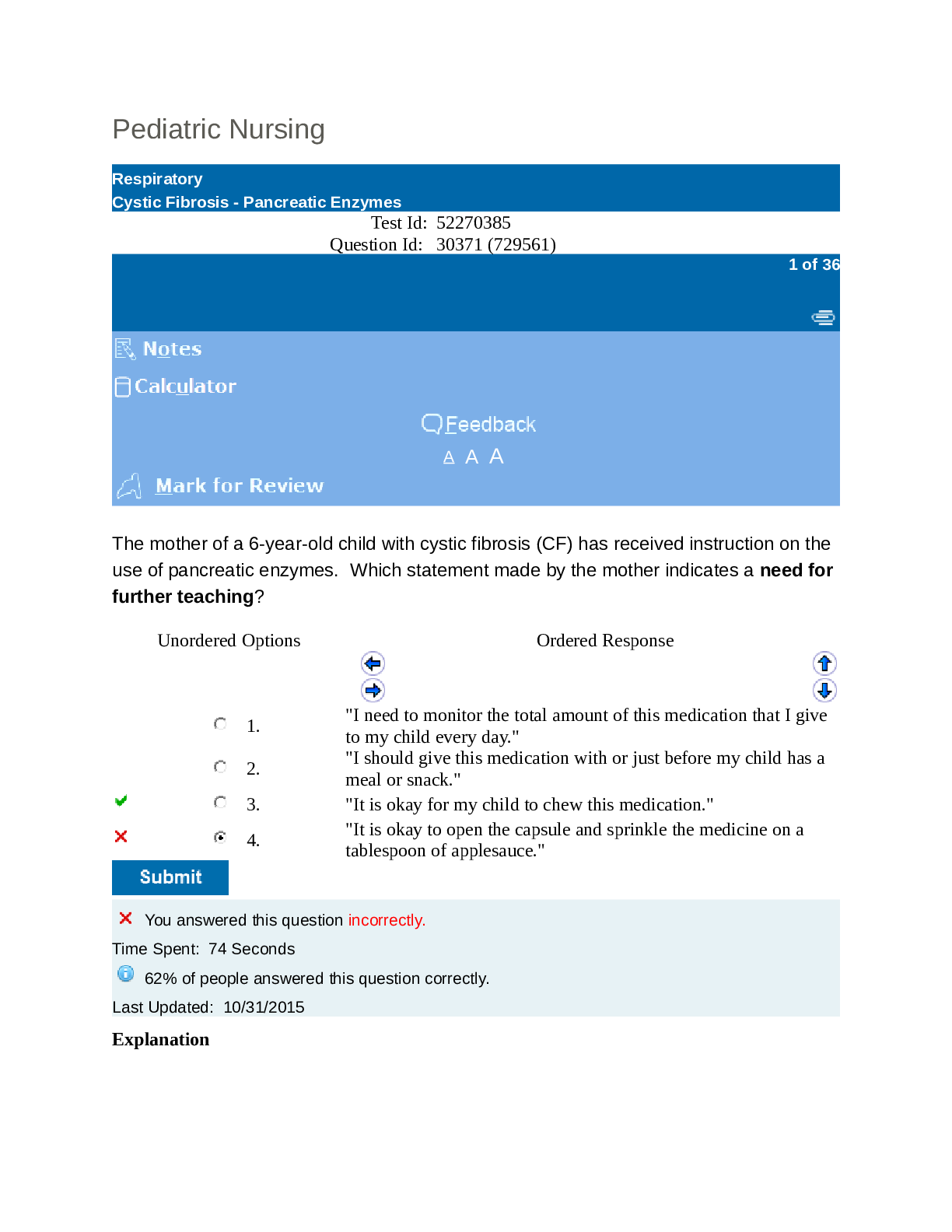

.png)



![Preview of The Well-Managed Healthcare Organization 9th Edition by Griffith [eBook] [PDF]](https://scholarfriends.com/storage/The_Well_Managed_Healthcare_Organization_9th_Edition_by_Griffith.png)





.png)


