Date of Completion
Apr 27, 2020 09:29 AM
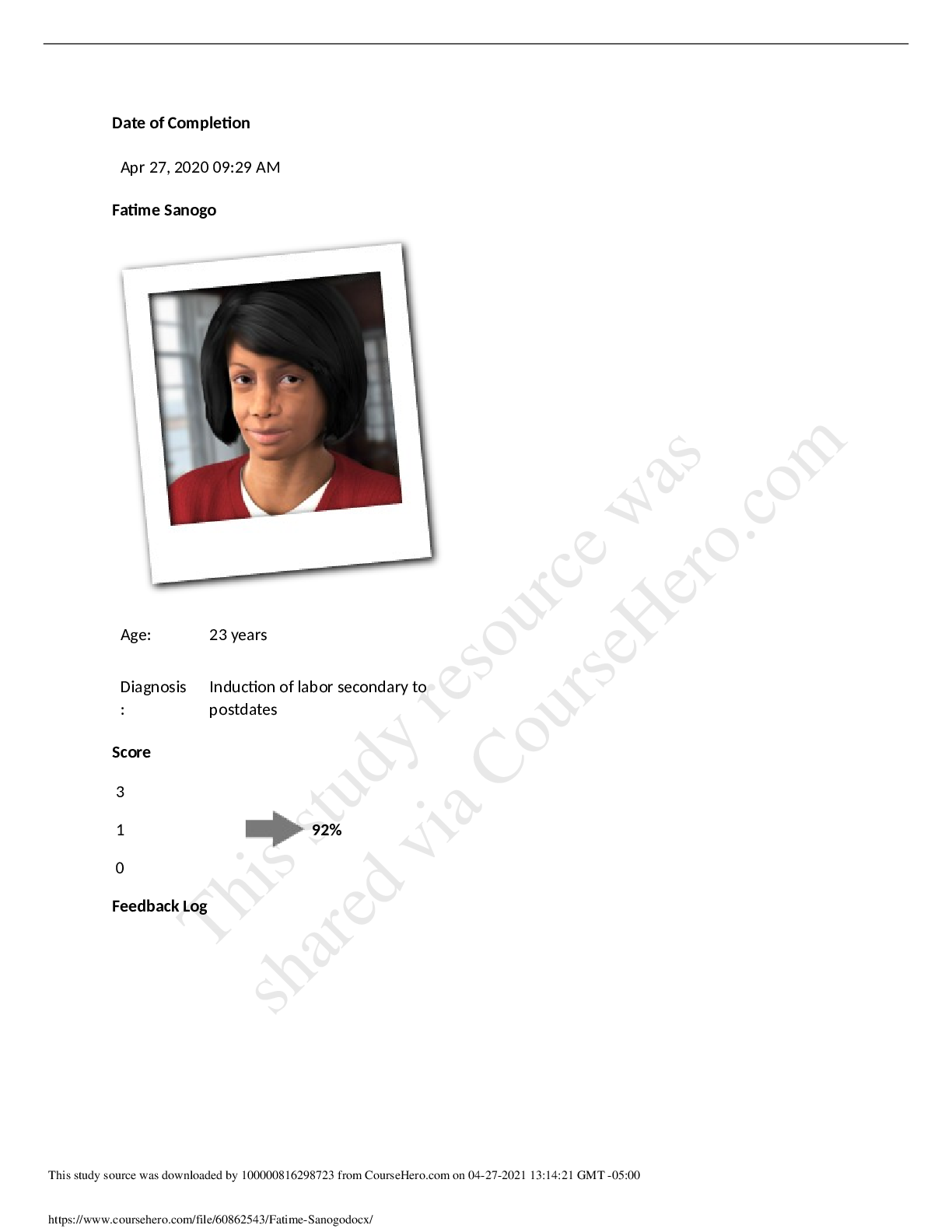
Fatime Sanogo
Age: 23 years
Diagnosis: Induction of labor secondary to postdates
Score
3
1
0
92%
Feedback Log
0:00 You arrived at the patient.
0:0
...
Date of Completion
Apr 27, 2020 09:29 AM
Fatime Sanogo
Age: 23 years
Diagnosis: Induction of labor secondary to postdates
Score
3
1
0
92%
Feedback Log
0:00 You arrived at the patient.
0:00 You introduced yourself.
0:10 Patient status - Heart rate: 103. Pulse: Present. Blood pressure: 101/51 mmHg. Respiration: 18. Conscious state: Appropriate. SpO2: 97%. Temp: 37 C. EFM: --. Fetal heart rate: --.
0:15 You washed your hands. To maintain patient safety it is important to wash your hands as soon as you enter the room.
0:45 You identified the patient. To maintain patient safety it is important that you quickly identify the patient.
0:57 You asked if the patient was <Allergy>allergic<> to anything. (In pain) She replied: 'No, I am not allergic to anything.'
1:10 Patient status - Heart rate: 104. Pulse: Present. Blood pressure: 98/51 mmHg. Respiration: 19. Conscious state: Appropriate. SpO2: 97%. Temp: 37 C. EFM: --. Fetal heart rate: --.
1:11 You looked for normal breathing. She is breathing at 19 breaths per minute. The chest is moving equally.
1:40 You attached the <Pulseoximeter>pulse oximeter.<> This was indicated by order.
1:59 You attached the automatic noninvasive blood pressure (NIBP) measurement cuff. This will allow you to reassess the patient continuously.
2:10 Patient status - Heart rate: 106. Pulse: Present. Blood pressure: 99/50 mmHg. Respiration: 20. Conscious state: Appropriate. SpO2: 97%. Temp: 37 C. EFM: --. Fetal heart rate: --.
2:10 You checked the radial pulse. The pulse is strong, 105 per minute and regular. It is correct to assess the patient's vital signs.
You should assess the patient's temperature as part of assessing the vital signs.
2:44 You assessed the patient's perineum. This was reasonable. There was minimal redness, minimal edema, no echimosis, and no discharge from the repair, and it is well approximated. A lot of blood and lochia was seen in the vaginal. She was bleeding at a moderate rate.
3:10 Patient status - Heart rate: 107. Pulse: Present. Blood pressure: 98/50 mmHg. Respiration: 20. Conscious state: Appropriate. SpO2: 96%. Temp: 37 C. EFM: --. Fetal heart rate: --.
3:14 You checked for blood, lochia, and fluid on the bed.
3:31 You palpated the fundus of uterus. This was not correct. You should have put the patient into lying or trendelenburg position to get more accurate results. The uterus was soft and boggy.
3:49 You changed and weighed the bed pads. The increase in weight of the bed pads suggests that approximately 1150 mL of lochia was on the pads. The time since the last change of the pads suggests a bleeding rate of approximately 2040 mL/hr.
4:10 Patient status - Heart rate: 109. Pulse: Present. Blood pressure: 96/50 mmHg. Respiration: 20. Conscious state: Appropriate. SpO2: 96%. Temp: 37 C. EFM: --. Fetal heart rate: --.
4:19 You assessed the bladder status. The bladder contained 300 mL of urine.
4:44 You assisted the patient into Trendelenburg position.
5:01 You performed a straight catheterization. This was reasonable. The bladder was emptied. There was about 300 ml of urine in the bladder.
5:10 Patient status - Heart rate: 110. Pulse: Present. Blood pressure: 96/50 mmHg. Respiration: 20. Conscious state: Appropriate. SpO2: 96%. Temp: 37 C. EFM: --. Fetal heart rate: --.
5:57 You performed fundal massage. This was indicated and the correct response to the patient's condition. The uterus did not firm up properly.
6:10 Patient status - Heart rate: 112. Pulse: Present. Blood pressure: 96/50 mmHg. Respiration: 20. Conscious state: Appropriate. SpO2: 95%. Temp: 37 C. EFM: --. Fetal heart rate: --.
6:21 You phoned the provider in order to discuss the patient.
7:10 Patient status - Heart rate: 113. Pulse: Present. Blood pressure: 96/50 mmHg. Respiration: 21. Conscious state: Appropriate. SpO2: 95%. Temp: 37 C. EFM: --. Fetal heart rate: --.
8:01 You gave the patient 100% oxygen from a nonrebreathing mask.
8:07 You turned the oxygen on.
8:10 Patient status - Heart rate: 114. Pulse: Present. Blood pressure: 95/50 mmHg. Respiration: 21. Conscious state: Appropriate. SpO2: 95%. Temp: 37 C. EFM: --. Fetal heart rate: --.
8:37 You identified the patient. If you are in doubt, it is always a good idea to repeat the identification.
8:48 You asked if the patient was <Allergy>allergic<> to anything. (In pain) She replied: 'No, I am not allergic to anything.'
9:10 You assessed the patient's IV. The site had no redness, swelling, infiltration, bleeding, or drainage. The dressing was dry and intact. This is correct. Assessing any IVs the patient has is always important.
9:10 Patient status - Heart rate: 112. Pulse: Present. Blood pressure: 96/50 mmHg. Respiration: 21. Conscious state: Appropriate. SpO2: 97%. Temp: 37 C. EFM: --. Fetal heart rate: --.
9:41 You verified the dose with another nurse. This was reasonable. The dose was correct.
10:10 Patient status - Heart rate: 112. Pulse: Present. Blood pressure: 93/49 mmHg. Respiration: 21. Conscious state: Appropriate. SpO2: 98%. Temp: 37 C. EFM: --. Fetal heart rate: --.
10:47 You started infusing oxytocin postpartum (mL/hr) at 500 mL/hr. It is important to use the basic rights of medication administration to ensure proper drug therapy. This was indicated by order.
11:10 Patient status - Heart rate: 113. Pulse: Present. Blood pressure: 94/50 mmHg. Respiration: 21. Conscious state: Appropriate. SpO2: 99%. Temp: 37 C. EFM: --. Fetal heart rate: --.
11:16 You started a bolus of 500 mL of lactated Ringer's solution IV, given over 60 minutes. It is important to give IV fluids to bleeding patients.
You should reassess the patient's breathing at this point.
12:03 You phoned the provider in order to discuss the patient.
12:10 Patient status - Heart rate: 114. Pulse: Present. Blood pressure: 93/49 mmHg. Respiration: 21. Conscious state: Appropriate. SpO2: 99%. Temp: 37 C. EFM: --. Fetal heart rate: --.
13:10 Patient status - Heart rate: 115. Pulse: Present. Blood pressure: 90/48 mmHg. Respiration: 21. Conscious state: Appropriate. SpO2: 99%. Temp: 37 C. EFM: --. Fetal heart rate: --.
13:35 A 800-mcg dose of misoprostol was given rectally. This was indicated by order.
14:04 You flushed the cannula.
14:10 You administered 5 mg of morphine IV.
14:26 You flushed the cannula.
15:01 You flushed the cannula.
15:09 You administered 2 mg of butorphanol tartrate IV. This was indicated by order.
15:10 Patient status - Heart rate: 114. Pulse: Present. Blood pressure: 90/49 mmHg. Respiration: 22. Conscious state: Appropriate. SpO2: 99%. Temp: 37 C. EFM: --. Fetal heart rate: --.
15:48 You listened to the lungs of the patient. The breath sounds are clear and equal bilaterally.
15:54 You looked for normal breathing. She is breathing at 22 breaths per minute. The chest is moving equally.
16:10 Patient status - Heart rate: 113. Pulse: Present. Blood pressure: 91/51 mmHg. Respiration: 22. Conscious state: Appropriate. SpO2: 99%. Temp: 37 C. EFM: --. Fetal heart rate: --.
16:21 You asked the patient if she had any pain. She replied: 'Yes, I have some pain.'
16:29 You asked: How bad is the pain? She replied: 'Not too bad; it's about a 2.'
16:46 You provided patient education. This is correct. It is important to provide patient educate to improve understanding of the patient's medical condition and methodes and means to manage her condition. Effective communication and patient education increases patient motivation to comply.
You should have drawn a blood sample.
17:10 Patient status - Heart rate: 112. Pulse: Present. Blood pressure: 93/54 mmHg. Respiration: 22. Conscious state: Appropriate. SpO2: 99%. Temp: 37 C. EFM: --. Fetal heart rate: --.
17:13 You phoned the provider in order to discuss the patient.
18:10 Patient status - Heart rate: 112. Pulse: Present. Blood pressure: 93/55 mmHg. Respiration: 22. Conscious state: Appropriate. SpO2: 99%. Temp: 37 C. EFM: --. Fetal heart rate: --.
18:32 You asked the patient if she had any medical problems. She replied: 'Yes. I have sickle cell trait.'
18:46 You asked the patient what medication she was taking, if any. She replied: 'No.'
18:56 You asked the patient if she was a smoker. She replied: 'I do not smoke.'
19:10 Patient status - Heart rate: 112. Pulse: Present. Blood pressure: 93/56 mmHg. Respiration: 22. Conscious state: Appropriate. SpO2: 99%. Temp: 37 C. EFM: --. Fetal heart rate: --.
19:15 You asked the patient how she felt. She replied: 'A little better.'
19:35 You ended the scenario by returning to the nurse's station. This was reasonable.
The patient's prolonged second stage, long third stage, and manual removal of the placenta put her at high risk for hemorrhage. In this situation, the nurse needs to address the most likely cause of the boggy uterus: retained placental fragments. Therefore, the nurse should prioritize encouraging uterine contractions. After that, uterotonics are the next priority and should be used in a stepwise fashion, moving on to the next medicine if the previous one fails. Constant assessment of uterotonic effect is critical in deciding whether the medicine has had an effect.[newline][newline]Although catheterization, increased oxytocin infusion, and administration of misoprostol are adequate in this situation, it is important to plan for the next steps in case the patient deteriorates further. This includes calling the provider for help, getting additional medications ready for administration, and anticipating infusion of blood products.[newline][newline]The beads and/or amulets worn by the patient are often worn around the female waist in the Mande and other West African cultures as a way to express both femininity and fertility, and for specific spiritual and/or medicinal purposes. For example, some beads or amulets may be intended to ward off spirits and to protect the infant's and mother's health during pregnancy and delivery.
You got 92%
[Show More]








.png)