PHARM EXAM 1 BLUE PRINT
EXAM 1 NOTES
- Pharmacology: Study / Science of Drugs
- Drugs: any chemical that affects the physiological (function) process of a living organism
- Pharmacokinetics: drug movement “pharma” =
...
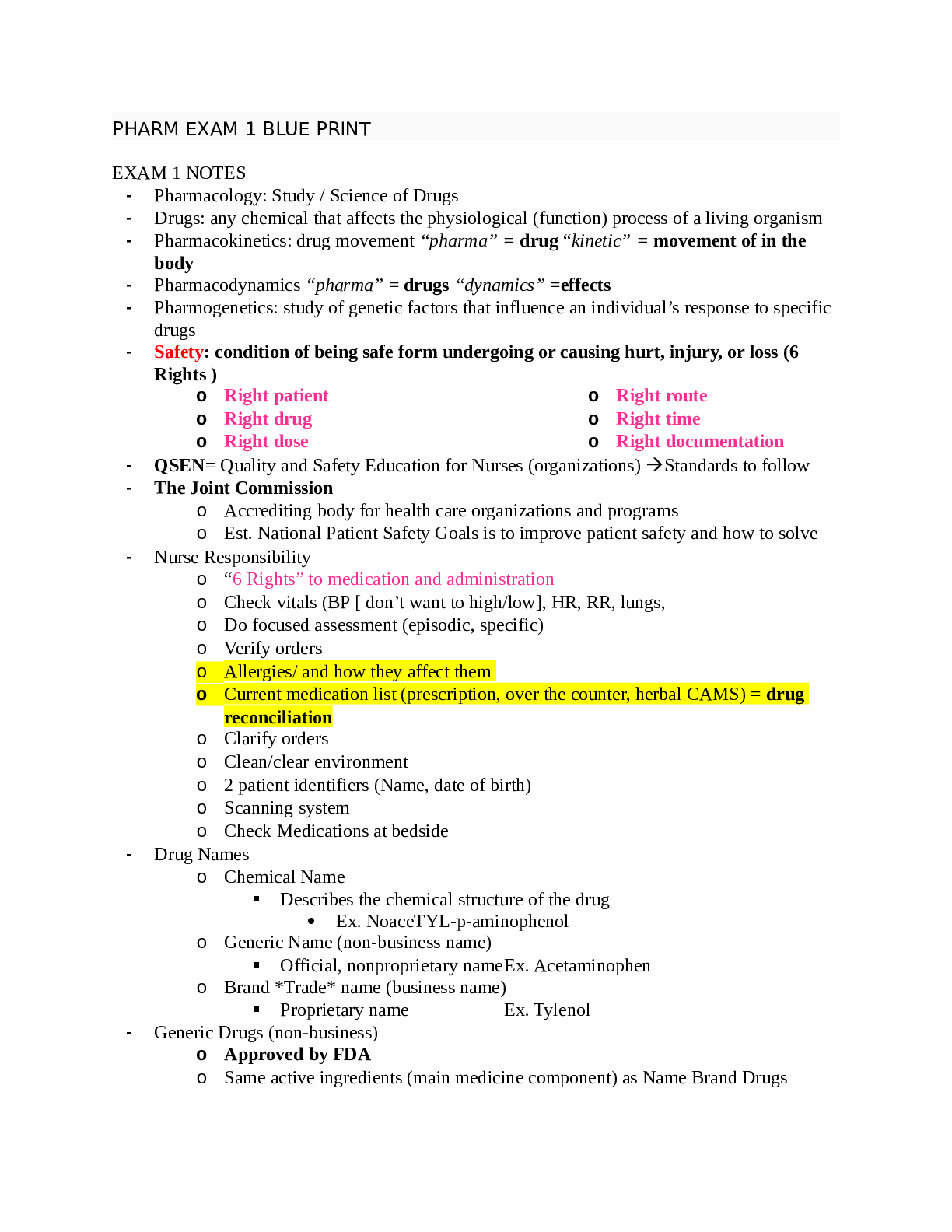
PHARM EXAM 1 BLUE PRINT
EXAM 1 NOTES
- Pharmacology: Study / Science of Drugs
- Drugs: any chemical that affects the physiological (function) process of a living organism
- Pharmacokinetics: drug movement “pharma” = drug “kinetic” = movement of in the
body
- Pharmacodynamics “pharma” = drugs “dynamics” =effects
- Pharmogenetics: study of genetic factors that influence an individual’s response to specific
drugs
- Safety: condition of being safe form undergoing or causing hurt, injury, or loss (6
Rights )
o Right patient
o Right drug
o Right dose
o Right route
o Right time
o Right documentation
- QSEN= Quality and Safety Education for Nurses (organizations) Standards to follow
- The Joint Commission
o Accrediting body for health care organizations and programs
o Est. National Patient Safety Goals is to improve patient safety and how to solve
- Nurse Responsibility
o “6 Rights” to medication and administration
o Check vitals (BP [ don’t want to high/low], HR, RR, lungs,
o Do focused assessment (episodic, specific)
o Verify orders
o Allergies/ and how they affect them
o Current medication list (prescription, over the counter, herbal CAMS) = drug
reconciliation
o Clarify orders
o Clean/clear environment
o 2 patient identifiers (Name, date of birth)
o Scanning system
o Check Medications at bedside
- Drug Names
o Chemical Name
Describes the chemical structure of the drug
Ex. NoaceTYL-p-aminophenol
o Generic Name (non-business name)
Official, nonproprietary nameEx. Acetaminophen
o Brand *Trade* name (business name)
Proprietary name Ex. Tylenol
- Generic Drugs (non-business)
o Approved by FDA
o Same active ingredients (main medicine component) as Name Brand Drugs
o Inert or inactive (provide in forming the shape, color) (don’t have to do with the
function of the drug)
o Less expensive
o Products that help in providing the shape of tablets and controls the timing of
release in the body
o Must be stated on the prescription if it is generic or name brand by the health care
provider
- Over- The- Counter (OTC)
o Safe and appropriate for use without the supervision of the health care provider
o Nurse needs to be aware of the OTC drugs
o Can go buy in the store (not necessarily good)
- Drug Labels
o Active and inactive/inert ingredients
o Dosage
o Purpose and use of product
o Specific warnings
o Dosage instructions or directions
Complementary and Alternative Therapies (CAM’s)
- No regulatory agencies
- Includes botanicals, nutritional products, and herbal supplements
- National Center for Complementary and Integrative Health (NCCIH)
- Dietary Supplement Health and Education Act (DSHEA)
o Ensure that products are safe and label information is truthful and not misleading
- Current Good Manufacturing Practices (CGMPs)
o Standards require package labels that declare quality and strength of the contents
and that it is without contaminants and impurities
- Herbal Preparations
o Decoction
o Infusions
o Tinctures
o Liniment
o Poultice
o Essential oils
o Herb-infused
o Percolations
- Potential Hazards
o Natural substances are not always safe
o Not all compounds are safe in all intake routes
o Collect complete list of herbals use
o Can affect lab results
o Interfere with absorption, breakdowns, and excretion of anesthetics,
anticoagulants and other drugs in surgery (about 2-3 weeks before surgery)
- DO’s and DON’T’s
o Don’t give to the pregnant, nursing mothers
o Don’t give to children
o Don’t take in large sums
o Follow the labels
o Stop if the side effects are disturbing and contact health care provider
Drug Administration
- Forms and routes
o Sublingual (under tongue), buccal (check)
o Oral (mouth) (by tablets, capsules, liquids, suspensions, elixirs)
PO – per oral (the medial abbreviation)
o Transdermal (on the skin) (cream, ointment), topical
o Instillation (drops, sprays)
o Nasogastric (nose to stomach) and gastrostomy tubes (straight to the stomach)
o Suppositories (rectal) (abbreviation: PR, per rectal)
o Parenteral (injection)
- Tablets and Capsules
o Extended release- never crushed or cut
Want it to take a while and not released at the same period of time
o Administer irritating drugs with food to decrease GI upset
o Administer foods on empty stomach if food interfered with medication absorption
- Tablets
o Sublingual (under tongue)
o Buccal (between Cheek and gum)
o Via sublingual or buccal need to remain in place till fully absorbed
No food/ liquid to be taken while meds are in place
- Liquid
o Elixirs
o Emulations
o Suspensions
- Transdermal
o Patched on the skin and absorbed through the skin
o Little as 12 hours to 7 days
o Preventing of breakdown by moving patch sites
- Topicals
o Applied to skin
- Instillations
o Eye drops
o Eye ointments
o Ear drops
o Nose drops and sprays
- Inhalations
o Meter-dosed inhalers
Handheld device to deliver asthma and bronchitis drugs to lower
respiratory track
o Spacers
Device used to enhance the delivery of medication from the MDI
o Nebulizer
A device that changes liquid medication into a fine mist or aerosol that has
the ability ti reach the lower, smaller airways
- NG and Gastrostomy tubes
o Soft, flexible tube inserted int the nasopharynx with the tip lying in the stomach
o GI tube- tube surgically placed directly into the patient’s stomach
- Suppositories
o Solid medical preparation that is:
Cone/ spindle shaped – rectum
Globular/ egg shaped – vagina
Pencil shaper- urethra
Useful route in. babies, uncooperative patients, and in cases of vomiting or
digestive system problems
- Parenteral Administrations of medications
o Intradermal (ex. TB skin test)
o Subcutaneous (to the fatty layer)
o Intramuscular (in muscle)
o Intravenous (in blood stream)
o Intraosseous (into the bone) (emergency situation with no iv access and need to
have medication or fluids)
Drug Calculations
- Metric System
o Gram, Liter, Meter
o Household systems:
1 teaspoon= 5ml 3teaspoon = 1 tablespoon 2 tablespoon= 1 oz
- Gtt= drops gtts = drops
- Right of the Decimal place:
o Tenths, hundredths, thousandths
- General rule: rounds to the tenths place:
- Drops rounding round to the nearest whole number
- Tablet rounding: if there is a score it can be rounded to the nearest half
- If it cannot be split, or if it is an extended, controlled release or enteric coated tablet
- Liquids: rounded to the nearest 10ths place
Measuring Body weight
- Convert the pounds to kilograms
- Round the kg to the nearest 10th FIRST before continuing on to the additional calculations
- BODY WEIGHT (kg) * DESIRED * 1 DAY OR DOSE
TOPIC 2: Pharmacokinetics, Pharmacodynamics, Pharmacogenetics (Ch. 2-3, 11)
Drug Phases:
- Pharmacokinetic phases: MOVEMENT OF DRUGS WITHIN THE BODY
o Absorption
o Distribution
o Metabolism
o Excretion
- Pharmacodynamic phases
o Receptor binding
o Post receptor effect
o Chemical reaction
Describe the FDA pregnancy/lactation categories:
o Category A: no risk to the human fetus
o Category B: no risk to the animal fetus; info for humans is not available
o Category C: adverse effects reported in the animal fetus; info for humans is not
available
o Category D: possible fetal risk in humans has been reported. Potential benefit
versus risk may warrant use of these drugs in pregnant women.
o Category X: fetal abnormalities have been reported, and positive evidence of
fetal risk in humans is available. Those drugs are not used for pregnant women.
A: Safest
B: animal studies show no risk
C: potential risk, drugs may be used
D: evidence of fetal risk, but potential benefit to mother may be acceptable
X: fetal harm, outweighs any benefit
FDA pregnancy risk, clinical considerations and data
FDA lactation section is divided into:
o 1. risk summary
2. clinical consideration: method to prevent exposure
3. data of studies that form EBM
FDA female& Male: reproductive potential
Describe the drug approval process:
FDA regulates the process by which drugs are researched and released to the
population; 1st animal studies the human studies (4 phases)
Phase I: Small # of healthy to determine safe dosages, routes of administration,
absorption, metabolism, excretion, and toxicity they test drugs on healthy people
Phase II: Small number volunteers test drugs on a few subjects with the target
disease and compare to results from healthy subjects
Phase III: large double-blind studies are conducted with a placebo
Phase IV: drugs become marketable to general use; still in research but now the
manufacturer is monitoring and reporting the drug effects (if too many/severe
adverse effects come to light drugs can be taken off the market)
Describe the categories for controlled substances: Schedule categories
C-I: drugs with no currently accepted medical use, and high potential for abuse.
Ex: Heroin, lysergic acid, Marijuana
C-II: drugs with medical use and high potential for abuse.
Ex: Codeine, Cocaine
C-III: drugs with moderate to low potential for physical and psychological
dependence.
Ex: codeine with selected medications
C-IV: drugs with low potential for abuse and low risk of dependence
EX: written or oral prescription that expires in 6months. Phenobarbital
C-V: drugs with lower potential for abuse than C-IV
Ex: written prescription or OTC. Coughs or diarrhea
- Pharmacokinetics
o Drug absorption
Drug movement from GI track into the bloodstream
IV bypass and GI track go straight into the blood stream
o Disintegration
Breakdown of oral drugs form into small particles
o Dissolution
Process of combining small drug particles with liquid to form a solution
o Absorption methods:
Passive transport
Diffusion & facilitated diffusion
Active transport
Energy and a carrier substance (enzymes)
Pinocytosis
Cell carries drug across membrane by engulfing drug particles
o Factors affecting absorption:
Blood circulation
Slow circulation is less effective because it takes longer to have its
effectiveness
Pain, stress
Interstitial mobility
Food, food texture, fat content, temperature
Dissolves better in hot water
PH in stomach
Route of administration
o Drug movement from GI tract to Liver
Via portal vein
First pass effect
In which drug goes to the liver or hepatic
Some drugs pass multiple times before going to blood stream for
use
Bioavailability
Percentage that actually gets to the blood stream
o Oral medication: none are 100% because it goes through
the liver multiple times
o Factors affecting bioavailability
Drug form (pill, IV)
Route of administration
Gastric mucosa and motility (how fast it gets to the liver)
Administration with food and other drugs and other interactions
Changes in liver metabolism and the labs
o Drug Distribution
Protein binding- high protein bound or not
If it’s able to combine to a protein and then go to a receptor to get
through
Free Drugs
Floating in the blood stream because it can’t get to the ite of action
yet and can cause toxicity (life threatening)
Prevention: clarify with the physician and ask to stager the times
that they are given because protein binding will be to high
Volume of drug distribution
How much is going into the blood
Blood Brain Barrier (BBB)
Not many pass the BBB (about 98% because BBB is thicker and
harder to cross)
MEDICATIONS NOT SAFE TO TAKE DURING PREGNANCY OR
BREASTFEEDING
If oral medication, visocal, womb on the feet; effects the distribution
most.
o Drug Metabolism
Half-life (t1/2)- how long it takes for half the drug concentration to be
eliminated from the body
Metabolism by the LIVER
Elimination by the KIDNEY
Loading dose- bigger dose than normal that you give as the initial does so
that it can reach the minimum concentration level to start faster and then
follow the other doses as normal
Minimum concentration minimum therapeutic effects
Maintain at a therapeutic level after loading dose
Liver function test (LFT) (the A’s)
Aspartate transaminase (AST)
Alanine Aminotransferase (ALT)
Alkaline phosphate (ALP)
o Drug Excretion (kidney/liver determine effectiveness of drug)
Kidneys
Creatinine Clarence- Low= holding on to Creatinine and
Creatinine= High
BUN
Glomerular filtration rate
Liver bile
Feces
Lungs
Sweat, saliva, breast milk (can get to the baby)
LOW ALBUMIN levels= takes longer for the drug to work because there
isn’t that many proteins to bins and more Free drugs
Factors affecting drug excretion
Drugs that affect renal excretion
Drugs decreasing cardiac output (anything affecting HR decreases
the circulation through the body and decreases amount at the
kidneys
Use of diuretics (excretes to fast)
Competition with other drugs using the same rout of excretion
Change in urine pH
Patients with decrease renal (kidney) or hepatic (liver) function
Function of kidneys through lab work, urine studies, flank pain,
low/ no urinary output
LABS:
o Kidney- Creatinine and Blood Urea Nitrogen (CR & BUN)
NOT FILTERED OUT BYKIDNEYS CAN CAUSE TOXICITY
IN THE BODY
- Pharmacodynamics (effects of the drugs within the body)
o Study of the way the drugs affec
[Show More]


.png)