1. Not thinking too deeply or too systematically about ethical concerns
a. isolates you from other people. c. ensures that no moral dilemmas arise.
b. undermines your personal freedom. d. helps guide you to moral truth
...
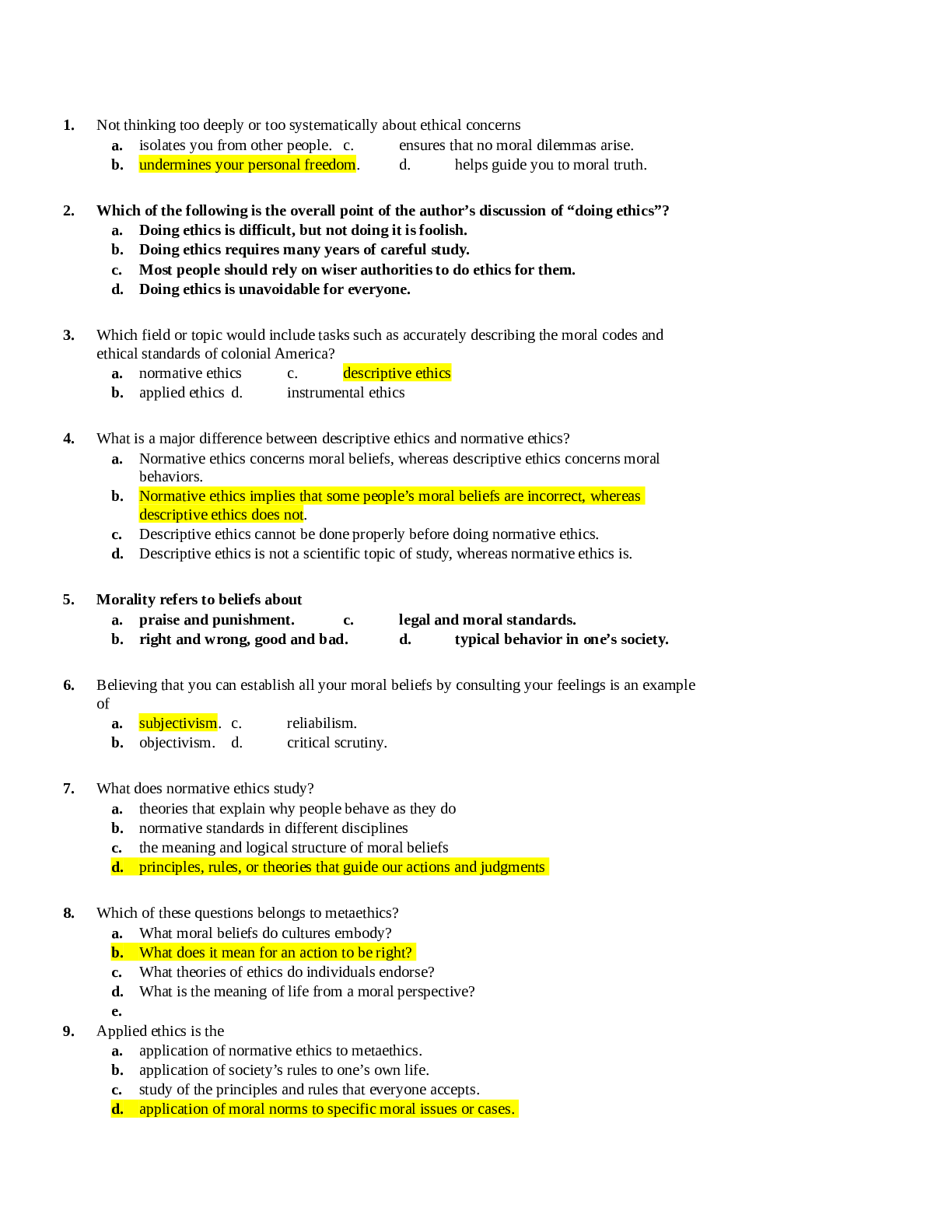
1. Not thinking too deeply or too systematically about ethical concerns
a. isolates you from other people. c. ensures that no moral dilemmas arise.
b. undermines your personal freedom. d. helps guide you to moral truth.
2. Which of the following is the overall point of the author’s discussion of “doing ethics”?
a. Doing ethics is difficult, but not doing it is foolish.
b. Doing ethics requires many years of careful study.
c. Most people should rely on wiser authorities to do ethics for them.
d. Doing ethics is unavoidable for everyone.
3. Which field or topic would include tasks such as accurately describing the moral codes and
ethical standards of colonial America?
a. normative ethics c. descriptive ethics
b. applied ethics d. instrumental ethics
4. What is a major difference between descriptive ethics and normative ethics?
a. Normative ethics concerns moral beliefs, whereas descriptive ethics concerns moral
behaviors.
b. Normative ethics implies that some people’s moral beliefs are incorrect, whereas
descriptive ethics does not.
c. Descriptive ethics cannot be done properly before doing normative ethics.
d. Descriptive ethics is not a scientific topic of study, whereas normative ethics is.
5. Morality refers to beliefs about
a. praise and punishment. c. legal and moral standards.
b. right and wrong, good and bad. d. typical behavior in one’s society.
6. Believing that you can establish all your moral beliefs by consulting your feelings is an example
of
a. subjectivism. c. reliabilism.
b. objectivism. d. critical scrutiny.
7. What does normative ethics study?
a. theories that explain why people behave as they do
b. normative standards in different disciplines
c. the meaning and logical structure of moral beliefs
d. principles, rules, or theories that guide our actions and judgments
8. Which of these questions belongs to metaethics?
a. What moral beliefs do cultures embody?
b. What does it mean for an action to be right?
c. What theories of ethics do individuals endorse?
d. What is the meaning of life from a moral perspective?
e.
9. Applied ethics is the
a. application of normative ethics to metaethics.
b. application of society’s rules to one’s own life.
c. study of the principles and rules that everyone accepts.
d. application of moral norms to specific moral issues or cases.
10. Which field concerns questions such as “Was this abortion permissible?” or “Was this instance of
mercy killing immoral?”
a. applied ethics c. normative ethics
b. metaethics d. descriptive ethics
11. The preeminence of reason refers to the
a. times when our emotions overwhelm our reason.
b. gap between our feelings and our reason.
c. overriding importance of critical reasoning in ethics.
d. guidance that conscience gives to our reason.
12. Which of the following is a consequence of the principle of universalizability?
a. If harming someone is wrong in a particular situation, then harming someone would be
wrong for anyone in a relevantly similar situation.
b. If harming someone is wrong in a particular situation, then harming someone would be
wrong in all situations.
c. The moral rules implied by your behavior apply to everyone, even in dissimilar situations.
d. A person’s morality is dictated by his or her culture-wide morality.
13. Which statement would the author most likely agree with, based on what he states in this
chapter?
a. If your moral beliefs depend on your religious views, it is important to be able to
convince others of your religious views before presenting your moral beliefs.
b. Because we live with people who have different religious views, we need standards for
moral reasoning that do not depend on any particular religious views.
c. Religious believers tend not to think about morality as much as nonbelievers do.
d. Religious believers tend to have more detailed moral beliefs than nonbelievers do.
14. Which of the following correctly applies the principle of impartiality?
a. A mass murderer deserves the same treatment as a heart surgeon.
b. You cannot fairly punish one member of a group unless you punish all of them.
c. All moral judgments must be made on a case-by-case basis, setting aside all personal
biases.
d. Everyone deserves the same treatment, unless there is a morally relevant reason to
favor someone.
15. The dominance of moral norms suggests that if a speed limit on a highway conflicts with a
person’s moral duty to rush a dying man to the hospital, then
a. the moral duty would be as weighty as the legal duty.
b. neither the legal duty nor the moral duty would apply.
c. the moral duty would take precedence over the legal duty.
d. the moral duty would sanction any method whatsoever of getting the dying man to the
hospital.
16. Which of these illustrates the need for moral reasoning when applying religious moral codes?
a. My religious moral code includes a general rule not to kill, but sometimes killing might be
the only way to defend myself.
b. My religious moral code includes a general rule not to lie, but some people lie frequently.
c. My religious moral code has many rules that are not relevant to me.
d. My religious moral code is difficult to follow because it is very strict and demanding.
17. When religious adherents claim that murder is wrong because God says that it is, they are
implicitly espousing the
a. legal theory of divine justice. c. religious demand theory.
b. greatest happiness principle. d. divine command theory.
18. In arguing against the divine command theory, many critics insist that
a. God has the power to will actions to be morally permissible.
b. if an action is right only because God wills it, then all actions are right.
c. if an action is right only because God wills it, then many evil actions would be right if God
willed them.
d. if an action is right only because God wills it, then many evil actions would be right for
believers but wrong for nonbelievers.
19. Why does Leibniz, the great theistic philosopher, reject the divine command theory?
a. because it implies God is beyond our understanding
b. because it implies God is unworthy of worship
c. because it implies a utilitarian conception of morality
d. because it implies God plays no role in morality
20. Which of these best describes the purpose of the book’s discussion of ethics and religion?
a. to convince religious believers of the value of doing ethics
b. to convince the reader that religious moral codes and theories are unacceptable
c. to convince the reader to question everything about morality
d. to convince religious believers that ethics is a replacement for religious beliefs
21. Subjective relativism is the doctrine that
a. an action is morally right if one approves of it.
b. an action is morally right if one’s culture approves of it.
c. actions are judged by objective standards.
d. an action is morally right even if no one approves of it.
22. Suppose I think that I sometimes make mistakes on moral matters, and so does my culture.
Acknowledging this, I say, “My moral beliefs are sometimes wrong and sometimes my
culture’s moral principles are wrong as well.” On which view could my statement be true?
e. emotivism c. objectivism
f. cultural relativism d. subjective relativism
23. Objectivism is the view that
g. moral principles are rigid rules that have no exceptions.
h. there are no objective moral principles.
i. some moral principles are valid for everyone.
j. moral utterances are neither true nor false.
24. Subjective relativism implies that when Sofia says, “I think abortion is wrong,” and Emma
replies,
“I think abortion is permissible,” Sofia and Emma are
k. having a moral disagreement. c. not having a moral disagreement.
l. really saying the same thing. d. not entirely serious.
25. Subjective relativism implies that when a person states their moral beliefs, that person is
m. incapable of making moral judgments.
n. incapable of being in error.
o. morally fallible.
p. infallible on some moral judgments, but not others.
26. Both objectivists and cultural relativists agree that
q. the truth of moral judgments depends on whether one’s culture approves of them.
r. moral judgments differ from culture to culture.
s. moral judgments do not differ from culture to culture.
t. the truth of moral judgments does not depend on whether one’s culture approves of them.
27. Which statement is a consequence of objectivism?
u. Moral rules apply in all cases, without exceptions.
v. If two people have a moral disagreement, only one of them can be right.
w. Everyone has the same beliefs about morality.
x. Whether an action is objectively right depends on its consequences.
28. Cultural relativists may believe their theory promotes tolerance of other cultures. However,
the author argues against this. Which statement best summarizes his argument?
y. Cultural relativists really only value the practices of some cultures, not all cultures.
z. Subjective relativists and emotivists can also promote tolerance.
aa. Tolerance is not really a good thing, and so cultural relativists should not support it.
bb. Cultural relativists cannot consistently say that tolerance is objectively good.
29. According to the main argument for cultural relativism, if culture X and culture Y disagree about
the morality of physician-assisted suicide, this shows that
a. right and wrong are not relative to cultures.
b. physician-assisted suicide is permissible
[Show More]