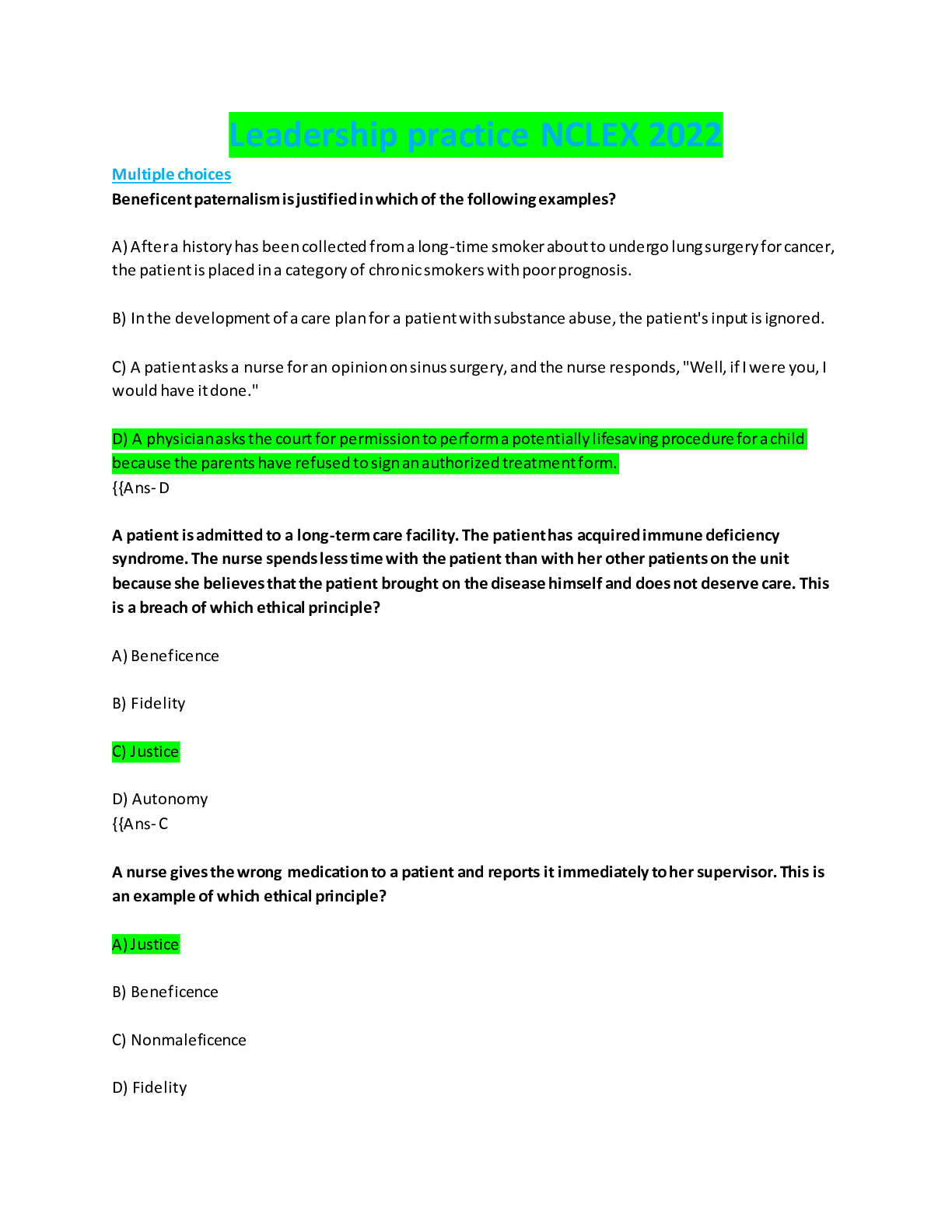
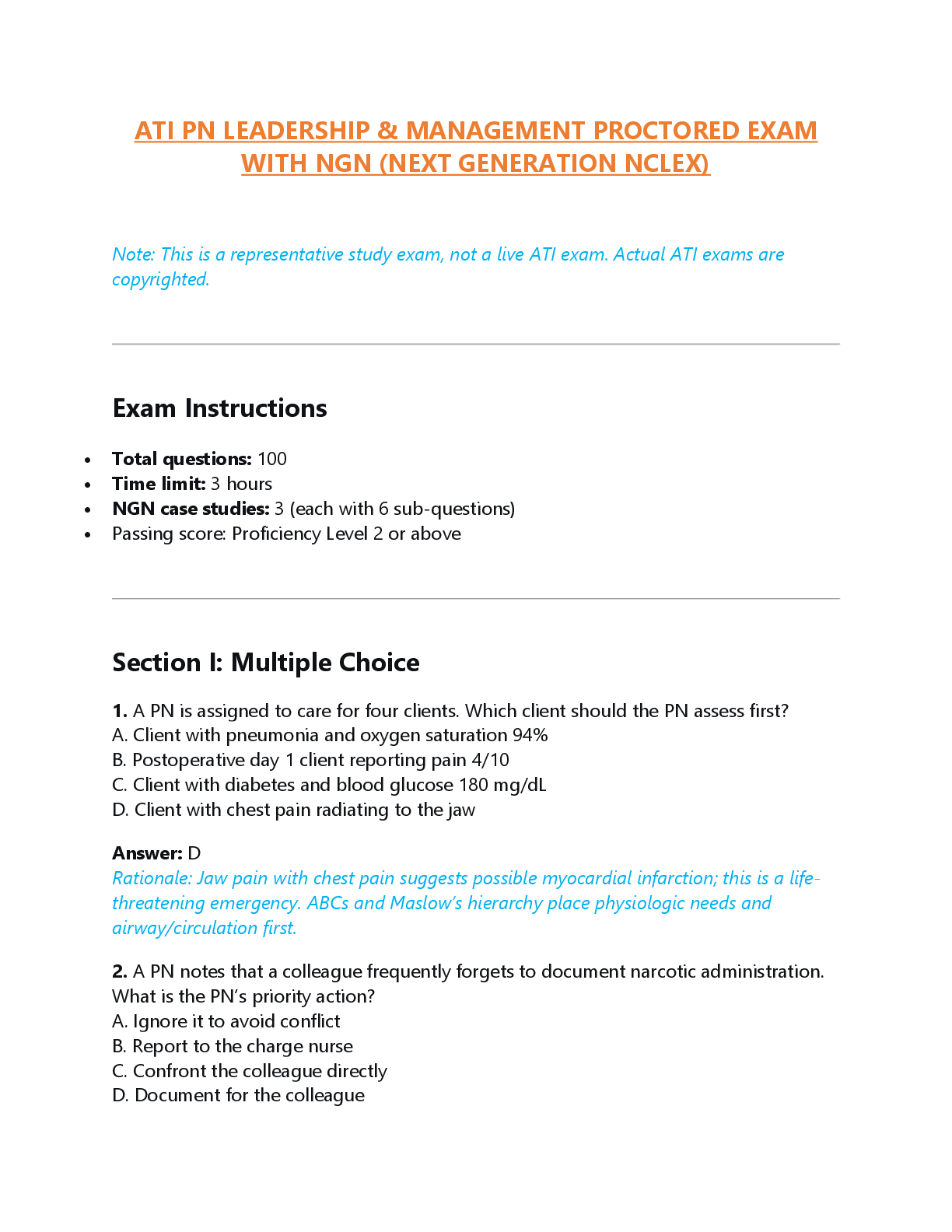
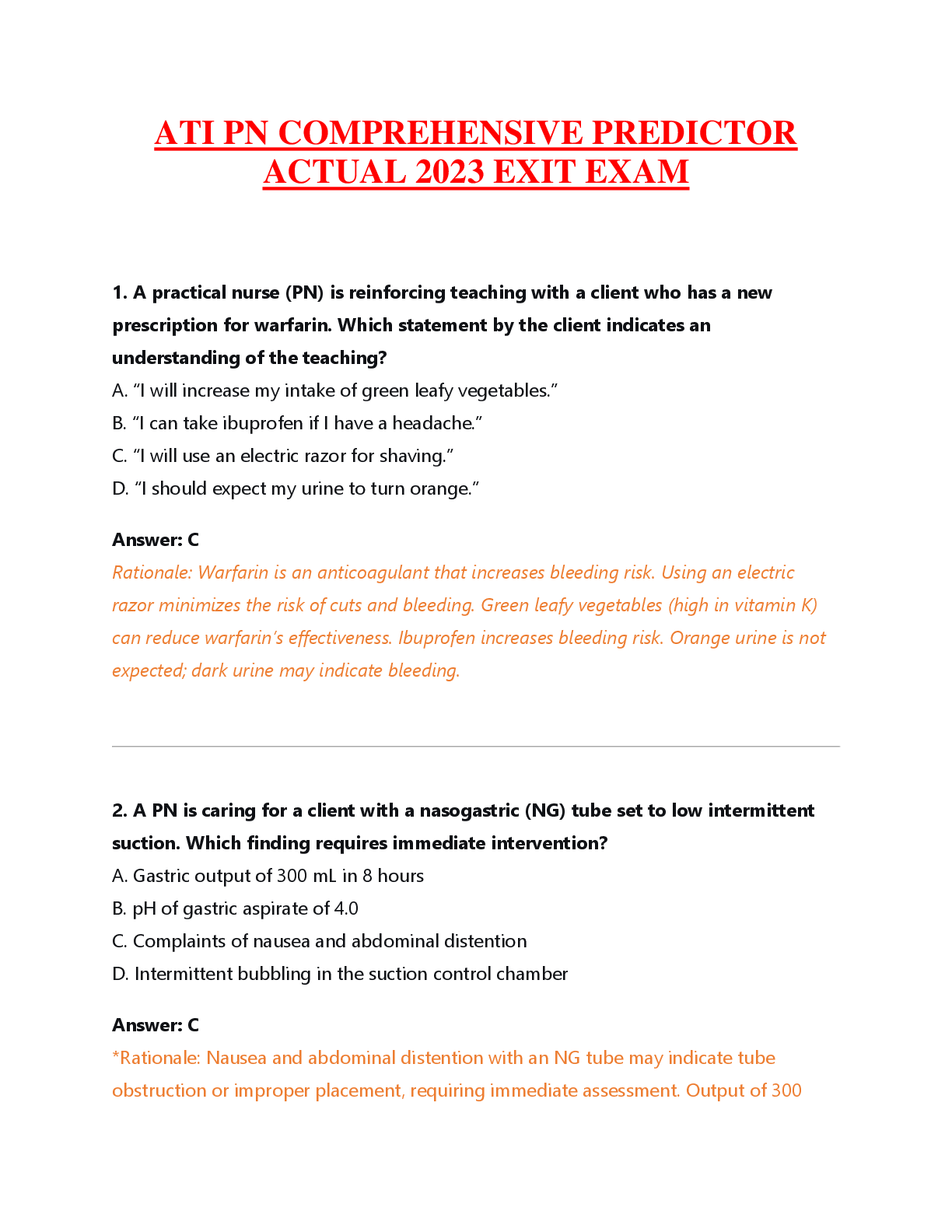
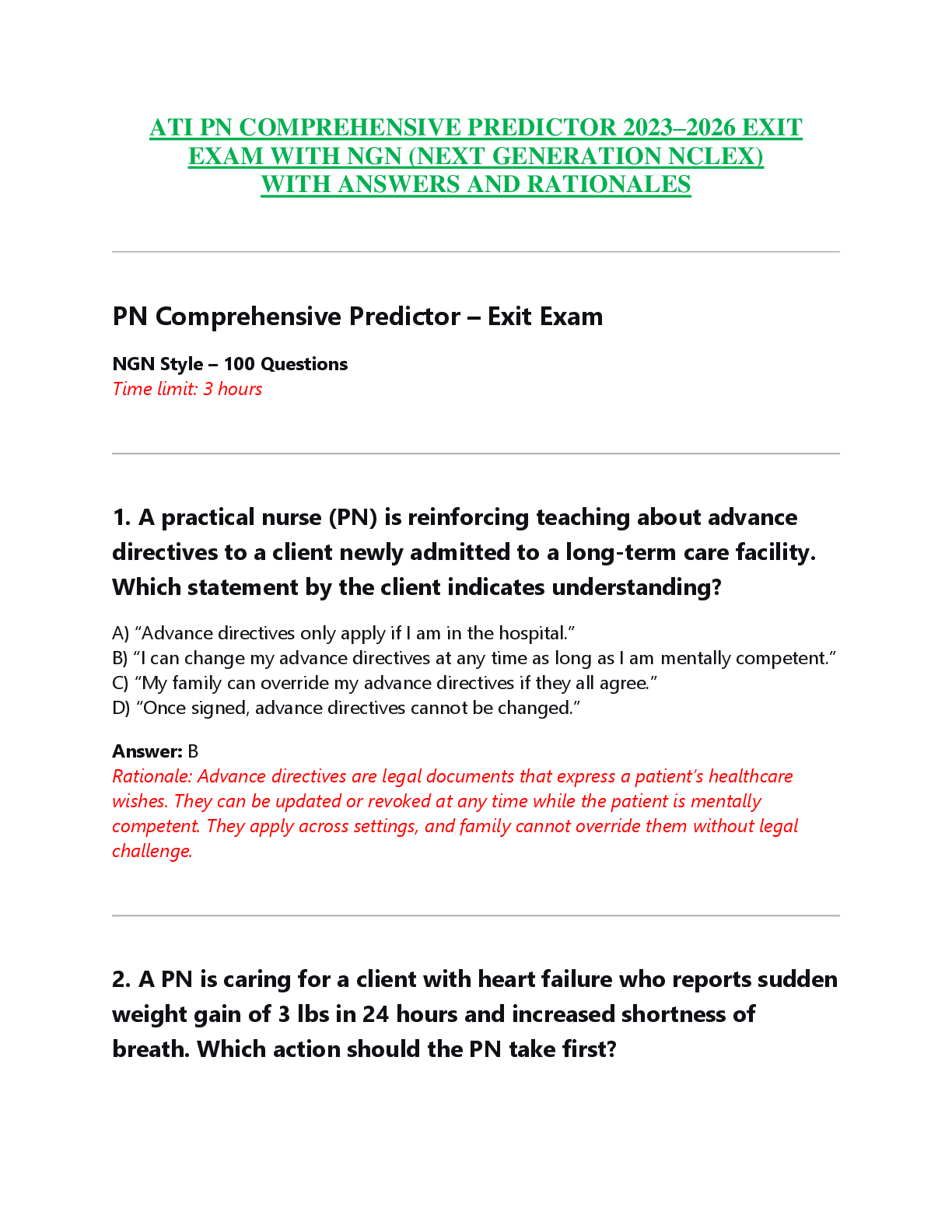
Which of the following statements is true regarding licensed practical nurses (LPNs)?
A) LPNs do not function independently.
B) Upon graduation, an LPN receives a certificate.
C) LPNs are the third largest grou
...
Which of the following statements is true regarding licensed practical nurses (LPNs)?
A) LPNs do not function independently.
B) Upon graduation, an LPN receives a certificate.
C) LPNs are the third largest group of health care workers.
D) The educational progress varies from 24 to 36 months.
Which of the following are nursing members of the interdisciplinary team?
Select all that apply.
A) Nurse practitioners
B) LPNs/LVNs
C) Student nurses
D) NAs
E) Clinical instructors
F) RNs
LP/LVN who provides care that acknowledges the patient's preferences, needs, and values and who communicates these to other members of the health care team is engaging in what type of care?
A) Holistic care
B) Total patient care
C) Patient-centered care
D) Relationship-centered care
The family of a person who is in treatment for alcoholism is seeking support in the community so that they can better deal with the alcoholism as a family. Which volunteer agency could be suggested that is specific to their needs?
A) A private clinic
B) Ambulatory care
C) Alcoholic Anonymous
D) ALS Society of America
Hospitals operated by the Department of Veterans Affairs are which type of hospital?
A) Proprietary hospitals
B) Research hospitals
C) Public hospitals
D) Voluntary community hospitals
A family member of a patient who suffers from severe chronic pain and who requires 24-hour care in an institutional setting asks a practical nurse why the patient cannot enter a hospice where "patients receive wonderful care for pain." The response of the practical nurse would best reflect which of the following?
A) Hospice care is only available in the community.
B) The hospice care philosophy is to maintain comfort as death approaches.
C) The focus in hospice care is on relief of symptoms.
D) Hospice care is only available to those who are certified as terminally ill.
A patient has recently been diagnosed with terminal cancer and wants to try a drug that may prolong her life that is available in other countries. Her specialist says that it is not available in the United States. The patient questions why and the specialist explains that its safety has not yet been established for human use. He further explains that it has to be approved at a federal level by which of the following agencies?
A) National Institute of Health
B) Centers for Disease Control and Prevention
C) Food and Drug Administration
D) Agency for Toxic Substance and Disease Registry
Which of the following type of health care delivery provides 24-hour nursing services per day but does not always have licensed RNs available?
A) Assisted living
B) Skilled nursing home
C) Custodial care
D) Adult day care
A young, single female who is unemployed and without insurance has been diagnosed with genital herpes. Which type of setting would be most appropriate for this patient?
A) Physician's office
B) Outpatient primary care clinic
C) Urgent care center
D) Free clinic
Which of the following is a private health care agency?
A) County health department
B) Family practice physicians
C) Department of Health and Human Services (DHHS)
D) Visiting Nurse Association (VNA)
A mother with a 5-year-old child has recently relocated. Her child has a cough and sore throat that is worsening. She would like the child to be seen by a health care provider but does not yet have a family physician. Which of the following would be the most appropriate for the mother to obtain care for her child?
A) Primary care
B) Urgent care
C) Emergency room services
D) Outpatient clinic
A family with an older adult relative who is no longer able to care for herself and her personal needs would like her to stay close to them in their community in an alternative setting. The family finds a board and care home close by that has an opening. The family is concerned, however, about whether the owner is able to provide safe and compassionate care for their relative and wonders who oversees the residence. What would be the most appropriate response?
A) "Because this is a private living arrangement, oversight is provided by the owner and by family members."
B) "Professionals such as an RN or an LPN/LVN provide oversight of care of the residents."
C) "If needed, extra skilled help will be brought in to assist with health care issues."
D) "The home is under the oversight of the Department of Social Services."
After hearing about the outbreak of Zika virus, a woman who has recently returned from a country where Zika virus was first identified wonders why there is not an international response to this type of outbreak. Which of the following responses would be appropriate?
A) "Outbreaks are a national responsibility and are handled individually by each country."
B) "Your impression is correct because there is no international or national coordination of such outbreaks."
C) "There is reluctance by countries to fund international health concerns, and so their international response is limited."
D) "The World Health Organization is funded by members of the United Nations and coordinates outbreak efforts."
A practical nurse is hired for home health nursing and wonders what types of skills or knowledge might be required within this type of patient care practice. Which of the following knowledge or skills might the practical nurse be expected to have?
A) Performance of skilled physical therapy
B) Sufficient knowledge to change treatment orders to meet patient needs
C) Provision of catheter and ostomy care
D) Prescribing of basic medications, such as ointments
Custodial care includes which of the following?
A) Getting into and out of bed
B) Bedside glucose monitoring
C) Medication administration
D) Blood pressure monitoring
Outpatient clinics that are not attached to a hospital are called ____________________ .
A 75-year-old male suffered a stroke with right extremity weakness and dysphasia and was hospitalized in acute care for 4 days. The most appropriate discharge plan for this patient would be to which setting?
A) Home with home health care
B) Home with hospice
C) A Green House home
D) A sub-acute rehabilitation unit
Which of the following services focuses on relational care within the family's and patient's environment as well as on restoring health?
A) Primary care
B) Hospice care
C) Adult day care center
D) Home health nursing
A patient who has been seen in a primary care physician's office for several years for sinusitis and other health issues tells the nurse that he worried about what care he will need because he no longer carries health insurance. The patient is employed and is a middle-income earner, who has a young family. Which of the following factors may have had the most impact on his decision not to carry health insurance?
A) Increased cost of premiums
B) Age of the patient
C) Belief that he does not need health insurance
D) Exemplary health status
Medicare Part B does not cover which of the following services?
A) Routine physicals
B) Oxygen
C) Flu vaccine yearly
D) Digital exam every year
Which of the following is true regarding the health care system in the United States?
A) Life expectancy in the United States is higher than in most industrialized countries.
B) Health care costs in the United States are higher because individuals are sicker in the United States than in other countries.
C) Nearly 100,000 people die each year from errors in health care that could be prevented.
D) Emergency rooms are an inexpensive and accessible approach to treating common illnesses.
A patient has been with a health maintenance organization (HMO) that uses the capitation method of payment. The patient's health has been stable for a number of years while on the capitation plan, and monitoring has included annual screening blood tests. She has just experienced the re-occurrence of a disorder that requires a number of additional diagnostic tests. The patient is worried that the increase in diagnostic tests will mean additional costs for her. Your response is based on which of the following?
A) Under capitation, the patient must pay if costs are more than the monthly fee paid for services.
B) Under capitation, the HMO and not the patient will absorb costs for services that are more than the monthly fee.
C) Services are guaranteed under the capitation fee and so there will be no reduction in services offered.
D) The patient will be discharged from the capitation fee plan because she is no longer healthy.
Which of the following medical plans provides only prescription drug coverage?
A) Medicare Part A
B) Medicare Part B
C) Medicare Part D
D) Medicare Advantage Plan
Under the provisions of the Affordable Care Act, what would be important for a patient without health insurance to know?
A) Health insurance is not mandatory for residents and legal citizens.
B) All U.S. residents and legal residents must have health insurance or pay a fine.
C) Health insurance is not needed if patients only access emergency department services.
D) Health insurance coverage can only be denied if you have a serious preexisting health condition.
A resident of a long-term care facility is returned back to the facility after a 2-week acute care hospitalization for severe pneumonia. Which of the following actions would reflect understanding of the readmission reduction program by the Centers for Medicare and Medicaid (CMS)?
A) Follow the treatment plan established for the resident prior to admission to acute care
B) Consult with the family regarding their wishes for end of life care
C) Call the patient by name before giving the patient oxygen therapy
D) Report an elevated temperature to the RN
Medicare Part A does not pay for which of the following services?
A) Long-term care custodial services
B) Hospice care for terminally ill beneficiaries
C) Inpatient hospital care
D) Twenty days post hospitalization skilled nursing facility care for rehabilitation
The driving force in all health care agencies is ______________ , which is the need to hold costs within fixed limits.
Which of the following can LPNs/LVNs do to contain the costs of health care?
Select all that apply.
A) Perform nursing procedures accurately and safely.
B) Minimize waste in use of supplies.
C) Organize care efficiently.
D) Provide care according to patient needs.
E) Follow agency policy on documenting care for reimbursement.
Which of the following is characteristic of a navigator of change?
A) Confident and excited
B) Unwilling to participate
C) Goes along with change
D) Experiences fear
Which of the following statements is true regarding capitation?
A) Capitation is a traditional fee-for-service method of payment.
B) Capitation is a major way to finance health care services.
C) The provider does not absorb any costs.
D) The provider always makes a profit.
The monthly fee a person must pay for health care insurance coverage is which of the following?
A) Coinsurance
B) Co-payment
C) Deductible
D) Premium
A patient has been seen by a primary care physician for several years. The patient has recently received a diagnosis of cancer and would like a second opinion about treatment. The patient would like to see a specialist about whom she has heard "many good things." She is told instead by her insurance company that she must see another specialist in order to have a larger portion of her costs paid. What is the best explanation for the direction given by the patient's insurance company?
A) The specialist whom the patient prefers is not considered competent.
B) The specialist to whom the insurance company has directed the patient has a reduced wait list for new patients.
C) The specialist to whom the insurance company has directed the patient is a member of a preferred provider network.
D) The specialist to whom the insurance company directs the patient is considered more competent than the one she prefers.
Continuous quality improvement is best exemplified by which of the following?
A) Examining reasons for a medication error.
B) Initiating evidence-based practices and training programs for safe transfer of patients.
C) Conducting chart audits to determine if documentation is properly done.
D) Reporting the number of adverse events to a clinical review committee.
When individuals delay treatment because they have no or insufficient health insurance, what is the impact on health care costs?
A) None
B) Costs decrease
C) Costs increase
D) Costs increase for insurance companies
Which of the following involves a mathematical formula that is used to arrive at the fee the government will pay for hospitalization?
A) Medicare
B) Medicaid
C) Diagnosis-related group (DRG) system
D) Capitation
[Show More]