Question 1 0.5 pts
survive in all possible environments.
reduce mutation rate.
adjust to environmental changes.
hybridize.
Evolution by natural selection allows species to
Question 2 0.5 pts
It is an increase in t
...
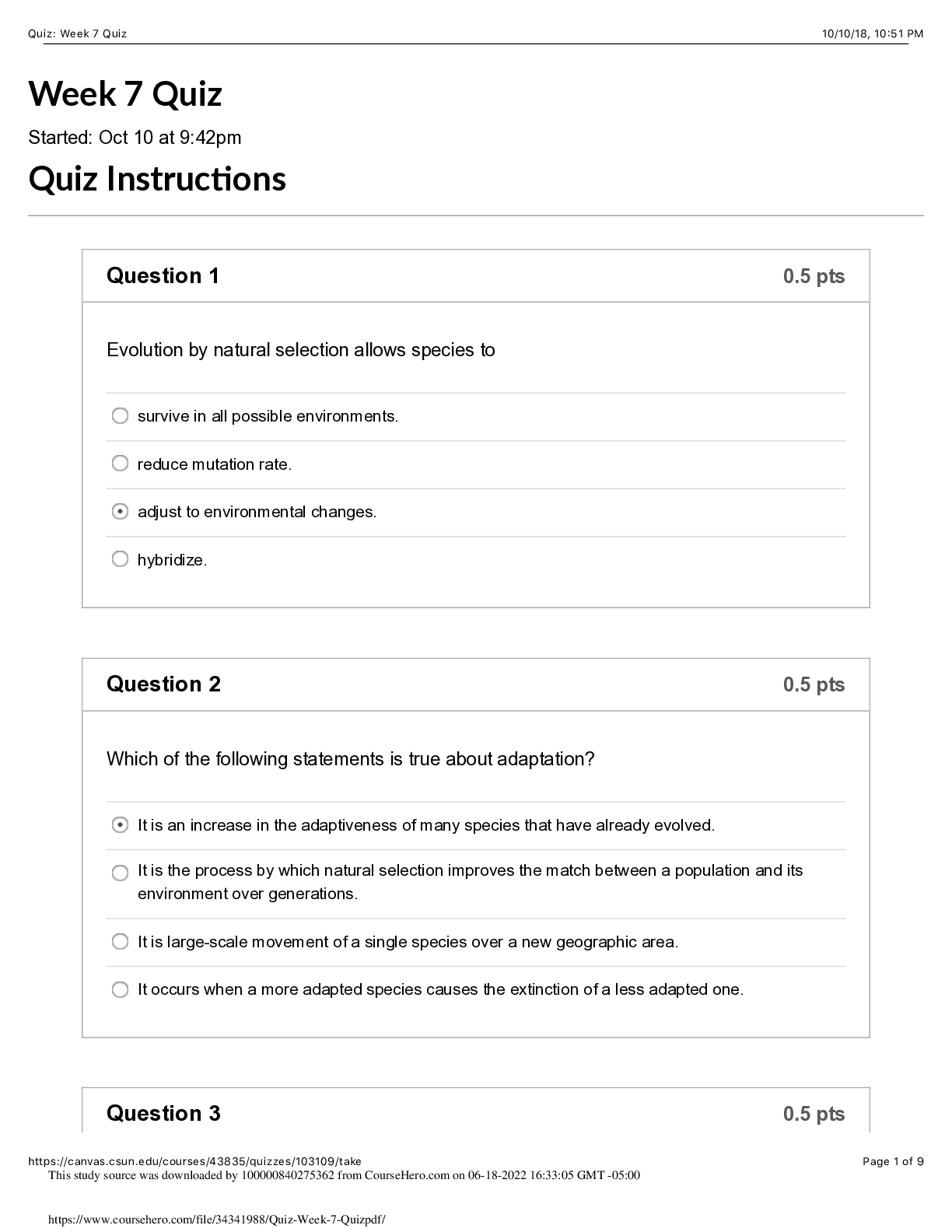
Question 1 0.5 pts
survive in all possible environments.
reduce mutation rate.
adjust to environmental changes.
hybridize.
Evolution by natural selection allows species to
Question 2 0.5 pts
It is an increase in the adaptiveness of many species that have already evolved.
It is the process by which natural selection improves the match between a population and its
environment over generations.
It is large-scale movement of a single species over a new geographic area.
It occurs when a more adapted species causes the extinction of a less adapted one.
Which of the following statements is true about adaptation?
Question 3 0.5 pts
This study source was downloaded by 100000840275362 from CourseHero.com on 06-18-2022 16:33:05 GMT -05:00
https://www.coursehero.com/file/34341988/Quiz-Week-7-Quizpdf/
Quiz: Week 7 Quiz 10/10/18, 10'51 PM
https://canvas.csun.edu/courses/43835/quizzes/103109/take Page 2 of 9
force new color mutations to occur.
improve the match between guppies that reproduce and their environment.
change the color preferences of female guppies.
convert a dominant allele into a recessive allele.
When a brightly colored guppy population is placed in an area containing many visual
predators, the population changes in only a few generations to one containing only
guppies with drab, dull colors that blend into their environment. This is an example of how
natural selection can
Question 4 0.5 pts
organisms that reproduce sexually.
species that cannot produce hybrids.
organisms known only from fossils.
species whose ranges overlap.
Using the biological species concept as a method of defining a species is NOT useful for
Question 5 0.5 pts
According to the biological species concept, a species is defined when individuals of the
same species
This study source was downloaded by 100000840275362 from CourseHero.com on 06-18-2022 16:33:05 GMT -05:00
https://www.coursehero.com/file/34341988/Quiz-Week-7-Quizpdf/
Quiz: Week 7 Quiz 10/10/18, 10'51 PM
https://canvas.csun.edu/courses/43835/quizzes/103109/take Page 3 of 9
differ widely in their DNA sequences.
always have the same physical traits.
are capable of interbreeding and producing fertile offspring.
must reproduce asexually.
Question 6 0.5 pts
gene flow.
continental drift.
speciation.
genetic drift.
Populations within a species are connected by
Question 7 0.5 pts
can occur any time genetic divergence occurs.
can only occur when two populations are geographically isolated.
can only occur when two populations are sympatric.
is a process that stopped occurring thousands of years ago.
The formation of a new species
This study source was downloaded by 100000840275362 from CourseHero.com on 06-18-2022 16:33:05 GMT -05:00
https://www.coursehero.com/file/34341988/Quiz-Week-7-Quizpdf/
Quiz: Week 7 Quiz 10/10/18, 10'51 PM
https://canvas.csun.edu/courses/43835/quizzes/103109/take Page 4 of 9
Question 8 0.5 pts
adaptation
genetic differences
gene flow
directional selection
Geographic isolation limits the ________ between separated populations of a species.
Question 9 0.5 pts
hybrids.
geographically isolated.
artificially isolated.
ecologically isolated.
Two species live in the same area but breed in different parts of their habitat. These
species are
Question 10 0.5 pts
birds
Which of these groups of animals has the greatest number of species?
This study source was downloaded by 100000840275362 from CourseHero.com on 06-18-2022 16:33:05 GMT -05:00
https://www.coursehero.com/file/34341988/Quiz-Week-7-Quizpdf/
Quiz: Week 7 Quiz 10/10/18, 10'51 PM
https://canvas.csun.edu/courses/43835/quizzes/103109/take Page 5 of 9
insects
reptiles
mammals
[Show More]