Week One
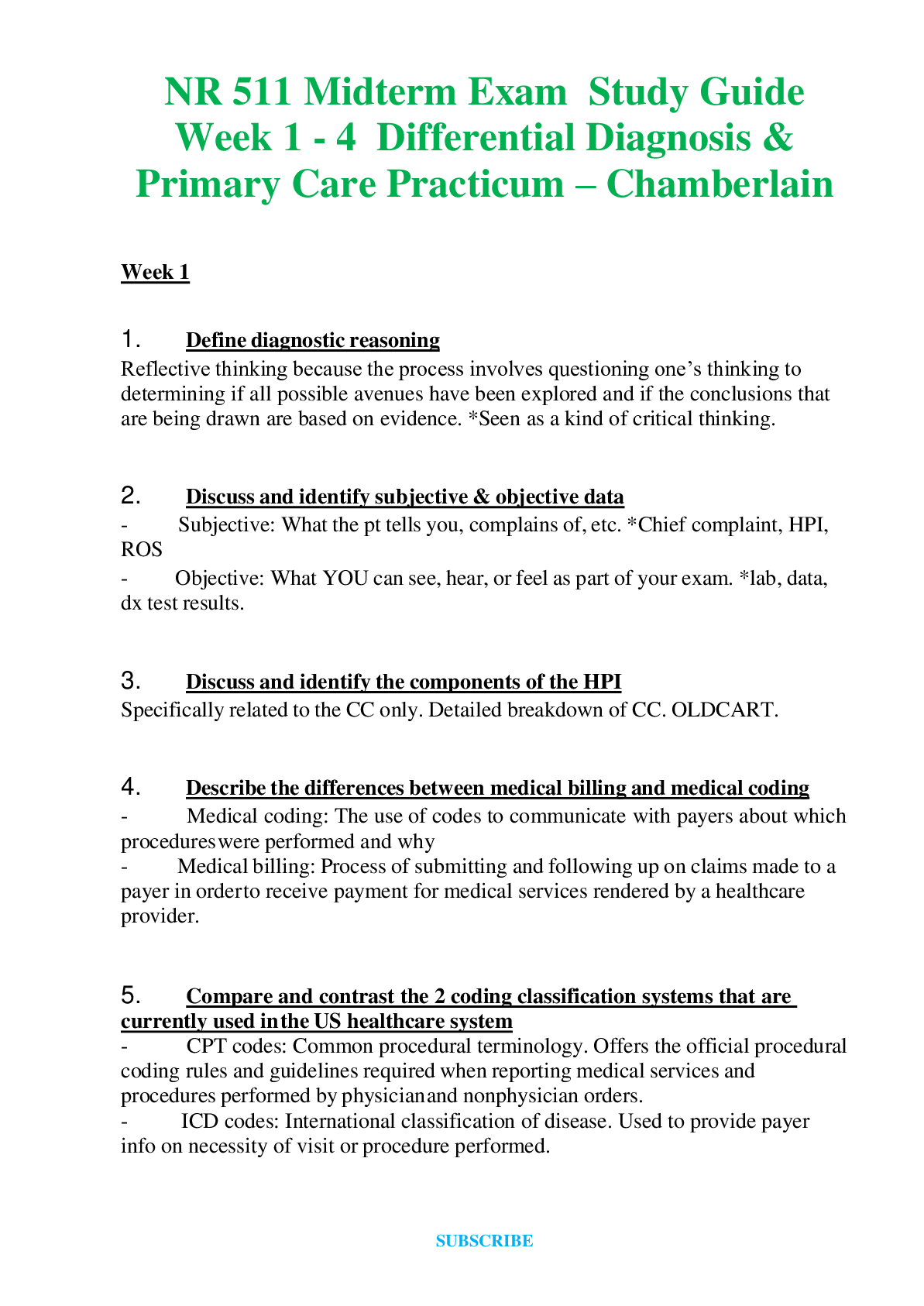
Define diagnostic reasoning.
o Reflective thinking because the process involves questioning one's thinking to determine if all possible
avenues have been explored and if the conclusions that are being drawn
...
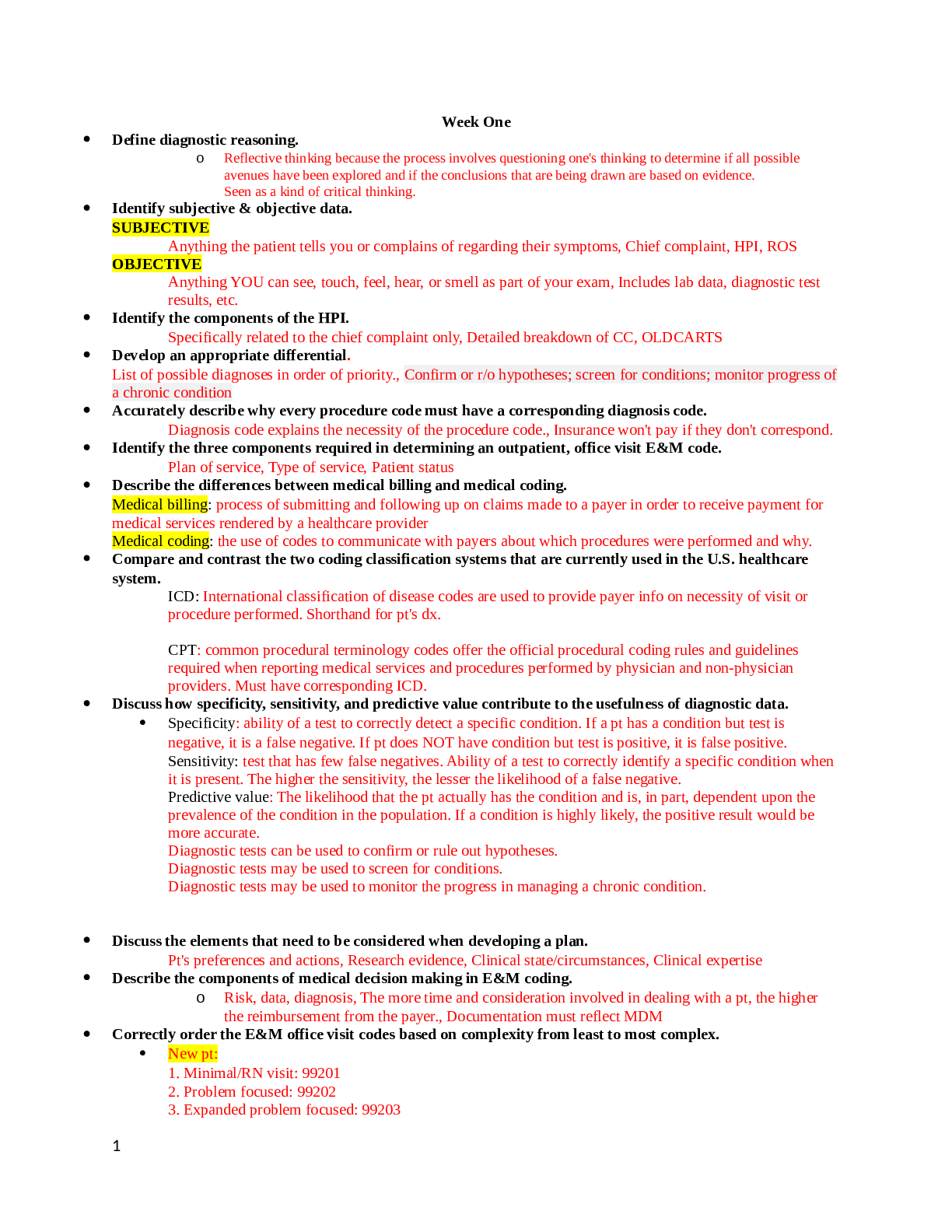
Week One
Define diagnostic reasoning.
o Reflective thinking because the process involves questioning one's thinking to determine if all possible
avenues have been explored and if the conclusions that are being drawn are based on evidence.
Seen as a kind of critical thinking.
Identify subjective & objective data.
SUBJECTIVE
Anything the patient tells you or complains of regarding their symptoms, Chief complaint, HPI, ROS
OBJECTIVE
Anything YOU can see, touch, feel, hear, or smell as part of your exam, Includes lab data, diagnostic test
results, etc.
Identify the components of the HPI.
Specifically related to the chief complaint only, Detailed breakdown of CC, OLDCARTS
Develop an appropriate differential.
List of possible diagnoses in order of priority., Confirm or r/o hypotheses; screen for conditions; monitor progress of
a chronic condition
Accurately describe why every procedure code must have a corresponding diagnosis code.
Diagnosis code explains the necessity of the procedure code., Insurance won't pay if they don't correspond.
Identify the three components required in determining an outpatient, office visit E&M code.
Plan of service, Type of service, Patient status
Describe the differences between medical billing and medical coding.
Medical billing: process of submitting and following up on claims made to a payer in order to receive payment for
medical services rendered by a healthcare provider
Medical coding: the use of codes to communicate with payers about which procedures were performed and why.
Compare and contrast the two coding classification systems that are currently used in the U.S. healthcare
system.
ICD: International classification of disease codes are used to provide payer info on necessity of visit or
procedure performed. Shorthand for pt's dx.
CPT: common procedural terminology codes offer the official procedural coding rules and guidelines
required when reporting medical services and procedures performed by physician and non-physician
providers. Must have corresponding ICD.
Discuss how specificity, sensitivity, and predictive value contribute to the usefulness of diagnostic data.
Specificity: ability of a test to correctly detect a specific condition. If a pt has a condition but test is
negative, it is a false negative. If pt does NOT have condition but test is positive, it is false positive.
Sensitivity: test that has few false negatives. Ability of a test to correctly identify a specific condition when
it is present. The higher the sensitivity, the lesser the likelihood of a false negative.
Predictive value: The likelihood that the pt actually has the condition and is, in part, dependent upon the
prevalence of the condition in the population. If a condition is highly likely, the positive result would be
more accurate.
Diagnostic tests can be used to confirm or rule out hypotheses.
Diagnostic tests may be used to screen for conditions.
Diagnostic tests may be used to monitor the progress in managing a chronic condition.
Discuss the elements that need to be considered when developing a plan.
Pt's preferences and actions, Research evidence, Clinical state/circumstances, Clinical expertise
Describe the components of medical decision making in E&M coding.
o Risk, data, diagnosis, The more time and consideration involved in dealing with a pt, the higher
the reimbursement from the payer., Documentation must reflect MDM
Correctly order the E&M office visit codes based on complexity from least to most complex.
New pt:
1. Minimal/RN visit: 99201
2. Problem focused: 99202
3. Expanded problem focused: 99203
2
4. Detailed: 99204
5. Comprehensive: 99205
Established pt:
1. Minimal/RN visit: 99211
2. Problem focused: 99212
3. Expanded problem focused: 99213
4. Detailed: 99214
5. Comprehensive: 99215
Define the components of a SOAP note.
o S: subjective (what the pt tells you)
CC
HPI
PMH
Fam Hx
Social Hx
ROS
O: objective (what you can see, hear, feel on exam)
Physical findings
Vital signs
General survey
HEENT
Etc...
A: assessment
Global assessment of pt including differentials in order from most to least likely
Combination of subjective and objective info
List of dx addressed and billed for at the visit
P: plan
What you will Rx
When to come back
Diagnostic tests
Pt education
Discuss a minimum of three purposes of the written history and physical in relation to the importance of
documentation.
o Important reference document that gives concise info about the pt's hx and exam findings
Outlines a plan for addressing issues that prompted the visit. Info should be presented in a logical
fashion that prominently features all data relevant to the pt's condition., Is a means of
communicating info to all providers involved in pt's care, Is a medical-legal document
Is essential in order to accurately code and bill for services
Correctly identify a patient as new or established given the historical information.
o Pt status: whether or not pt is new or established., New: has not received professional service from
provider in same group within past 3 years., Established: has received professional service from
provider in same group in last 3 years.
Correctly identify the most specific ICD-10 code with the information given
Explain what a "well rounded" clinical experience means.
Includes seeing kids from birth through young adult visits for well child and acute visits, as well as adults
for wellness or acute/routine visits., Seeing a variety of pt's, including 15% of peds and 15% of women's
health of total time in the program.
Discuss the maximum number of hours that time can be spent "rounding" in a facility.
No more than 25% of total practicum hours in the program
Discuss nine things that must be documented when inputting data into clinical encounter logs.
Date of service
Age
Gender and ethnicity
Visit E&M code
3
CC
Procedures
Tests performed/ordered
Dx
Level of involvement
Explain each part of the acronym the SNAPPS presentation.
S: summarize (present pt's H&P findings)
N: narrow (based on H&P, narrow down top 2-3 differentials)
A: analyze (compare/contrast H&P findings for each differential and narrow it down to most likely one)
P: probe (ask preceptor questions of anything you are unsure of)
P: plan (come up with specific management plan)
S: Self-directed learning (opportunity to investigate more about topics you are uncertain of)
[Show More]