1. What substance joins proteoglycans together into
gigantic complexes called proteoglycan aggregates?
A. Hyaluronidase
B. Hyaluronic acid
C. Glucosaminoglycans
D. Fibronectin
E. Chondroitin
2. What would be the e
...
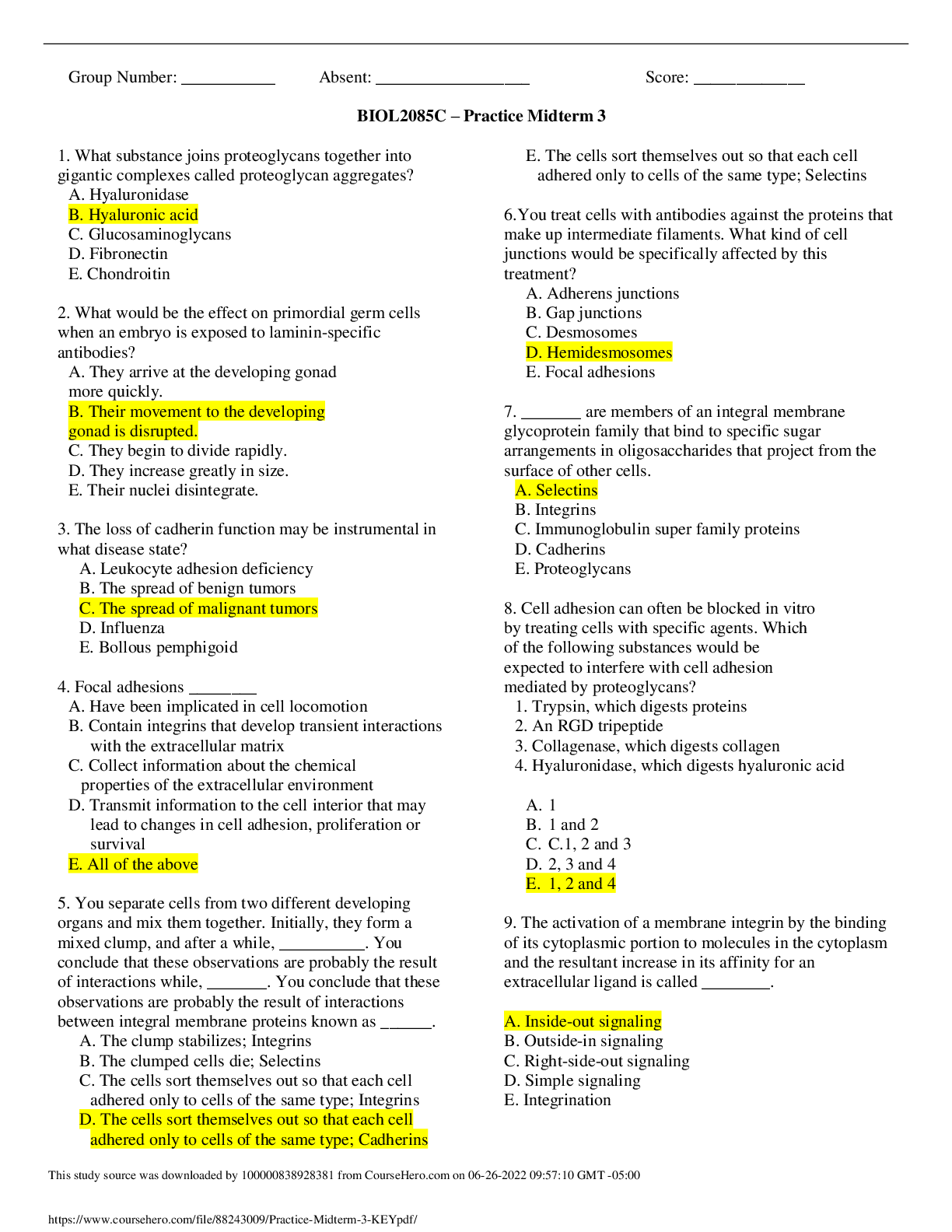
1. What substance joins proteoglycans together into
gigantic complexes called proteoglycan aggregates?
A. Hyaluronidase
B. Hyaluronic acid
C. Glucosaminoglycans
D. Fibronectin
E. Chondroitin
2. What would be the effect on primordial germ cells
when an embryo is exposed to laminin-specific
antibodies?
A. They arrive at the developing gonad
more quickly.
B. Their movement to the developing
gonad is disrupted.
C. They begin to divide rapidly.
D. They increase greatly in size.
E. Their nuclei disintegrate.
3. The loss of cadherin function may be instrumental in
what disease state?
A. Leukocyte adhesion deficiency
B. The spread of benign tumors
C. The spread of malignant tumors
D. Influenza
E. Bollous pemphigoid
4. Focal adhesions ________
A. Have been implicated in cell locomotion
B. Contain integrins that develop transient interactions
with the extracellular matrix
C. Collect information about the chemical
properties of the extracellular environment
D. Transmit information to the cell interior that may
lead to changes in cell adhesion, proliferation or
survival
E. All of the above
5. You separate cells from two different developing
organs and mix them together. Initially, they form a
mixed clump, and after a while, __________. You
conclude that these observations are probably the result
of interactions while, _______. You conclude that these
observations are probably the result of interactions
between integral membrane proteins known as ______.
A. The clump stabilizes; Integrins
B. The clumped cells die; Selectins
C. The cells sort themselves out so that each cell
adhered only to cells of the same type; Integrins
D. The cells sort themselves out so that each cell
adhered only to cells of the same type; Cadherins
E. The cells sort themselves out so that each cell
adhered only to cells of the same type; Selectins
6.You treat cells with antibodies against the proteins that
make up intermediate filaments. What kind of cell
junctions would be specifically affected by this
treatment?
A. Adherens junctions
B. Gap junctions
C. Desmosomes
D. Hemidesmosomes
E. Focal adhesions
7. _______ are members of an integral membrane
glycoprotein family that bind to specific sugar
arrangements in oligosaccharides that project from the
surface of other cells.
A. Selectins
B. Integrins
C. Immunoglobulin super family proteins
D. Cadherins
E. Proteoglycans
8. Cell adhesion can often be blocked in vitro
by treating cells with specific agents. Which
of the following substances would be
expected to interfere with cell adhesion
mediated by proteoglycans?
1. Trypsin, which digests proteins
2. An RGD tripeptide
3. Collagenase, which digests collagen
4. Hyaluronidase, which digests hyaluronic acid
A. 1
B. 1 and 2
C. C.1, 2 and 3
D. 2, 3 and 4
E. 1, 2 and 4
9. The activation of a membrane integrin by the binding
of its cytoplasmic portion to molecules in the cytoplasm
and the resultant increase in its affinity for an
extracellular ligand is called ________.
A. Inside-out signaling
B. Outside-in signaling
C. Right-side-out signaling
D. Simple signaling
E. Integrination
[Show More]