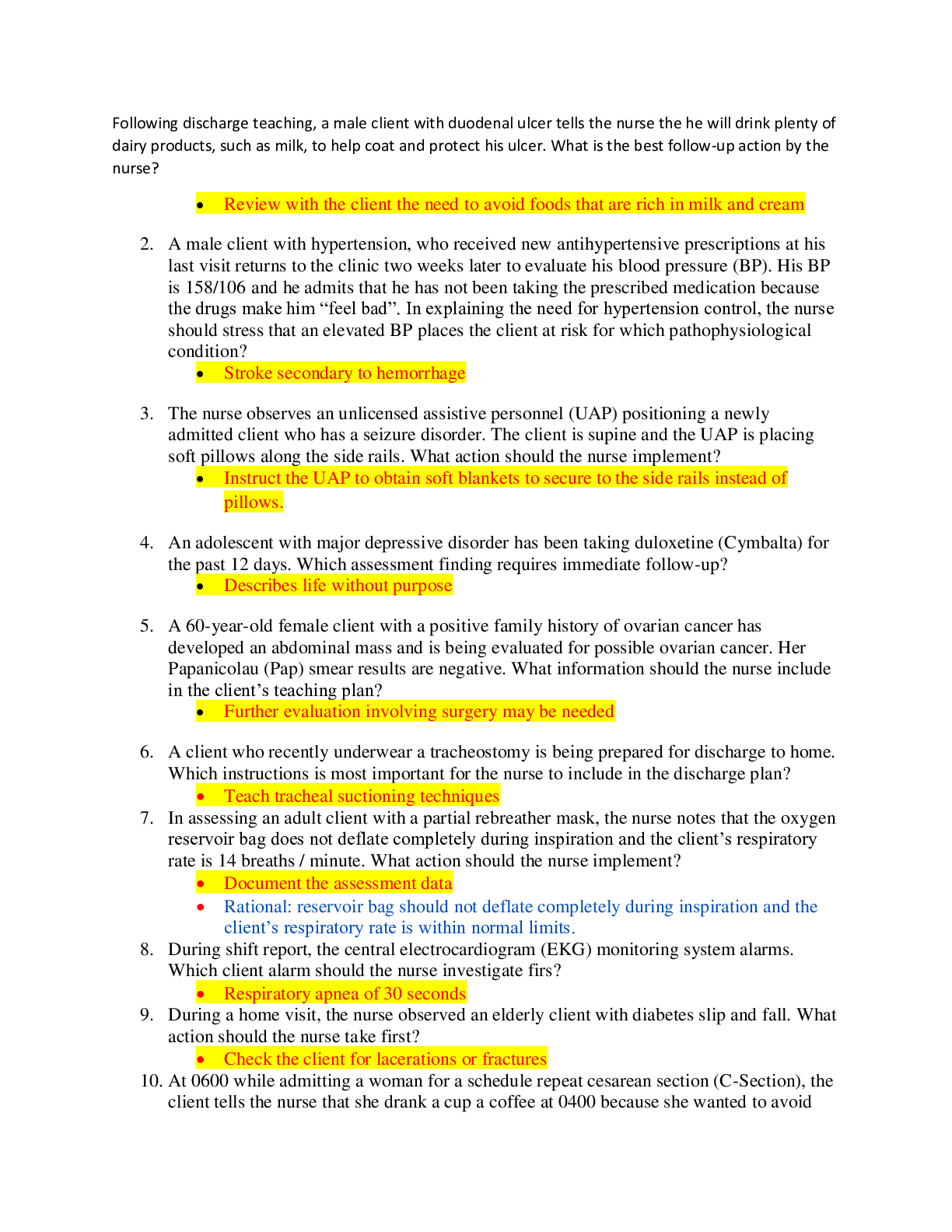
PATHO TEST ONE
What is the sequence of steps in the development of a digestive enzyme by the pancreas cells from the initial transcription to the release from the cells?
Question 1 options:
a) The enzyme is transcri
...
PATHO TEST ONE
What is the sequence of steps in the development of a digestive enzyme by the pancreas cells from the initial transcription to the release from the cells?
Question 1 options:
a) The enzyme is transcribed from DNA by ribonucleic acid (RNA) in the nucleus, proceeds to the ribosomes for synthesis, and is transported in secretory vesicles to the cell membrane.
b) The enzyme is transcribed from RNA by DNA in the nucleus, proceeds to the lysosomes for synthesis, and is transported in an encapsulated membrane to the cell membrane.
c) The enzyme is transcribed by the mitochondria in the nucleus, proceeds to the ribosomes for synthesis, and is transported in a cytoskeleton to the cell membrane.
d. The enzyme is transcribed from DNA by RNA in the nucleus, proceeds to the Golgi complex for synthesis, and is transported in the cytosol to the cell membrane.
Save
Question 2 (0.5 points)
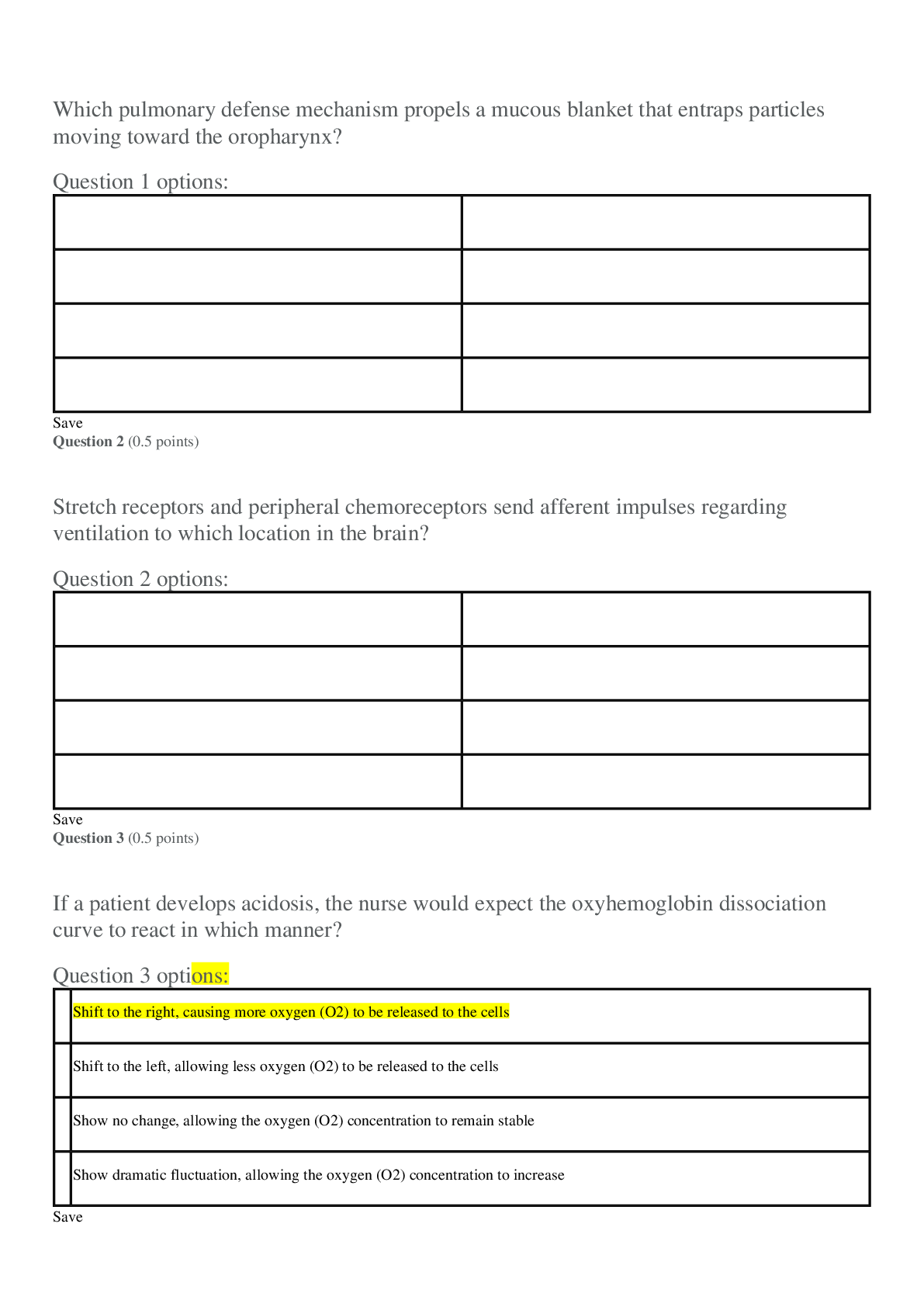
Which organic compounds facilitate transportation across the cell membrane by acting as receptors, transport channels for electrolytes, and enzymes to drive active pumps?
Question 2 options:
a) Lipids
b) Proteases
c) Proteins
d) Carbohydrates
Save
Question 3 (0.5 points)
Understanding the various steps of proteolytic cascades, such as caspase-mediated apoptosis and complement cascades, may be useful in designing drug therapy for which human diseases?
Question 3 options:
a) Cardiac and vascular disorders
b) Autoimmune and malignant disorders
c) Gastrointestinal and renal disorders
d) Endocrine and gastrointestinal disorders
Save
Question 4 (0.5 points)
Which structure prevents water-soluble molecules from entering cells across the plasma membrane?
Question 4 options:
a) Carbohydrate chains
b) Glycoprotein channels
c) Membrane channel proteins
d) Lipid bilayer
Save
Question 5 (0.5 points)
Which form of cell communication is used to communicate within the cell itself and with other cells in direct physical contact?
Question 5 options:
a) Protein channel (gap junction)
b) Plasma membrane–bound signaling molecules (involving receptors)
c) Hormone secretion, such as neurotransmitters
d) Extracellular chemical messengers such as ligands
Save
Question 6 (0.5 points)
Which mode of chemical signaling uses blood to transport communication to cells some distance away?
Question 6 options:
a) Paracrine
b) Autocrine
c) Neurotransmitter
d) Hormonal
Save
Question 7 (0.5 points)
Which mode of chemical signaling uses local chemical mediators that are quickly taken up, destroyed, or immobilized?
Question 7 options:
a) Paracrine
b) Autocrine
c) Neurotransmitter
d) Hormone
Save
Question 8 (0.5 points)
How do cells receive communication from the ECF surrounding them?
Question 8 options:
a) Protein channel (gap junction)
b) Plasma membrane–bound signaling molecules (involving receptors)
c) Hormone secretion, such as neurotransmitters
d) Chemical messengers such as ligands
Save
Question 9 (0.5 points)
Under anaerobic conditions, which process provides energy for the cell?
Question 9 options:
a) Oxidative phosphorylation
b) Glycolysis
c) Lactolysis
d) Passive transport
Save
Question 10 (0.5 points)
What is the mechanism by which the energy produced from carbohydrates, proteins, and lipids is transferred to ATP?
Question 10 options:
a) Anaerobic glycolysis
b) Oxidative cellular metabolism
c) Oxidative phosphorylation
d) Tricarboxylic acid phosphorylation
Save
Question 11 (0.5 points)
Passive transport is best described by which statement?
Question 11 options:
a) Being driven by osmosis, hydrostatic pressure, and diffusion
b) Involving receptors that can bind with substances being transported
c) Being capable of transporting macromolecules
d) Requiring energy generated by the cell
Save
Question 12 (0.5 points)
Active transport occurs across which type of membranes?
Question 12 options:
a) Membranes that have a higher concentration of the solute on the outside of the cell
b) Membranes that are semipermeable to water and small electrically uncharged molecules
c) Membranes that have receptors that are capable of binding with the substances to be transported
d) Membranes that have a cell membrane that is hydrophobic rather than hydrophilic
Save
Question 13 (0.5 points)
Why is osmolality preferred over osmolarity as the measurement of osmotic activity in the clinical assessment of individuals?
Question 13 options:
a) Plasma contains sodium and chloride, which influence the volume of solution.
b) Volume affects perfusion more than the weight of solutes.
c) More of the weight of plasma is influenced by solutes, such as proteins and glucose, rather than by water.
d) Osmotic activity depends on the concentration of solutes present in plasma, such as proteins and glucose.
Save
Question 14 (0.5 points)
Why is it possible for potassium to diffuse easily into and out of cells?
Question 14 options:
a) Potassium has a greater concentration in the ICF.
b) Sodium has a greater concentration in the ECF.
c) The resting plasma membrane is more permeable to potassium.
d) An excess of anions is inside the cell
Save
Question 15 (0.5 points)
What causes a rapid change in the resting membrane potential to initiate an action potential?
Question 15 options:
a) Potassium gates open, and potassium rushes into the cell, changing the membrane potential from negative to positive.
b) Sodium gates open, and sodium rushes into the cell, changing the membrane potential from negative to positive.
c) Sodium gates close, allowing potassium into the cell, changing the membrane potential from positive to negative.
d) Potassium gates close, allowing sodium into the cell, changing the membrane potential from positive to negative.
Save
Question 16 (0.5 points)
The action of the platelet-derived growth factor is to stimulate the production of which cells?
Question 16 options:
a) Platelets
b) Epidermal cells
c) Connective tissue cells
d) Fibroblast cells
Save
Question 17 (0.5 points)
What is a consequence of leakage of lysosomal enzymes during chemical injury?
Question 17 options:
a) Enzymatic digestion of the nucleus and nucleolus occurs, halting DNA synthesis.
b) Influx of potassium ions into the mitochondria occurs, halting ATP production.
c) Edema of the Golgi body occurs, preventing the transport of proteins out of the cell.
d) Shifting of calcium out of the plasma membrane occurs, destroying the cytoskeleton.
Save
Question 18 (0.5 points)
During cell injury caused by hypoxia, an increase in the osmotic pressure occurs within the cell because:
Question 18 options:
a) Plasma proteins enter the cell.
b) The adenosine triphosphatase (ATPase-driven pump is stronger during hypoxia.
c) Sodium chloride enters the cell.
d) An influx of glucose occurs through the injured cell membrane.
Save
Question 19 (0.5 points)
Which statement is true regarding the difference between a subdural hematoma and an epidural hematoma?
Question 19 options:
a) No difference exists, and these terms may be correctly used interchangeably.
b) A subdural hematoma occurs above the dura, whereas an epidural hematoma occurs under the dura.
c) A subdural hematoma is often the result of shaken baby syndrome, whereas an epidural hematoma rapidly forms as a result of a skull fracture.
d) A subdural hematoma usually forms from bleeding within the skull, such as an aneurysm eruption, whereas an epidural hematoma occurs from trauma outside the skull, such as a blunt force trauma.
Save
Question 20 (0.5 points)
During cell injury caused by hypoxia, sodium and water move into the cell because:
Question 20 options:
a) Potassium moves out of the cell, and potassium and sodium are inversely related.
b) The pump that transports sodium out of the cell cannot function because of a decrease in ATP levels.
c) The osmotic pressure is increased, which pulls additional sodium across the cell membrane.
d) Oxygen is not available to bind with sodium to maintain it outside the cell.
Save
________________________________________
[Show More]





![Preview of eBook [PDF] Pathophysiology 7th Edition by Jacquelyn L. Banasik](https://scholarfriends.com/storage/YslD4meI2026-05-26-01-356a14ce9ff0e6c.png)

.png)


.png)