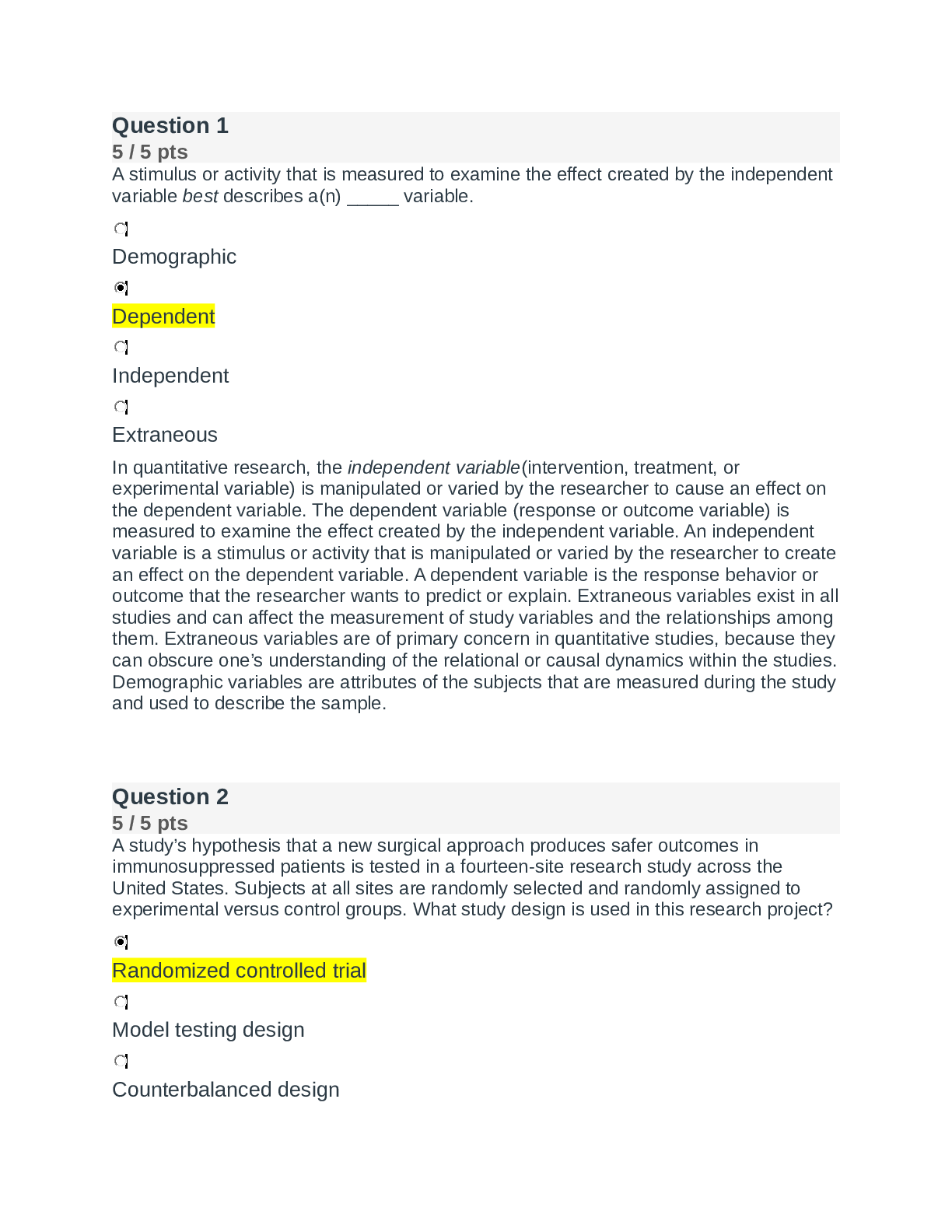
A stimulus or activity that is measured to examine the effect created by the independent
variable best describes a(n) _____ variable.
Demographic
Dependent
Independent
Extraneous
In quantitative research, the indep
...
A stimulus or activity that is measured to examine the effect created by the independent
variable best describes a(n) _____ variable.
Demographic
Dependent
Independent
Extraneous
In quantitative research, the independent variable(intervention, treatment, or
experimental variable) is manipulated or varied by the researcher to cause an effect on
the dependent variable. The dependent variable (response or outcome variable) is
measured to examine the effect created by the independent variable. An independent
variable is a stimulus or activity that is manipulated or varied by the researcher to create
an effect on the dependent variable. A dependent variable is the response behavior or
outcome that the researcher wants to predict or explain. Extraneous variables exist in all
studies and can affect the measurement of study variables and the relationships among
them. Extraneous variables are of primary concern in quantitative studies, because they
can obscure one’s understanding of the relational or causal dynamics within the studies.
Demographic variables are attributes of the subjects that are measured during the study
and used to describe the sample.
Question 2
5 / 5 pts
A study’s hypothesis that a new surgical approach produces safer outcomes in
immunosuppressed patients is tested in a fourteen-site research study across the
United States. Subjects at all sites are randomly selected and randomly assigned to
experimental versus control groups. What study design is used in this research project?
Randomized controlled trial
Model testing design
Counterbalanced design
Quasi-experimental design
A randomized clinical trial (RCT) contains random assignment to experimental
and clinical groups and very often is multi-site. A fully randomized design
contains both random selection and random assignment. Quasi-experimental
designs facilitate the search for knowledge and examination of causality in
situations in which complete control is not possible. Such designs lack a
control group, or lack random assignment to group. The model-testing
design requires that all variables relevant to the model be measured, using
correlational statistics. A large, heterogeneous sample is required. Crossover,
or counterbalancing, is a strategy designed to guard against possible
erroneous conclusions resulting from carryover effects. With
counterbalancing, subjects are randomly assigned to a specific sequencing of
treatment conditions. This approach distributes the carryover effects equally
throughout all the conditions of the study, thus canceling them out. To prevent
an effect related to time, the same amount of time must be allotted to each
treatment, and the crossover point must be related to time, not to the condition
of the subject.
Question 3
5 / 5 pts
The director of a major hospital conducts a study to discover the types of critical
incidents that have occurred in the the hospital over the past 5 years. She compiles a
list of all the critical incidents that occurred during that time. In this study, critical
incidents serve as the___________.
study sample.
extraneous variable.
dependent variable.
In quantitative research, the independent
variable (intervention, treatment, or experimental variable) is
manipulated or varied by the researcher to cause an effect on the
dependent variable. The dependent variable (response or outcome
variable) is measured to examine the effect created by the
independent variable. An independent variable is a stimulus or
activity that is manipulated or varied by the researcher to create an
effect on the dependent variable. A dependent variable is the
response behavior or outcome that the researcher wants to predict
or explain. Extraneous variables exist in all studies and can affect
the measurement of study variables and the relationships among
them. Extraneous variables are of primary concern in quantitative
studies, because they can obscure one’s understanding of the
relational or causal dynamics within the studies. Demographic
variables are attributes of the subjects that are measured during the
study and used to describe the sample.
[Show More]