ECON 6100: Chapter 13 and 14 Direct and Indirect Price Discrimination.
Document Content and Description Below
ECON 6100: Chapter 13 and 14 Direct and Indirect Price Discrimination.1. Which of the following is an example of price discrimination?
a. Seniors paying a lower price for tickets at movie theatres
b. Students p
...
[Show More]
Last updated: 3 years ago
Preview 1 out of 13 pages
Instant download
.png)
Buy this Document to get the Full Access Instantly
Provided by Students Who Aced it
We Verify Document Content to Gurantee Accuracy
Reviews( 0 )
Document information
Connected school, study & course
About the document
Uploaded On
Nov 24, 2020
Number of pages
13
Written in
All

Additional information
This document has been written for:
Uploaded
Nov 24, 2020
Downloads
0
Views
138
Topic Tags
Recommended For You
Get more on EXAM »
$21
106 Pages
Test Bank For Health Informatics An Interprofessional Approach...

$19
196 Pages
Test Bank For Advanced Practice Nursing Essentials for Role De...
$19
350 Pages
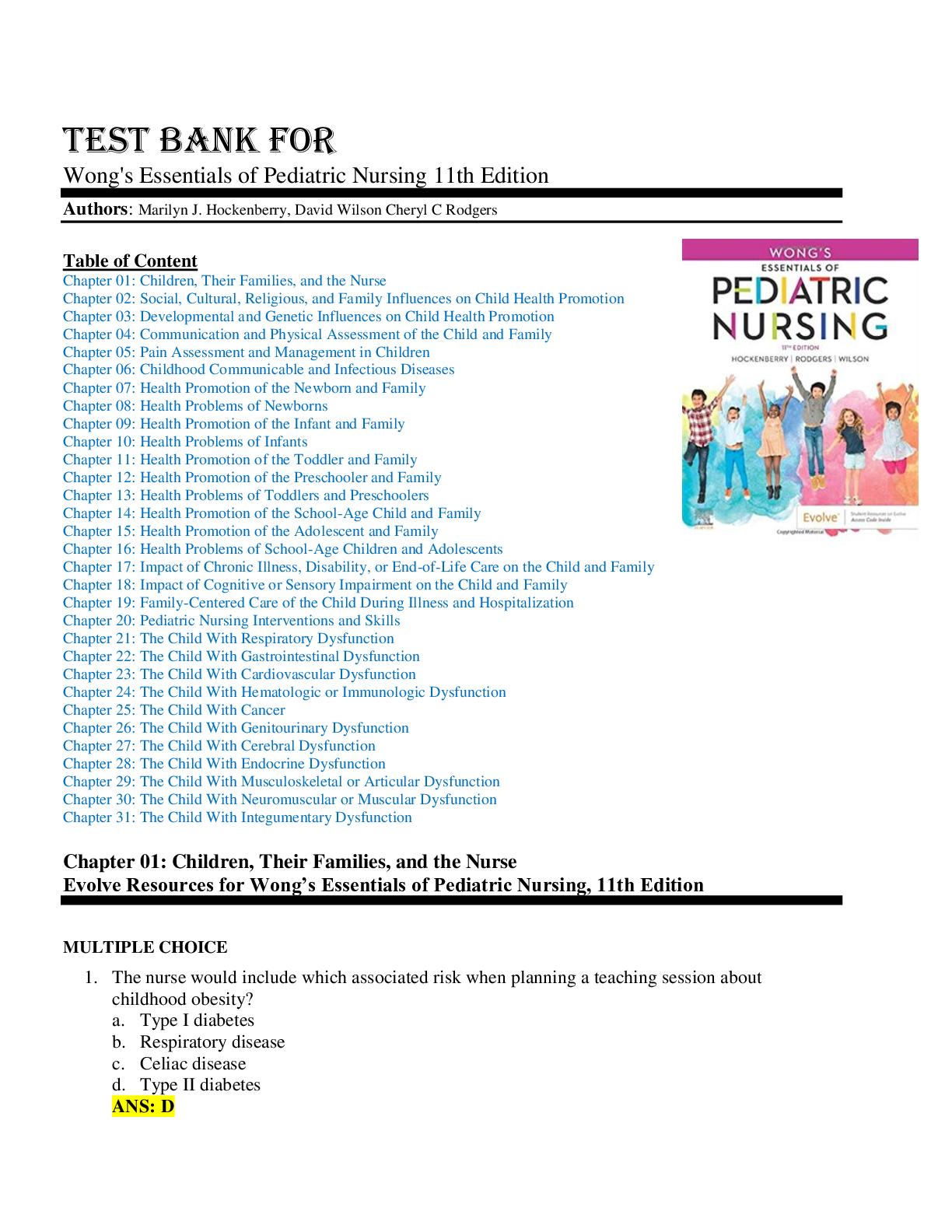
TEST BANK FOR Wong's Essentials of Pediatric Nursing 11th Edit...

$18
275 Pages
Wongs Nursing Care of Infants and Children 10th Edition by Hoc...
$19
275 Pages
TEST BANK for Wongs Nursing Care of Infants and Children 10th...
$8.5
55 Pages
NR 331 Maternal Child Nursing Care- Chapter 13-16 Uncomplicate...
$8.5
18 Pages
NR 331 Maternal Child Nursing Care Chapter 13 Labor and Birth...
$25
52 Pages
PHYSICAL EXAMINATION AND HEALTH ASSESSMENT CHAPTER 1-3 PRACTIC...
$12.5
20 Pages
BIOS 195 Unit 1 Vocal (Chapter 1-3) Questions and Answers (...
$12.5
396 Pages
Solution Manual for Principles of Corporate Finance 14th Edit...
$41
8 Pages
Hartman's Complete Guide for the Medication Aide, 2nd Editio...

$7
4 Pages
PHSC 211 Elements of Earth Science Chapter 13 Quiz – Liberty U...
$19
3 Pages
Hartman's Medication Aide / chapter 13 / score 100% / new vers...
$10
34 Pages
Nursing Care During Newborn Transition, Chapter 18 PrepU, Chap...
$25
19 Pages
Project Stakeholder Management / Score 100% / New Version 2025...
$19
3 Pages
Hartman's Medication Aide / Score 100% / New Version 2025 Upda...
$15
21 Pages
ATI Mental Health Week 1 Chapter 1-32 All Answers correct (100...
$9
10 Pages
A Creative Approach to Music Fundamentals by William Duckworth...
$24
385 Pages
Solutions Manual For Fundamentals Of Corporate Finance 11th Ca...

$25
634 Pages
Financial Management Core Concepts 3rd Edition By Raymond Broo...
More related documents below


.png)

.png)