Pathophysiology Final Rasmussen
College. Questions and answers. Graded
A+
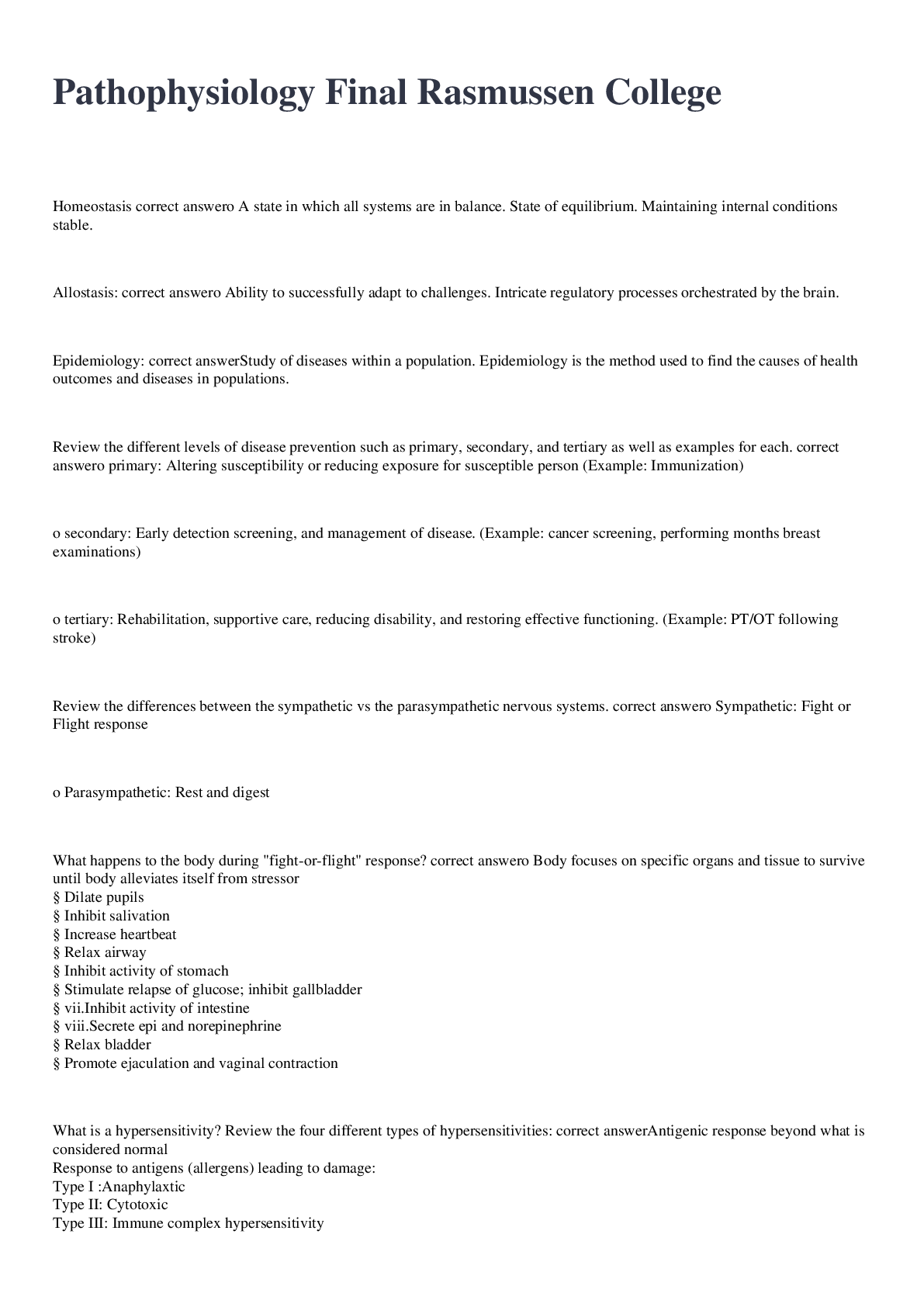
Homeostasis - Ans-o A state in which all systems are in balance. State of equilibrium. Maintaining
internal conditions stable.
Allostasis: -
...
Pathophysiology Final Rasmussen
College. Questions and answers. Graded
A+
Homeostasis - Ans-o A state in which all systems are in balance. State of equilibrium. Maintaining
internal conditions stable.
Allostasis: - Ans-o Ability to successfully adapt to challenges. Intricate regulatory processes orchestrated
by the brain.
Epidemiology: - Ans-Study of diseases within a population. Epidemiology is the method used to find the
causes of health outcomes and diseases in populations.
Review the different levels of disease prevention such as primary, secondary, and tertiary as well as
examples for each. - Ans-o primary: Altering susceptibility or reducing exposure for susceptible person
(Example: Immunization)
o secondary: Early detection screening, and management of disease. (Example: cancer screening,
performing months breast examinations)
o tertiary: Rehabilitation, supportive care, reducing disability, and restoring effective functioning.
(Example: PT/OT following stroke)
Review the differences between the sympathetic vs the parasympathetic nervous systems. - Ans-o
Sympathetic: Fight or Flight response
o Parasympathetic: Rest and digest
What happens to the body during "fight-or-flight" response? - Ans-o Body focuses on specific organs and
tissue to survive until body alleviates itself from stressor
§ Dilate pupils§ Inhibit salivation
§ Increase heartbeat
§ Relax airway
§ Inhibit activity of stomach
§ Stimulate relapse of glucose; inhibit gallbladder
§ vii.Inhibit activity of intestine
§ viii.Secrete epi and norepinephrine
§ Relax bladder
§ Promote ejaculation and vaginal contraction
What is a hypersensitivity? Review the four different types of hypersensitivities: - Ans-Antigenic
response beyond what is considered normal
Response to antigens (allergens) leading to damage:
Type I :Anaphylaxtic
Type II: Cytotoxic
Type III: Immune complex hypersensitivity
Type Iv: Delayed cell mediated
Review the difference between active and passive immunity, know examples for each type. - Ans-o
Active immunity: When the body creates antibodies when coming into contact with a virus. Ex:
Vaccination
o Passive immunity: Passing on antigens. Ex: Breast feeding
Review the difference between active and passive immunity, know examples for each type. - AnsvActive - when the body creates a antibodies once coming into contact with specific virus
Passive - when passed from mother to child through breast milk or blood stream
Review the various factors that can contribute to edema. - Ans-o Increases in capillary hydrostatic
pressure (blood vessel blockage, incompetent venous valves
o Increased capillary permeability (inflammation)
o Congestive heart failure
o High blood volume or HTNo Decrease in plasma proteins (such as albumin)
o Blockage of lymphatic drainage (due to cancer or removal of lymph tissue)
Review the differences between benign and malignant tumors. - Ans--Benign
More closely resembles original tissue type
Grows more slowly
Little vascularity
Rarely necrotic
Does not invade adjacent tissue or spread to distant sites
Malignant
-Malignant cells ignore growth controlling signals
-Proliferate despite lack of growth-initiating signals from the environment
-Escape signals to die and achieve a kind of immortality
-Display a lack of differentiated features(anaplasia) and contribute poorly or not at all to the function of
their tissue
Metastasis - process by which cancer cells escape their tissue of origin and initiate new colonies of
cancer in distant sites
Review the differences between benign and malignant tumors. - Ans-Benign: Localized, generally
curable
-More closely resembles original tissue type
-Grows more slowly
-Little vascularity
-Rarely necrotic
-Often retains original function
-Noninvasive, does not invade adjacent tissue
Malignant: Ex: Anastasia, and metastasis
-Malignant cells ignore growth controlling signals
-Proliferate despite lack of growth-initiating signals from the environment
-Escape signals to die and achieve a kind of immortality-Display a lack of differentiated features(anaplasia) and contribute poorly or not at all to the function of
their tissue
Review signs and symptoms of peptic ulcer disease. - Ans-Caused by Stress, smoking, genetics. No
relation between diet and PUD. Caused by NSAIDS, stress (gluccocorticoids) smoking
Bacterial infection: H. Pylori key role in promoting both gastric and duodenal ulcer formation, thrives in
acidic conditions, slow rate of ulcer healing, high rate of recurrence, clearance of Hy. Pyloric promotes
ulcer healing
Clinical Manifestations: Epigastric burning pain- occurs on an empty stomach. Pain of duodenal ulcer
classically occurs to 2-3 hours after. Meal.
Treatment: Reduce acidity to heal the injured mucosa, antibiotics, proton pumps inhibitors, sucralfate.
Review signs and symptoms of appendicitis. How do we assess for this condition? - Ans-Inflammation of
vermiform appendix. Obstruction by fecalith. Rebound tenderness.Systemic signs of inflammation
Check blood work, "mcburnies point"
Review signs and symptoms of liver disease. Review complications of liver disease such as ascites,
hepatic encephalopathy and esophageal varices. How are esophageal varices managed/treated? - AnsSigns and symptoms of Liver disease
o Jaundice of the eyes
- Staining issues by bilirubin
- Results from impaired bilirubin metabolism
o Bloody stool
What role does albumin play in the blood? What happens to albumin production with liver failure? -
Ans-Helps keep fluid in blood vessels and helps transport materials like vitamins, enzymes, and
hormones. Liver failure decreases albumin productionWhat are the function of the kidneys? How do we assess for renal disorders? - Ans-Function of kidneys
o Regulate water and electrolyte levels
o Produces erythropoietin
Assessment:
o CVA tenderness
o Urine test
1. Dipstick and microscopic urinalysis
o Ultra sound
What is cystic kidney disease? What causes this condition? - Ans-a. Cystic kidney disease - Genetically
transmitted renal disorder, resulting in fluid filled; may be localized to one area or affect both kidneys
b. Causes - autosomal recessive forms, autosomal dominant types (most common, symptoms appears
later in life)
[Show More]


.png)







_Already Graded A.png)