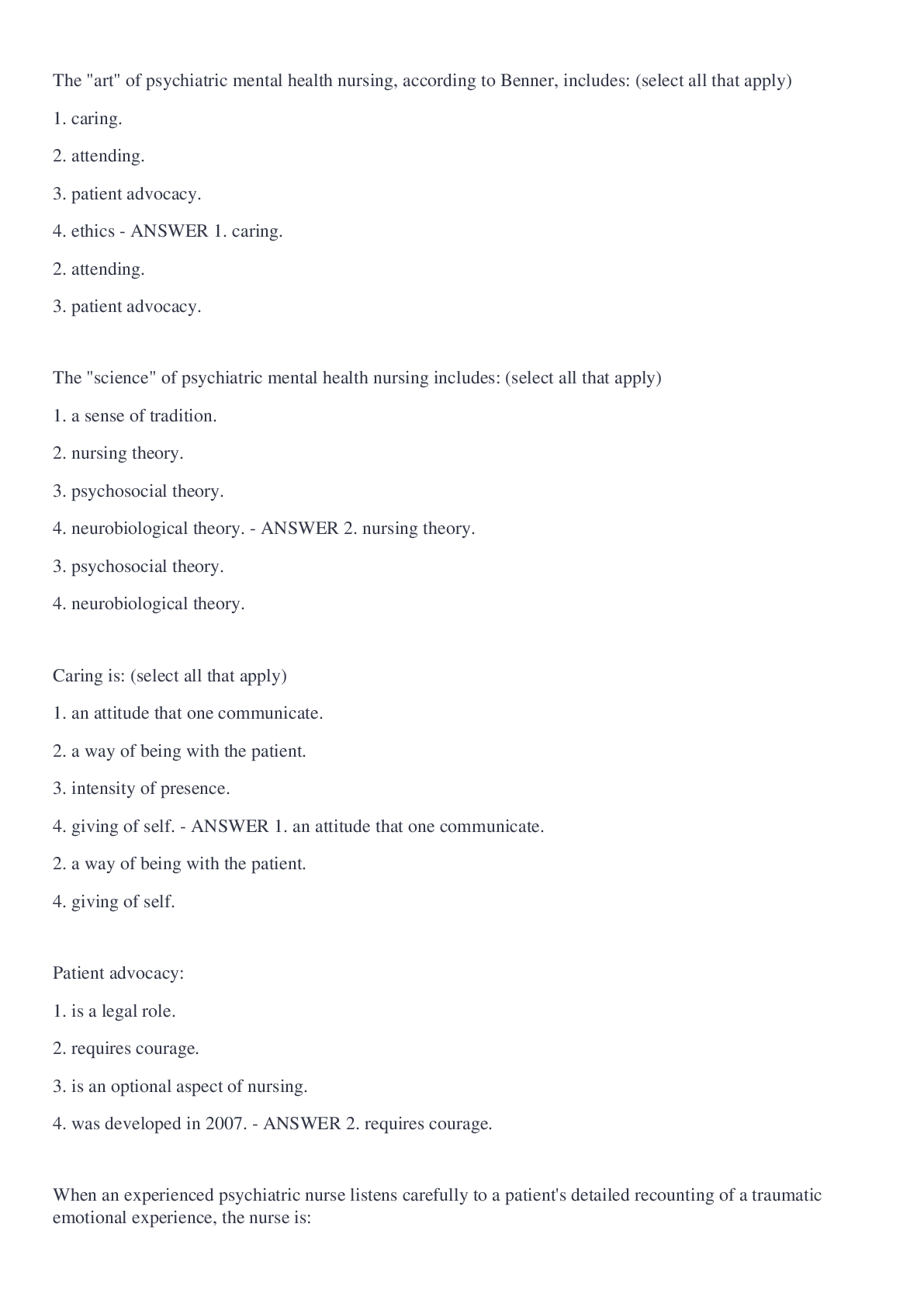
The "art" of psychiatric mental health nursing, according to Benner, includes: (select all that apply)
1. caring.
2. attending.
3. patient advocacy.
4. ethics
1. caring.
2. attending.
3. patient advocacy.
The
...
The "art" of psychiatric mental health nursing, according to Benner, includes: (select all that apply)
1. caring.
2. attending.
3. patient advocacy.
4. ethics
1. caring.
2. attending.
3. patient advocacy.
The "science" of psychiatric mental health nursing includes: (select all that apply)
1. a sense of tradition.
2. nursing theory.
3. psychosocial theory.
4. neurobiological theory.
2. nursing theory.
3. psychosocial theory.
4. neurobiological theory.
00:25
01:17
Caring is: (select all that apply)
1. an attitude that one communicate.
2. a way of being with the patient.
3. intensity of presence.
4. giving of self.
1. an attitude that one communicate.
2. a way of being with the patient.
4. giving of self.
Patient advocacy:
1. is a legal role.
2. requires courage.
3. is an optional aspect of nursing.
4. was developed in 2007.
2. requires courage.
When an experienced psychiatric nurse listens carefully to a patient's detailed recounting of a traumatic emotional experience, the nurse is:
1. acting as a patient advocate.
2. using an attending behavior.
3. interpreting "best evidence."
4. using a systematic approach.
2. using an attending behavior.
Which statement about mental illness is true?
1. Mental illness is a matter of individual nonconformity with societal norms.
2. Mental illness is present when individual irrational and illogical behavior occurs.
3. Mental illness is defined in relation to the culture, time in history, political system, and group in which it occurs.
4. Mental illness is evaluated solely by considering individual control over behavior and appraisal of reality.
3. Mental illness is defined in relation to the culture, time in history, political system, and group in which it occurs.
Axis V of the DSM multiaxial system:
1. refers to medical illness.
2. reports psychosocial and environmental problems.
3. indicates a need for substance abuse treatment.
4. describes a person's level of functioning.
4. describes a person's level of functioning.
Why is it important for a nurse to be aware of the multiple factors that can influence an individual's mental health?
1. Rates of illness differ among various groups.
2. The DSM cannot be used without information on multiple factors.
3. The nurse diagnoses and treats human responses, which are influenced by many factors.
4. The nurse must contribute these data for epidemiological research.
3. The nurse diagnoses and treats human responses, which are influenced by many factors.
Factors that affect a person's mental health are: (select all that apply)
1. support systems.
2. developmental events.
3. socioeconomic status.
4. cultural beliefs.
1. support systems.
2. developmental events.
4. cultural beliefs.
Which statement best describes a major difference between a DSM-IV-TR diagnosis and a nursing diagnosis?
1. There is no functional difference between the two. Both serve to identify a human deviance.
2. The DSM-IV-TR diagnosis disregards culture, whereas the nursing diagnosis takes culture into account.
3. The DSM-IV-TR is associated with present distress or disability, whereas a nursing diagnosis considers past and present responses to actual mental health problems.
4. The DSM-IV-TR diagnosis distinguishes a person's specific psychiatric disorder, whereas a nursing diagnosis offers a framework for identifying interventions for phenomena a patient is experiencing.
4. The DSM-IV-TR diagnosis distinguishes a person's specific psychiatric disorder, whereas a nursing diagnosis offers a framework for identifying interventions for phenomena a patient is experiencing.
Which of the following contributions to modern psychiatric nursing practice was made by Freud?
1. The theory of personality structure and levels of awareness.
2. The concept of a "self-actualized personality."
3. The thesis that culture and societal exert significant influence on personality.
4. Provision of a developmental model that includes the entire life span.
1. The theory of personality structure and levels of awareness.
The theory of interpersonal relationships developed by Hildegard Peplau is based on the foundation provided by which of the following early theorists?
1. Freud
2. Piaget
3. Sullivan
4. Maslow
3. Sullivan
[Show More]