acids - ANSWER sour taste, changes litmus from blue to red, pH < 7
bases - ANSWER bitter or caustic taste, slippery/soapy feeling, changes litmus from red to blue, pH > 7
Gay-Lussac's Law - ANSWER the pressure of a
...
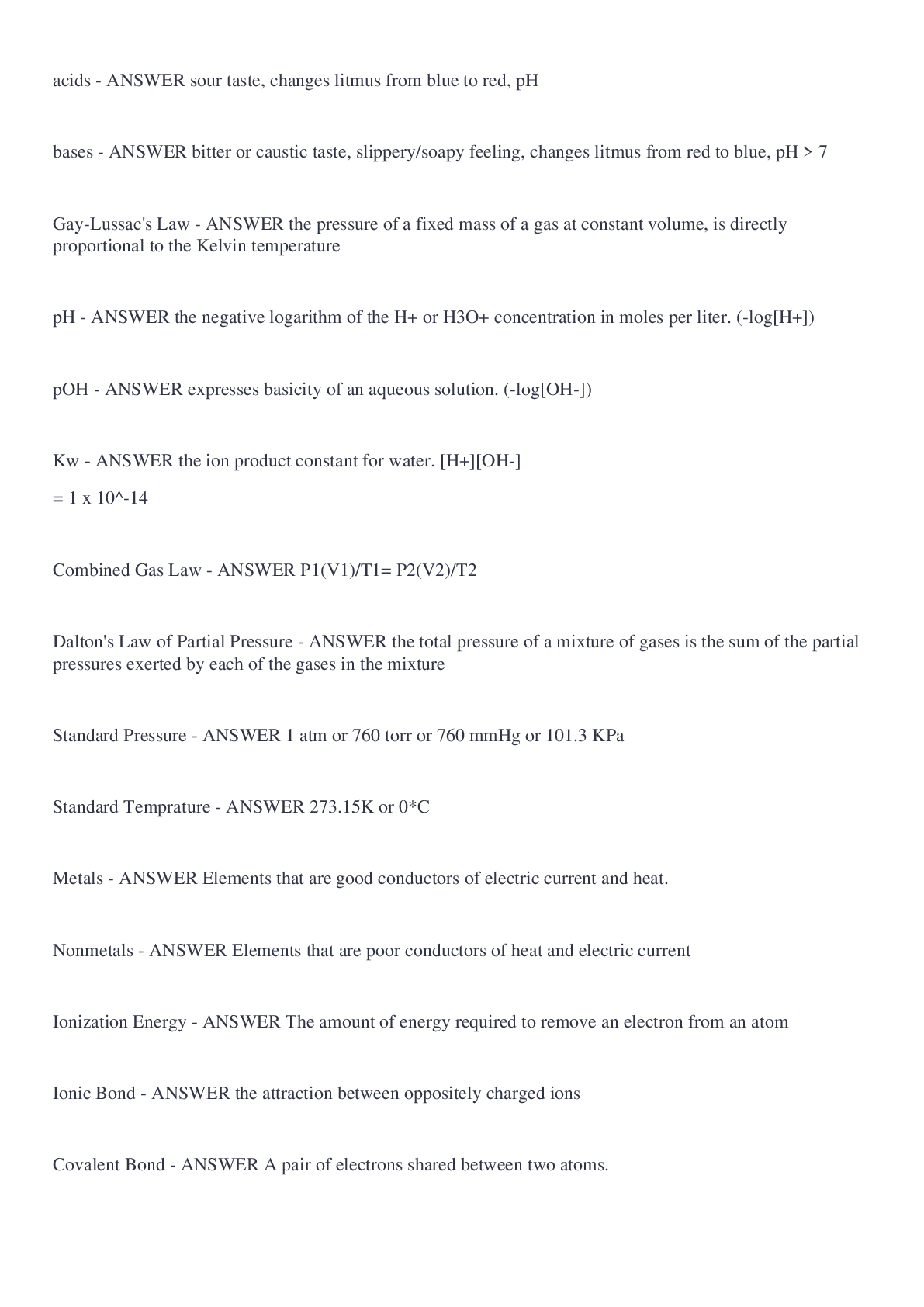
acids - ANSWER sour taste, changes litmus from blue to red, pH < 7
bases - ANSWER bitter or caustic taste, slippery/soapy feeling, changes litmus from red to blue, pH > 7
Gay-Lussac's Law - ANSWER the pressure of a fixed mass of a gas at constant volume, is directly proportional to the Kelvin temperature
pH - ANSWER the negative logarithm of the H+ or H3O+ concentration in moles per liter. (-log[H+])
pOH - ANSWER expresses basicity of an aqueous solution. (-log[OH-])
Kw - ANSWER the ion product constant for water. [H+][OH-]
= 1 x 10^-14
Combined Gas Law - ANSWER P1(V1)/T1= P2(V2)/T2
Dalton's Law of Partial Pressure - ANSWER the total pressure of a mixture of gases is the sum of the partial pressures exerted by each of the gases in the mixture
Standard Pressure - ANSWER 1 atm or 760 torr or 760 mmHg or 101.3 KPa
Standard Temprature - ANSWER 273.15K or 0*C
Metals - ANSWER Elements that are good conductors of electric current and heat.
Nonmetals - ANSWER Elements that are poor conductors of heat and electric current
Ionization Energy - ANSWER The amount of energy required to remove an electron from an atom
Ionic Bond - ANSWER the attraction between oppositely charged ions
Covalent Bond - ANSWER A pair of electrons shared between two atoms.
Polar Covalent - ANSWER Unequal sharing of electrons formation.
Nonpolar Covalent - ANSWER Electronegativities are the same, electrons are shared equally.
Electronegativity - ANSWER Attractive force that an atom of an element has for shared electrons in a molecule or polyatomic ion.
Dipole - ANSWER Molecule that is electrically asymmetrical, causing it to be oppositely charged at two points.
Percent yield - ANSWER Ratio of actual yield to theoretical yield multiplied by 100 (actual/theoretical x 100)
limiting reactant - ANSWER In chemical processes the quantities of reactants used are such that one reactant is in excess ??
electromagnetic radiation - ANSWER This is a way energy travels through space
Wavelength - ANSWER Distance between consecutive peaks and troughs
Speed - ANSWER Tells how fast a wave moves through space
Frequency - ANSWER Tells how many waves pass a particular point per second
Photons - ANSWER A beam of light behaves like a stream of tiny packets of energy
Quanta - ANSWER Energy is never emitted in a continuous stream but only in small discrete packets
Ground state - ANSWER The lowest energy level
Schrödinger model - ANSWER Forms our modern understanding of atomic structure
Orbital - ANSWER A region in space around the nucleus where there is a high probability of finding an electron
Sublevel - ANSWER What principle energy levels are divided in tk
Period - ANSWER each horizontal row of the periodic table
Group - ANSWER Elements that behave in a similar manner
Boyle's Law - ANSWER At a constant temperature the volume if a fixed mass of gas is inversely proportional to the pressure, P1V1= P2V2
Charles Law - ANSWER at a constant pressure the volume of a fixed mass of any gas is directly proportional to the absolute temperature, V1/T1= V2/T2
[Show More]