Carbon Dioxide - ANSWER CO2
Acidity (pH) - ANSWER Acidity is the measure of Hydrogen ions in a substance.
ocean acidification - ANSWER decreasing pH of ocean waters due to absorption of excess atmospheric CO2 from
...
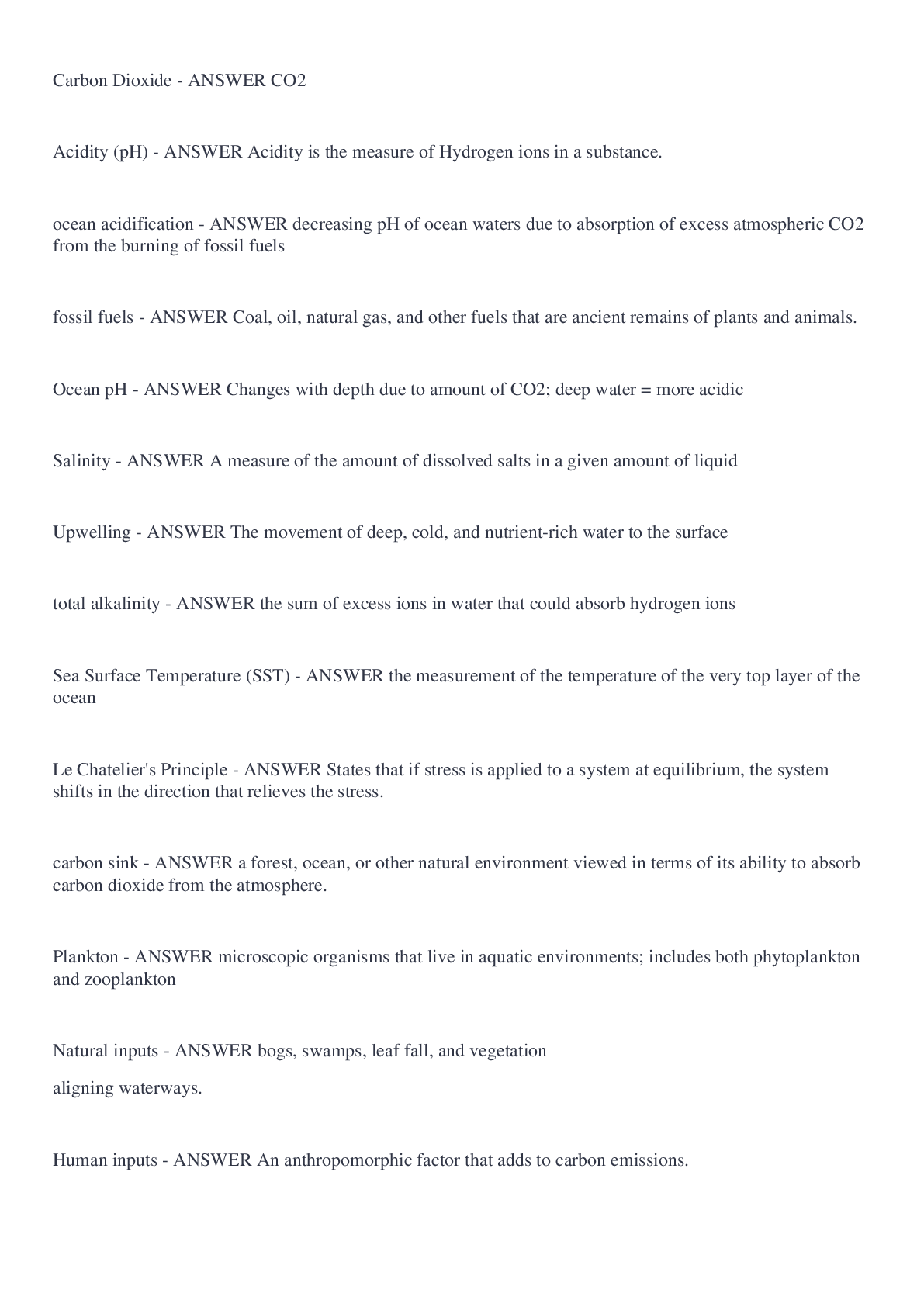
Carbon Dioxide - ANSWER CO2
Acidity (pH) - ANSWER Acidity is the measure of Hydrogen ions in a substance.
ocean acidification - ANSWER decreasing pH of ocean waters due to absorption of excess atmospheric CO2 from the burning of fossil fuels
fossil fuels - ANSWER Coal, oil, natural gas, and other fuels that are ancient remains of plants and animals.
Ocean pH - ANSWER Changes with depth due to amount of CO2; deep water = more acidic
Salinity - ANSWER A measure of the amount of dissolved salts in a given amount of liquid
Upwelling - ANSWER The movement of deep, cold, and nutrient-rich water to the surface
total alkalinity - ANSWER the sum of excess ions in water that could absorb hydrogen ions
Sea Surface Temperature (SST) - ANSWER the measurement of the temperature of the very top layer of the ocean
Le Chatelier's Principle - ANSWER States that if stress is applied to a system at equilibrium, the system shifts in the direction that relieves the stress.
carbon sink - ANSWER a forest, ocean, or other natural environment viewed in terms of its ability to absorb carbon dioxide from the atmosphere.
Plankton - ANSWER microscopic organisms that live in aquatic environments; includes both phytoplankton and zooplankton
Natural inputs - ANSWER bogs, swamps, leaf fall, and vegetation
aligning waterways.
Human inputs - ANSWER An anthropomorphic factor that adds to carbon emissions.
deep ocean carbon cycling - ANSWER the deep ocean holds most of the ocean's carbon
Deep ocean currents - ANSWER masses of ocean water below the ocean surface that flow steadily in a particular direction
Temperature and CO2 concentration - ANSWER the solubility of carbon dioxide decreases with increasing temperature. An increase in ocean temperature decreases the amount of CO2 that can be stored in the sea water.
carbonate compensation depth - ANSWER Depth of the ocean below which calcium carbonate, shells and skeletons dissolve and do not accumulate; 4500m(14,800 ft.)
Solubility - ANSWER The ability to dissolve in another substance
dissolution - ANSWER the breaking up or dissolving of something into parts; disintegration
biogenic carbon - ANSWER Carbon of biological origin
Carbon Pump - ANSWER Any part of the carbon cycle that moves carbon to the next part of the cycle
ocean currents - ANSWER Global patterns created from the movement of the oceans; such as the Gulf Stream
Biosphere - ANSWER part of Earth in which life exists including land, water, and air or atmosphere
Coriolis effect - ANSWER the curving of moving objects from a straight path due to the Earth's rotation
Thermocline - ANSWER a layer in a large body of water, such as a lake, that sharply separates regions differing in temperature, so that the temperature gradient across the layer is abrupt.
ocean deoxygenation - ANSWER the expansion of low-oxygen zones in the ocean as a consequence of rising temperatures
El Nino-Southern Oscillation (ENSO) - ANSWER The periodic changes in winds and ocean currents, cause cooler and wetter conditions in the southeastern United States and unusually dry weather in southern Africa and Southeast Asia.
La Nina Effect - ANSWER a change in the eastern Pacific Ocean in which the surface water temperature becomes unusually cool
Calcification - ANSWER the use of carbon from dissolved carbon dioxide to build the shells of marine organisms.
Red Tides - ANSWER A red, orange, or brown coloration of water caused by a bloom, or population explosion of algae; many cause serious environmental harm and threaten the health of humans and animals
coral bleaching - ANSWER Occurs when a coral becomes stressed and expels most of its colorful algae, leaving an underlying ghostly white skeleton of calcium carbonate
greenhouse gases - ANSWER Gases in Earth's atmosphere that trap heat near the surface
Global Warming Potential (GWP) - ANSWER the relative ability of one molecule of a greenhouse gas to contribute to warming
Carbon Dioxide (CO2) - ANSWER gas (waste) released by body cells, transported via veins to the heart, and then to the lungs for exhalation
Methane (CH4) - ANSWER Methane contributes to the greenhouse effect. Since 1750, methane has increased about 150% due to use of fossil fuels, coal mining, landfills, grazers, etc.
-stays in atmosphere 12 years
Nitrous Oxide (N2O) - ANSWER a greenhouse gas that comes from using nitrogen fertilizers and from burning fossil fuels
CFCs - ANSWER Chlorinated Fluorocarbons are chemicals that break down the ozone layer
Radiation - ANSWER Energy that is radiated or transmitted in the form of rays or waves or particles.
Ozone - ANSWER A form of oxygen that has three oxygen atoms in each molecule instead of the usual two.
absorption of radiation - ANSWER the process that occurs when energy is absorbed: the energy of a photon is converted to electrical, chemical, vibrational, or heat energy, and the photon disappears
incoming radiation - ANSWER All the radiant energy that reaches Earth
outgoing radiation - ANSWER the thermal radiation emitted by Earth's surface and atmosphere that is not absorbed by greenhouse gases of the atmosphere
climate change - ANSWER a change in global or regional climate patterns
glacier ice - ANSWER yearly snows that slowly become compacted, building up a record of climate that extends across time.
ice cores - ANSWER method for studying climate change by drilling cores in ice caps and glaciers that have build up over thousands of years
Paleoclimate - ANSWER climate of the geological past
Sea level change - ANSWER the rise or fall in the average level of the sea over long periods of time
rising sea levels - ANSWER the increased height of the level of seas and oceans from ocean warming and glacial ice melting.
Varves - ANSWER Layers found in sedimentary rocks that show seasonal variations
Tree rings - ANSWER tree growth is influenced by climate conditions, patterns in tree rings and isotopic composition of materin within each ring reflect variations in past climate
Ocean Temperature - ANSWER this factor is affected by the amount of solar energy an area receives and by the movement of water
Little Ice Age - ANSWER A century-long period of cool climate that began in the 1590s. Its ill effects on agriculture in northern Europe were notable.
Climate Cycles - ANSWER Follows large scale reorganization of oceanic and atmospheric circulation (following tectonic plate movement and the growth of mountains.) Accompany large changes in global average temperature.
Solar variation - ANSWER Changes in the amount of energy emitted by the Sun; high levels of radiation can create polar aura
El Nino - ANSWER A warm ocean current flows along the equator from the dateline and south off the coast of Ecuador at Christmas time. Bring cooler air and lots of rain to southern North America.
La Nina - ANSWER A climate event in the eastern Pacific Ocean in which surface waters are colder than normal. Brings warmer drier air to the south.
Milankovitch cycles - ANSWER Changes in the shape earth's orbit and tilt that cause glacial periods and interglacial periods.
eccentric orbit - ANSWER a parameter that determines the amount by which its orbit around another body deviates from a perfect circle
Earth's tilt - ANSWER 23.5 degrees
Earth's procession - ANSWER Changes in Earth's Precession means the north pole won't always point to Polaris the "North Start"
Sunspots - ANSWER areas of gas on the sun's surface that are cooler than the gases around them
Carbon-14 dating - ANSWER Process of estimating the age of once-living material by measuring the amount of radioactive isotope of carbon present in the material.
SO2 - ANSWER sulfur dioxide, Released during volcanic eruptions. Cools the earth.
Halocarbons - ANSWER human-made compounds made from hydrocarbons with added chlorine, bromine, or fluorine
Climate Zones - ANSWER a large area of Earth with a particular pattern of weather
Sun's Core - ANSWER The inner most layer of the Sun where nuclear fusion, converting Hydrogen into Helium, takes place.
Convective Zone (Convection Zone) - ANSWER a region of the sun where gases circulate in convection currents, bringing the sun's energy to the surface
carbon dioxide - ANSWER a colorless, odorless gas produced by burning carbon and organic compounds and by respiration. It is naturally present in air (about 0.03 percent) and is absorbed by plants in photosynthesis.
Nitrogen - ANSWER Most abundant gas in the atmosphere
water vapor - ANSWER water in the form of a gas
Biodiversity - ANSWER the variety of life in the world or in a particular habitat or ecosystem.
flood basalt - ANSWER huge amounts of lava that erupt from fissures
Erosion - ANSWER the process of eroding or being eroded by wind, water, or other natural agents. Can contribute to global cooling through the removal of CO2 from Earth's surface systems.
Continental distribution - ANSWER Plate tectonics changes the size and location of continents over millions of years.
ocean circulation patterns - ANSWER Created by the wind and the spin of the Earth. Currents move warm and cool water which influences the climate of the lands near the ocean.
climate zones - ANSWER a large area of Earth with a particular pattern of weather
latitude and altitude - ANSWER determine patterns of wet and dry zones. temps decrease twoard the poles or as altitude increases.
Koppen Climate System - ANSWER Most widely used system to classify the world's climates.
Long Term Changes in Sunlight - ANSWER Like other stars the sun changes over its lifetime.
Photosphere - ANSWER the visible surface of the sun
The core of the Sun - ANSWER The sun's energy comes from the fusion of hydrogen into helium.
Radiative zone of the sun - ANSWER Layer of the Sun immediately surrounding the core where energy moves atom to atom as electromagnetic waves.
The convective zone of the Sun is - ANSWER outside the radiative zone and inside the photosphere
Composition of the Atmosphere - ANSWER 78% nitrogen, 21% oxygen, 1% other
Carbon Dioxide and Biodiversity - ANSWER Carbon dioxide has decreased as the number of living things has increased.
Volcanic Activity and CO2 - ANSWER Extended periods of volcanic activity add large amounts of CO2 into the atmosphere
Erosion and CO2 - ANSWER Chemical weathering of rocks removes CO2 from the atmosphere. It becomes part of shells and then sedimentary limestone.
solar radiation - ANSWER energy from the sun
CO2 - ANSWER carbon dioxide
Evaporation - ANSWER The change of a substance from a liquid to a gas
Precipitation - ANSWER Any form of water that falls from clouds and reaches Earth's surface.
Weathering - ANSWER The breaking down of rocks and other materials on the Earth's surface.
biochemical cycle - ANSWER process in which elements, chemical compounds and other forms of matter are passed from one organism to another
water reservoir - ANSWER in the atmosphere, ocean, or underground, where water is stored for some period of time
residence time - ANSWER Period of time that groundwater remains in an aquifer.
carbon cycle - ANSWER The organic circulation of carbon from the atmosphere into organisms and back again
Carbon Reservoir - ANSWER A natural feature, such as a rock, a pinch of soil, or an organism, that stores carbon-containing molecules and exchanges them with other carbon reservoirs.
rock cycle - ANSWER the series of processes that change one type of rock into another type of rock
metamorphic rock - ANSWER rock that has been changed by heat and pressure
Feedback - ANSWER when an affected system responds to and applies a change back on another system
reinforcing feedback - ANSWER change to a system that promotes further change in the same direction the system is moving
counterbalancing feedback - ANSWER feedback that resists or reduces a change. Also called negative feedback.
[Show More]










.png)