Nursing responds to the health care needs of society, which are influenced by economic, social and cultural
factors
American Nursing Association (ANA) definition:
o Nursing is “the protection, promotion, and optimiz
...
Nursing responds to the health care needs of society, which are influenced by economic, social and cultural
factors
American Nursing Association (ANA) definition:
o Nursing is “the protection, promotion, and optimization of health and abilities; prevention of
illness and injury; alleviation of suffering through the diagnosis and treatment of human
response; and advocacy in the care of individuals, families, communities, and populations”
International Council of Nurses (ICN) definition:
o Nursing “encompasses autonomous and collaborative care of individuals of all ages, families,
groups and communities, sick or well, and in all settings
o Nursing includes the promotion of health; prevention of illness; and the care of ill, disables
and dying people
**Advocacy, promotion of a safe environment, research, participation in shaping health policy and in patient
and health systems management, and the education are key nursing roles
Trends in nursing: evidence base practice, nursing shortage etc.
Changes in society, such as health care reform, changing demographic patterns, increases in the medically
underserved population, and increased consumerism, affect the practice of nursing
Evidence-Based Practice integrates best current evidence with clinical expertise and patient/family
preferences and values for delivery of optimal health care.
o * Demonstrate knowledge of basic scientific methods
o * Appreciate strengths and weaknesses of scientific bases for practice
o * Appreciate the importance of regularly reading relevant journals.
Quality and Safety Education for Nurses (QSEN) addresses the challenge to prepare nurses with the
competencies needed to continuously improve the quality of care in their work environments
o The QSEN initiative encompasses the competencies of patient-centered care, teamwork and
collaboration, evidence-based practice, quality improvement, safety, and informatics.
Impact of Emerging Technologies
o Computerized physician/provider order entry (CPOE) is a critical patient safety initiative
Genomics: study of all the genes in a person and interaction of these genes with one another and
with the person's environment.
o allows health care providers to determine how genomic changes contribute to patient
conditions and influence treatment decisions
For example, when a family member has colon cancer before the age of 50, it is
likely that other family members are at risk for developing this cancer
Public Perception of Nursing
Impact of Nursing on Politics and Health Policy
o Professional nursing organizations and state nursing boards employ lobbyists to urge state
legislatures and the US Congress to pass legislation that will improve the quality of health
care
Roles of the Nurse
Advocate: protect your patient’s human and legal rights and provide assistance in asserting these
rights if the need arises
o Example: You provide additional information to help a patient decide whether to accept a
treatment, or you find an interpreter to help family members communicate their concerns
Care manager
o Coordinates the activities of members of the nursing staff in delivering nursing care and has
personnel, policy and budgetary responsibility for a specific nursing unit or agency
Deliverer of services
o Delivery of direct services such as health education, flu shots, counseling and health
promotion
o Visible and direct delivery = foundation of public image of nursing
Educator
o Explain concepts and facts about health, describe the reason for routine care activities,
demonstrate procedures such as self-care activities, reinforce learning or patient behavior,
and evaluate the patient’s progress in learning
Healer
o incorporate the specific insight into a care plan that helps that person develop his or her own
capacity to heal
Researcher
o conducts evidence-based practice and research to improve nursing care and further define
and expand the scope of nursing practice; preferred educational requirement is a doctoral
degree, with at least a master’s degree in nursing
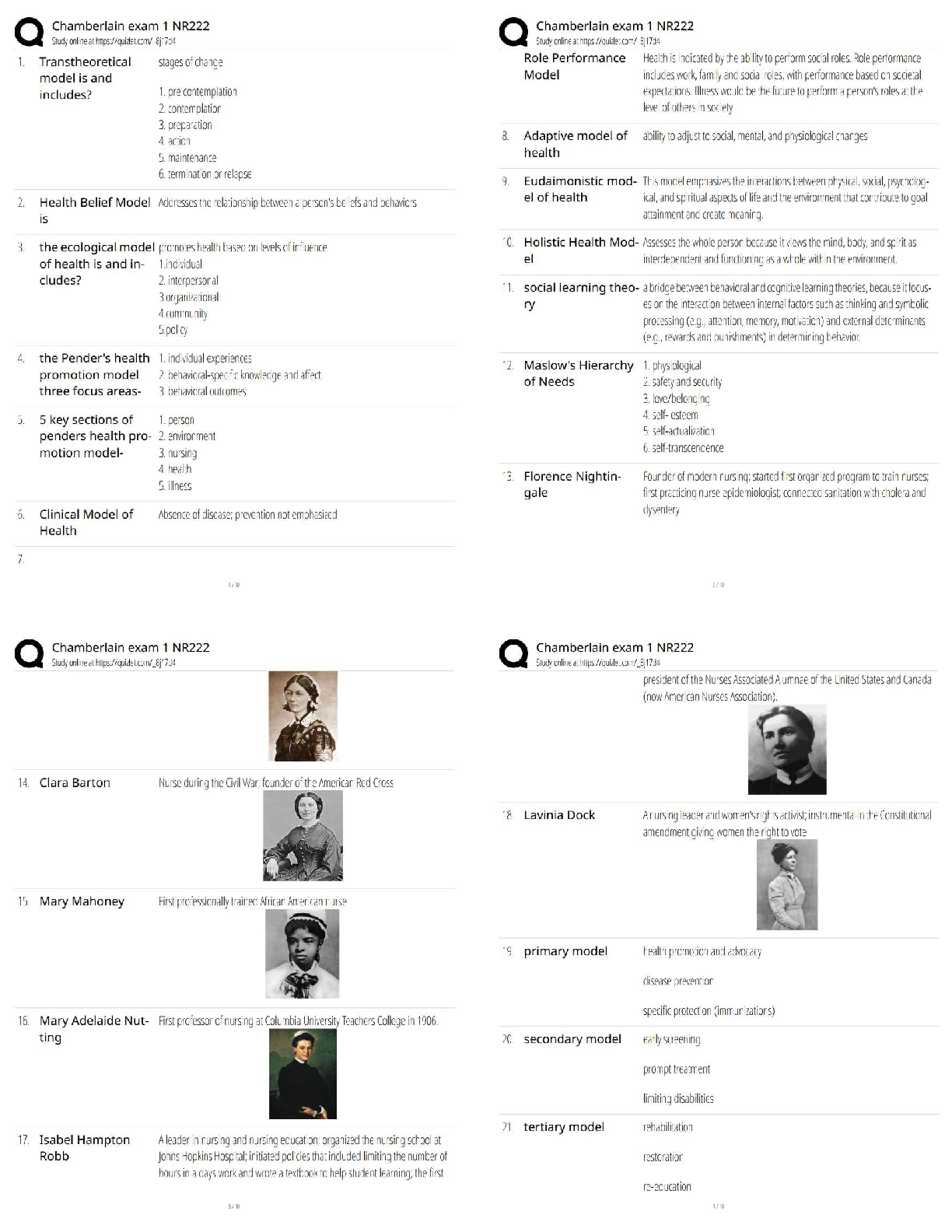
Role of Florence Nightingale. Her impact on Nursing
Founder of modern nursing
First practicing nurse epidemiologist
Established sanitary nursing care units (connected sanitation with cholera and dysentery)
Began professional education of nursing
Known as “Lady with the Lamp”
Significance of:
Clara Barton
o Founder of American Red Cross
o Cared for soldiers on the battlefields, cleansing their wounds, meeting their basic needs and
comforting them at the end of life
Lillian Wald and Mary Brewster
o Opened the Henry Street Settlement, focusing on the health needs of the poor
Mary Adelaide Nutting
o Become the first nursing professor at Columbia Teachers College in 1901; was instrumental
in moving nursing education into universities
Mary Mahoney
o First professionally educated African American nurse
o Concerned with relationships between cultures and races; she brought forth an awareness of
cultural diversity and respect for an individual regardless of background race, color or
religion
Define Health Promotion and Disease Prevention:
Health promotion and disease prevention programs focus on keeping people healthy.
Health promotion activities include routine exercise and good nutrition that help patients maintain
or enhance their present levels of health and reduce their risk of developing certain diseases. They
motivate people to act positively to reach more stable levels of health.
o Defined by the World Health Organization, health promotion:
“enables people to increase control over their own health. It covers a wide range of social
and environmental interventions that are designed to benefit and protect individual people’s
health and quality of life by addressing and preventing the root causes of ill health, not just
focusing on treatment and cure.”
Health education involves the use of teaching-learning strategies; learners maintain voluntary control
over the decision to make changes in their actions; and focuses on behavior changes that have been
found to improve health status
Disease prevention differs from health promotion because it focuses on specific efforts aimed at
reducing the development and severity of chronic disease
o Disease prevention includes health education programs or activities directed toward
protecting patients from threats or potential threats to health and minimizing risk factors
o Immunization programs and blood pressure screenings
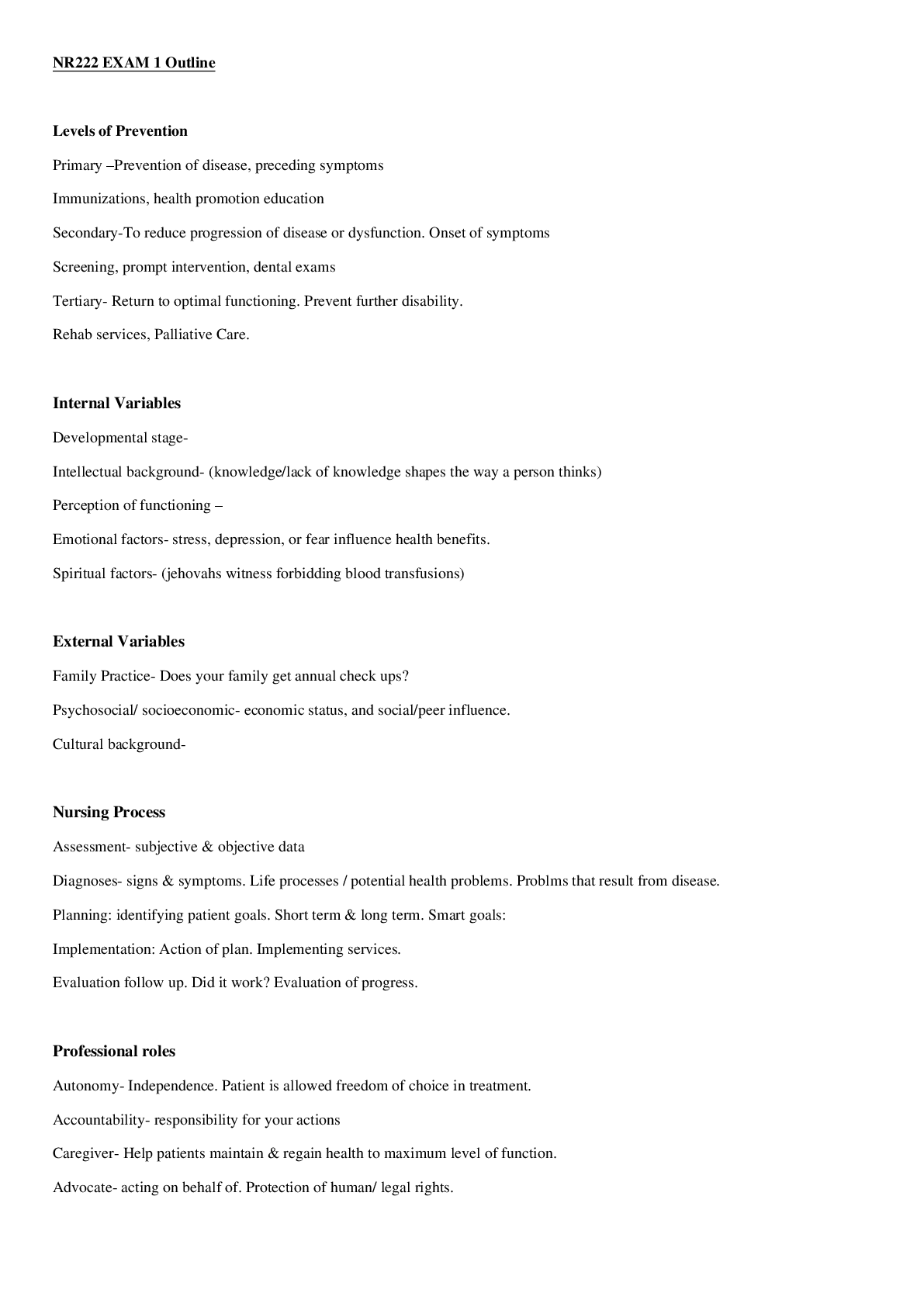
Health is the dynamic and holistic process in a person's perceived state of being
The Word Health Organization (WHO) defines health as “a state of complete physical, mental and
social well-being, not merely the absence of disease or infirmity”
Internal variables, such as a person’s developmental stage and spirituality, and external factors,
such as family roles and SDOH, influence a person’s health, health beliefs, and health practices
Wellness: education that teaches people how to care for themselves in a healthy way and includes
topics such as physical awareness, stress management, and self-responsibility. Helps people achieve
new understanding and control of their lives.
Disease is the malfunctioning or maladaptation of biological or psychological processes
Illness is a state in which a person’s physical, emotional, intellectual, social, developmental, or
spiritual functioning is diminished or impaired
o subjective symptoms (like a headache)
o illness is like pain PATIENT PERCEPTION IS KEY
o Acute illness is a sudden illness from which a person is expected to recover
Example: Appendicitis & Strep Throat
o Chronic illness persists longer than 6 months, is irreversible, and affects functioning in one or
more systems; examples: asthma and COPD
[Show More]