NCLE exam prep
optic zone - - - the central portion of a contact lens which contains the refractive power and
generally corresponds to the central corneal cap
posterior apecal radius - - - this term is generally used
...
NCLE exam prep
optic zone - - - the central portion of a contact lens which contains the refractive power and
generally corresponds to the central corneal cap
posterior apecal radius - - - this term is generally used in reference to spin-cast soft lenses. the
curvature of the posterior surface of the lens changes with the refractive power. the radius of
curvature is measured at the apex of the posterior surface.
steeper base curve - - - occurs when the posterior radius of curvature is decreased (i.e. 8.4 to 8.1
mm)
flatter base curve - - - occurs when the posterior radius of curvature is increased (i.e.8.1 to 8.4
mm)
bicurve lens - - - a contact lens which contains two curves: one base curve and one secondary
curve. it is usually small 7.5 to 8.8 mm on diameter, relatively steep and made with narrow
peripheral curves about 0.2 mm. lenses are usually intrapalpebral lenses, designed to fit within
the palpebral fissure limits.
tricurve lens - - - a contact lens which contains three curves: a base curve, an outer peripheral
posterior curve (PPC), and an intermediate posterior curve (IPC). lenses are generally larger, 9.5
mm or greater.
multicurve lens - - - contains a base curve and three or more peripheral curves. usually a larger
lens.
junctional zone - - - the junction of two curves
blending - - - the smoothing of a junctional zone by removing the sharp line between the zones
lens diameter or chord diameter - - - the width of a lens or the measurement from one edge of the
lens to the opposite edge
curve widths - - - the width of the CPC, PPC, or IPC
central thickness - - - separation between the anterior and posterior surface at the geometric
center of the lens. minus lenses are thinner, plus lenses are thicker
ballasted lens - - - lens with a heavier base which becomes oriented inferiorly or downward when
the lens is worn
prism ballated lens - - - a ballasted lens which utilizes a prism wedge designed to weight the lens
truncated lens - - - a lens which has been cut off, usually 0.5-1.5 mm along its lower edge, to
form a horizontal base. double ________ along the top and bottom portion of the lens is
sometimes done to help improve stabilization
back surface power - - - effective power of a lens when measured from the back surface
wetting angle - - - the angle that the edge of a bead of water makes with the surface of the plastic,
the smaller the angle the greater the wetting ability
toric lenses or toroid lenses - - - lenses with different radii of curvature in each meridian which
are used to correct astigmatism
principal meridians - - - the meridians of shortest and longest radii which differ by 90 degrees
front surface toric lens - - - a lens in which the anterior surface has two different radii and the
posterior surface is spherical
back surface toric lens - - - a lens in which the posterior surface has two different radii and the
anterior surface is spherical
bitoric lens - - - a lens in which both the posterior and anterior surfaces contain two different
radii
lenticular bowl - - - a lens design generally used in higher plus power which consists of a central
optic zone and a surrounding non-optic peripheral or "carrier" portion
spin-cast soft lens - - - a mentioned of manufacturing soft contact lenses whereby a liquid
material is revolved in a mold at a controlled speed and temperature which produces the desired
curvature, design, and power
acuity - - - clearness; visual ________ is measured by the smallest object that can be seen at a
certain distance
adnexa oculi - - - accessory structures of the eye, such as the lacrimal appatatus and the eyelids
albinism - - - heredetary loss of pigment in the eye, skin, hair, usually associated with lowered
visual acuity, nystagmus and light sensitivity
amblyopia - - - loss of vision without any apparent disease of the eye
ametropia - - - a refractive error in which the eye, when in a state of rest, does not focus the
image of an object upon the retina; includes hyperopia, myopia, and astigmatism. see also
refractive error
aniridia - - - congenital absence of the iris
aniseikonia - - - a condition in which the ocular image of an object as seen by one eye differs so
much in size or shape from that seen by the other eye that the two images cannot be focused into
a single impression
aniscoria - - - inequality of the pupils in diameter
anomaly - - - departure from the normal
anophthalmia - - - absence of a true eyeball
anterior chamber - - - space in front of the eye, bounded in front by the cornea and behind by the
iris; filled with aqueous humor
antibody - - - a specific substance produced by the body in the presence of an antigen
antigen - - - any substance that acts against the action of histamine
antihistamine - - - a substance that acts against the action of histamine
aphakia - - - absence of the crystalline lens of the eye
aqueous humor - - - clear, watery fluid that fills the anterior and posterior chambers within the
front part of the eye
arcus senilus - - - grayish white ring in the periphery of the cornea
asthenopia - - - eye fatigue caused by tiring of the internal and/or external muscles
astigmatism - - - a refractive error that prevents the light rays from coming to a single focus on
the retina because of different degrees of refraction in the various meridians of the eye
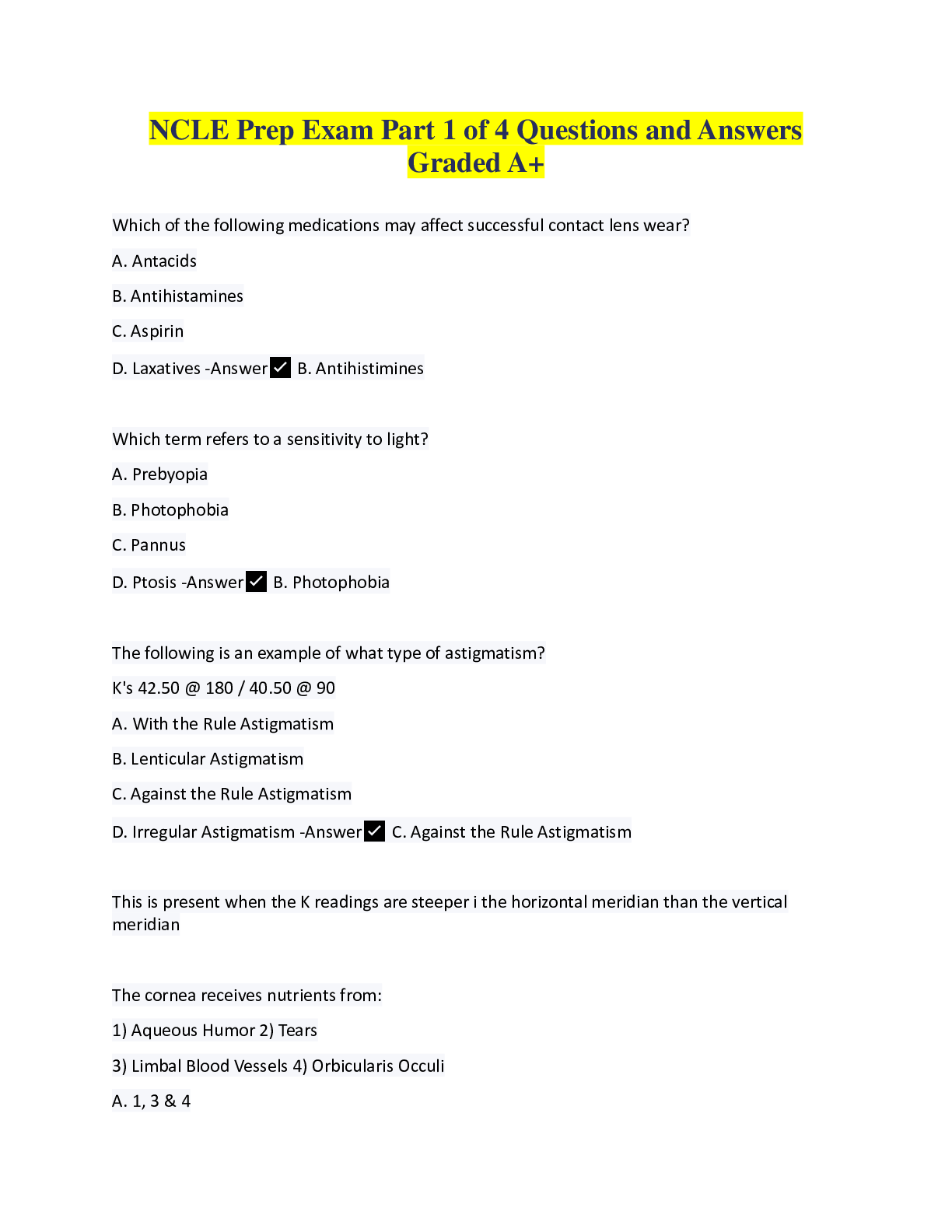
against the rule astigmatism - - - condition in which the steepest corneal meridian is in the
horizontal plane. an example of keratometer readings for a patient exhibiting_______________
would be: K's 45.00 @ 180/042.00 @ 90
lenticular astigmatism - - - astigmatism that is found in the crystallilne lens
oblique astigmatism - - - regular astigmatism in which the principal meridians are other than 90
and 180
residual astigmatism - - - astigmatism remaining after the corneal astigmatism has been
neutralized
with the rule astigmatism - - - condition in which the steepest corneal meridian is in the vertical
plane. as example of keratometer readings for a patient exhibiting with the rule astigmatism
would be: k's 42.00 @ 180/45.00 @90
atrophy - - - wasting or decreasing of a tissue due to faulty nutrition or loss of nerve supply
hydrogel - - - soft contact lenses are also kno
[Show More]


.png)
.png)
.png)
.png)
.png)
.png)
.png)
.png)


.png)
.png)