Sensory Function Case Study with
Rationale – COMPLETE SOLUTION
During the initial interview, the nurse inspects the external anatomy of the eye. The eye is a sensory
organ of vision, and it is well protected by a bony
...
Sensory Function Case Study with
Rationale – COMPLETE SOLUTION
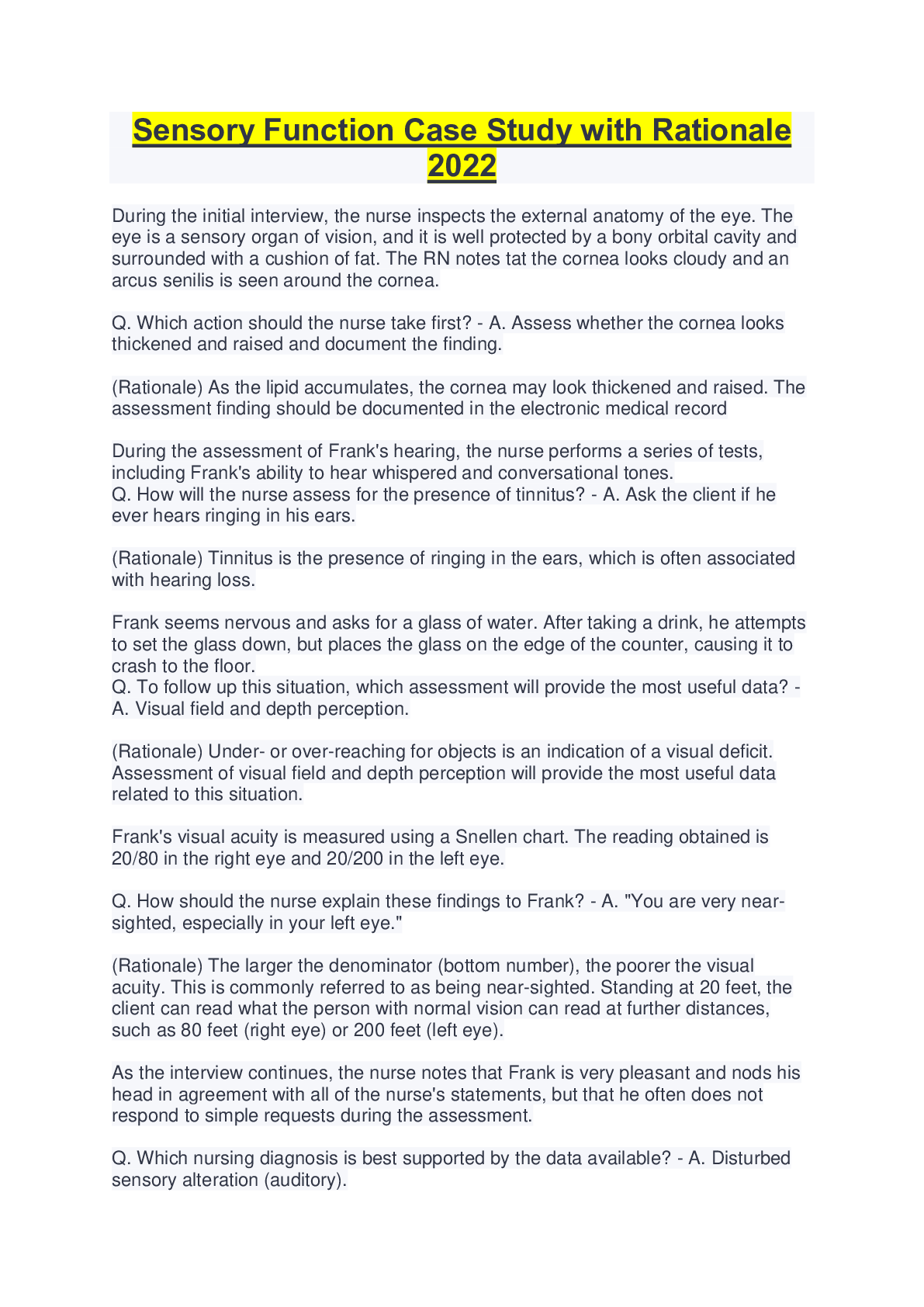
During the initial interview, the nurse inspects the external anatomy of the eye. The eye is a sensory
organ of vision, and it is well protected by a bony orbital cavity and surrounded with a cushion of fat.
The RN notes tat the cornea looks cloudy and an arcus senilis is seen around the cornea.
Q. Which action should the nurse take first? - ✔✔A. Assess whether the cornea looks thickened and
raised and document the finding.
(Rationale) As the lipid accumulates, the cornea may look thickened and raised. The assessment finding
should be documented in the electronic medical record
During the assessment of Frank's hearing, the nurse performs a series of tests, including Frank's ability
to hear whispered and conversational tones.
Q. How will the nurse assess for the presence of tinnitus? - ✔✔A. Ask the client if he ever hears ringing
in his ears.
(Rationale) Tinnitus is the presence of ringing in the ears, which is often associated with hearing loss.
Frank seems nervous and asks for a glass of water. After taking a drink, he attempts to set the glass
down, but places the glass on the edge of the counter, causing it to crash to the floor.
Q. To follow up this situation, which assessment will provide the most useful data? - ✔✔A. Visual field
and depth perception.
(Rationale) Under- or over-reaching for objects is an indication of a visual deficit. Assessment of visual
field and depth perception will provide the most useful data related to this situation.
Frank's visual acuity is measured using a Snellen chart. The reading obtained is 20/80 in the right eye
and 20/200 in the left eye.Q. How should the nurse explain these findings to Frank? - ✔✔A. "You are very near-sighted, especially
in your left eye."
(Rationale) The larger the denominator (bottom number), the poorer the visual acuity. This is commonly
referred to as being near-sighted. Standing at 20 feet, the client can read what the person with normal
vision can read at further distances, such as 80 feet (right eye) or 200 feet (left eye).
As the interview continues, the nurse notes that Frank is very pleasant and nods his head in agreement
with all of the nurse's statements, but that he often does not respond to simple requests during the
assessment.
Q. Which nursing diagnosis is best supported by the data available? - ✔✔A. Disturbed sensory alteration
(auditory).
(Rationale) Clients with impaired hearing often smile and nod in agreement with the person conversing
even though they are unable to clearly hear the conversation. Appearing to be inattentive, speaking
loudly, and difficulty following directions are other indications of a disturbance in auditory sensory
function.
Q. In identifying this problem, the nurse clustered the assessment data and compared it with which
information? - ✔✔A. Defining characteristics of the problem.
(Rationale) The assessment data is compared with the defining characteristics of the problem to ensure
that the correct problem is identified.
[Show More]