PMBOK 6TH EDITION GLOSSARY
A set of conditions that is required to be met before deliverables are accepted. - ✔✔Acceptance
Criteria.
Products, results, or capabilities produced by a project and validated by the projec
...
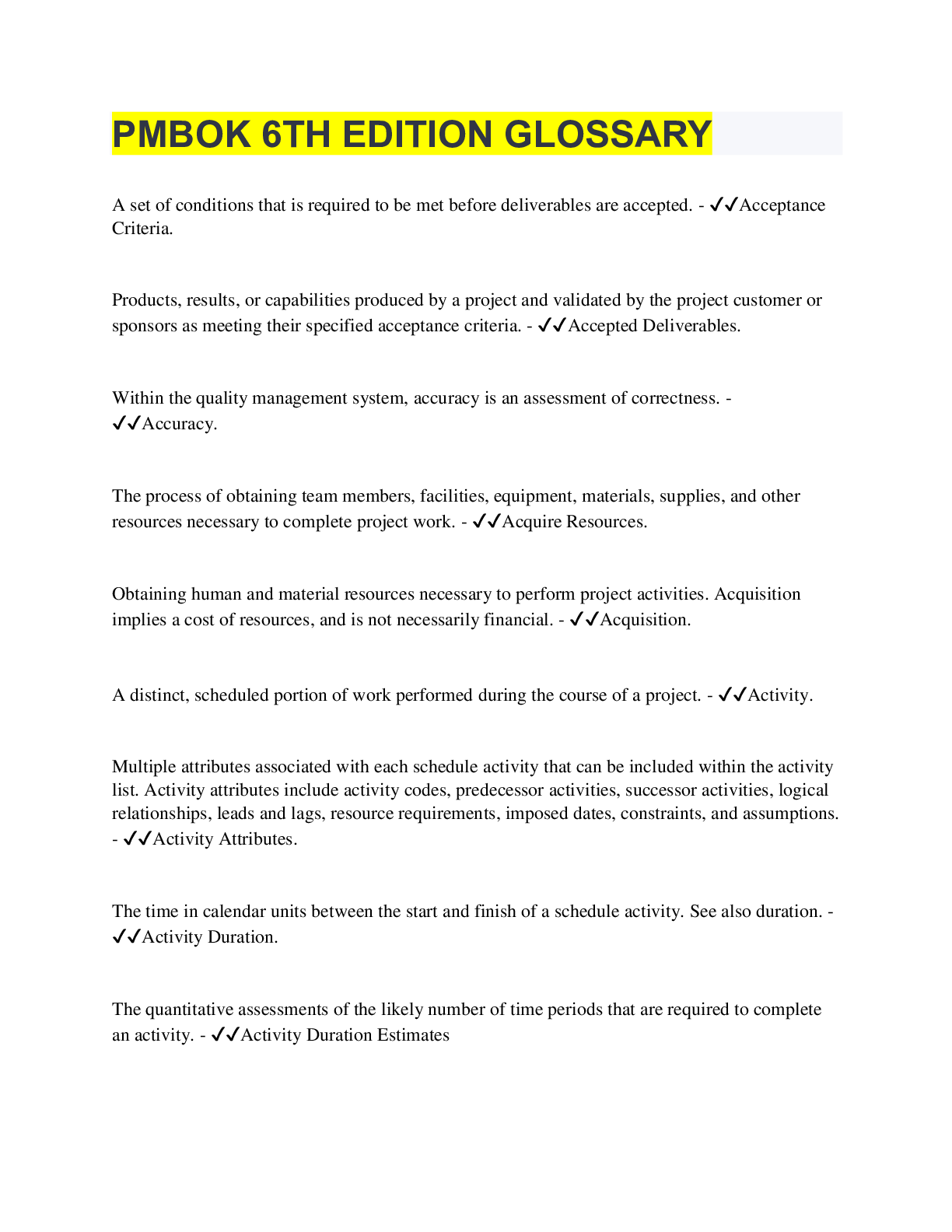
PMBOK 6TH EDITION GLOSSARY
A set of conditions that is required to be met before deliverables are accepted. - ✔✔Acceptance
Criteria.
Products, results, or capabilities produced by a project and validated by the project customer or
sponsors as meeting their specified acceptance criteria. - ✔✔Accepted Deliverables.
Within the quality management system, accuracy is an assessment of correctness. -
✔✔Accuracy.
The process of obtaining team members, facilities, equipment, materials, supplies, and other
resources necessary to complete project work. - ✔✔Acquire Resources.
Obtaining human and material resources necessary to perform project activities. Acquisition
implies a cost of resources, and is not necessarily financial. - ✔✔Acquisition.
A distinct, scheduled portion of work performed during the course of a project. - ✔✔Activity.
Multiple attributes associated with each schedule activity that can be included within the activity
list. Activity attributes include activity codes, predecessor activities, successor activities, logical
relationships, leads and lags, resource requirements, imposed dates, constraints, and assumptions.
- ✔✔Activity Attributes.
The time in calendar units between the start and finish of a schedule activity. See also duration. -
✔✔Activity Duration.
The quantitative assessments of the likely number of time periods that are required to complete
an activity. - ✔✔Activity Duration Estimates
A documented tabulation of schedule activities that shows the activity description, activity
identifier, and a sufficiently detailed scope of work description so project team members
understand what work is to be performed. - ✔✔Activity List.
See precedence diagramming method (PDM). - ✔✔Activity-on-Node (AON).
The realized cost incurred for the work performed on an activity during a specific time period. -
✔✔Actual Cost (AC).
The time in calendar units between the actual start date of the schedule activity and either the
data date of the project schedule if the schedule activity is in progress or the actual finish date if
the schedule activity is complete. - ✔✔Actual Duration.
A project life cycle that is iterative or incremental. - ✔✔Adaptive Life Cycle.
A technique that allows large numbers of ideas to be classified into groups for review and
analysis. - ✔✔Affinity Diagrams.
Any document or communication that defines the initial intentions of a project. This can take the
form of a contract, memorandum of understanding (MOU), letters of agreement, verbal
agreements, email, etc. - ✔✔Agreements.
A technique used to evaluate identified options in order to select the options or approaches to use
to execute and perform the work of the project. - ✔✔Alternative Analysis.
A technique for estimating the duration or cost of an activity or a project using historical data
from a similar activity or project. - ✔✔Analogous Estimating.
Various techniques used to evaluate, analyze, or forecast potential outcomes based on possible
variations of project or environmental variables and their relationships with other variables. -
✔✔Analytical Techniques.
A factor in the planning process that is considered to be true, real, or certain, without proof or
demonstration. - ✔✔Assumption.
A project document used to record all assumptions and constraints throughout the project life
cycle. - ✔✔Assumption Log.
Method of measuring quality that consists of noting the presence (or absence) of some
characteristic (attribute) in each of the units under consideration. - ✔✔Attribute Sampling.
The right to apply project resources, expend funds, make decisions, or give approvals. -
✔✔Authority.
A critical path method technique for calculating the late start and late finish dates by working
backward through the schedule model from the project end date. - ✔✔Backward Pass.
A graphic display of schedule-related information. In the typical bar chart, schedule activities or
work breakdown structure components are listed down the left side of the chart, dates are shown
across the top, and activity durations are shown as date-placed horizontal bars. See also Gantt
chart. - ✔✔Bar Chart.
The approved version of a work product that can be changed only through formal change control
procedures and is used as a basis for comparison to actual results. - ✔✔Baseline.
Supporting documentation outlining the details used in establishing project estimates such as
assumptions, constraints, level of detail, ranges, and confidence levels. - ✔✔Basis of Estimates.
Benchmarking is the comparison of actual or planned products, processes, and practices to those
of comparable organizations to identify best practices, generate ideas for improvement, and
provide a basis for measuring performance. - ✔✔Benchmarking.
The documented explanation defining the processes for creating, maximizing, and sustaining the
benefits provided by a project or program. - ✔✔Benefits Management Plan.
All documents used to solicit information, quotations, or proposals from prospective sellers. -
✔✔Bid Documents.
The meetings with prospective sellers prior to the preparation of a bid or proposal to ensure all
prospective vendors have a clear and common understanding of the procurement. Also known as
contractor conferences, vendor conferences, or pre-bid conferences. - ✔✔Bidder Conference.
A method of estimating project duration or cost by aggregating the estimates of the lower-level
components of the work breakdown structure (WBS). - ✔✔Bottom-Up Estimating.
The approved estimate for the project or any work breakdown structure component or any
schedule activity. - ✔✔Budget.
The sum of all budgets established for the work to be performed. - ✔✔Budget at Completion
(BAC).
See reserve. - ✔✔Buffer.
A documented economic feasibility study used to establish validity of the benefits of a selected
component lacking sufficient definition and that is used as a basis for the authorization of further
project management activities. - ✔✔Business Case.
The net quantifiable benefit derived from a business endeavor. The benefit may be tangible,
intangible, or both. - ✔✔Business Value.
A decomposition technique that helps trace an undesirable effect back to its root cause. -
✔✔Cause and Effect Diagram.
A modification to any formally controlled deliverable, project management plan component, or
project document. - ✔✔Change.
A process whereby modifications to documents, deliverables, or baselines associated with the
project are identified, documented, approved, or rejected. - ✔✔Change Control.
A formally chartered group responsible for reviewing, evaluating, approving, delaying, or
rejecting changes to the project, and for recording and communicating such decisions. -
✔✔Change Control Board (CCB).
A set of procedures that describes how modifications to the project deliverables and
documentation are managed and controlled. - ✔✔Change Control System.
Manual or automated tools to assist with change and/or configuration management. At a
minimum, the tools should support the activities of the CCB. - ✔✔Change Control Tools.
A comprehensive list of changes submitted during the project and their current status. -
✔✔Change Log.
A component of the project management plan that establishes the change control board,
documents the extent of its authority, and describes how the change control system will be
implemented. - ✔✔Change Management Plan.
A formal proposal to modify a document, deliverable, or baseline. - ✔✔Change Request.
See project charter. - ✔✔Charter.
A technique for systematically reviewing materials using a list for accuracy and completeness. -
✔✔Checklist Analysis.
A tally sheet that can be used as a checklist when gathering data. - ✔✔Checksheets.
A request, demand, or assertion of rights by
[Show More]