Question 1 1 out of 1 points When endothelial cells are injured, what
alteration contributes to atherosclerosis? Selected Answer: Cells are unable to
make the normal amount of vasodilating cytokines.
• Question 2 1 ou
...
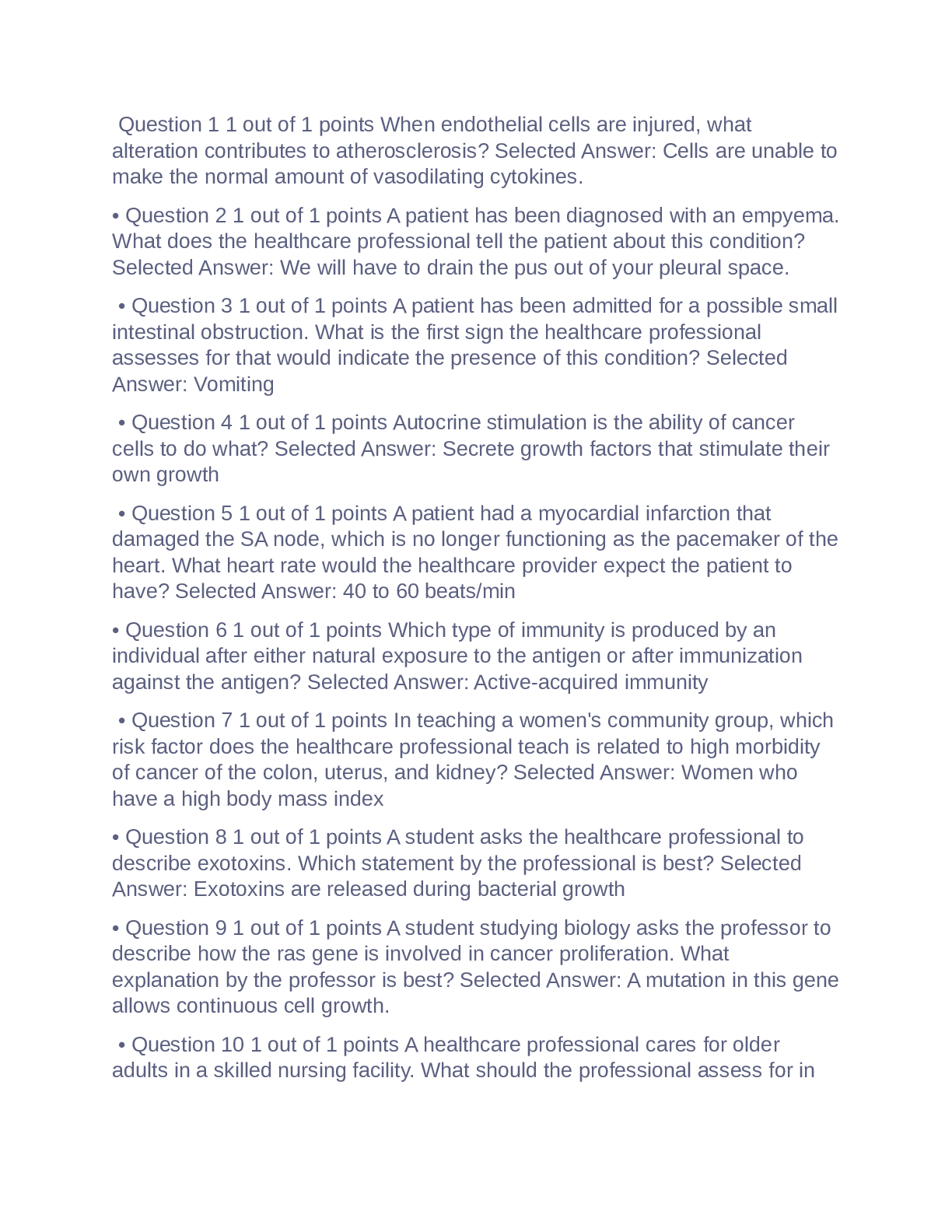
Question 1 1 out of 1 points When endothelial cells are injured, what
alteration contributes to atherosclerosis? Selected Answer: Cells are unable to
make the normal amount of vasodilating cytokines.
• Question 2 1 out of 1 points A patient has been diagnosed with an empyema.
What does the healthcare professional tell the patient about this condition?
Selected Answer: We will have to drain the pus out of your pleural space.
• Question 3 1 out of 1 points A patient has been admitted for a possible small
intestinal obstruction. What is the first sign the healthcare professional
assesses for that would indicate the presence of this condition? Selected
Answer: Vomiting
• Question 4 1 out of 1 points Autocrine stimulation is the ability of cancer
cells to do what? Selected Answer: Secrete growth factors that stimulate their
own growth
• Question 5 1 out of 1 points A patient had a myocardial infarction that
damaged the SA node, which is no longer functioning as the pacemaker of the
heart. What heart rate would the healthcare provider expect the patient to
have? Selected Answer: 40 to 60 beats/min
• Question 6 1 out of 1 points Which type of immunity is produced by an
individual after either natural exposure to the antigen or after immunization
against the antigen? Selected Answer: Active-acquired immunity
• Question 7 1 out of 1 points In teaching a women's community group, which
risk factor does the healthcare professional teach is related to high morbidity
of cancer of the colon, uterus, and kidney? Selected Answer: Women who
have a high body mass index
• Question 8 1 out of 1 points A student asks the healthcare professional to
describe exotoxins. Which statement by the professional is best? Selected
Answer: Exotoxins are released during bacterial growth
• Question 9 1 out of 1 points A student studying biology asks the professor to
describe how the ras gene is involved in cancer proliferation. What
explanation by the professor is best? Selected Answer: A mutation in this gene
allows continuous cell growth.
[Show More]