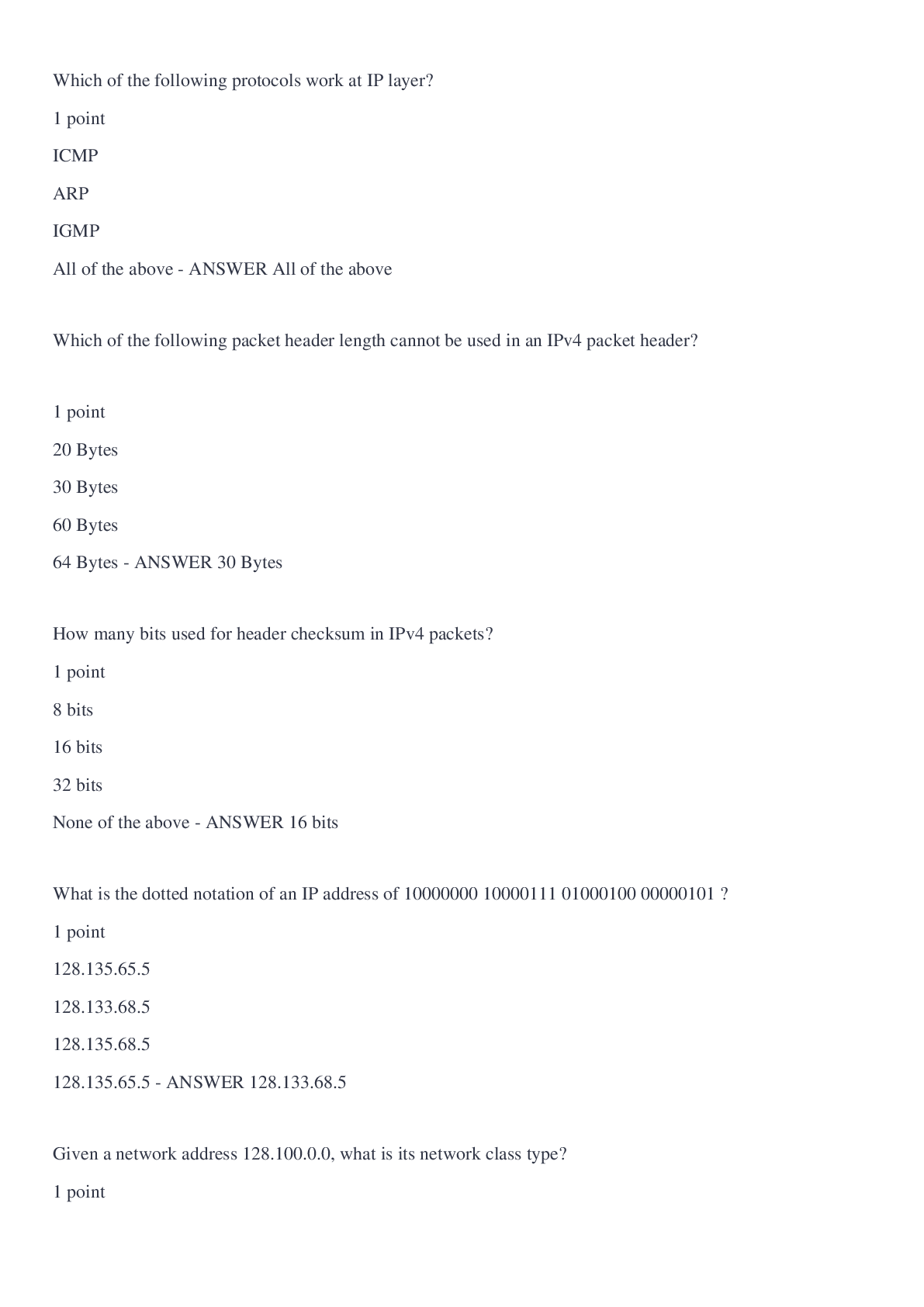
Which of the following protocols work at IP layer?
1 point
ICMP
ARP
IGMP
All of the above - ANSWER All of the above
Which of the following packet header length cannot be used in an IPv4 packet header?
1 point
...
Which of the following protocols work at IP layer?
1 point
ICMP
ARP
IGMP
All of the above - ANSWER All of the above
Which of the following packet header length cannot be used in an IPv4 packet header?
1 point
20 Bytes
30 Bytes
60 Bytes
64 Bytes - ANSWER 30 Bytes
How many bits used for header checksum in IPv4 packets?
1 point
8 bits
16 bits
32 bits
None of the above - ANSWER 16 bits
What is the dotted notation of an IP address of 10000000 10000111 01000100 00000101 ?
1 point
128.135.65.5
128.133.68.5
128.135.68.5
128.135.65.5 - ANSWER 128.133.68.5
Given a network address 128.100.0.0, what is its network class type?
1 point
Class A
Class B
Class C
None of the above - ANSWER Class B
Which of the following is provided at the IP layer
1 point
Connectionless
Best effort delivery service
Both of the above
None of the above - ANSWER
You need to subnet a network that has 5 subnets, each with at least 16 hosts. Which will be your closest choice
1 point
255.255.255.224
255.255.255.192
255.255.255.240
255.255.255.248 - ANSWER 255.255.255.224
What is the subnetwork number of a host with an IP address of 172.16.66.0/21
1 point
172.16.48.0
172.16.64.0
172.16.0.0
172.16.36.0 - ANSWER 172.16.64.0
What is the first valid host on the subnetwork that the node 172.30.190.198/24 belongs to?
1 point
172.30.190.0
172.30.190.1
172.30.190.100
None of the above - ANSWER 172.30.190.1
Based on 1.1.1.0/24, the IP address would be:
1 point
Class A
Class B
Class C
Class D - ANSWER Class A
1.
Question 1
Which of following is the range of IPv4 addresses spanned by Class C?
1 point
1.0.0.0 to 127.255.255.255
128.0.0.0 to 191.255.255.255
192.0.0.0 to 223.255.255.255
None of the above - ANSWER 192.0.0.0 to 223.255.255.255
2.
Question 2
If a subnet needs to accommodate up to 500 hosts. How many bits for HostID would be sufficient?
1 point
5
9
8
7 - ANSWER 9
3.
Question 3
Consider a Class B network, where the subnet ID takes 9 bits. What will be the subnet mask?
1 point
11111111 11111111 11111110 00000000
11111111 11111111 11111111 10000000
11111111 11111111 00000000 00000000
None of the above - ANSWER 11111111 11111111 11111111 10000000
4.
Question 4
Given a subnet mask 255.255.255.240, how many hosts the subnet can support?
1 point
14
30
62
None of the above - ANSWER 14
5.
Question 5
A host in an organization has an IP address 150.32.64.34 and a subnet mask 255.255.240.0. What is the address of this subnet?
1 point
150.32.64.16
150.32.64.24
150.32.64.0
150.32.64.32 - ANSWER 150.32.64.0
6.
Question 6
What is the maximum number of IP addresses that can be assigned to hosts on a local subnet that uses the 255.255.255.224 subnet mask
1 point
14
15
30
62 - ANSWER 30
7.
Question 7
When calculating usable hosts per subnet, the following formula is used 2^bits - 2. For what reason is two subtracted? (choose two)
1 point
Multicast
Unicast
Broadcast
Network - ANSWER Broadcast
Network
8.
Question 8
How many hosts can be addressed on 10.0.0.0/16?
1 point
16
254
65536
65534 - ANSWER 65534
9.
Question 9
Which of the following is a valid IP host address given the network ID of 191.254.0.0 while using 11 bits for subnetting?
1 point
191.254.1.29
191.54.1.64
191.254.0.96
191.254.0.32 - ANSWER 191.254.1.29
10.
Question 10
DISCO Corporation has been assigned the Class B network address 165.87.0.0. DISCO needs to divide the network into eight subnets. What subnet mask should be applied to the network to provide the most hosts per subnet?
1 point
255.255.248.0
255.255.224.0
255.255.192.0
255.255.240.0 - ANSWER 255.255.240.0
Question 1
Which class of IP addresses does CIDR performs aggregation on?
1 point
Class C
Class D
Class A
Class B - ANSWER Class C
Using a CIDR notation, a prefix 205.100.0.0 of length 22 is written as 205.100.0.0/22. What network mask that the /22 notation indicates?
1 point
205.255.255.0
255.255.252.0
255.255.22.0
None of the above - ANSWER 255.255.252.0
Perform CIDR aggregation on the following /24 IP addresses: 128.58.24.0/24, 128.58.25.0/24, 128.58.26.0/24, 128.58.27.0/24. What is the CIDR outcome?
1 point
128.58.28.0/22
128.58.24.0/22
128.58.28.0/24
None of the above - ANSWER 128.58.24.0/22
Which protocol is used to assign temporary IP addresses to hosts?
1 point
ICMP
DHCP
ARP
None of the above - ANSWER DHCP
In order to maximize the usage of limited IP addresses, which of the following protocol is commonly used
1 point
NAT
DHCP
Both of the above
None of the above - ANSWER Both of the above
The internet protocol allows IP fragmentation so that datagrams can be fragmented into pieces small enough to pass over a link with a smaller MTU than the original datagram size
1 point
True
False - ANSWER True
Which of the following statement is correct for IPv6
1 point
Broadcast in IPv4 have been replaced with multicast in IPv6
There are 2.7 billion available addresses
Does not support multiple multiple IPv6 address per interface
Addresses are not hierarchical and are randomly assigned - ANSWER Broadcast in IPv4 have been replaced with multicast in IPv6
Question 9
Bootstrap Protocol (BOOTP) allows a diskless workstation to be remotely booted up in a network with TCP port designation for both client and server
1 point
True
False - ANSWER False
In NAT operations, which of the following statements are correct (Select 3)
1 point
NAT maps each private IP address and port number into shared global IP address and available port number
Hosts inside private networks generate packets with private IP address and TCP/UDP port numbers
Translation table allows packets to be routed ambiguously
Translation table allows packets to be routed unambiguously - ANSWER NAT maps each private IP address and port number into shared global IP address and available port number
Hosts inside private networks generate packets with private IP address and TCP/UDP port numbers
Translation table allows packets to be routed unambiguously
1.
Question 1
Packet is to be forwarded to a network with MTU of 592 bytes. The packet has an IP header of 20 bytes and a data part of 1484 bytes. Which of following maximum data length per fragment is legitimate?
1 point
568
592
572
562 - ANSWER 568
2.
Question 2
What information is used as the entry of the lookup table in a Network Address Translation box?
1 point
UDP port number
IP address
All of the above
TCP port number - ANSWER All of the above
3.
Question 3
IPv6 allows fragmentation at
1 point
Source only
Intermediate routers only
Both source and intermediate routers
None of the above - ANSWER Source only
4.
Question 4
Which of following fields that IPv6 dropped from IPv4?
1 point
All of the above
Header checksum
ID/flags/frag offset
Header length - ANSWER All of the above
5.
Question 5
in practical IPv6 application, a technology encapsulates IPv6 packets inside IPv4 packets, this technology is called
1 point
IP tunneling
Dynamic host configuration protocol
Network address translation
Routing - ANSWER IP tunneling
6.
Question 6
Which fields in IP packet provide for fragmentation of datagrams to allow differing MTUs in the internet
1 point
Fragmentation offset
Type of service
Identification
Flags - ANSWER Fragmentation offset
Identification
Flags
7.
Question 7
IPv6 has a much larger space of
1 point
2^8
2^16
2^32
2^128 - ANSWER 2^128
8.
Question 8
Which of these statements are true of IPv6 representation
1 point
Leading zeros in an IPv6 16 bit hexadecimal field are mandatory
Every IPv6 interface contains at least one loopback address
A single interface may be assigned multiple IPv6 addresses of any type
The first 64 bits represent the dynamically created interface ID. - ANSWER Every IPv6 interface contains at least one loopback address
A single interface may be assigned multiple IPv6 addresses of any type
9.
Question 9
Which of the following statement is true for DHCP
1 point
Used extensively to assign temporary IP addresses to hosts
Allows ISP to maximize usage of their limited IP addresses
Time threshold to enforce lease time
All of the above - ANSWER All of the above
10.
Question 10
In Network Address Translation (NAT), which of the following statement is true for a packet with an associated private IP address at the routers in the global internet
1 point
Discarded due to the nature of the packet address
Redirected to other routers for address confirmation
Forwarded to the destination address in the packet header
Create an exception and then forward the packet to the destination address in the header - ANSWER Discarded due to the nature of the packet address
Which of following control is enabled in UDP?
1 point
Flow control
Error control
Congestion control
None of the above - ANSWER
Which of following information is not used in UDP de-multiplexing?
1 point
Destination IP address
Source IP address
Destination port number
Source port number - ANSWER
TCP adopts selective repeat ARQ protocol for flow control. In TCP flow control implementation, the window slides at
1 point
Per-packet basis
Per-byte basis
Per-bit basis
None of the above - ANSWER Per-byte basis
Which flag bit in TCP header must be set when a TCP client initiates a three-way handshake?
1 point
SYN
ACK
RST
None of the above - ANSWER SYN
Which flag bit in TCP header must be set when a TCP entity wants to terminate a connection?
1 point
ACK
SYN
RST
FIN - ANSWER
In Transmission Control Protocol (TCP), When a segment carries a combination of data and control information, it uses a
1 point
Port Number
Sequence Number
Source Number
Slot Number - ANSWER Sequence Number
Transmission Control Protocol (TCP), has same Checksum controlling like
1 point
UDP
TCP/IP
ICMP
IP - ANSWER UDP
In TCP connection management, which of the following statements are true
1 point
Select initial sequence numbers (ISN) to protect against segments from prior connections
High bandwidth connection pose a problem
Use global clock to select ISN sequence number
Time for clock to go through a full cycle should be less than the maximum lifetime of a segment - ANSWER Select initial sequence numbers (ISN) to protect against segments from prior connections
High bandwidth connection pose a problem
In phases of congestion behavior, when arrival rate is greater than outgoing line bandwidth
1 point
Congestion collapse
Knee
Congestion onset
Light traffic - ANSWER Congestion collapse
Which of the following services are provided by UDP
1 point
IP
De-multiplexing
Error Checking
All of the above - ANSWER All of the above
1.
Question 1
When a TCP client initiates a three-way handshake with a sequence number x, what will be the acknowledgement number when the TCP server replies?
1 point
x
x + 1
x + y (where y is the sequence number proposed by TCP server)
None of the above - ANSWER x + 1
2.
Question 2
TCP header has a field called window size. What value is the value window size set to?
1 point
Advertised window size for congestion control
Advertised window size for flow control
Round-trip delay
None of the above - ANSWER None of the above
3.
Question 3
In general, there are three phases of congestion behavior, i.e., light traffic, knee, congestion collapse. Which phase does TCP congestion avoidance maps to?
1 point
Light traffic
Knee
Congestion collapse
None of the above - ANSWER Knee
4.
Question 4
When three duplicate acknowledgements arrive before timeout expires, what will TCP congestion control algorithm reset congestion threshold to for fast re-transmission and fast recovery?
1 point
Reset congestion threshold to 1
Reset congestion threshold to half of the current congestion window size
Reset congestion threshold to the current congestion window size
None of the above - ANSWER Reset congestion threshold to half of the current congestion window size
5.
Question 5
Assume a TCP source writes a 1200-byte message in one write. Which of following is possible for the destination to receive the message?
1 point
All of the above
It receives a 1200-byte message in one read
It receives three reads of 400 bytes each
It receives two reads of 600 bytes each - ANSWER All of the above
6.
Question 6
The process of combining multiple outgoing protocol streams at the Transport and Network layers in TCP/IP is called Multiplexing
1 point
True
False - ANSWER True
7.
Question 7
TIMELY provides a framework for rate control that depends on transport layer protocol for reliability
1 point
True
False - ANSWER False
8.
Question 8
The operation of TCP congestion control can be divided into three phases, which phase requires that the congestion window size be increased by one segment upon receiving an ACK from receiver
1 point
Congestion avoidance
Slow start
Congestion
None of the above - ANSWER Slow start
9.
Question 9
In a router, the control of the transmission rate at the sender's side such that the router's buffer will not be over-filled is called _________ if sender is transmitting too fast
1 point
Network under-utilization
Host flooding
Network congestion
None of the above - ANSWER Network congestion
10.
Question 10
Congestion control is associated with the window size field
1 point
True
False - ANSWER False
Which of following protocol allows a host to signal its multicast group membership to its attached routers?
1 point
ICMP
IGMP
OPSF
None of the above - ANSWER IGMP
Which of following statements most accurately describes the reverse-path broadcasting?
1 point
It assumes that the shortest path from the source to a given router should be the same as the shortest path from the router to the source
Each link in the network to be symmetric
Each packet is forwarded by a router exactly once
All of the above - ANSWER It assumes that the shortest path from the source to a given router should be the same as the shortest path from the router to the source
Which class of IP address does the reverse-path broadcasting uses?
1 point
Class B
Class A
Class C
Class D - ANSWER Class D
Attackers attempt to gain unauthorized access to server. What type of network security threat it imposes?
1 point
Client imposter
Server imposter
Man-in-Middle
None of the above - ANSWER Client imposter
In mobile IP, when a home agent wants to send a packet to a mobile host in a foreign network, each IP packet at the home agent will be encapsulated with an outer IP header. What is the destination IP address in the outer IP header?
1 point
Care-of address
Mobile host's address
Home agent's address
None of the above - ANSWER Care-of address
An IP address associated with a mobile node while visiting a foreign link
1 point
Home address
Handover address
Care of address
Home link - ANSWER Care of address
TCP SYN flood attack exploits the TCP three-way handshake
1 point
True
False - ANSWER True
In multicast communication, relationship is
1 point
one to one
many to one
one to many
one to all - ANSWER one to many
1.
Question 1
What is the security requirement in case of Denial of Service?
1 point
Privacy
Availability
Integrity
None of the above - ANSWER Availability
2.
Question 2
In a software defined network (SDN), which of the architectural layer is responsible for switch configuration and forwarding instruction?
1 point
Middle layer
Infrastructure layer
Security layer
None of the above - ANSWER Middle layer
3.
Question 3
What is the security requirement in case of Malicious Code?
1 point
Privacy
Availability
Integrity
All of the above - ANSWER All of the above
[Show More]