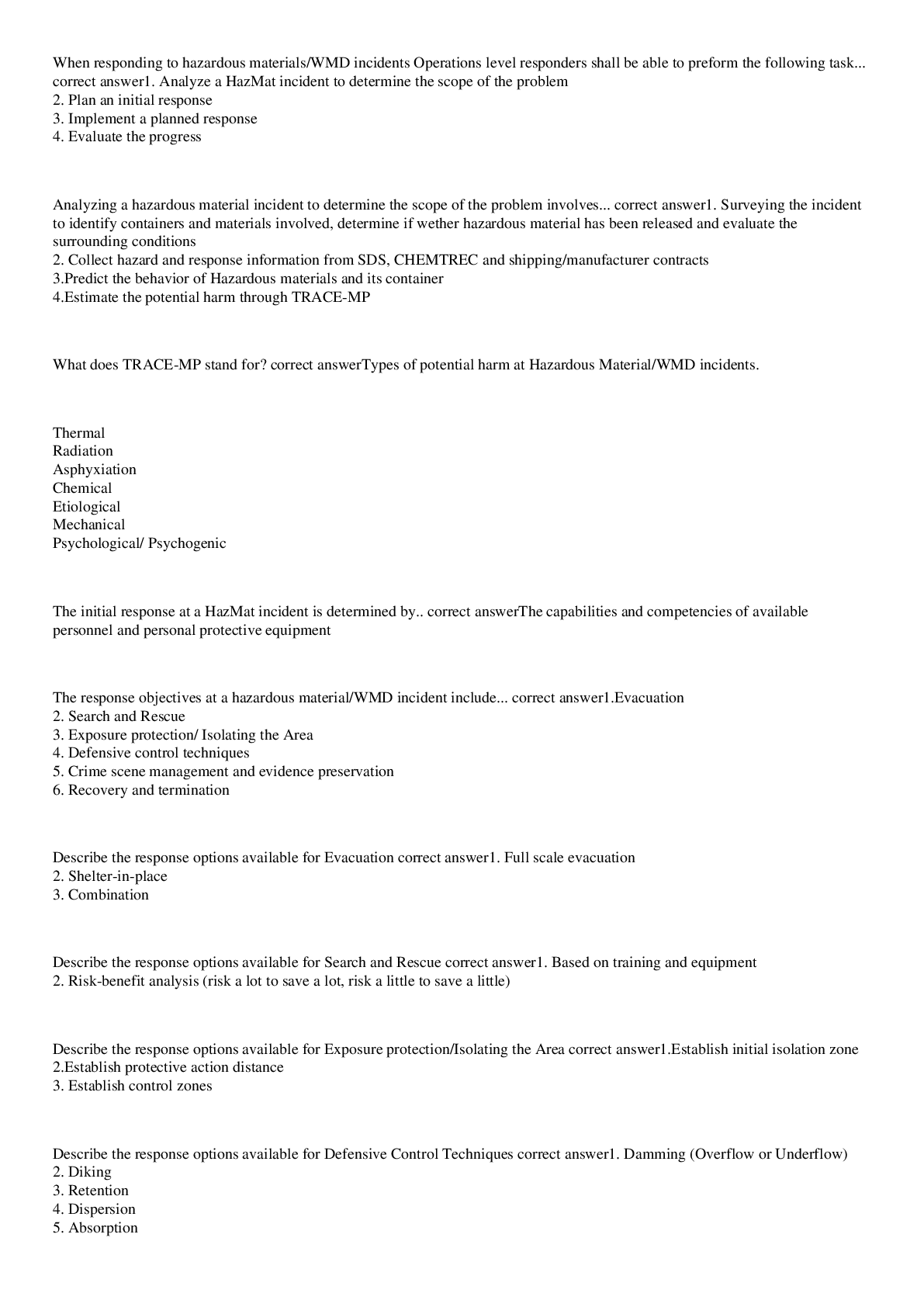
When responding to hazardous materials/WMD incidents Operations level responders shall be able to preform the following task... correct answer1. Analyze a HazMat incident to determine the scope of the problem
2. Plan an
...
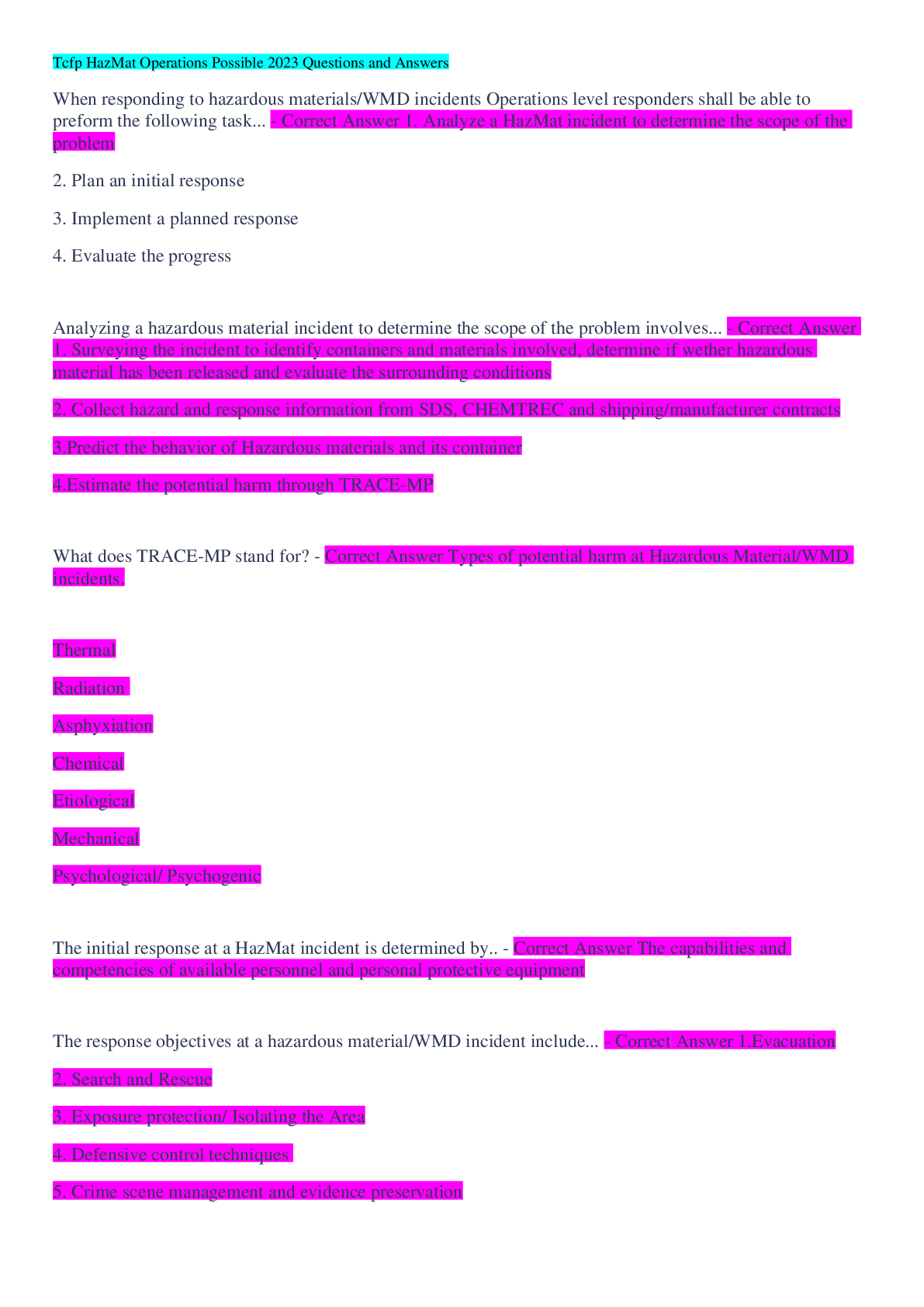
When responding to hazardous materials/WMD incidents Operations level responders shall be able to preform the following task... correct answer1. Analyze a HazMat incident to determine the scope of the problem
2. Plan an initial response
3. Implement a planned response
4. Evaluate the progress
Analyzing a hazardous material incident to determine the scope of the problem involves... correct answer1. Surveying the incident to identify containers and materials involved, determine if wether hazardous material has been released and evaluate the surrounding conditions
2. Collect hazard and response information from SDS, CHEMTREC and shipping/manufacturer contracts
3.Predict the behavior of Hazardous materials and its container
4.Estimate the potential harm through TRACE-MP
What does TRACE-MP stand for? correct answerTypes of potential harm at Hazardous Material/WMD incidents.
Thermal
Radiation
Asphyxiation
Chemical
Etiological
Mechanical
Psychological/ Psychogenic
The initial response at a HazMat incident is determined by.. correct answerThe capabilities and competencies of available personnel and personal protective equipment
The response objectives at a hazardous material/WMD incident include... correct answer1.Evacuation
2. Search and Rescue
3. Exposure protection/ Isolating the Area
4. Defensive control techniques
5. Crime scene management and evidence preservation
6. Recovery and termination
Describe the response options available for Evacuation correct answer1. Full scale evacuation
2. Shelter-in-place
3. Combination
Describe the response options available for Search and Rescue correct answer1. Based on training and equipment
2. Risk-benefit analysis (risk a lot to save a lot, risk a little to save a little)
Describe the response options available for Exposure protection/Isolating the Area correct answer1.Establish initial isolation zone
2.Establish protective action distance
3. Establish control zones
Describe the response options available for Defensive Control Techniques correct answer1. Damming (Overflow or Underflow)
2. Diking
3. Retention
4. Dispersion
5. Absorption
6. Adsorption
7. Dilution
8. Dissolution
9. Diversion
10. Vapor dispersion
11. Vapor suppression
12. Ventilation
13. Remote valve shutoff
What is Damming... correct answerPhysical method of confinement by which barriers are constructed to prevent or reduce the quantity of liquid flowing into the environment. Consists of constructing a barrier across a waterway to stop/control the product flow and pick up liquid or solid contaminants
What is Underflow Damming ... correct answerSpill control tactic used to trap floating lighter than water materials behind the dam. Dam is constructed in a manner that allows uncontaminated water to flow unobstructed under the dam while keeping the contaminant behind the dam.
What is Overflow Damming... correct answerSpill control tactic used to trap sinking heavier than water materials behind the dam. With the product trapped, uncontaminated water is allowed to flow unobstructed over the top of the dam.
What is Diking... correct answerPhysical method of confinement by which barriers are constructed on ground used to control the movement of liquids, sludges, solids, or other materials. Prevents the passage of hazmat from entering an area where it will produce more harm.
What is retention... correct answerPhysical method of confinement by which a liquid is temporarily contained in an area where it can be absorbed, neutralized, or picked up for proper disposal
What is dispersion... correct answerChemical method of confinement by which certain chemical and biological agents are used to disperse or break up the material involved in liquid spills on water
may result in spreading the hazardous material over a large area.
What is absorption... correct answerAbsorption occurs when one material enters the cell structure of another and is retianed within. Absorbents retain the properties of the materials they absorb and must be treated and disposed of as hazardous material
What is adsorption... correct answerAdsorption is different from absorption in that the molecules of the hazardous materials physically adhere to the adsorbent material Adsorbents do not swell like absorbents
Produces heat and can cause spontaneous combustion must be disposed of properly.
Examples: activated charcoal, silica, aluminum gel, fuller's eath, POROUS clay and other clays
What is dilution.. correct answerDilution involves applying water to a water soluble material in order to reduce the hazard. It is a useful way to preform decontamination but it is not a practical practical spill control method as it typically requires so much water that it creates a runoff problem
What is dissolution... correct answerDissolution is the process of dissolving a gas in water. This tactic can only be used on water-soluble gases such as chlorine or anhydrous ammonia.
What is Diversion... correct answerPhysical method of confinement by which barriers are constructed on ground or placed in a waterway to intentionally control the movement of a hazmat into an area where it will pose less harm to the community and the environment
What is Vapor Dispersion... correct answerVapor dispersion is that action taken todirect or influence the course of airborne hazardous material. Pressurized streams (hoselines or unattended master streams) create turbulence which increase the rate of mixing with air and reduces the concentration of the hazardous material
What is vapor suppression... correct answerVapor suppression is the action taken to reduce the emission of vapors at a hazmat spill. Fire Fighting foams are effective on spills of flammable and combustible liquids.
Water-miscible materials such as alcohols, esters and ketones destroy regular firefighting foams and require alcohol-resistant foams
What is ventilation... correct answerVentilation is any natural or mechanical means of controlling air movement. The same ventilation techniques used for smoke removal can be used for hazmat incidents
What is a remote valve shutoff.. correct answerIn some situations it may be safe and acceptable for Operations level responders to operate emergency remote shutoff valves. Activation of a remote shutoff valves varies by device but can be as simple as flipping a switch or handle or breaking a fusible device.
Describe the response options available for Crime Scene management and evidence preservation correct answer1. Maintain scene control
2. Limit access
3. Maintain chain of custody
4. Coordinate with AHJ
What is an AHJ... correct answerAuthority Having Jurisdiction
Describe the response options available for Recovery and Termination correct answer1. Short-term recovery
2. Long-term recovery
3. Termination activities
a)Debriefing
b) Critique
c) Post incident analysis
4. Demobilization
What is an EPA Level A suit and when is it used... correct answerVapor protective, provides the highest level of respiratory and skin protection
Used when chemical hazards are unknown, identified hazards are highly hazardous, when there is high potential for splash, immersion or exposure to vapors or when operations are conducted in a confined or poorly ventilated area
What is an EPA Level B suit and when is it used... correct answerLiquid Splash protection, provides the highest level respiratory but lesser skin protection.
Used when Atmosphere contains less than 19.5 percent oxygen or more than 23.5 percent oxygen. When there is a presence of vapors or gases indicated by a direct reading organic vapor detection instrument but vapors are not known to be harmful to skin
What is an EPA Level C suit and when is it used.. correct answerLevel B suit with an Air Purifying Respirator
When the concentration and types of airborne substances are known and the criteria for using an Air Purifying Respirator are met.
What is an EPA Level D suit correct answerWork uniforms, street clothing
Used when no hazard are present, not acceptable for HazMat response beyond Awareness level
What is Decontamination... correct answerDecontamination is performed at Hazmat incidents to remove hazardous materials from victims, PPE, Tools equipment and anything else contaminated.
What are the three principles of Decon... correct answer1. Get it off
2. Keep it off
3. Contain it ( Prevent cross contamination )
What is Emergency Decon.. correct answerEmergency decontamination is the process of removing threatening contaminants from the victim or rescuers as quickly as possible without regard for the environment or property.
What are some instances where emergency decon is needed.. correct answer1.Failure of protective clothing
2.Accidental contamination of first responders
3.Heat illness or other injury suffered while emergency workers were in the Hot Zone
4. When immediate medical attention is required
What is Technical Decon... correct answerTechnical Decon is using chemical or physical methods to throughly remove or neutralize contaminants. Technical decon is usually conducted within a formal decon line or corridor
What is triage... correct answerTriage is a system used for sorting and classifying accident casualties to determine the priority for medical treatment and transportation
What is Isolation and Scene control.. correct answerIsolation and Scene control is one of the primary strategic goals of a Hazmat incident and one of the most important means by which you can ensure the safety of yourself and others.
What is an Isolation perimeter.. correct answerSometimes called the outer perimeter, it is the boundary established to prevent access by the public and unauthorized persons.
What are Hazard control zones.. correct answerHazard control zones provide the scene control required at hazmat operations to protect responders from interference by unauthorized persons, help regulate movement across zones and minimize cross contamination
What is the hot zone.. correct answeralso called the exclusion zone, the Hot zone is potentially very dangerous. Responders need proper training and PPE to work in the hot zone.
What is the warm zone.. correct answerThe contamination reduction zone, decontamination stations are located here. PPE will normally be required here although in some circumstances the level of PPE may be a reduced level from the hot zone
What is the cold zone... correct answerAlso called the support zone. All logistical support is carried out here. PPE is not required here because it is considered safe. The multiagency command post, staging area, donning/doffing area, backup teams, research teams, logistical support, triage and transportation areas are located here as well.
Describe: Cryogenic liquid tank cars (railroad) correct answerFittings are in ground level cabinets at diagonal corners of the car or in the center of one end of the car.
Describe: Nonpressure tank cars
(railroad) correct answerFittings are visible on top of these tank cars.
Older Models of Nonpressure tank cars as well have an expansion dome with fittings visible on top the car.
Describe: Pressure Tank cars correct answerFittings are inside a protective hosing on top of the car.
Describe: Nonpressure intermodal tank IM-101 correct answer25.4 to 100 psi, Contents can be liquid or Solid (both hazardous and nonhazardous)
Describe: Nonpressure intermodal tank IM-102 correct answer14.5 to 25.4 psi, Contents can be liquid or Solid (both hazardous and nonhazardous)
Describe: Pressure Intermodal tank Spec 51/IMO Type 5 correct answer100 to 500 psi, Contents liquefied gas or liquids
Describe: Cryogenic Intermodal tanks IMO Type 7 correct answerContents: Refrigerated liquid gases, argon, oxygen, helium
Describe: Tube module Intermodal Container correct answer3000 or 5000 psi,
Contents: Gases in high pressure cylinders mounted in the frame
Describe: Compressed gas tube trailers correct answerPressure at 3000 to 5000 psi
Individual steel cylinders stacked and banded together
Usually has overpressure device for each cylinder
Valves are protected in the rear
Contents: Helium, hydrogen, methane and other gases
Describe: Corrosive liquid tanks correct answerMC 312, DOT 412,
Pressure less thean 75 psi
Typical capacity 7000 gallons
Rubber lined or steel
Small diameter round shape when viewed from the rear
Splashguard serving as rollover protection around the valve fittings
Contents: Corrosive liquids (usually acids)
Describe: Cryogenic liquid tanks correct answerMC338,
Pressure at less than 22 psi
Well insulated steel tank
Round tank with flat ends
Large and bulky double shelling and heavy insulation
Loading and Unloading station attached at either the rear or at the front of the rear dual wheels
Contents: Liquid oxygen, liquid nitrogen, liquid carbon dioxide, and other gases that have been liquefied by lowering their temperature
Describe: Dry Bulk cargo tanks correct answerPressure less than 22 psi
Typically not under pressure
Bottom valves
shape varies but has v shaped bottom unloading compartments
Top manway assemblies
Contents: Calcium carbide, oxidizers, corrosive solids, cement, plastic pellets and fertilizers
Describe: High Pressure tanks correct answerMC 331,
Pressure above 100 psi
Typical maximum capacity of 11,500 gallons
Single steel compartment
Bolted manway on the front or rear
Guard cage around the bottom loading and unloading piping
Uninsulated tanks, single shelled vessels
Contents:Pressurized gases and liquids, anhydrous ammonia, propane, butane and other gases that have been liquefied under pressure
Describe: Low pressure chemical tanks correct answerDOT 407, MC 307
Pressure under 40psi
Typical maximum capacity 7000 gallons
Rubber lined or steel
Typically double shell
Stiffening rings may be covered or visible
Circumferential roll over protection
Single or multiple compartments
Single outlet discharge piping at midship or rear
Rounded or Horseshoe shaped ends
Contents: Flammable liquids, combustible liquids, acids, caustics and poisons
Describe: Non-pressure liquid tanks correct answerDOT 406, MC 306
Pressure less than 4 psi
Typical maximum capacity 9000 gallons
New tanks made out of aluminum
Old tanks made out of steel
Oval or Elliptical shape
Multiple compartments
Recessed manways
Bottom valves
Longitudinal rollover protection
Valve assembly and unloading control box under tank
Vapor recovery system on curbside and rear
Contents: Gasoline, fuel oil, alcohol, other flammable/combustible liquids, other liquids and liquid fuel products
Describe: Cryogenic liquid tank correct answerInsulated, vacuum jacketed tanks with safety release valves and rupture disk. Capacities can range from 300 to 400,000 gallons.
Refrigerated storage tanks: less than 15psi
High pressure cryogenic tanks: greater than 15psi
What is a NFPA 704 placard.. correct answerPlacard marking that is required at fixed facilities. The placard helps to alert responders to the health hazards, flammability and reactivity of products using a scoring system from 0 ( least ) to 4 ( severe ). There are two possible special hazards as well that can be located on the sign for Water reactive materials ( a W with line through it horizontally ) and an "OX" for oxidizers.
Describe: Non- Pressure Horizontal tank correct answerHorizontal laying tanks sitting on legs, blocks, or similar. Typically constructed of steel with flat ends. Used typically for bulk storage in conjunction with fuel dispensing operations
Contents: Flammable and combustible liquids, corrosives, poisons
Cone Roof tank correct answerCone-shaped or pointed roofs with weak roof-to-shell seams that will break if the container becomes overpressured
-when partially full the empty space in the container contains dangers vapors
Contents:flammable, combustible or corrosive liquids (Non pressured)
Floating Roof tank correct answerThe roof floats on the surface of the liquids and moves up and down depending on level of the liquids
-non-pressure
-minimal to no vapors
-rubber/fabric seal around the edges
-above ground
Contents: flammable/ combustible liquids
Covered Floating Roof tank correct answerHas a fixed cone roof with vents along the top edge, and a floating deck inside that stays on the surface of the liquids to minimize vapors
-above ground
-non-pressure
Contents: flammable/combustible liquids
Floating Roof with Geodesic Dome correct answerA nonpressure, floating roof with geodesic dome
Contents: flammable liquids
Lifter Roof tank correct answerThe roof floats within a series of vertical guides that only allow a few feet of travel
Contents: flammable/combustible liquids
Vapor Dome Roof tank correct answerA vertical storage tank that has a geodesic dome at the top.
-dome is a flexible and moves in coordination with the change in vapor pressure
Contents: combustible liquids of medium volatility and other nonhazardous materials
Underground Storage tank correct answerThese tanks are made out of steel or fiberglass and have at least 10% of their surface areas underground
-used at gas stations
Contents: petroleum products
High/Low Pressure tank examples... correct answerLow Pressure (0.5-15 psi)
-Vertical dome roof tanks
High pressure (greater than 15 psi)
-Horizontal pressure vessel
-Spherical pressure vessel
-Noded spheroid
-Underground high pressure
Non-Bulk Packaging correct answer1. Bags
2. Carboys and Jerricans
3. Cylinders
4. Drums
5. Dewar flask (cryogenic liquids)
Different kinds of drums... correct answerOpen head/Closed head
Construction Materials
Metal, Plastic, Fiberboard, Other suitable materials
Fittings
Bungs, Chime ring
Intermediate Bulk Containers (IBC) correct answerIntermediate bulk containers (IBC)
a. Rigid intermediate bulk containers (RIBCs)
b. Flexible intermediate bulk containers (FIBCs)
Ton containers
a. Convex
b. Concave
Excepted Packaging correct answerUsed to transport hazmats with extremely low levels of radiation
Industrial Packaging correct answerUsed to transport hazmats with low level radiation, materials may be liquid, or solidified in materials like concrete or glass
Type A Packaging correct answerdesigned to contain greater amounts of radioactivity than excepted for normal transport
Type B Packaging correct answerFor highly radioactive shipments, designed to hold contents under extreme conditions
Type C Packaging correct answerRarely used, most hazardous amounts of radiation.. if packaging is released or shielding fails life threatening conditions could exist
DOT Placarding and Labeling System correct answerDOT placards and labels are required on all products shipped in commerce. The DOT placard system is recognized internationally in the transportation of dangerous goods. Consists of different colors, numbers, and pictures to quickly identify hazmats.
UN Numbers correct answerUN numbers or UN IDs are four-digit numbers that identify dangerous goods, hazardous substances and articles (such as explosives, flammable liquids, toxic substances, etc.) in the framework of international transport. They are assigned by the United Nations Committee of Experts on the Transport of Dangerous Goods.
NFPA 704 System correct answerRed (top of diamond) Flammability
Yellow (right side of diamond) Reactivity
White (bottom of diamond) Special Hazards
Blue (left side of diamond) Health Hazards
Hazardous Materials Identification System (HMIS) correct answerRefers to the numbers found inside the NFPA 704 diamond. 0 being the least dangerous, 4 being the most dangerous
Hazard Identification Codes (Intermodal Containers) correct answerAlso known as "hazard identification numbers," or Kemler code, is carried on placards on tank cars and tank containers running by road under international ADR regulations.
How to ID hazmats.. correct answerHighway Transportation vehicles you must search for...
a. Company names and logos
b. Vehicle identification numbers
c. Manufacturer's specification plate
Intermodal equipment, including tank containers you must search for
a. Reporting marks
b. Tank number
c. Specification markings
Rail transport vehicles, including tank cars you must search for
a. Standard transportation commodity code (STCC)
b. Commodity stencil
c. Reporting marks
d. Capacity stencil
e. Specification markings
Manufacturer's specification plate correct answerWill have specific instructions from the manufacturer, telling you how to deal with the hazmat
What should you look for on a pipeline.. correct answer1. Emergency telephone number
2. Owner
3. Product
What should you look for on a pesticide label.. correct answer1. Active ingredient
2. Hazard statement
3. Name of pesticide
4. EPA Registration Number
5. Precautionary statement
6. Signal word (Poison/Danger, Warning, Caution)
Radioactive White-I Label correct answerFissile class, white in color, low levels on surface
Radioactive Yellow-II Label correct answerFissile class, yellow in color, medium levels of radiation on external surface on package
Radioactive Yellow-III Label correct answerFissile class, yellow in color, highest level of radiation
What are some surrounding conditions that will effect hazmats.. correct answer1. Topography
2. Land use
3. Accessibility
4. Weather conditions
5. Bodies of water
6. Public exposure potential
7. Overhead and underground wires and pipelines
8. Storms and sewer drains
9. Possible ignition sources
10. Adjacent land use
11. Nature and extent of injuries
12. Building information
13. Ventilation ducts
14. Air returns
CHEMTREC correct answerCHEMTREC is the acronym for the Chemical Transportation Emergency Center. It is a 24-hour emergency response service that provides assistance in the handling of incidents involving hazardous materials
SDS/MSDS correct answerA safety data sheet, material safety data sheet, or product safety data sheet is a document provided by the manufacturer that details product hazards and spill-handling procedures.
ERG correct answerA Guidebook for First Responders during the initial phase of a dangerous goods/hazardous materials transportation incident; is color coded yellow (UN number), blue (name), orange (on fire), and green (isolation zones).
What are some additional hazards that could be associated with an incident involving terrorist/criminal
activities... correct answer1. Secondary events/devices intended to incapacitate or delay emergency responders
2. Armed resistance
3. Use of weapons
4. Booby traps
5. Secondary contamination from handling patients
What are 4 ways to obtain the MSDS in an emergency.. correct answera. Shipper
b. Manufacturer
c. CHEMTREC
d. Websites
UN/DOT Classes correct answerClass 1- explosives
Class 2- gases
Class 3- liquids
Class 4- solids
Class 5- oxidizers
Class 6- poisons
Class 7- radioactive
Class 8- corrosives
Class 9- misc
UN/DOT Divisions correct answerDivision 1.1 - Mass explosion hazard
Division 1.2- Projection hazard
Division 1.3- Fire hazard
Division 1.4- Minor explosion
Division 1.5- Very sensitive explosives with mass explosion hazard
Division 1.6- Extremely insensitive no mass explosive hazard
1.1 is the most dangerous, 1.6 is the least
What can CHEMTREC/CANUTEC/SETIQ can provide.. correct answer1. Immediate advice and shipper contact information
2. Hazard information warnings and guidance
Three methods of contacting the manufacturer or shipper to obtain hazard and response information.. correct answera. Shipping paper contact information
b. MSDS/SDS contact information
c. CHEMTREC
What are types of assistance provided by Federal governmental authorities with respect to criminal or terrorist activities at Hazardous Materials/WMD incidents correct answerDHS - Homeland Security Issues
FBI - Crisis Management
FEMA - Consequence Management
EPA - Environmental Management
US Coast Guard - Navigable Waterway
Management & Port Security
DOD - Explosives, Munitions, Military Shipments
Technical Assistance/Response
ATF - Explosives Technical Assistance
What are types of assistance provided by State governmental authorities with respect to criminal or terrorist activities at Hazardous Materials/WMD incidents correct answerDepartment of Public Safety (DPS) - District Disaster Chair (DDC)
TDEM - Emergency Management
Texas Commission on Environmental Quality (TCEQ) - Environmental Management
Texas General Land office (TGLO) - Water Quality
Texas Railroad Commission (TRRC) - Pipelines and Propane Storage
What are types of assistance provided by Local governmental authorities with respect to criminal or terrorist activities at Hazardous Materials/WMD incidents correct answerLocal emergency management
Local fire department
Local police department
EMS providers
What are the properties of Alpha Radiation... correct answerAlpha particles lose energy rapidly when traveling through matter. They can be stopped by a sheet of paper or by the outer layer of human skin. Is not harmful to outside skin, but can be harmful if ingested.
What are the properties of Beta Radiation.. correct answerThese particles are more fast moving that alpha radiation, they can penetrate the outer layer of skin and cause radiation damage to the body. Can travel up to 20 feet through they air, after traveling that distance they can be stopped by a single layer of clothing
What are the properties of Gamma Radiation.. correct answerHave no mass or electric charge but are highly penetrating. They can easily pass through the human body, inflicting severe radiation damage. Gamma radiation can be stopped by two inches of lead, two feet of concrete or several feet of dirt.
[Show More]


![Preview of eBook [PDF] Barash, Cullen, and Stoelting's Clinical Anesthesia 9th Edition By Bruce F. Cu](https://browseimages.nyc3.digitaloceanspaces.com/paper-images/2024/Aug/29/8DF2QRTq2024-08-29-10-3966d0259b7c4b5.png)
![Preview of eBook [PDF] Burns' Pediatric Primary Care 7th Edition BY Dawn Lee Garzon Maaks,, Nancy Bar](https://browseimages.nyc3.digitaloceanspaces.com/paper-images/2024/Aug/26/WR2rowXX2024-08-26-02-0966cc625bea839.png)



![Preview of eBook [PDF] AACN Essentials of Progressive Care Nursing 5th Edition By Sarah A. Delgado](https://browseimages.nyc3.digitaloceanspaces.com/paper-images/2024/Aug/29/ipbdJSTN2024-08-29-11-1466d02df30fc96.png)
![Preview of [eTextbook] [PDF] Labor Economics 9th Edition By George Borjas](https://browseimages.nyc3.digitaloceanspaces.com/paper-images/2025/Jan/13/JcsHZtUb2025-01-13-07-42678542822cb77.png)


![Preview of ATI critical points (1/1)[updated 2022/2023]](https://scholarfriends.com/storage/ATI critical points.png)