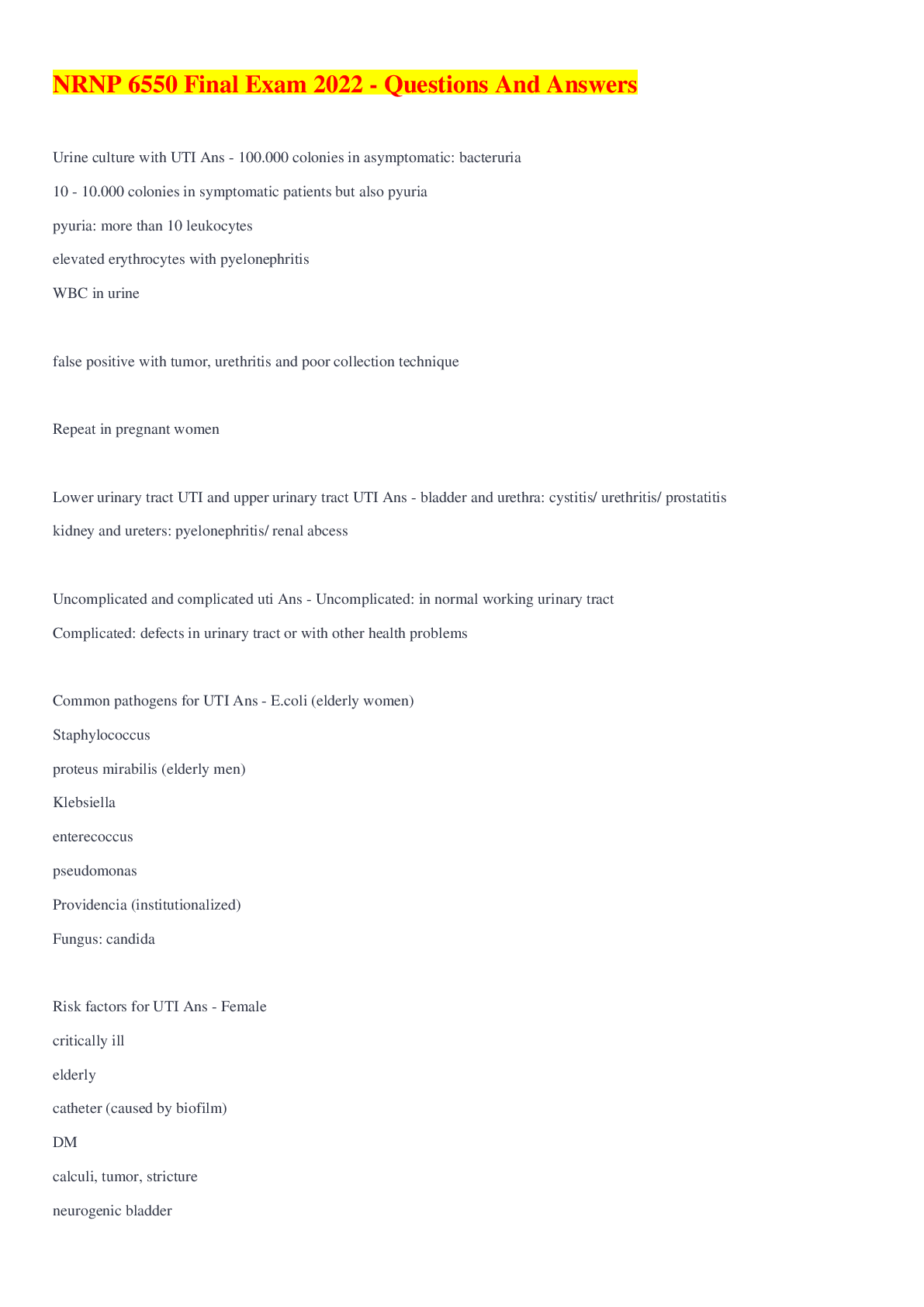
Urine culture with UTI - ANSWER 100.000 colonies in asymptomatic: bacteruria
10 - 10.000 colonies in symptomatic patients but also pyuria
pyuria: more than 10 leukocytes
elevated erythrocytes with pyelonephritis
WBC
...
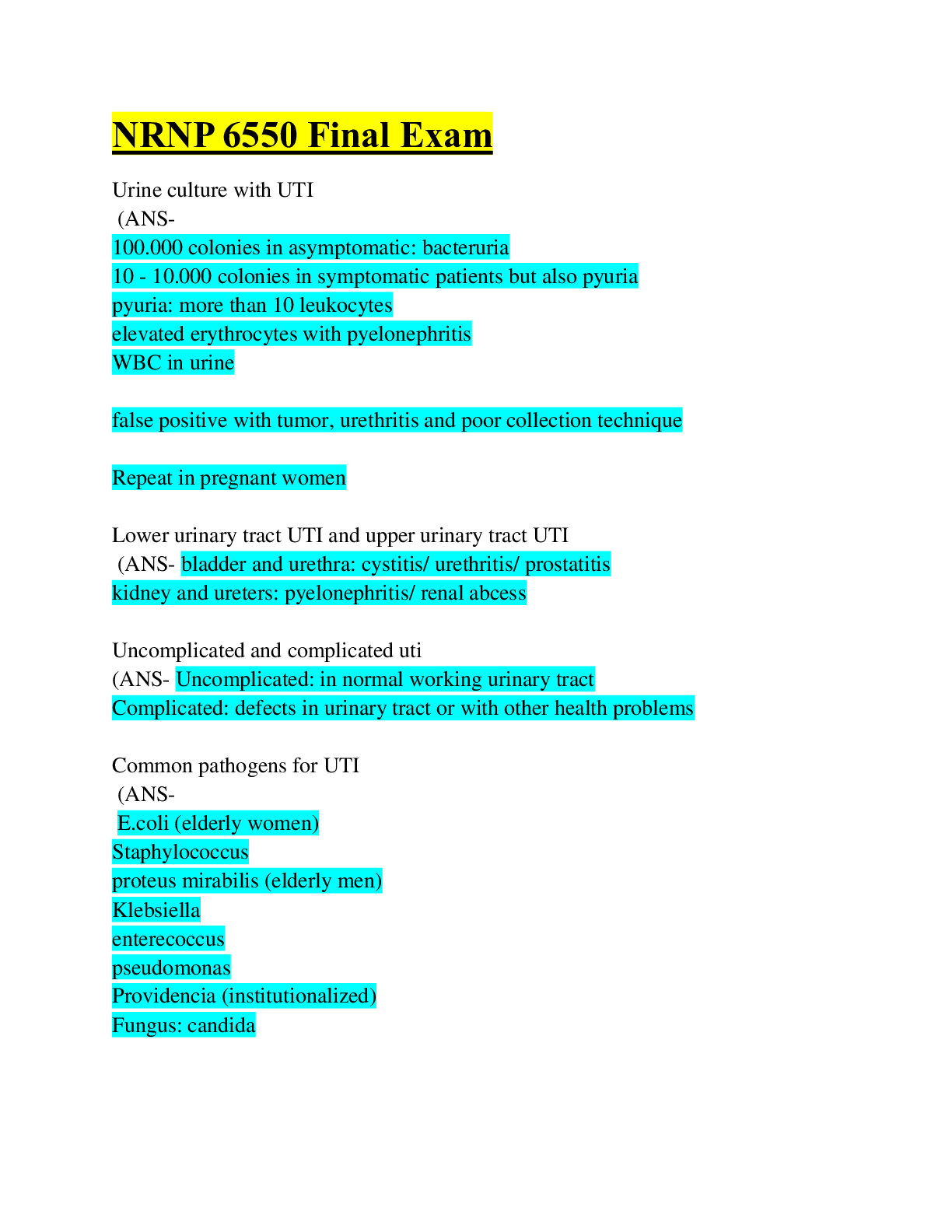
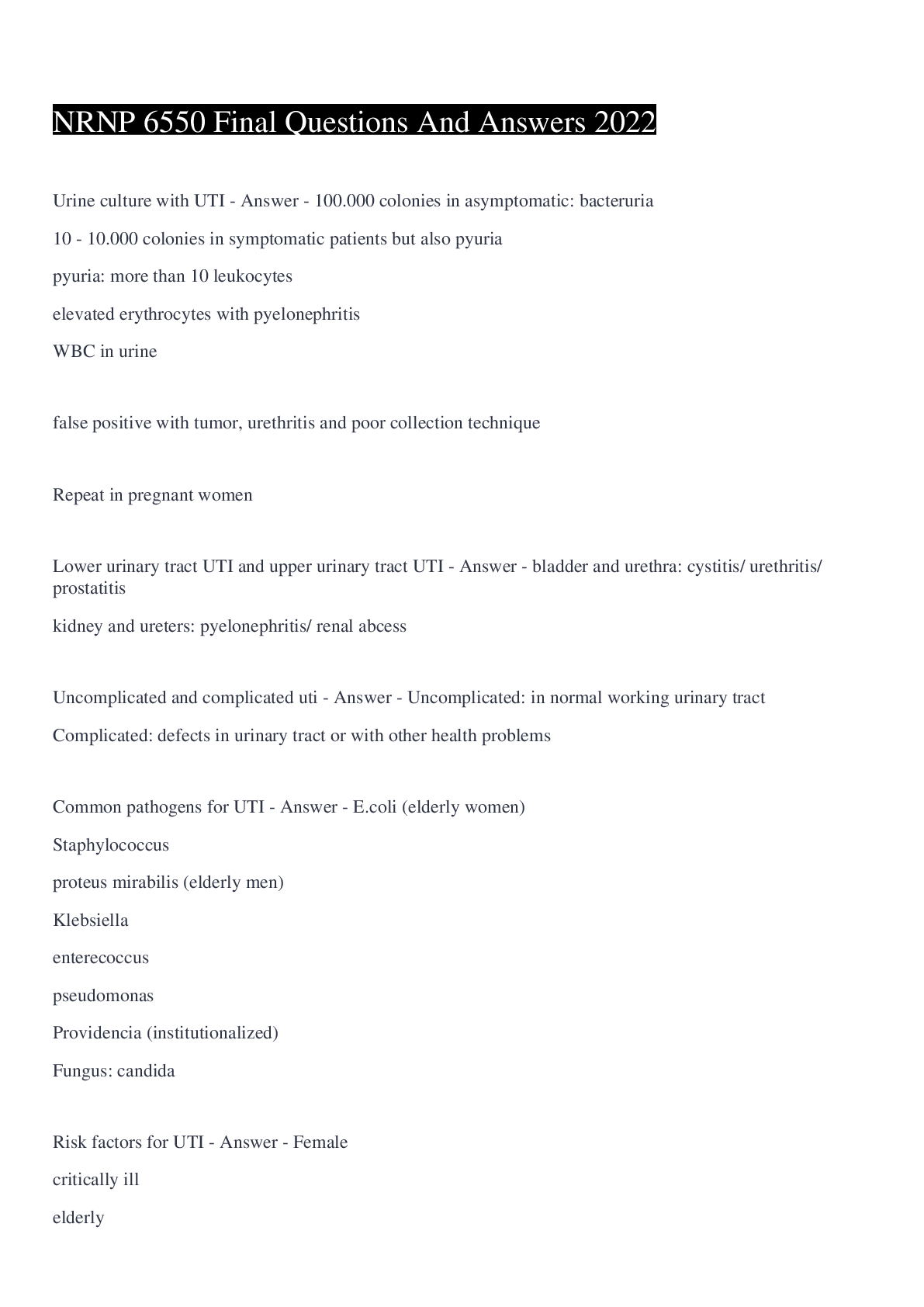
Urine culture with UTI - ANSWER 100.000 colonies in asymptomatic: bacteruria
10 - 10.000 colonies in symptomatic patients but also pyuria
pyuria: more than 10 leukocytes
elevated erythrocytes with pyelonephritis
WBC in urine
false positive with tumor, urethritis and poor collection technique
Repeat in pregnant women
Lower urinary tract UTI and upper urinary tract UTI - ANSWER bladder and urethra: cystitis/ urethritis/ prostatitis
kidney and ureters: pyelonephritis/ renal abcess
Uncomplicated and complicated uti - ANSWER Uncomplicated: in normal working urinary tract
Complicated: defects in urinary tract or with other health problems
Common pathogens for UTI - ANSWER E.coli (elderly women)
Staphylococcus
proteus mirabilis (elderly men)
Klebsiella
enterecoccus
pseudomonas
Providencia (institutionalized)
Fungus: candida
Risk factors for UTI - ANSWER Female
critically ill
elderly
catheter (caused by biofilm)
DM
calculi, tumor, stricture
neurogenic bladder
Women:
sexual intercourse or new sex partner
pregnancy
previous UTI
Men:
prostate enlargement
prostatitis
lack of circumcision
gay
HIV
Findings UTI - ANSWER Lower:
Dysuria/ urgency/ frequency/ incontinence
suprapubic pain
hematuria
fever/ chills uncommon
No flank pain
Upper:
flank pain
fever and chills
hematuria
n/v
ams (in elderly)
malaise
tachycardia/ tachypnea
Testing and results for UTI - ANSWER Gold standard: urine culture and sensitivity: detection of bacteria. Start with POC: urine analysis.
UA: pos for nitrite or leukocyte or blood
CBC: leukocyte with left shift in pyelonephritis
For recurrent UTI in women or UTI in men rule out obstruction, calculi, or necrosis with:
xr voiding
CT abdomen
US pelvis
MRI pelvis
Management acute cystitis - ANSWER First line:
- Single dose Fosfomycin (monurol)
- 3 day: sulfa: trimethoprim/ sulfa (bactrim) (do not give near delivery of baby, give cephalexin instead) or sulfa
- 5 days: nitrofurantoin, caution in elderly
Second line:
- qiunolones: ciprofloxain or levofloxacin for 3 days (not for pregnant women!)
- B-lactams: amoxi-clav, cefdinir for 3 - 7 days
Management uncomplicated upper UTI - ANSWER Outpt:
quinolone: ciprofloxacin for 7 days or levofloxacin for 5 days
Sulfa: trimethoprim/ sulfa (bactrim) for 14 days
Inpt:
Ceftriaxone or cefotaxime
Ampicillin
CAUTI:
bacterial: treat with AB for 7 days
Candiduria: fluconazole for 14 days
Discomfort: Pyridium
Management acute complicated bacterial pyelonephritis - ANSWER - Admit
- Aminoglycosides: gentamicin/ tobramycin (not for monotherapy), based on renal function (trough less than 2 and peak level 5-10mg/L) and do not give for CKD
- Ampicillin
- Cefazolin
- Cefotaxime and Ceftriaxon based on obesity and pulm disease
Urine analysis: glucose and ketones - ANSWER Serum glucose at least 180mg/dl for glucose to appear in urine
Glucose in ua caused by:
- Fancone Syndrome (bad wall: caused by ahminoglycosides for example)
- DM
- Cushing's
- Vit C can give false negative
Ketones in urine:
- Alcohol
- Diabetic
- Starvation
Acute Kidney Injury - ANSWER -Acute renal function loss with inability to excrete metabolic waste products (urea nitrogen and creatinine) to inability to maintain fluid and electrolyte balance.
- Resolves within 3mo
- classified with RIFLE or etiology
RIFLE - ANSWER Risk: creatinine up x 1.5 from baseline, GFR decrease more than 25% and UO less than 0.5ml/kg/hr for 6hr
Injury: creatinine up x 2 from baseline, GFR decrease more than 50% and UO less than 0.5ml/kg/hr for 12hr
Failure: creatinine up x 1.5 from baseline, GFR decrease more than 25% and UO less than 0.3ml/kg/hr for 12hr or anuria for 12hr
Loss: Complete loss of renal function for more than 4 weeks
End-stage Kidney Disease: RRT need for more than 3mo
Prerenal renal failure - ANSWER Most often the cause of RF
- Decreased blood supply; intravascular volume depletion, vasodilatory states
- Increased tubular sodium and water reabsorption, causing: oliguria, decreased urine sodium, high urine osmolality, increased urine specific gravity
caused by:
1. Low CO
2. Hypovolemia
3. RAS (renal artery stenosis)
4. aminoglycosides, NSAIDS
Result:
- low urine volume
- increased urine creatinine with normal serum creatinine
- minimal proteinuria
- serum K moderately increased
- serum phos moderately increased
- serum calcium normal
- normal renal size on US
4. Low Na+
5. Low H2O
6. High osmolality (500 and up)
7. High uric acid
8. Specific gravity: greater than 1,010
9. Urinary sodium: less than 20
10. Sediment*: 0 (hyaline casts)
11. BUN/ creat ratio: greater than 10/1
Intrarenal - ANSWER Cause:
- Ischemia or nephrotixic injury (rhabdo, multiple myeloma, aminoglycosides, chemo, contrast)
- Necrosis (acute tubular necrosis ATN) (prolonged hypotension, low CO, liver disease)
- Acute tubulointerstitial nephritis from bacterial pyelonephritis, drug-induced, immunologic disorders
- oliguric/ anuric
- decreased urine creatinine
- no proteinuria
- serum creatinine increased
- serum K increased
- serum phos increased
- serum Calcium decreased
Low Na+
High H2O
Low osmolality (350 and less)
Specific gravity: 1,010
Urinary sodium: greater than 20
Sediment: +
BUN/ creat ratio: less than 20/1
FEna: greater than 2%
Treat: stop offending drug.
Contrast: fluid administration, pre- and post. Hold metformin before contrast, for 48hrs.
Postrenal - ANSWER Cause:
Urinary flow obstruction: Enlarged prostate
Cervical cancer
Tumors
Kidney stones
Neurogenic bladder, diabetic neuropathy, spinal cord disease
- urine creatinine decreased
- no proteinuria
- no sediment or hematuria with stones
- BUN increased
- serum creatinine increased
- serum phos increased
- serum calcium decreased
Anuria/ polyuria
Urine osmolality less than 350
Fixed urine specific gravity (1.0008- 1.012)
Urine Na greater than 40
BUN to creatinine ratio: greater than 20:1
Treat with catheter drainage, urethral stents, percutaneous nephrostomy
treatment of ARF/AKI - ANSWER -· Therapy for ARF:
o Treat underlying cause
o Correct fluid, electrolyte, uremic abnormalities
o Prevent complications
o Lasix can be given for volume overload (due to oliguria)
o Patient can become nutritionally deficient as ARF is a catabolic state. Total caloric intake: 30 - 45 kcal/kg/day. Protein restricted when not on dialysis: 0.6g/ kg/day. If on dialysis protein should be 1-1.5g/kg/day.
Diet should be low protein/ Na/ K
o Dialysis, often needed. Especially when BUN greater than 100 and serum creatinine greater than 5 - 10, acidosis/ alkalosis, hyperkalemia
o Metabolic acidosis: treat with IV (or oral) bicarb when serum HCO3 is less than 15, or PH less than 7.2
o Renal transplant
Treat renal failure complications: which and how - ANSWER Hyperkalemia:
- Kayelxalate 15-30 g with 100 ml sorbitol: enema
- IV calcium: cardioprotective
- Insulin (10units) with 25 g glucose
- IV sodium Bicarb (150 mEq in 1 lt)
- dialysis in significantly elevated K (greater than 7)
Hyperphosphatemia:
- Keep below 4.6
- Restrict phos (cola, eggs, dairy, meat)
- Give calcium carbonate (650mg TID)
- Renvela (Sevelamir)
- Calcium acetate
- Dialysis
Hypocalcemia (ion Ca less than 1.12):
- Calcium carbonate supplements
- maintain phos at 6
Hypermagnesemia
Avoid mag. laxatives
Fluid overload:
- Decrease Na and fluid intake and give lasix
HTN:
Goal: 140/80 unless proteinuria than 125/75
ACE-inhib, calcium blockers if proteinuria present, hydralazine, B-blocker
Protein catabolism:
- Limit protein intake: less than 8gr/kg.day, avoid stress and not too much physical activity
Acidosis
Give sodium citrate when HCO3 below 20
Anemia
- give iron
- give erythropoietin injection
RRT option in AKI and CKD - ANSWER - Hemodialysis (intermittent (MAP of at least 60mmHg), continuously venous or arterial)
- Peritoneal dialysis - for long term use. Does not achieve adequate creatinine clearance (may be switched to hemodialysis in acute care situations) and high risk for infection
chronic kidney disease - ANSWER · Chronic kidney disease: GFR 60ml/ min or less for longer than 3mo.
o HTN common
o US with show bilat small kidneys
o Cause:
§ HTN nephropathy
§ Diabetic nephropathy
§ Renal artery stenosis
§ Glomerular disease
o When GFR between 5 - 10: dialysis
o Creatinine clearance: age and gender-dependent. Males: 97-137, Females: 88-128
o Signs/ Symptoms:
- Fatigue/ weakness
- Pruritis
- bruising
- dyspnea on exertion
- HTN
- Metallic taste
- SOB/ pleural effusion
- n/v with anorexia
- impotence/ nocturia
- peripheral neuropathy
- anemia (due to erythropoietin deficiency)
Stages of CKD - ANSWER o Stages - 5 stages 80 - 120 ml/min
§ 1: GFR greater than 90
§ 2: GFR 60 - 89
§ 3: GFR 30 - 59
§ 4: GFR 15 - 29
§ 5: ESRD GFR less than 15, uremia, cardiovascular disease.
Modification of drug dosages based on kidney function - ANSWER serum creat greater than 10mg/ml: major modification
serum creat 3-10 mg/ml: modest changes
Types of drugs and kidney function - ANSWER Type A: eliminated by kidney entirely
Type B: eliminated by extrarenal entirely
Type C: eliminated by renal and extrarenal
Decreased renal function results in: - ANSWER abnormal excretion rates
abnormal metabolism rates
abnormal sensitivity to drugs
benign prostatic hyperplasia - ANSWER enlargement of prostate gland in men older than 50yrs, interfering with urinary flow by obstructing the urethra (straining, frequency, dribbling, incontinence, nocturia)
Diagnosis of bph: definition and symptoms - ANSWER Prostate enlargement during digital rectal exam (if nodules or hardness is felt than concern for malignancy)
- Avoid meds that worsen symptoms (decongestants, diuretics, anticholinergic, tricyclic antidepressants, opiates
- Give Alpha blockers, such as terazosin, prazosin, tamsulosin and hormonal stimulation, such as finasteride
- surgery: TURP, TUIP, prostatectomy
PSA - ANSWER prostate-specific antigen: prostate ca risk
Level between 4 - 10: 25% risk
above 10, more than 50% risk
Crockcroft-Gault equation - ANSWER deterination of renal function through gfr.
Males: creatinine clearnace = (140 - age) x (body weight kg) / (72 x serum creatinine)
Females: creatinine clearnace = (140 - age) x (body weight kg) / (72 x serum creatinine) x 0.85
Renal function and older age - ANSWER - diminshed kidney mass, blood flow, gfr
- reduced bladder elasticity, muscle tone, and capacity
renal artery stenosis - ANSWER Renal artery stenosis causes ischemia in artery providing the affected kidney with blood. In turn the kidney will produce renin which causes HTN. Kidney will also shrink (atrophy): ischemic nephropathy. Long term it can lead to chronic RF.
Renal artery stenosis: signs, tests, management - ANSWER · Signs:
sudden or unexpected HTN
epigastric bruits
edema
increase/ decrease urine
itching
dry skin
n/v
muscle cramping
unexplained hf/ pulm edema
decline in gfr
metabolic acidosis
· Tests: doppler/ ultrasound and CT-angio of renal arteries (risk of contrast induced nephropathy)
· Management:
o Life-style changes
o Meds to optimize glycemic control, blood pressure, cholesterol
o ACE-inhibitors (Pril), ARB's (tan) (further decline in GFR may occur)
o RAAS-blockade (ACE and ARB), statin, aspirin: cornerstone therapy
o Check kidney function after two weeks of starting ACE and ARB: may cause acute RF.
o Diuretic, beta-blocker, or calcium channel blocker might be needed as well
- revascularization of kidneys through PTA (with stent)
- endarterectomy
- assess for CAD
nephrolithiasis: definition, risk factors - ANSWER - stones in pelvis, kidney or ureter
- male, age 30 and up
- previous calculi
- dehydration
- stress
- diet: high sodium, high protein, high fructose, low calcium
- obesity
- dm
- sarcoidosis
- gout
- uti
- chemo/ steroids/ vit d supplements
types of renal calculi - ANSWER - Calcium stones (most common)
- Hypercalciuric calcium nephrolithiasis, caused by absorptive (bowel absorption of calcium), resorptive (hyperparathyroidism causing hypercalcemia) and renal (no filtering of calcium) disorders
- Hyperuricosuric calcium nephrolithiasis (excess uric acid in diet, such as alcohol and fish)
- Hyperoxaluric calcium nephrolithiasis (intestinal disorder)
- Hypercitraturic calcium nephrolithiasis
- uric acid calculi
- struvite calculi
- cystine calculi
Findings with nephrolithiasis - ANSWER - acute flank pain
- testicular pain
- n/v
- frequency/ dysuria/ oliguria/ hematuria
- Gold standard: noncontrast helical CT
- renal us, less sensitive
- ua: blood
- wbc increased
- 24/hr urine collection
- cmp: calcium, electrolytes, phosphate, uric acid
Management of nephrolithiasis - ANSWER - relieve pain and n/v with NSAIDS (not with renal dysfunction!), dilaudid, norco, zofran
- increase oral fluid intake to speed up passing of stone
- antispasmodics (such as flomax) can hasten stone passage
- lithotripsy and ureteroscopy for stones greater than 10mm
- promote healthy diet and exercise
Onset and duration of regular and basal insulin - ANSWER · Short acting: Onset: 10-30min Duration: 3-5 hrs. lispro, aspart (Glulisine 1.5hrs)
· Regular: Onset: 30-60min Duration: 6-8 hrs.
· Intermediate acting: Onset 2-4 hrs. NPH (Humulin): Duration: 12 - 15 hrs.
· Long-acting: 1-2hrs Levemir/ Lantus. Duration: 24 hrs
· Pre-mixed: NPH/ regular Onset: 30min. Duration: 18 - 24 hrs
Adjustment of insulin based on glucose levels - ANSWER · 0.5units/ kg/ day, 2/3 in the morning and remaining 1/3 in evening (lower for thinner and higher for obese)
· Glucose above 140 mg/ dl before evening meal: add 2 - 5 units every 3 days until regulated
· Afternoon regulated, then fasting glucose: elevated? Then 2/3 insulin before breakfast and 1/3 before dinner. Goal fasting: 120 - 140 mg/dl
Insulin intake with n/v or poor intake - ANSWER - Don't stop insulin administration.
- Check glucose q2-4hrs, plus ketones in urine (also night).
- continue oral meds and insulin even if not eating normally
- stop taking metformin if dehydrated
- if npo drink 8oz sugar containing fld per hr
- check BG q 2-4 hrs
- Call MD for persistent vomiting/diarrhea, BG consistently >300, temp >101, ketonuria
Diagnostic criteria for DM - ANSWER o Random glucose greater than 200mg/ dl
o Two hour post glucose test greater than 200 mg/dl
o HgbA1C greater than 6.5% (measure every 6mo post diagnosis; less than 6% is goal. Measure q3 - 4mo when using sliding scale)
o Fasting glucose greater than 126 mg/dl on two occasions
o Urine will show glycosuria and ketonuria
Standard insulin dose for new diabetic type 1 - ANSWER - 0.5units/ kg/ day, 2/3 in the morning and remaining 1/3 in evening (regular)
- Physiologic: basal long-acting once daily at same time: 1/3 of insulin requirement for dm1. For dm2: kg x 0.2 = basal
- non physiologic/ split-dose: morning 2/3 NPH and 1/3 regular. Evening: 1/2 NPH and 1/2 regular
- bolus fast-acting before meal: 0.5-1 unit/kg (novolog)
DKA vs HHS - ANSWER DKA: PH less than 7.3, HCO3 less than 15, PCO2. Normal in HHS
DKA: Ketones in urine/ serum, none in HHS
HHS: blood sugar usually elevated 600 mg/dl and higher
HHS: hypernatremia, DKA: hyponatremia
Metformin side effects and interactions - ANSWER Side effects:
o n/v
o diarrhea
o B12 and folic acid deficiency
o Metabolic acidosis in pt's with renal impairment. So do not use! Also contraindicated in HF (predisposed to lactic acidosis)
Interactions:
o Alcohol: avoid alcohol
o Cimetidine (Tagamet) can increase lactic acidosis
o Contrast dye: can cayse RF and thus induce lactic acidosis. Dc metformin for 48hrs pre-procedure, start 48 hrs after
Treatment of DKA - ANSWER · Critical care
· Hydration: NS at 1000ml/hr for 1-2 hrs, then 300-500ml/hr for 4 hrs to correct deficit of 4-8ltr. Then 250ml/ hr. First isotonic, then hypotonic. Change to D5 0.45NS once glucose lower than 250 mg/dl. Add K if potassium smaller than 5 to first bags of fluid.
· Monitor K, phos, mag
· Loading dose insulin: 0.1 units/ kg regular insulin followed by continuous drip of 0.1units/kg/hr. Decrease to 0.05units/kg/hr once glucose less than 200mg/ dl
· If PH less than 7.0. give Bicarb (50 -100 mEq in 1 ltr fluid). DC bicarb when PH 7.1
Management DM - ANSWER - Diet: carb 60% of total intake, fats 25% of total, protein 15% of total. Artificial sweetener better than sugar. Balance and individualized. DM1: 3 meals/ day + 3 snacks. DM2: meals 5 hours apart, no snacks.
- Exercise (insulin in non exercised body part)
- Foot care
- test blood glucose 4/day
- For DM2: oral meds when not controlled with diet and exercise. Insulin if oral fails or HgbA1C greater than 8.
Complications of DM - ANSWER Diabetes- related retinopathy (blindness)
Cardiovascular disease
Cataracts and glaucoma
Neuropathy (most common complication)
Nephropathy (more in DM1 than DM2)
Infections
Gangrene feet
DKA and HHS
DM 1 - ANSWER Autoimmune pancreatic Beta-Cell destruction
Somogyi effect: definition and treatment - ANSWER nocturnal hypoglycemia followed by rebound hyperglycemia in the morning
Reduce bedtime dose of insulin. Give Levemir instead of lantus (is shorter acting)
Dawn phenomenon - ANSWER Early morning glucose elevation because of growth hormone which decreases sensitivity to insulin.
Add/ increase bedtime dose of insulin
Oral Antidiabetic Drugs - ANSWER 1. Biguanides (Metformin)
2. Sulfonylureas
3. Meglitinides
4. Thiazolidinediones (glitazones)
5. Alpha-glucosidase inhibitors
6. DPP-4 inhibitors
7. SGLT-2 inhibitors
Biguanides - ANSWER Metformin
§ Drug of choice for initial treatment for T2DM.
§ Action: inhibits glucose production, reduces glucose absorption, sensitizes tissues to insulin. Does NOT stimulate insulin release.
§ Excreted by kidneys so may be toxic in renal failure.
§ Use: glycemic control. Safe for people who skip meals because it does not actively lower blood sugar.
§ Side-effects: GI disturbances. Does not cause weight gain. Can cause metabolic acidosis in pt's with renal failure. Alcohol can cause acidosis as well.
Sulfonylureas: - ANSWER Glimepiride, Glipizide, Glyburide
§ Action: promote insulin release
§ Use: T2DM
§ Side effects: weight gain and hypoglycemia (especially with renal or liver failure and alcohol use), small and questionable risk for sudden cardiac death. Not in pregnancy! May cause severe hypoglycemia in newborn.
Meglitinides - ANSWER Repaglinides, Nateglinide
§ Action: same as sulfonylureas but act shorter thus taken with meal. Adverse effects: hypoglycemia. NOt for DM1
Thiazolidinediones - ANSWER Rosiglitazones, Pioglitazone
§ Action: reduces insulin resistance and may decrease glucose production
§ Adverse effect: upper resp infection, sinusitis, fluid retention and thus heart failure. Do not give for HF patients! Ovulation, bladder cancer, fractures (in women)
Alpha-glucosidase ihibitors - ANSWER acarbose, miglitol
§ Action: delay absorption of carbs
§ Adverse effects: cramping, flatulence, abd distention
Take with first bite of meal not with garlic, juniper, ginseng
Dipeptidyl Peptidase-4 Inhibitors: - ANSWER Linagliptin, Saxagliptin
§ Action: enhances incretin hormones
§ Use: add-on to metformin
contraindicated for ESRD
Sodium-glucose cotransporter 2 inhibitors - ANSWER Canagliflozins
§ Action: blocks glucose reabsorption in kidneys.
§ Adverse effects: vaginal fungal infections/ vulvovaginitis, genital infections (increased sugar in urine).
DKA: definition and signs - ANSWER Intracellular dehydration due to hyperglycemia, hyperketonemia, acidotic PH
N/V, weakness, AMS, tachycardia, fruity breath, kusmaul breathing, hyperkalemia, hypotension
Glucose greater than 300mg/dl
PH less than 7.3
Ketones in serum and urine
Hyperkalemia
increased BUN
Leukocytosis
serum hyperosmolality (greater than 280)
Increased anion gap
HHS: definition and signs - ANSWER Severe hyperglycemia, hyperosmolality without ketone production, often DM 2
Weakness, AMS, hypotension, tachycardia, shallow breathing
Glucose greater than 600mg/dl
Serum hyperosmolality, greater than 310
increased BUN and creat
Hypernatremia
PH greater than 7.3
Normal anion gap
Management of HHS - ANSWER Critical care
Fluid replacement: isotonic fluids, hypotonic once Na+ reaches 145 (4-6ltr in 10hrs)
Monitor for fluid overload
Loading dose of 0.1-0.15units/ kg of regular insulin followed by drip
Monitor and replace electrolytes
[Show More]





! A+ Answers.png)