Source: Map created from various sources, 2012.
Note: The number of electoral votes per state is apportioned (distributed) every ten years based on the results of the US Census. state's number of electors is tied to i
...
Source: Map created from various sources, 2012.
Note: The number of electoral votes per state is apportioned (distributed) every ten years based on the results of the US Census. state's number of electors is tied to its number of Congressional representatives: one for each senator and one for each member of the House. Therefore, the changing population affects not only representation but also how many electoral votes a state has. A state can never have fewer than three electors.
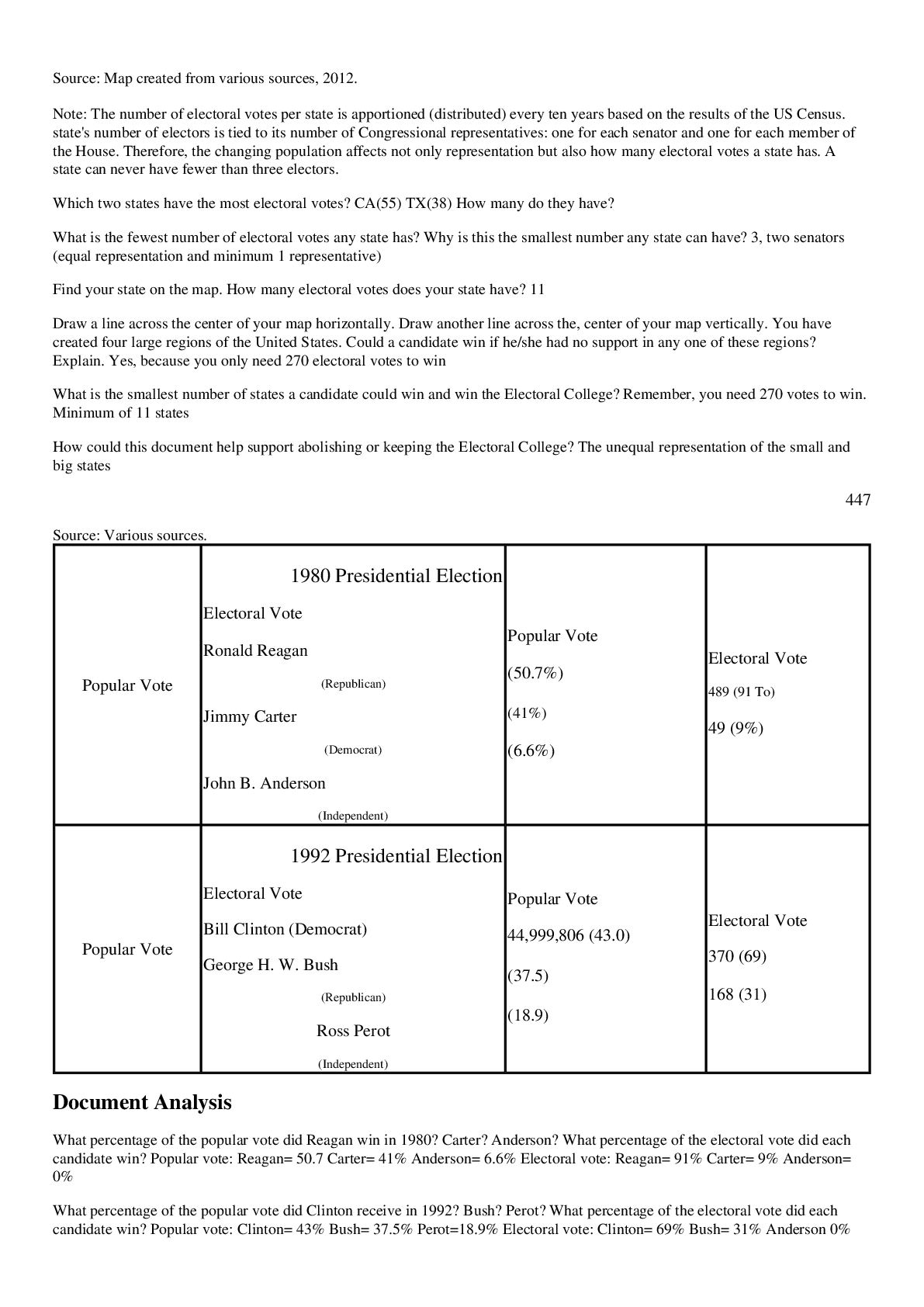
1. Which two states have the most electoral votes? How many do they have?
2. What is the fewest number of electoral votes any state has? Why is this the smallest number any state can have?
3. Find your state on the map. How many electoral votes does your state have?
4. Draw a line across the center of your map horizontally. Draw another line across the, center of your map vertically. You have created four large regions of the United States. Could a candidate win if he/she had no support in any one of these regions? Explain.
5. What is the smallest number of states a candidate could win and win the Electoral College? Remember, you need 270 votes to win.
6. How could this document help support abolishing or keeping the Electoral College? 447
Source: Various sources.
| | Popular Vote
| 1980 Presidential Election Electoral Vote
Ronald Reagan (Republican) Jimmy Carter (Democrat) John B. Anderson (Independent) | Popular Vote
(50.7%)
(41%)
(6.6%) | Electoral Vote 489 (91 To) 49 (9%)
| Popular Vote
| 1992 Presidential Election Electoral Vote
Bill Clinton (Democrat) George H. W. Bush (Republican) Ross Perot (Independent) | Popular Vote 44,999,806 (43.0)
(37.5)
(18.9) | Electoral Vote 370 (69) 168 (31) |
| | | | | |
Document Analysis
1. What percentage of the popular vote did Reagan win in 1980? Carter? Anderson? What percentage of the electoral vote did each candidate win
2. What percentage of the popular vote did Clinton receive in 1992? Bush? Perot? What percentage of the electoral vote did each candidate win
3. How would you describe the results of the popular vote in these two elections'? How would you describe the results of the electoral vote in these two elections'?
4. What effect does the Electoral College seem to have on the chances of a third-party or independent candidate?
5. What benefit might having a larger Electoral College majority give the person who wins the election?
6. How could this document help you argue or against the Electoral College being abolished? Project 449
Source: John Samples, "In Defense of the Electoral College," Cato Institute, November 10, 2000.
The Electoral College makes sure that the states count in presidential elections. As such, it is an important part of our federalist system—a system worth preserving. Historically, federalism [the combination of a central government with some authority given to state and local governments] is central to our grand constitutional effort to restrain power.
Source: Mitch McConnell, from "Introduction" in Securing Democracy: Why We Have an Electoral College, edited by Gary L. Gregg Il, 2008.
| Is the Electoral College method of presidential selection the easiest to understand or the most efficient in its execution? No. But our system is not designed to be simple and efficient. It is designed to promote good government and legislation that forwards the common good of a large and diverse nation. For two centuries it has
done a pretty good job at that. Every day when I walk into my Senate office, I am thankful for the complexities and inefficiencies that have contributed to the freedom and prosperity we know in America. Though it may never have functioned as intended, the Electoral College has been the linchpin of American political prosperity. It has formed our political parties, moderated our more extreme elements, and forged the presidential campaigns that have given direction to our ship of state.
Document Analysis
I . Does John Samples believe that government power should be increased or limited? Samples says that the Electoral College helps preserve the federalist structure of our government.
What is a federalist structure'? In Samples' view, how does the Electoral College help preserve it!?
2. Why does Mitch McConnell believe the inefficiency of elections is actually a positive thing?
3. Compare and contrast Samples' and McConnell's views about the Electoral College.
4. How could this document help you argue for keeping the Electoral College'? 451
oaae
Source: George C. Edwards, Why the Electoral College Is Bad for America, New Haven, CT: Yale University Press, 2004.
The Electoral College violates political equality. It is not a neutral counting device (I)t favors some citizens over others, depending solely upon the state in which voters cast their votes for president
Source: Chatt created from various sources,
| Comparison of Population and Electoral Votes (2010) State Population Electoral Votes Alaska 710,231 3 Delaware 897,934 3 District of Columbia 601,723 3 Hawaii 4 Idaho 1,567,582 4 Maine 4 Montana 989,415 3 North Dakota 672,591 3 New Hampshire 4 Rhode Island 1,052,567 4 South Dakota 814,180 3 Vermont 625,741 3 Wyoming 563,626 3 12 States + DC total 44 Illinois 20
Document Analysis
I. What political principle does George Edwards say the Electoral College violates? How, according to Edwards, does it violate that principle'?
2. Which has the larger population Illinois or the other 12 states listed in the chart and the District of Columbia combined? Which has more electoral votes?
3. How does the chart illustrate Edwards's point about political equality'?
4. How could you use this document to argue that the Electoral College be abolished? Project 453
Note: The United States has historically had a two-party system. This means that there are only two major political patties. These are the parties that contend for and almost always win political office. Some other democracies have multi-party systems, where there are many more parties with a real chance of winning office.
Source: Arthur Schlesinger, Jr., "Electoral College Debate: Election 2000: It's a Mess, But We've Been Through It Before," Time, November 20, 2000.
| The abolition of state-by-state, take-all electoral votes would speed the disintegration [falling apart] of the already weakened two-patty system. It would encourage single-issue ideologues* and eccentric millionaires to jump into presidential contests. The multiplication of splinter parties* * would make it hard for major-party candidates to win popular-vote majorities. *ideologues: People who blindly support a particular idea or set of ideas * *splinter parties: Small parties with ideas outside the mainstream | Even when the popular vote margin is wafer-thin, the winner-take-all electoral vote allocation tends to produce a winning margin that looks like national decisiveness. . . . (T)he system bolsters the two-party system by discouraging independent candidacies that splinter the electorate. It generates moderate mandates for parties that seek a broad cönsensus through [alliances] and accommodations.
Source: George Will, "Cheers for the Electoral College," The Baltimore Sun, April 19, 1992.
Document Analysis
I . What does Arthur Schlesinger, Jr. say would happen if the Electoral College were abolished? Why does he think that is a problem'? What does George Will mean when he says independent candidates could "splinter the electorate"? Why would this be important'?
2. Will says that the electoral vote produces a result that looks like ('national decisiveness." Why might the appearance of decisiveness be important'
3. Schlesinger and Will both mention "splinter" parties and candidates. How docs each writer fee]
about such candidates? Compare their views.
4. How could this document be used to support keeping the Electoral College'?
5. 455
on 19 Prr,iect naae
Source: Bradford Plumer, "The Indefensible Electoral College," Mother Jones, October 8, 2004.
| Perhaps most worrying is the prospect of a tie in the electoral vote.
In that case, the election would be thrown to the House of Representatives, where state delegations vote on the president,
(The Senate would choose the vice-president.) Because each state casts only one vote, the single representative from representing 500,000 voters, would have as much representatives from California, who represent 35 million | |
|
|
| |
|
Document Analysis
1. What is Plumer's concern about a tie in the Electoral College? Why does he think this would be a bad outcome?
2. Plumer provides numbers to support his argument. How do these numbers show inequality?
3. How do you think voters would respond if the House of Representatives were to decide the outcome of a presidential election?
4. How could this document help you argue for abolishing the Electoral College'?
5. @ 2012 The DBa Project 457
Source: Various Sources.
| 1824 1876 1888 2000 | Four Candidate Adams Clay Crawford Jackson Hayes Tilden Harrison Cleveland G. W. Bush Gore Nader | Presidential Popular Vote 113,122 47,531 40,856 151,271 4,036,572 5,443,892 5,534,488 50,456,002 | EleElections Electoral Vote 84 (winner) 37 41 99 185 (winner) 184 233 (winner) 168 271 (winner) 266 0
Document Analysis
1. What generalization can you make, about these four presidential elections?
2. From your general knowledge of how the Electoral College system works, what government body finally elected John Quincy Adams president in 1824'?
3.
459
© 2012 The DBQ Project
[Show More]



















.png)


