i-Human Case Study: Evaluating and Managing Musculoskeletal Conditions
Reviewing Carlotta A. Russe V5 PC.
Health History
In this context, the patient Carlotta Russe aged 66 years old self-reported back pain as the
ch
...
i-Human Case Study: Evaluating and Managing Musculoskeletal Conditions
Reviewing Carlotta A. Russe V5 PC.
Health History
In this context, the patient Carlotta Russe aged 66 years old self-reported back pain as the
chief complaint. The following are some of the health history information I would collect from
the patient;
How can I help you today?
What current or past medical problems have you had?
Previous medical, surgical, or dental procedures?
What is your current general state of health?
What do you think might be causing your symptoms?
Where more precisely is the pain in your back?
How long does your back pain last?
When did the pain start in your back start?
What are the events surrounding the start of your back pain?
Does anything make the pain in your back better or worse?
Do you have pain or discomfort when you are at rest?
Does the pain get better when you bend forward or sit?
Does walking or standing for a long time bring on the pain?
Is the pain in your back superficial (on the surface) or deep inside?
Does the pain in your back keep you from sleeping?
Does your pain awaken you from sleep?
Have you had pain in your back before?
This study source was downloaded by 100000830772748 from CourseHero.com on 07-11-2022 07:03:07 GMT -05:00
https://www.coursehero.com/file/98788697/i-Human-Case-Study-Evaluating-and-Managing-Musculoskeletal-Conditions-1docx/
3
How quickly does the pain in your back come on?
Any change in your back pain since it began?
Does the pain in your back come and go?
How often does this back pain occur?
Is there a pattern to the pain in your back?
What treatment have you had for the pain in your back?
Have you had any trauma to your back?
Have you recently lifted something heavy or used your back in unusual ways or postures?
Do you have a history of spinal cord injury?
How did you injure yourself?
When did the pain in your leg start?
What are the events surrounding the start of the pain in your leg?
What does the pain in the leg feel like?
The health history of the client also included a question on her previous and current
medical status. The questions also enquired about the client’s family health history and how they
are associated with the conditions and even other chronic health conditions.
Physical Examination
The following key exams will be conducted for this case;
Vitals: temperature
Vitals: pulse
Heart: Auscultate heart
Chest wall and lungs: Auscultate lungs
Musculoskeletal: inspect/palpate back and spine
This study source was downloaded by 100000830772748 from CourseHero.com on 07-11-2022 07:03:07 GMT -05:00
https://www.coursehero.com/file/98788697/i-Human-Case-Study-Evaluating-and-Managing-Musculoskeletal-Conditions-1docx/
4
Musculoskeletal: test range motion
Musculoskeletal: test strength
Neurological: Reflexes – plantar/Babinski (L5/S1)
Neurological: Reflexes – deep tendon
Neurological: Sensory tests (light touch, pain, position, temperature, vibration).
Diagnostic Testing
In this case, to understand the diagnostics testing, it was imperative to understand the risk
factors for Osteoporosis. Among the client’s major risk factors, her history of hysterectomy with
oophorectomy.
Additionally, requisite diagnostics tests were conducted on musculoskeletal, neurological,
endocrine, and respiratory conditions demonstrated by the patient.
Reflecting on how the results would be used to make a diagnosis.
In the assessment, the 66-year old patient report back pain, which was her chief pain
complaint. Physical assessment revealed an acute-onset LPB radiating from the right butt down
the leg following lifting tables. In addition to the back pain caused chiefly at the patient’s
workplace, she also demonstrated RLE sensory deficit, RLE motor deficit, and hyporeflexia as
well as testing positive for contralateral SLR. The patient also self-reported numerous possible
medical problems, such as asthma, hypertension, and osteoporosis.
Approximate Selection and Ranking of Differential Diagnoses
At least three diagnoses include compression fracture, disk herniation, and spinal neoplasm
were considered in a differential diagnosis for the patient. Considering the patient’s diagnosis,
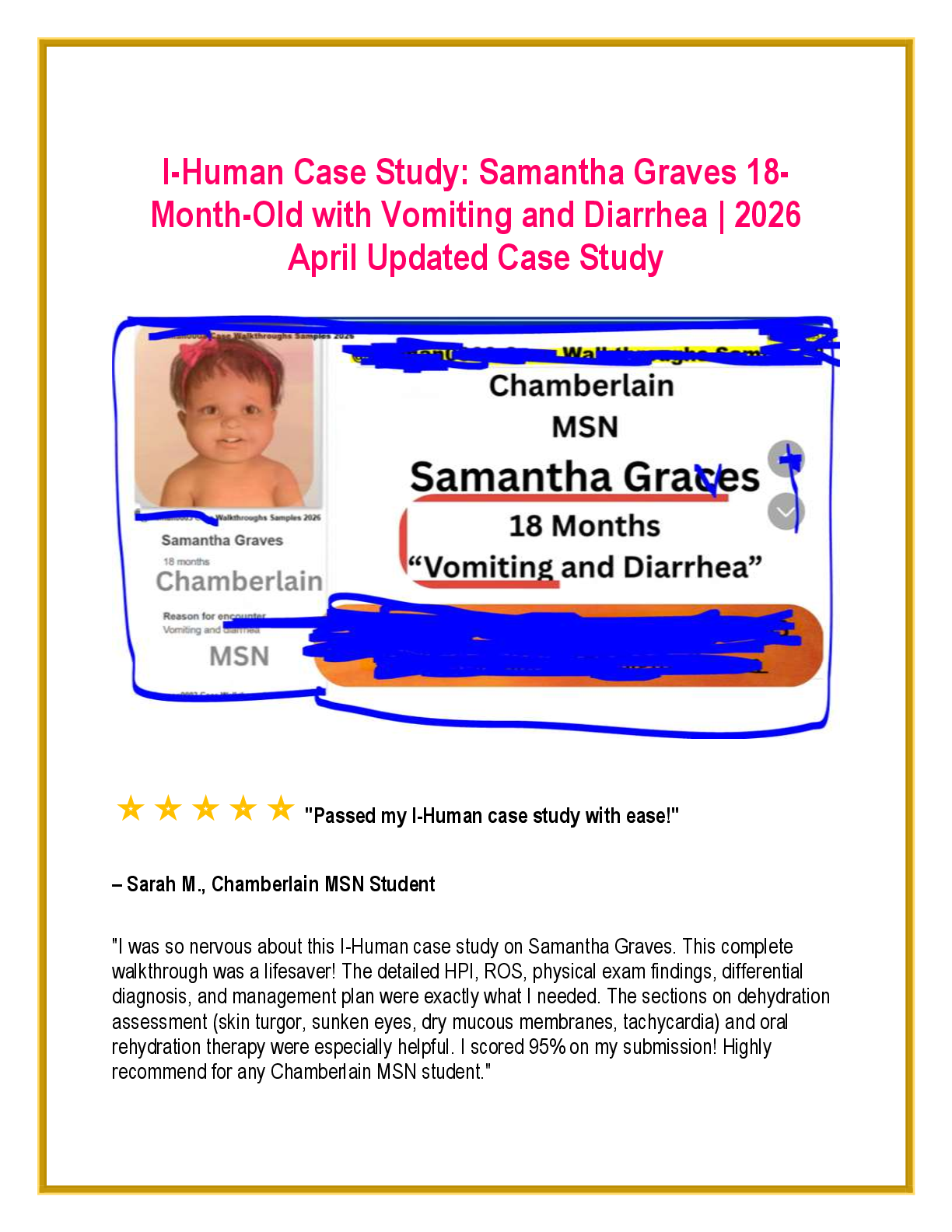
several clinical tests were administered to support the main diagnosis. After the assessment and
the tests, the MRI of the Lumbar spine demonstrated the following
[Show More]







.png)