ANCC PMHNP Cert Exam Review Questions
How do you assess cranial nerve V trigeminal? –
ANSWER Tell patient to close eyes, take piece of cotton or other soft item and lightly touch either one of both sides of each of
...
ANCC PMHNP Cert Exam Review Questions
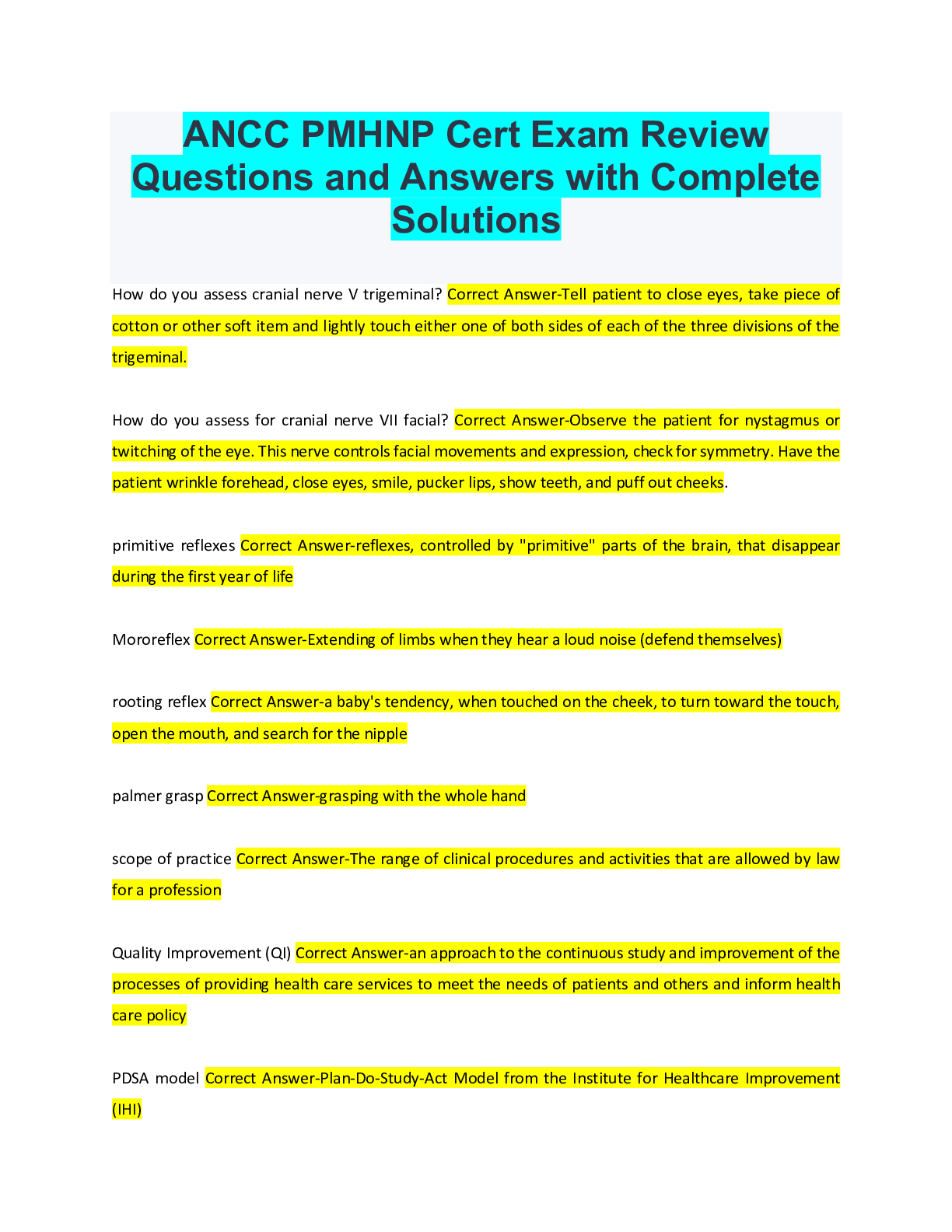
How do you assess cranial nerve V trigeminal? –
ANSWER Tell patient to close eyes, take piece of cotton or other soft item and lightly touch either one of both sides of each of the three divisions of the trigeminal.
How do you assess for cranial nerve VII facial? –
ANSWER Observe the patient for nystagmus or twitching of the eye. This nerve controls facial movements and expression, check for symmetry. Have the patient wrinkle forehead, close eyes, smile, pucker lips, show teeth, and puff out cheeks.
primitive reflexes –
ANSWER reflexes, controlled by "primitive" parts of the brain, that disappear during the first year of life
Mororeflex –
ANSWER Extending of limbs when they hear a loud noise (defend themselves)
rooting reflex –
ANSWER a baby's tendency, when touched on the cheek, to turn toward the touch, open the mouth, and search for the nipple
palmer grasp - ANSWER grasping with the whole hand
scope of practice –
ANSWER The range of clinical procedures and activities that are allowed by law for a profession
Quality Improvement (QI) –
ANSWER an approach to the continuous study and improvement of the processes of providing health care services to meet the needs of patients and others and inform health care policy
PDSA model –
ANSWER Plan-Do-Study-Act Model from the Institute for Healthcare Improvement (IHI)
Trendelenburg sign –
ANSWER Occurs with severe subluxation of one hip
When the child stands on the good leg, the pelvis looks level. When the child stands on the affected leg the pelvis drops toward the good side
CYP450 inhibitors
- ANSWER Fluvoxamine
Fluoxetine
Paroxetine
Duloxetine
Sertraline
CYP450 inducers –
ANSWER Carbamazepine
Phenobarbital
Phenytoin
Rifampin
Griseofulvin
St John's Wort
What is the adverse effect of Depakote on the liver? –
ANSWER can cause liver damage, and the risk is more likely to occur during the first 6 months of taking the medication. Signs might include nausea or vomiting, loss of appetite, abdominal pain, dark-colored urine, facial swelling, and yellowing of the skin or white of eyes
What would you do for a patient on Depakote with +4 protein in the urine? –
ANSWER Rule out UTI, no adjustment for medication is needed
What happens when you take carbamazepine (tegertal) and erythromycin together? - ANSWER It will decrease the effect of the antibiotic by inhibition
What happens when you take zyprexa and smoke? –
ANSWER nicotine will increase the excretion of the drug thereby inhibiting it's effect
ICP in Infants S/S –
ANSWER Bulging fontanels, high-pitch cry, irritability, restlessness
*ICP*
*CHILDREN* signs and symptoms –
ANSWER • Headache
• Vomiting (usually projectile)
• Seizures
• Diplopia (Dbl vision), blurred vision
Neuro cry –
ANSWER high-pitched and very grating on the ears due to their neurological sxs being overwhelmed
Neuroleptic Malignant Syndrome –
ANSWER Adverse reaction to antipsychotics with severe "lead pipe" rigidty, FEVER, and mental status changes.
FEVER:
Fever
Encephalopathy
Vitals unstable
Elevated enzymes
Rigidity of muscles
NMS treatment –
ANSWER Dantrolene
D2 agonists (e.g., bromocriptine).
lead poisoning –
ANSWER A medical condition caused by toxic levels of the metal lead in the blood
Lead poisoning treatment –
ANSWER chelation therapy
Amygdala's role in emotion –
ANSWER – Aggression center
- Role in storing implicit emotional memories
- Stimulation (+) anger/violence or fear/anxiety
- Damage (-) mellow; hyperorality; hypersexuality; dis-inhibited behavior
Amygdala role in aggression –
ANSWER Small volume increase aggression.
Frontal Lobe Atrophy –
ANSWER As neurons die in the frontal and temporal regions, these lobes atrophy, or shrink. Gradually, this damage causes difficulties in thinking and behaviors normally controlled by these parts of the brain. ... Scientists think that FTLD (frontal temporal lobe dementia) is the most common cause of dementia in people younger than age 60
Four dopaminergic pathways –
ANSWER mesocortical
mesolimbic
nigrostriatal
tuberoinfundibular
mesocortical pathway –
ANSWER a path through which dopaminergic projections travel to reach the neocortex
mescolimbic pathway –
ANSWER The mesolimbic pathway, sometimes referred to as the reward pathway, is a dopaminergic pathway in the brain. The pathway connects the ventral tegmental area in the midbrain, to the ventral striatum of the basal ganglia in the forebrain. The ventral striatum includes the nucleus accumbens and the olfactory tubercle.
Nigrostriatal pathway –
ANSWER the dopaminergic tract from the substantia nigra to the striatum
Tuberoinfundibular pathway –
ANSWER from hypothalamus to anterior pituitary -> DA released from these neurons inhibit prolactin secretion -> when DA receptors here are blocked prolactin levels rise cause galactorrhea)
primary prevention –
ANSWER Efforts to prevent an injury or illness from ever occurring.
secondary prevention –
ANSWER Efforts to limit the effects of an injury or illness that you cannot completely prevent, screening exams.
tertiary prevention –
ANSWER actions taken to contain damage once a disease or disability has progressed beyond its early stages
[Show More]


.png)


.png)