PHIL 201 HONORS POSSIBLE QUESTIONS WITH ANSWERS SOLUTION DOCS 2020
• Question 1
3 out of 3 points
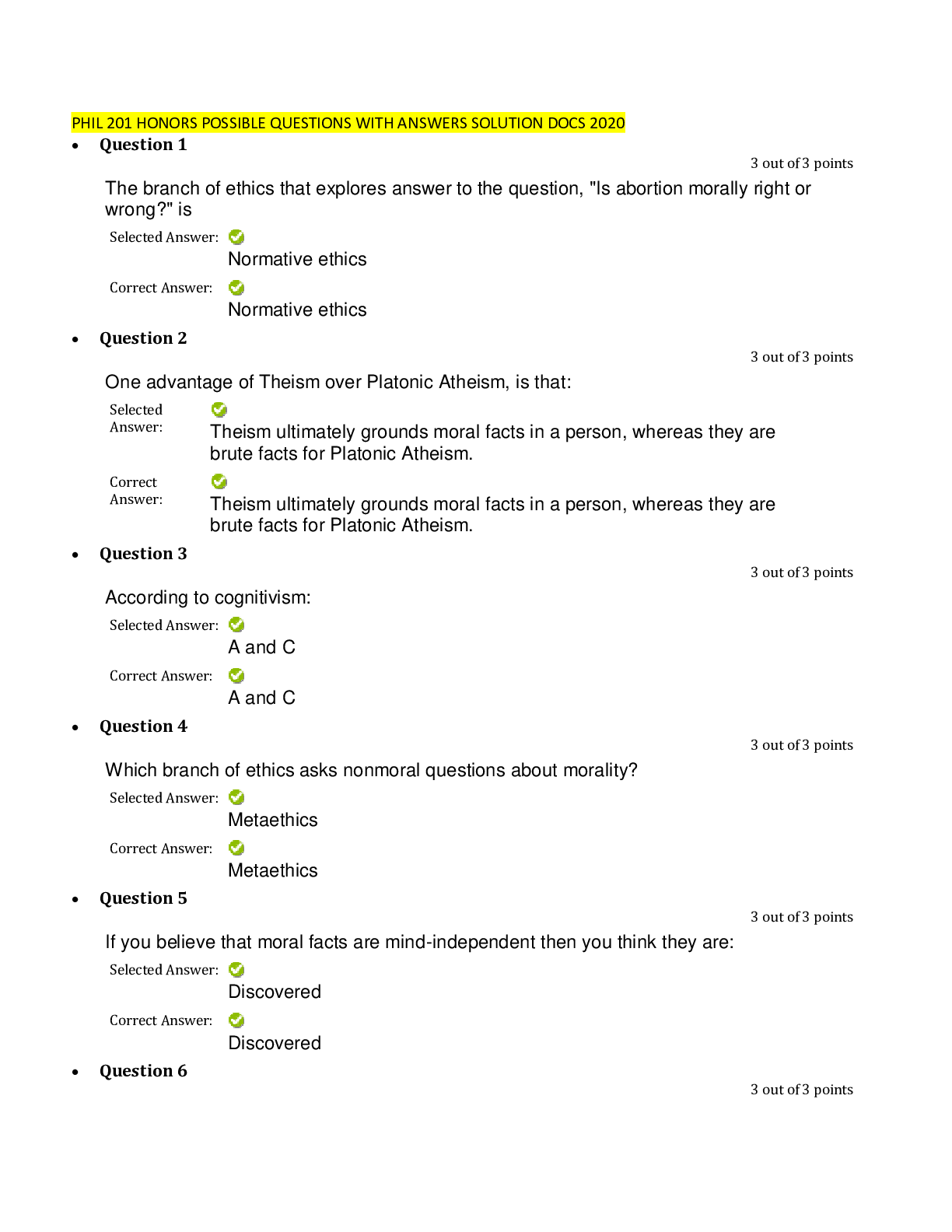
The branch of ethics that explores answer to the question, "Is abortion morally right or wrong?" is
• Que
...
PHIL 201 HONORS POSSIBLE QUESTIONS WITH ANSWERS SOLUTION DOCS 2020
• Question 1
3 out of 3 points
The branch of ethics that explores answer to the question, "Is abortion morally right or wrong?" is
• Question 2
3 out of 3 points
One advantage of Theism over Platonic Atheism, is that:
• Question 3
3 out of 3 points
According to cognitivism:
• Question 4
3 out of 3 points
Which branch of ethics asks nonmoral questions about morality?
• Question 5
3 out of 3 points
If you believe that moral facts are mind-independent then you think they are:
• Question 6
3 out of 3 points
Subjectivist metaethical theories are:
• Question 7
3 out of 3 points
Examples of noncogitivist metaethical theories include:
• Question 8
3 out of 3 points
Objectivist metaethical theories are:
• Question 9
3 out of 3 points
Which branch of ethics attempts to answer moral questions and settle issues about what to do and who to be is:
• Question 10
3 out of 3 points
Just because an individual (or group of individuals) believe something is the case, that doesn't mean it is the case.
• Question 11
3 out of 3 points
According to the atheist Bertrand Russell, if there is no God, then all we can do is build our lives on the firm foundation of unyielding despair.
• Question 12
3 out of 3 points
If you believe that moral facts are mind-dependent then you think they are:
• Question 13
3 out of 3 points
John Stuart Mill, a pioneer of Utilitarian ethics, sought to find an objective morality through an ontological basis of morality.
• Question 14
3 out of 3 points
The Enlightenment philosopher was one of the leading voices for deontological ethics.
• Question 15
3 out of 3 points
Deontological theories are primarily concerned with:
• Question 16
3 out of 3 points
For MacIntyre, the process of judging the intellectual viability of ethical views is a 3-stage process. Which is NOT one of those stages?
• Question 17
3 out of 3 points
The authors note that because Utilitarianism broadens its concern to all people or an entire community, it is an improvement on Egoism.
• Question 18
3 out of 3 points
The authors describe the ancient concept eudaimonia (what Aristotle believed to be the end/purpose of every man) as:
• Question 19
3 out of 3 points
The authors conclude by endorsing which of the ethical systems discussed in the chapter?
• Question 20
3 out of 3 points
In Deontological ethics, “a rule or command that is universally and objectively applicable” is called a:
• Question 21
3 out of 3 points
Teleological ethical theories are primarily concerned with commands to do right, and to avoid wrong-doing.
• Question 22
3 out of 3 points
Alasdair MacIntyre is founded which modern ethical approach?
• Question 23
3 out of 3 points
MacIntyre argues that ethics should be about constructing a unified approach to morality that applies to all people everywhere.
• Question 24
3 out of 3 points
Divine command theory is the ethical theory that claims ethical wrongness:
• Question 25
Needs Grading
Which metaethical theory holds that morality is subjective and grounded in attitudes?
[Show More]