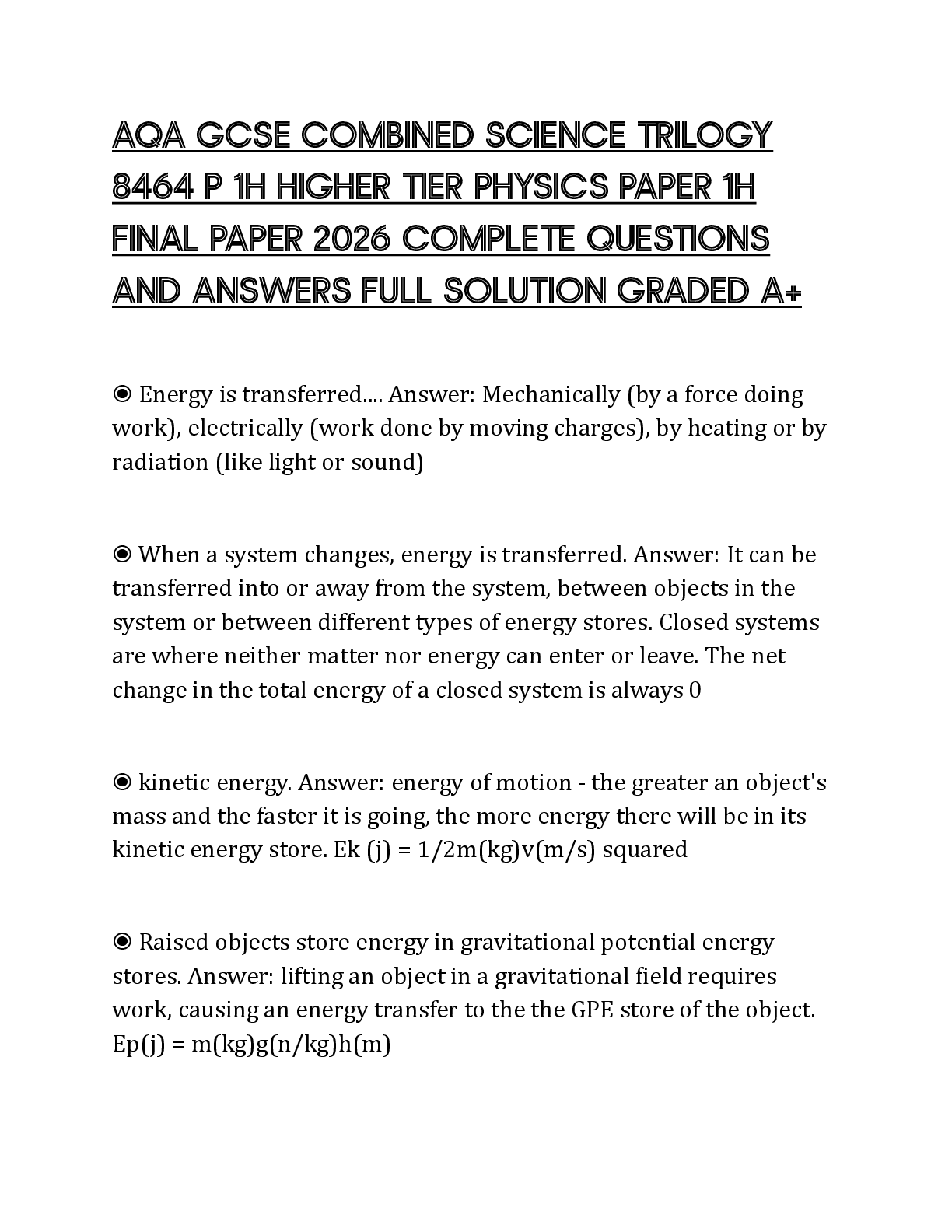
GCSE Physics Electricity Calculations “students should be able to…” Sheet 1
1. Calculate the amount of charge that flows
when a current of 3.8 A flows for 9 minutes.
Time in seconds = 9 x 60 = 540 s
Q = I x t
Q = 3.
...
GCSE Physics Electricity Calculations “students should be able to…” Sheet 1
1. Calculate the amount of charge that flows
when a current of 3.8 A flows for 9 minutes.
Time in seconds = 9 x 60 = 540 s
Q = I x t
Q = 3.8 x 540
Q = 2100 C
Clearly write out your unit conversions. It
means that if you make a mistake, you may
still get marks for your working.
2. Calculate the current when 1.9 C of
charge flows in 18 seconds.
Q = I x t
1.9 = I x 18
I = 1.9 / 18
I = 0.11 A (110 mA)
Always write out the equation in full to
begin your calculation.
3. Calculate the potential difference across a
component with a resistance of 260 Ω when
a current of 35 mA flows through it.
Current in amps = 35 x 10-3 = 0.035 A
V = I x R
V = 0.035 x 260
V = 9.1 V
Look out for unit prefixes before values in
the question.
4. Calculate the resistance of a component
when a potential difference of 1.5 V causes
a current of 23 mA to flow.
Current in amps = 23 x 10-3 = 0.023 A
V = I x R
1.5 = 0.023 x R
R = 1.5 / 0.023
R = 65 Ω
5. Calculate the power output of an
appliance with a potential difference of
240 V and a current of 10.5 A.
P = I x V
P = 10.5 x 240
P = 2500 W
6. Calculate the current through a 3.1 kW
appliance when a potential difference of
200 V is applied.
Power in watts = 3.1 x 103 = 3100 W
P= I x V
3100 = I x 200
I = 3100 / 200
I = 16 A
Always substitute before re-arranging.
7. Calculate the energy transferred when a
4.6 kW appliance is turned on for 30
minutes.
Power in watts = 4.6 x 103 = 4600 W
Time in seconds = 30 x 60 = 1800 s
E = P x t
E = 4600 x 1800
E = 8300000 J (8.3 MJ)
You can use unit prefixes in your answer if it
makes it easier to write down.
8. Calculate the amount of charge that flows
through an appliance when a potential
difference of 24 V transfers 2.7 kJ of energy.
Energy in joules = 2.7 x 103 = 2700 J
E = Q x V
2700 = Q x 24
Q = 2700 / 24
Q = 110 C
9. Calculate the power output of a component with a
resistance of 170 kΩ when a 1700 V potential difference is
applied.
Resistance in ohms = 170 x 103 = 170000 Ω
P = I x R
Need current, use separate equation to calculate current.
V = I x R
1700 = I x 170000
I = 1700 / 170000 = 0.01 A
Calculate power
P = I x V
P = 0.01 x 1700 = 17 W
10. Calculate the decrease in power loss when the
transmission of electrical energy through a power line with
a resistance of 1600 Ω is reduced from 18 A to 7 A.
Calculate corresponding power loss for both currents and
find difference.
P = I2 x R
P1 = 182 x 1600 = 518400 W
P2 = 72 x 1600 = 78400 W
Decrease = P1 – P2 = 518400 - 78400
Decrease = 440000 W (440 kW)
11. Calculate the power output of an appliance that has a
charge flow of 280 C in 3 minutes when a 230 V potential
difference is applied.
Time in seconds = 3 x 60 = 180 s
P = I x V
Need current, use separate equation to calculate current.
Q = I x t
280 = I x 180
I = 280 / 180 = 1.56 A
Calculate power output
P = I x V = 1.56 x 230
P = 360 WGCSE Physics Electricity Calculations “students should be able to…” Sheet 2
1. Calculate the amount of charge that flows
when a current of 3.7 A flows for 9 minutes.
Time in seconds = 9 x 60 = 540 s
Q = I x t
Q = 3.7 x 540
Q = 2000 C
Clearly write out your unit conversions. It
means that if you make a mistake, you may
still get marks for your working.
2. Calculate the current when 1.9 C of
charge flows in 13 seconds.
Q = I x t
1.9 = I x 13
I = 1.9 / 13
I = 0.15 A (150 mA)
Always write out the equation in full to
begin your calculation.
3. Calculate the potential difference across a
component with a resistance of 240 Ω when
a current of 22 mA flows through it.
Current in amps = 22 x 10-3 = 0.022 A
V = I x R
V = 0.022 x 240
V = 5.3 V
Look out for unit prefixes before values in
the question.
4. Calculate the resistance of a component
when a potential difference of 2.5 V causes
a current of 15 mA to flow.
Current in amps = 15 x 10-3 = 0.015 A
V = I x R
2.5 = 0.015 x R
R = 2.5 / 0.015
R = 170 Ω
5. Calculate the power output of an
appliance with a potential difference of
240 V and a current of 6 A.
P = I x V
P = 6 x 240
P = 1400 W
6. Calculate the current through a 4.8 kW
appliance when a potential difference of
160 V is applied.
Power in watts = 4.8 x 103 = 4800 W
P= I x V
4800 = I x 160
I = 4800 / 160
I = 30 A
Always substitute before re-arranging.
7. Calculate the energy transferred when a 3
kW appliance is turned on for 40 minutes.
Power in watts = 3 x 103 = 3000 W
Time in seconds = 40 x 60 = 2400 s
E = P x t
E = 3000 x 2400
E = 7200000 J (7.2 MJ)
You can use unit prefixes in your answer if it
makes it easier to write down.
8. Calculate the amount of charge that flows
through an appliance when a potential
difference of 28 V transfers 1.9 kJ of energy.
Energy in joules = 1.9 x 103 = 1900 J
E = Q x V
1900 = Q x 28
Q = 1900 / 28
Q = 68 C
9. Calculate the power output of a component with a
resistance of 220 kΩ when a 800 V potential difference is
applied.
Resistance in ohms = 220 x 103 = 220000 Ω
P = I x R
Need current, use separate equation to calculate current.
V = I x R
800 = I x 220000
I = 800 / 220000 = 0.0036 A
Calculate power
P = I x V
P = 0.0036 x 800 = 2.9 W
10. Calculate the decrease in power loss when the
transmission of electrical energy through a power line with
a resistance of 2400 Ω is reduced from 16 A to 9 A.
Calculate corresponding power loss for both currents and
find difference.
P = I2 x R
P1 = 162 x 2400 = 614400 W
P2 = 92 x 2400 = 194400 W
Decrease = P1 – P2 = 614400 - 194400
Decrease = 420000 W (420 kW)
11. Calculate the power output of an appliance that has a
charge flow of 400 C in 9 minutes when a 231 V potential
difference is applied.
Time in seconds = 9 x 60 = 540 s
P = I x V
Need current, use separate equation to calculate current.
Q = I x t
400 = I x 540
I = 400 / 540 = 0.741 A
Calculate power output
P = I x V = 0.741 x 231
P = 170 WGCSE Physics Electricity Calculations “students should be able to…” Sheet 3
1. Calculate the amount of charge that flows
when a current of 5.4 A flows for 6 minutes.
Time in seconds = 6 x 60 = 360 s
Q = I x t
Q = 5.4 x 360
Q = 1900 C
Clearly write out your unit conversions. It
means that if you make a mistake, you may
still get marks for your working.
2. Calculate the current when 0.3 C of
charge flows in 23 seconds.
Q = I x t
0.3 = I x 23
I = 0.3 / 23
I = 0.013 A (13 mA)
Always write out the equation in full to
begin your calculation.
3. Calculate the potential difference across a
component with a resistance of 450 Ω when
a current of 47 mA flows through it.
Current in amps = 47 x 10-3 = 0.047 A
V = I x R
V = 0.047 x 450
V = 21 V
Look out for unit prefixes before values in
the question.
4. Calculate the resistance of a component
when a potential difference of 3.5 V causes
a current of 40 mA to flow.
Current in amps = 40 x 10-3 = 0.04 A
V = I x R
3.5 = 0.04 x R
R = 3.5 / 0.04
R = 88 Ω
5. Calculate the power output of an
appliance with a potential difference of
230 V and a current of 6 A.
P = I x V
P = 6 x 230
P = 1400 W
6. Calculate the current through a 7.2 kW
appliance when a potential difference of
120 V is applied.
Power in watts = 7.2 x 103 = 7200 W
P= I x V
7200 = I x 120
I = 7200 / 120
I = 60 A
Always substitute before re-arranging.
7. Calculate the energy transferred when a
3.8 kW appliance is turned on for 35
minutes.
Power in watts = 3.8 x 103 = 3800 W
Time in seconds = 35 x 60 = 2100 s
E = P x t
E = 3800 x 2100
E = 8000000 J (8 MJ)
You can use unit prefixes in your answer if it
makes it easier to write down.
8. Calculate the amount of charge that flows
through an appliance when a potential
difference of 14 V transfers 1.3 kJ of energy.
Energy in joules = 1.3 x 103 = 1300 J
E = Q x V
1300 = Q x 14
Q = 1300 / 14
Q = 93 C
9. Calculate the power output of a component with a
resistance of 210 kΩ when a 1300 V potential difference is
applied.
Resistance in ohms = 210 x 103 = 210000 Ω
P = I x R
Need current, use separate equation to calculate current.
V = I x R
1300 = I x 210000
I = 1300 / 210000 = 0.0062 A
Calculate power
P = I x V
P = 0.0062 x 1300 = 8.1 W
10. Calculate the decrease in power loss when the
transmission of electrical energy through a power line with
a resistance of 1700 Ω is reduced from 23 A to 4 A.
Calculate corresponding power loss for both currents and
find difference.
P = I2 x R
P1 = 232 x 1700 = 899300 W
P2 = 42 x 1700 = 27200 W
Decrease = P1 – P2 = 899300 - 27200
Decrease = 870000 W (870 kW)
11. Calculate the power output of an appliance that has a
charge flow of 470 C in 2 minutes when a 232 V potential
difference is applied.
Time in seconds = 2 x 60 = 120 s
P = I x V
Need current, use separate equation to calculate current.
Q = I x t
470 = I x 120
I = 470 / 120 = 3.92 A
Calculate power output
P = I x V = 3.92 x 232
P = 910 W
[Show More]




.png)
.png)