Health Care > STUDY GUIDE > NR 283 PATHOPHYSIOLOGY EXAM 2 STUDY GUIDE (All)
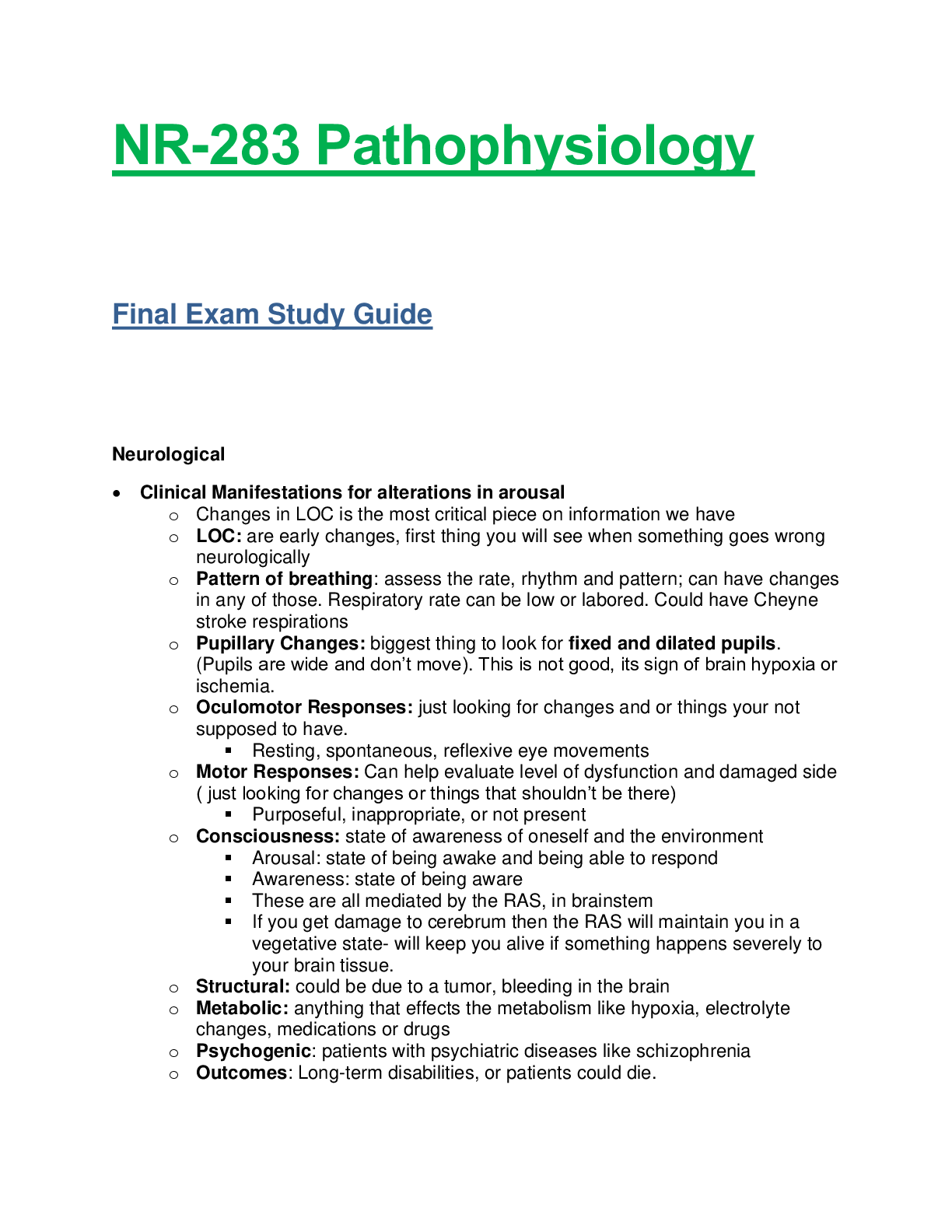
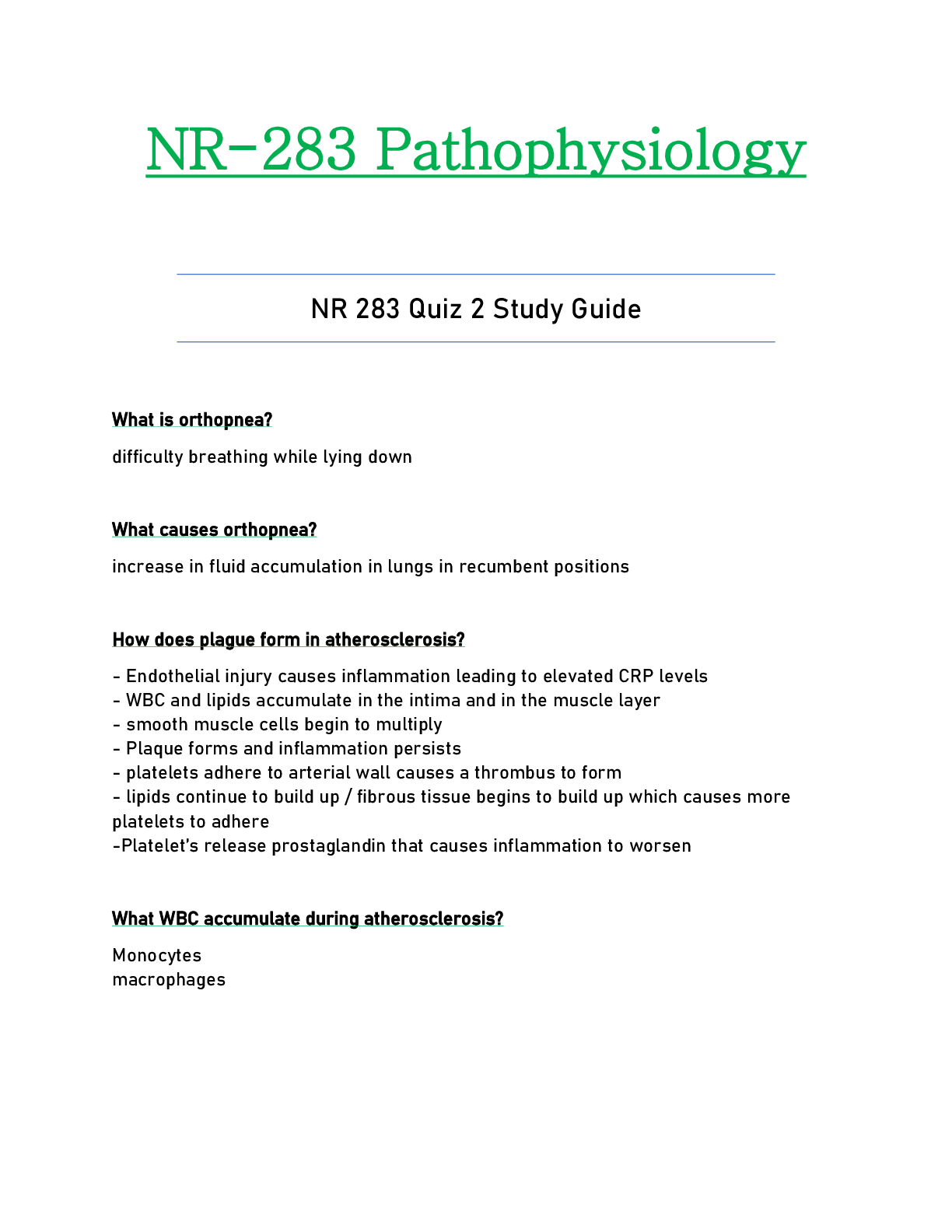
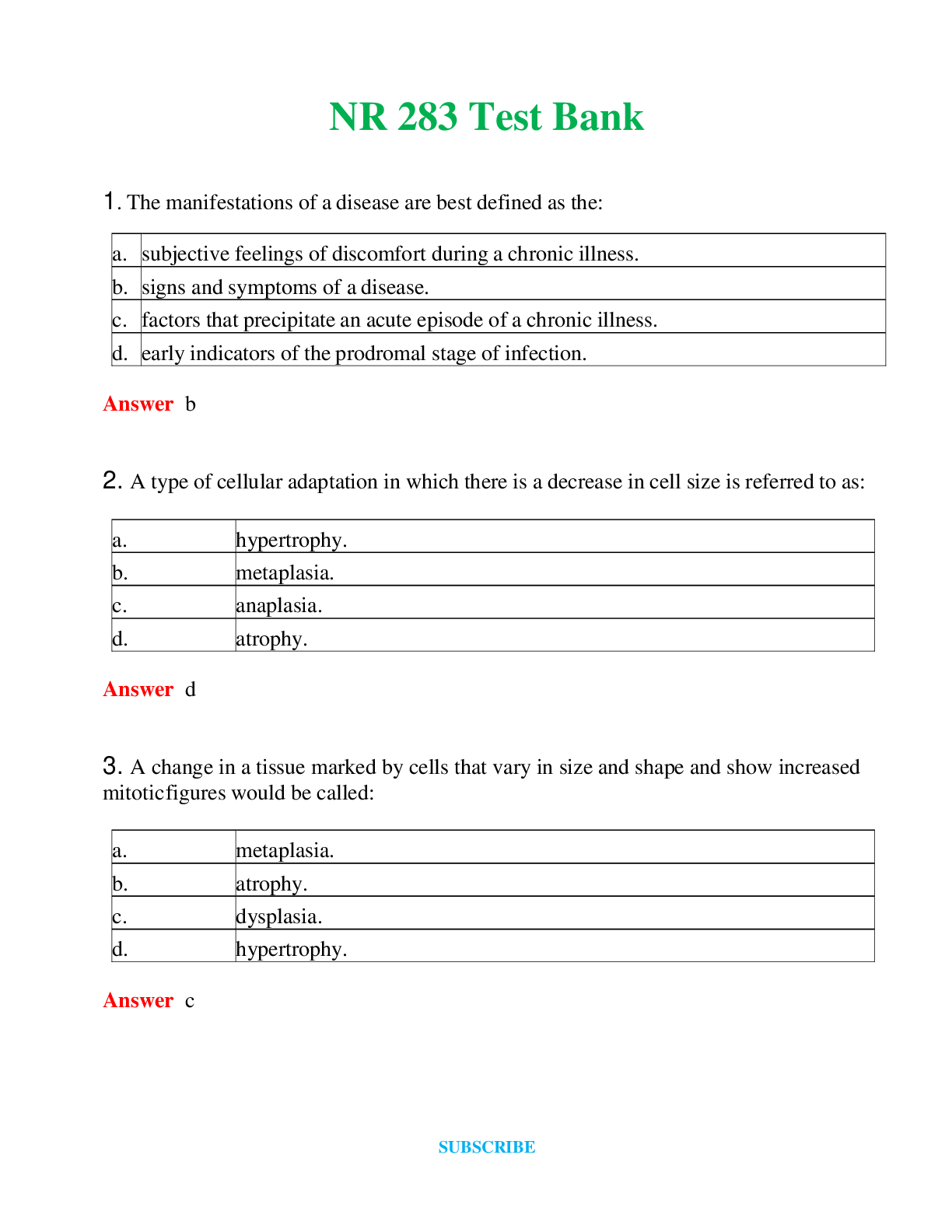
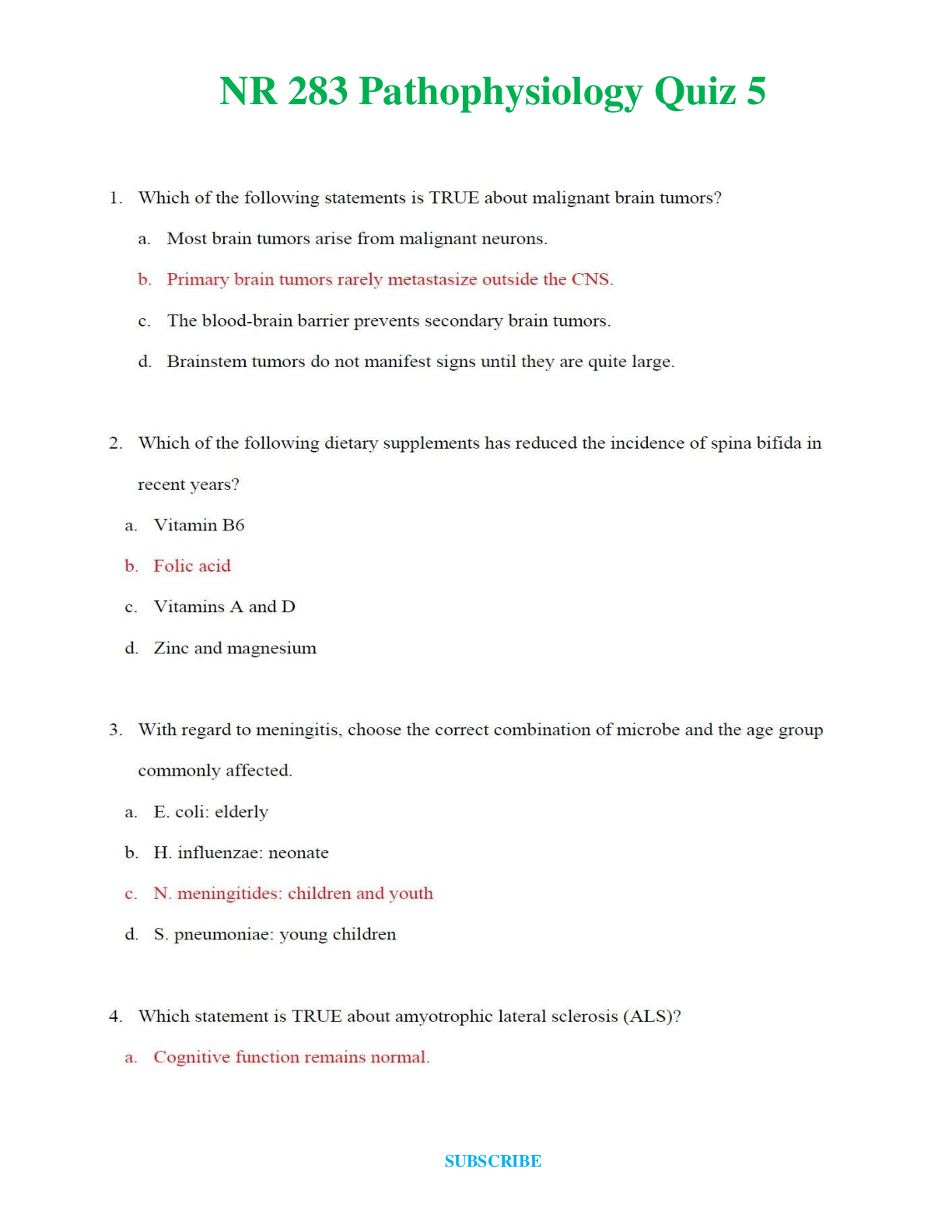
NR 283 PATHOPHYSIOLOGY EXAM 2 STUDY GUIDE Chapter 8: Skin Disorders 1.Viral infections a.Take antiviral to reduce viral shedding (can’t proliferate) 2.Autoimmune skin disorders a.Shingles b.Pe ... mphigus blisters i.2 forms = vulgaris & foliaceus ii.Antibodies disrupt the cohesion between the epidermal cells causing blisters to form iii.Treatment = systemic glucocorticoids such as prednisone & other immunosuppressants 3.Psoriasis a.A chronic inflammatory skin disorder caused by abnormal T cell activation b.Cells are shedding epithelium a lot faster than they should (increased mitosis) = flakiness c.lesions found on face, scalp, elbows & knees d.Treatment = glucocorticoids, tar preparations & antimetabolites 4.HSV I and HSV II (Herpes Simplex Virus I & II) a.Type I = cold sores & fever blister b.Type II = genital c.Spread by direct contact 5.HPV (Human Papilloma Virus) a.Types 1-4 = plantar warts b.Types 6 & 11 = genital warts c.Predisposing factor: Cancer Cervical 6.Fungal infections (mycoses) a.Most are superficial b.Diagnosed by skin scrapings c.Treatment = topical antifungal d.Athletes foot = Tinea pedis & Tinea capitis = cradle cap 7.Scabies a.Invasion by mite bite (female burrows, male fertilizes the female & dies, female lays eggs & dies, repeat) b.highly communicable in any setting and does not respect social status i.put patient in a private room ii.nurse should wear gloves & gown c.Itchy; Burrows appear on the skin as tiny, brown lines d.Common sites = between the fingers, wrists, inner surface of elbow & waistline e.Treatment = lindane (gamma-hexachlorocyclohexane) 8.Contact dermatitis a.Exposure to an allergen = Pruritic rash (wool, itchy) b.No immune response c.Treatment = topical glucocorticoid 9.Atopic dermatitis (eczema) a.A common problem in infancy & may persist in adulthood b.A familial type I hypersensitivity often associated with hay fever & asthma c.Atopic = refers to an inherited tendency toward allergic conditions d.Etiology = chronic inflammation results from the response to allergens; eosinophilia (high level of WBCs in the blood) & increased serum IgE levels indicate the allergic basis e.S&S = pruritic lesions, skin appears dry & scaly f.Treatment = avoid aggravating agents & topical glucocorticoids [Show More]
Last updated: 3 years ago
Preview 1 out of 15 pages
Buy this document to get the full access instantly
Instant Download Access after purchase
Buy NowInstant download
We Accept:
Can't find what you want? Try our AI powered Search
Connected school, study & course
About the document
Uploaded On
Jul 16, 2022
Number of pages
15
Written in
All
This document has been written for:
Uploaded
Jul 16, 2022
Downloads
0
Views
125
Scholarfriends.com Online Platform by Browsegrades Inc. 651N South Broad St, Middletown DE. United States.
We're available through e-mail, Twitter, and live chat.
FAQ
Questions? Leave a message!
Copyright © Scholarfriends · High quality services·