When selecting an NCLEX answer or determining the order of priority what should you remember or use and what is the exception? - ANSWER Use the ABC rule: Airway breathing, and circulation. The exception to the rule is wi
...
When selecting an NCLEX answer or determining the order of priority what should you remember or use and what is the exception? - ANSWER Use the ABC rule: Airway breathing, and circulation. The exception to the rule is with actual CPR, use C-A-B for CPR. Also remember safety first and acute before chronic. If the pt. is not in distress then you assess. If the pt is in distress then you should do something. If the pt has diaphorisis you should always do something.
How should you address questions related to Maslow's Hierarchy of Needs - ANSWER Address physiological needs first, followed by safety and security needs, love and belonging needs, self esteem needs and finally self actualization needs. *When a physiological need is not addressed in the question, look for the option that addresses safety.
If a question is related to the nursing process, read the question to determine the step of the nursing process. What are the steps in the nursing process and what kind of question might be related to that step. - ANSWER Assessment question address the gathering and verification of data.
Analysis questions require the nurse to: interpret data, collect additional information, identify and communicate nursing diagnoses and determine the health team's ability to meet the pts needs.
Planning questions ask about determining, prioritizing, and modifying outcomes of care.
Implementation questions reflect the management and organization of care and the assignment and delegation of tasks. Be prepared for questions on client teaching.
Evaluation questions focus on comparing the actual outcomes of care with the expected outcomes and on communicating and documenting findings.
What are the normal ranges for H&H? What are the nursing implications - ANSWER Hemoglobin - Male 14-18 Female 12-16 Newborn 14-24
High altitude living increases value, slight decrease during pregnancy. Drug therapy can alter values.
Hematocrit - Male 42-52 Female 37-47 Newborn 44-64
Prolonged stasis from vasoconstriction secondary to the tourniquet can alter values. Abnormalities in RBC size may alter Hct values
What are the normal ranges for WBC?
What can increase values?
What can decrease values?
How long does the postpartum period of pregnancy affect normal ranges? What range is normal during the postpartum period? - ANSWER Both genders 5000-10000 Newborn 9000-30000
Anesthetics, stress, exercise, and convulsions can increased values.
Drug therapy can decrease values.
24-28 hr postpartum: a count as high as 25000 is normal
What are the normal ranges for RBC?
What can increase levels
What happens to levels during pregnancy? - ANSWER Males: 4.7-6.1 million
Female: 4.2-5.4 million
Exercise and high altitudes can cause an increase levels
pregnancy usually lower values
drug therapy can alter values
Never draw a specimen from an arm with an infusing IV.
What are the normal ranges for PLATELETS?
What may increase values?
What may decrease values?
What drugs decrease values? - ANSWER Both Genders: 150000-400000
Living at high altitudes, exercising strenuously or taking oral contraceptives may increase values
decreased values may be caused by hemorrhage, DIC, reduced production of platelets, infections, use of prosthetic heart valves, and drugs.
Drugs that decrease platelets: acetaminophen, aspirin, chemotherapy, H2 blockers, INH, Levaquin, streptomycin, sulfonamides, thiazide diuretics.
What are the normal ranges for K+? What should you keep in mind when getting a specimen? - ANSWER 3.5-5 is normal range for potassium
Exercise of the forearm with tourniquet in place may cause an increased level. Hemolysis of specimen can result in a falsely elevated value
What are the normal ranges for Na+? What should you consider when collecting a specimen? - ANSWER 136-145 is a normal sodium range
Do Not collect from an arm with an infusing IV solution
What are the normal ranges for Ca+?
What type of drug can increase calcium levels?
What are two tests with positive results that are associated with hypocalcemia?
How do you preform the two tests? - ANSWER 9-10.5 for adults. slightly lower in the elder
Use of thiazide diuretics can cause increased levels of calcium
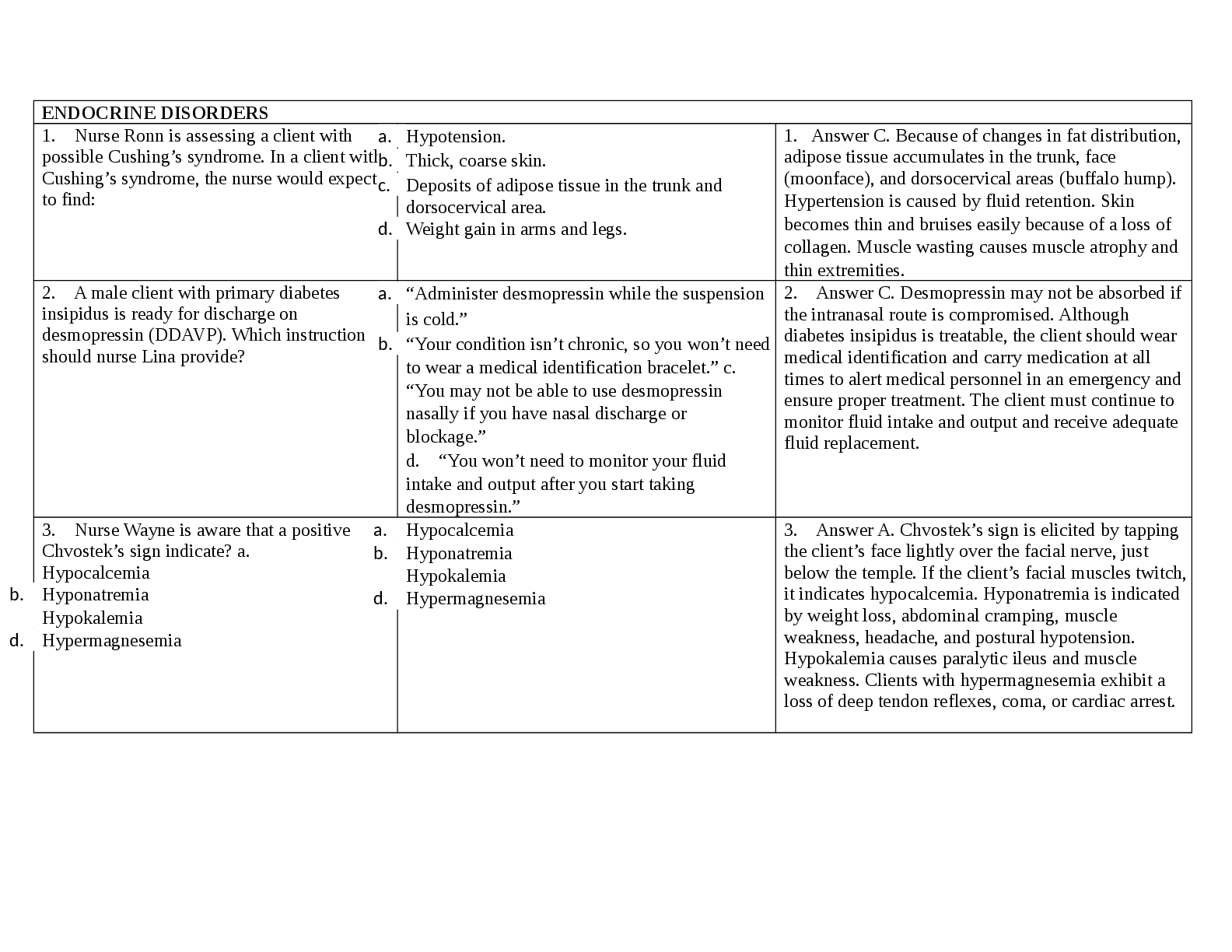
Positive Chvostek and Trousseau tests are associated with hypocalcemia.
• Chvostek sign: contraction of ipsilateral facial muscles when the facial nerve is tapped just in front of the ear.
• Trousseau sign: carpopedal spasm elicited by inflating a sphygmomanometer above systolic BP for 3 minutes.
What are the normal ranges for Mg+?
What may high magnesium levels indicate?
What may low magnesium levels indicate? - ANSWER 1.7-2.2
A high magnesium level may indicate: Addison disease
Chronic renal failure, Dehydration, Diabetic acidosis
Oliguria
A low magnesium level may indicate: Alcoholism
Chronic diarrhea, Delirium tremens, Hemodialysis
Hepatic (liver) cirrhosis, Hyperaldosteronism
Hypoparathyroidism, Pancreatitis, Too much insulin
Toxemia of pregnancy, Ulcerative colitis
What are the normal ranges for Cl- - ANSWER 98-106 is the normal range for chloride
What are the normal ranges for ALP (alkaline phosphatase)? - ANSWER 30-120
slightly increased in the elderly
What are the normal ranges for BUN?
What does BUN stand for?
What is the ratio of BUN-creatinine?
What does it indicate? - ANSWER 10-20
blood urea nitrogen
BUN-creatinine ratio of 20:1 indicates adequate kidney functioning
What are the normal ranges for Creatinine?
What is the ratio of BUN-creatinine?
What does it indicate? - ANSWER Male 0.6-1.2
Female 0.5-1.1
BUN-creatinine ratio of 20:1 indicates adequate kidney functioning
What is the relationship of Ca+ and PO4?
What is the relationship of Ca+ and pH? - ANSWER calcium and phosphorus have an inverse relationship: when calcium levels increase, phosphorus levels decrease, and vice versa.
pH also affects the level of ionized calcium:
As pH rises and blood becomes more alkalotic, calcium binds more easily with protein, causing the level of ionized calcium to drop.
Conversely, when pH falls, causing acidosis, less calcium binds with protein, which raises the ionized calcium level
What are the normal ranges for ABGs?
(pH, pCO2, HCO3) - ANSWER pH (AC) 7.35-7.45 (AL)
pCo2 (AL) 35 - 45 (AC)
HCO3 (AC) 22 - 26 (AL)
What are the normal ranges for PT? What is PT used to help regulate? What is the therapeutic range? - ANSWER 11-12.5 is a normal PT range
PT is used to help regulate Coumadin dosages. The therapeutic range: 1.5 to 2 times normal or control
What are the normal ranges for INR?
What type of patients should have individualized values
What should the values be for those patients? - ANSWER 0.8-1.1 normal INR
Individualized values for pts with:
Afib and DVT between 2.0 and 3.0
mechanical heart valves between 3.0 to 4.0
What are the normal ranges for PTT and aPTT? What do they help regulate? What is the therapeutic range? - ANSWER normal range PTT: 60-70
normal range aPTT: 30-40
Both PTT and aPTT are used to help regulate heparin dosages.
Therapeutic range is 1.5 to 2.5 times normal or control
What are the 7 Rights of medication administration? - ANSWER 1. Right drug
2. right dose
3. Right route
4. Right time
5. Right patient
6. Right documentation
7. Right to refuse
When should you draw a peak level? - ANSWER 30-60 minutes after medication administration
When should you draw a trough level? - ANSWER 30-60 minutes before medication administration
When introducing foods to infants what should you teach the new parents? - ANSWER Introduce one food at a time to help identify allergies.
Progression of food should be "AS TOLERATED"
The nursing assessment guides decisions about progression.
What is civil law concerned with? - ANSWER Protection of the patients private rights
What does criminal law deal with? - ANSWER Rights of individuals and society as defined by legislative laws
What is nursing negligence - ANSWER Negligence is malpractice that is NOT intentional. It is the failure to exercise the proper degree of care required by the circumstances that a reasonably prudent person would exercise under the circumstances to avoid harming others. It is a careless act of omission or commission that results in injury to another.
What is nursing malpractice? - ANSWER Malpractice is not always negligence. It is often referred to as professional negligence, it is a type of negligence. It is the failure to use that degree of care that a reasonable nurse would use under the same or similar circumstances. Malpractice is found when:
*The nurse owed a duty to the patient
*The nurse did NOT carry out the duty/breached that duty
*The patient was at a high risk of injury
* The nurse's failure to carry out that duty caused the patients injury
Where do Standards of Care originate? - ANSWER Nurses are required to follow standards of care, which originate in the Nurse Practice Acts, state and federal laws, accreditation recommendations, the guidelines of professional organizations, and the written policies and procedures of the healthcare agency
What are nurses responsible for related to the standards of care? - ANSWER Nurses are responsible for performing procedures correctly and exercising professional judgment when implementing healthcare providers prescriptions.
When can the nurse NOT follow the healthcare provider's prescription and what must they do about it? - ANSWER Nurses MUST follow the healthcare provider's prescription unless the nurse believes that it is in error; that it violates hospital policy; or that it is harmful to the patient. The nurse makes a formal report explaining the refusal. The nurse should file an incident (occurrence) report for any situation that may result in harm to the patient.
What should the nurse do related to advanced medical directives (ADs) - ANSWER Assess the patients knowledge of advance directives.
Integrate them into the patients plan of care
Provide the patient with information about advanced directives or review ADs on admission.
Have the knowledge that ADs can limit life-prolonging measures when there is little or no chance of recovery
What is documented in a living will? - ANSWER A person documents his or her wishes regarding future care in the event of terminal illness
What is a durable power of attorney for healthcare? - ANSWER The person appoints a representative (healthcare proxy) to make healthcare decisions in a document
When can restraints be used? What must the nurse do if restraints are used? - ANSWER Restraints can be used only: to ensure the physcial safety of the patient or other residents, when less restrictive interventions are not successful, and must have a written order of a HCP. The nurse must follow agency policy and procedure to retrain any client, Documentation of the use of restraints and of follow-up assessments must detail the attempts to use less restrictive interventions. Liability for improper or unlawful restraint lies with the nurse and the healthcare facility. 30 min pulse checks, 2 hr ROM, one on one,
Related to mental Health, how long can an involuntary admission last? - ANSWER 72 hours
What is HIPPA and what does it require? - ANSWER Health Insurance Portability and Accountability Act of 1996 established standards for the verbal, written and electronic exchange of private health information. HIPPA created patient rights to consent to use and disclose health information, to inspect and copy one's medical record, and to amend mistaken or incomplete information. HIPPA requires all hospitals and health agencies to have specific policies and procedures in place to ensure compliance with its standards.
What is required for informed consent to be valid? - ANSWER the patient giving consent must be competent and of legal age. The consent is given voluntarily. The patient giving consent understands the procedure, risks/benefits, and alternative procedures. The patient has the right to have all questions answered satisfactorily. It is the duty of the HCP performing the procedure or treatment to obtain informed consent and to answer any questions the patient might have about the procedure. The RN is witnessing the signature not providing informed consent.
what type of communication and leadership is it if the person says "do it my way"? - ANSWER Aggressive communication/authoritarian leader
What type of communication and leadership is it if the persons says "Whatever...as long as you like me." - ANSWER Passive communication/laissez-faire leader
What type of communication and leadership is it if the person says "Lets consider the options available."? - ANSWER Assertive communication/democratic leader
What are the five rights of delegation? - ANSWER 1. right task
2. right circumstance
3. right person
4. right direction/communication
5. right supervision
What skills are needed for Supervision - ANSWER Be able to:
give direction/guidance
evaluate/monitor
following up
What is the acronym S-BAR stand for? - ANSWER It is a interdisciplinary communication strategy that promotes effective communication between caregivers
S = situation - State the issue or problem
B = background - provide history
A = assessment - most recent VS and current findings
R = recommendation - state what should be done
What are the 3 categories of pain medications - ANSWER 1. non-opioids: for mild pain or in combination for moderate pain
2. Opioids: for moderate to severe pain
3. Co-analgesic or adjuvant drugs (i.e. anticonvulsants, antidepressants) for neuropathic pain
Name 4 types of Nonopioid Analgesics - ANSWER 1. Acetaminophen: Tylenol
2. Salicylates: Aspirin, Trilisate
3. NSAIDS: ibuprofen, Indomethacin, Ketorolac, Diclofenac
4. COX-2 inhibitors: Celebrex
What type of drug is Aspirin? - ANSWER Non opioid Analgesic
Salicylates
Choline magnesium trisaliclate (Trilisate) is another type of non opioid Analgesic salicylates
Acetaminophen (Tylenol) is what type of drug?
What is the maximum recommended dosage?
What should you monitor? - ANSWER Nonopioid Analgesics.
Max dose: 4000 mg (4 g) in 24 hrs
Monitor liver function
What have NSAIDs (except aspirin) been linked to and what type of patient should not take NSAIDs? - ANSWER NSAIDs (except aspirin) have been linked to a higher risk for increased cardiovascular events, such as myocardial infarction, stroke, and heart failure. Patients who have just had heart surgery should not take NSAIDs. NSAIDs are very hard on the stomach. NO NSAIDs for Cardiac patient.
At what pain level should an Opioid Analgesic be considered? - ANSWER Pain level of 6 or greater. Opioids are used for moderate to severe pain.
DO NOT delegate what you can EAT - ANSWER E = evaluate
A = assess
T = teach
What are some examples of Non-opioid Analgesic pain medications - ANSWER Acetaminophen (Tylenol)
Salicylates:
- Aspirin
- Choline magnesium trisalcylate (Trilisate)
NSAIDs:
- Ibuprofen
- Indomethacin
- Ketorolac
- Diclofenac K
Cyclooxygenase-2 (COX-2) inhibitors
- Celecoxib
What are some types of Analgesics (used for moderate to severe pain)? - ANSWER Mu agonists
- Morphine
- Hydromorphone
- Methadone
- Levorphanol
- Fentanyl
- Oxycodone
- Codeine (Tylenol No.3)
Mixed agonist-antagonists
- Pentazocine
-Butorphanol
Partial agonists
- Nuprenorphine
-Buprenorphine plus naloxone
Adjuvant drugs
- used for neuropathic pain
- Antiepileptic drugs, antidepressants, and anesthetics are prescribed alone or in combination with opioids for neuropathic pain,
- Corticosteroids
What is a Mu agonist? - ANSWER The so-called agonist-antagonist drugs have a relationship to the opioid receptors that includes activation and blockade. Some of these drugs activate one type of opioid receptor, known as the kappa receptor, while blocking another, the mu receptor
When an opioid is prescribed in combination with a nonopioid analgesic, such as acetaminophen or a NSAID, what should you monitor? - ANSWER The daily dose
Name 5 non-invasive non-pharmacological pain relief techniques (1st choice of pain relief) - ANSWER Ten's
heat and cold application
message therapy
relaxation techniques
guided imagery
biofeedback techniques
Name 3 Invasive non-pharmacological pain relief techniques. - ANSWER Nerve blocks
Interruption of neural pathways
Acupuncture
What can cause fluid volume excess? - ANSWER CHF (most common)
Renal failure
cirrhosis
overhydration
What are the symptoms of fluid volume excess? - ANSWER Peripheral edema
periorbital edema
elevated BP
dyspnea
ALOC
What may be some Lab findings r/t fld volume excess - ANSWER Everything will be decreased
Decreased: BUN, Hgb/Hct, serum osmolality, urine specific gravity and electrolytes
How would you treat fluid volume excess? - ANSWER Give Diuretics (Lasix), fluid restrictions, weigh daily, monitor K+
What can cause a fluid volume deficit - ANSWER Inadequate fluid intake
hemorrhage
vomiting or diarrhea
massive edema
What are some symptoms of fluid volume deficit - ANSWER weight loss
oliguria (not enough urine)
postural hypotension
What lab findings may be present with a fluid volume deficit? - ANSWER Increased BUN
Increased or normal creatinine
Increased H/H
Increased urine specific gravity
How do you treat fluid volume deficits? - ANSWER Strict I&O
Replace with isotonic fluids
monitor Bp
weight daily
What is most important to remember about intracellular electrolyte balance? - ANSWER That potassium K+ maintains osmotic pressure and if K+ is not in balance it may be life threatening.
What is most important to remember about extracellular electrolyte balance? - ANSWER That sodium Na+ maintains most abundant osmotic pressure. When either the ECF or the ICF changes in concentration, fluid shifts from the area of lesser concentration to the area of greater concentration.
What is Hyponatremia? Symptoms? and How should you treat it - ANSWER Hyponatremia is a sodium (Na+) level less than 135 mEq/L, it creates Neuro/confusion and muscle cramps. Check blood pressure often, restrict fluids, and be cautious with IV fluid replacement.
What is Hypernatremia? What symptoms might you see? How should you treat it? - ANSWER Na+ greater than 145 mEq/L
May see:
Pulmonary edema
Neuro: seizures, thirst, fever.
Do Not Use Ivs that contain sodium
Restrict sodium diet
Weigh daily
[Show More]