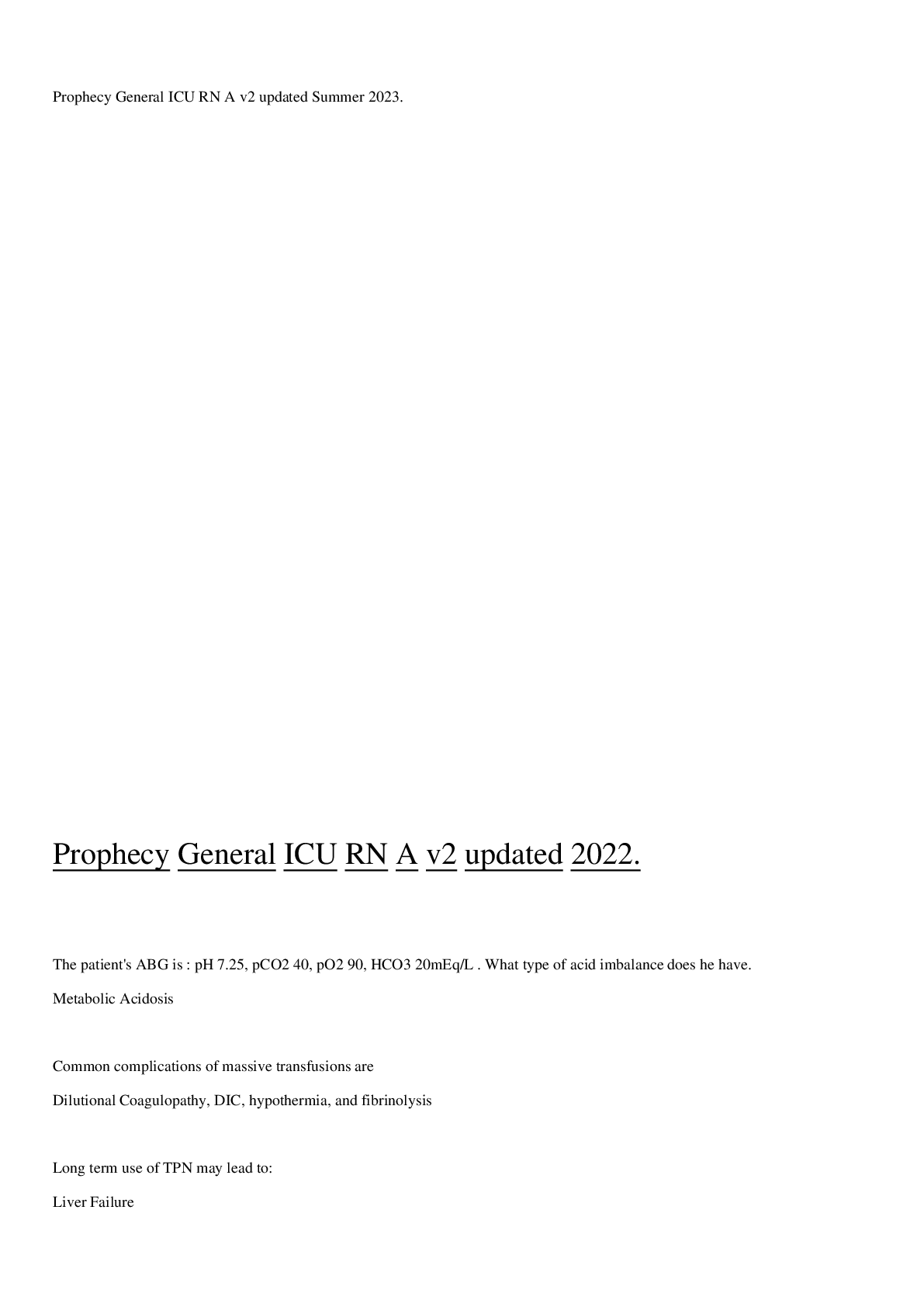
Common complications of massive transfusions are - ANSWER Dilutional Coagulopathy, DIC, hypothermia, and fibrinolysis
ABG pH 7.25, pCO2 40, pO2 90, HCO3 20mEq/L - Metabolic Acidosis
Long term use of TPN may lead to
...
Common complications of massive transfusions are - ANSWER Dilutional Coagulopathy, DIC, hypothermia, and fibrinolysis
ABG pH 7.25, pCO2 40, pO2 90, HCO3 20mEq/L - Metabolic Acidosis
Long term use of TPN may lead to: - Liver Failure
Which of the following is a potential complication of high PEEP - Pneumothorax
What is a common assessment finding for a patient returning from a small bowel resection? - ANSWER Hypoactive bowel sounds
Your patient suddenly becomes diaphoretic, anxious, tachycardic, and has clammy skin. Which of the following would you suspect? -*WRONG* Hypoxemia
B) Acute MI
C) Panic Attack
D) Hypoglycemia
The staff nurse asks the nursing assistant to check on a patient. The nursing assistant reports back that the patient is experiencing chest pain and is diaphorectic. Which of the following can the staff nurse delegate to the assistant? - A *WRONG* Calling the physician
B) Gathering vitals and assessing the cause for the change in status
C) Informing the charge nurse that a patient needs attention
D) Obtaining a medication for the nurse to administer to the patient
Your patient returned from PACU after surgery and is very drowsy. She attempts to eat a candy bar and begins to choke. The physician is unable to clear the airway. You would expect to prepare for which of the following. emergency procedures? - A) *WRONG* Endotracheal Intubation
B) Chest tube insertion
C) Tracheostomy
D) Bronchoscopy
The initial insulin therapy for a patient with acute DKA is usually administered by which route - ANSWER Intravenous bolus followed by a continuous infusion
Screening tests for DIC include: - D-Dimer and FDPs
Which of the following hormones is secreted by the hypothalamus in an effort to regulate water balance? - ADH
Which of the following IV sedatives would most likely be ordered for a non-intubated patient? - Precedex
Your patient is in bed and eating lunch when they begin to cough and gag. Suddenly they become dyspneic and bradycardic with excessive salivation. What do you suspect happened? - Aspiration
Which of the following is a response of the cardiovascular system to early sepsis? - Increased cardiac output and reduced systemic vascular resistance
Which patient would you expect to be extubated? - Patient is awake, follow commands with RR of 14, FiO2 40%, and PEEP 5
Hypertensive crisis - Nicardipine
Your patient sustained a crushed pelvis in a MVC. You notice a pinkish sediment in the urinary catheter tubing and decreased urinary output. Which of the following conditions would you suspect? - Rhabdomyolysis
Which class of drugs should be avoided in patients with asthma? - Beta Blockers
CAM-ICU is a measure for which condition? - Delirium
Which of the following drugs would you expect to administer in a patient diagnosed with myasthenia gravis? - Mestinon
ABG pH 7.56, paCO2 24 mmHG, HCO3 23 mEq/L - Respiratory Alkalosis
When assessing a chest tube, which of the following indicates a possible air leak - Excessive bubbling in the water chamber
Which of the following medications improves contractility, increases stroke volume, and increases cardiac output? - Dobutamine
Muffled heart sounds would indicate what condition? - Cardiac tamponade
Pain assessment in an unconscious patient - Requires astute assessment skills using multiple approaches
Which of the following tests should be performed prior to administering tPA - A CT Scan
Which of the following classes of drugs are used in an effort to therapeutically decrease venous return and reduce peripheral vascular resistance? - Vasodilators
Identify the type of renal failure that results from bilateral obstruction of urine outflow - Post-renal failure
A patient exhibits hypotension without an increase in HR is indicative of - Neurogenic Shock
Your patient is taking the following medications: Zoloft, Lanoxin, Protonix, lasix, and coumadin. Which medication would you hold for a blood pressure of 80/50? - Lasix
A patient was admitted with a hemoglobin of 6, hematocrit of 25, has clammy skin, confusion, and agitation, BP 80/40, HR 145. What type of shock is this? - AHypovolemic
The patient is admitted with suspected Guillain-Barre syndrome. The nurse would expect CSF analysis to reveal which of the following to confirm the diagnosis? - CSF protein of 60 mg/dL and WBC 0 cells/mm3
Your patient is receiving IV medications of Nitroglycerin and Verapamil. Which of the following should the nurse observe for during the assessment? - Hypotension
CVP measures the pressure in the - right atrium
Which lab value is used to determine the severity of sepsis - lactic acid
Which of the following hormones is secreted by the thyroid gland? - calcitonin
An adrenocorticotropic hormone (ACTH) stimulation test would be ordered for which diagnosis? - Adrenal crisis
The most common cause for the patient to file a nursing negligence claim is - Ineffective communication
Which medication is a paralytic - Vecuronium
90% of thrombi develop in which area of the body? - Legs
Which of the following medications is usually the first to be administered during status epilepticus - Ativan
Pt's BP on admission was 110/40, and Hgb was 10.5. The BP is now 80/50 and pt is vomiting coffee ground emesisi. You expect Hgb to be: - 8
You note the appearance of a U wave on the ECG tracing of your patient, This would indicate that the nurse check laboratory values for the presence of - Hypokalemia
Must be performed prior to A-line insertion - Allen test
Diet best for patient with renal failure? - low sodium, low potassium, and moderate protein
You're caring for a 49 yo head trauma pt with an ICP line. What is the formula for calculating the CPP? - MAP - ICP
Pt presents with fever, chills, cough, SOB and chest pain. Which diagnosis would you anticipate? - Pneumonia
CVP normal range - 2-8 mmHg
Pt presents with stiff neck, headache and fever for the last 24 hr. What condition would you suspect? - Bacterial meningitis
Hypotensive crisis, which med would you anticipate giving? - Levophed
Hypotonic solution - 0.45% NS
What pathological condition might you suspect in a patient with a serum sodium of 165 and serum osmolality of 330? - Diabetes Insipidus
Med commonly used to decrease ICP - Mannitol
ABG 7.35, paCO2 60mmHg, HCO3 38 mEq - Compensated respiratory acidosis
Contraindicated for Lorazepam - Pt with acute angle-closure glaucoma
[Show More]