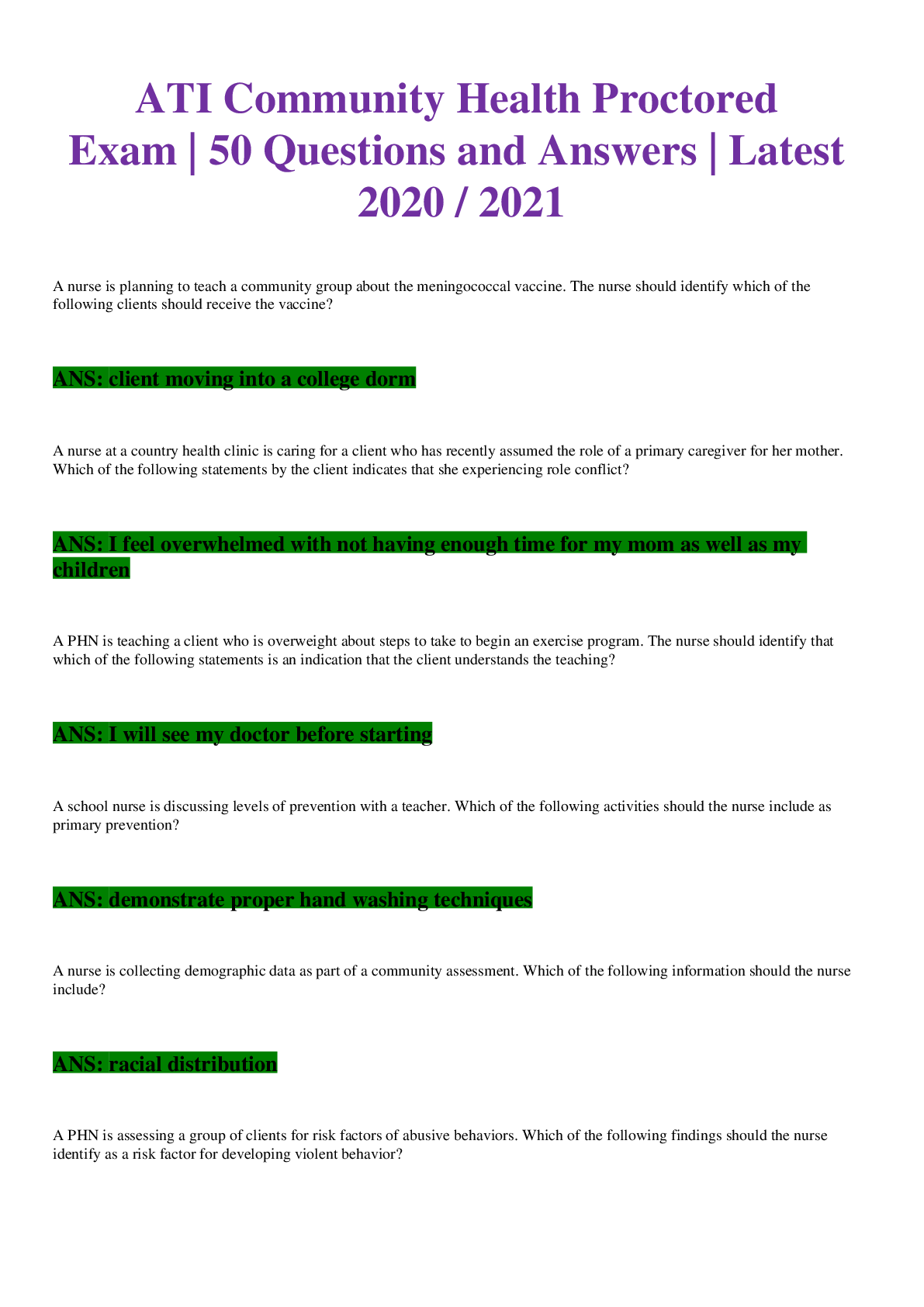
ATI Fundamentals Proctored Exam | 100, Questions and Answers | LATEST
1. A nurse manager is preparing to review medication documentation with a group of newly licensed nurses. Which of the following statements shou
...
ATI Fundamentals Proctored Exam | 100, Questions and Answers | LATEST
1. A nurse manager is preparing to review medication documentation with a group of newly licensed nurses. Which of the following statements should the nurse manager plan to include in the teaching?
ANS: "Use the complete name of the medication magnesium sulfate."
2. A nurse is caring for a client who has tuberculosis. Which of the following actions should the nurse take?
ANS: Place the client in a room with negative-pressure airflow.
Wear gloves when assisting the client with oral care.
Use antimicrobial sanitizer for hand hygiene.
3. A charge nurse is discussing the responsibility of nurses caring for clients who have Clostridium difficile infection. Which of the following information should the nurse include in the teaching?
ANS: Have family members wear a gown and gloves when visiting.
4. A nurse in a surgical suite notes documentation on a client's medical record he has a latex allergy. In preparation for the client's procedure, which of the following precautions should the nurse take?
ANS: Wrap monitoring cords with stockinette and tape them in place.
5. A nurse is caring for a client who is reporting difficulty falling asleep. Which of the following measures would the nurse recommend?
ANS: Use progressive relaxation techniques at bedtime.
6. A nurse is caring for a client who has a prescription for 5 units of regular insulin and 10 units of NPH insulin to mix together and administer subcutaneously. Determine the correct order of steps for this procedure.
ANS: Air into NPH
Air into Regular
Draw up Regular
Draw up NPH
7. A nurse is reviewing practice guidelines with a group of newly licensed nurses. Which of the following interventions should the nurse include that is within the RN scope of practice?
ANS: Initiate an enteral feeding through a gastrostomy tube.
8. A nurse is caring for a client who requires an NG tube for stomach decompression. Which of the following actions should the nurse take when inserting the NG tube?
ANS: Have the client take sips of water to promote insertion of the NG tube into the esophagus.
9. A nurse is assessing an older client's risk for falls. Which of the following assessments should the nurse use to identify the client's safety needs?
ANS: Pupil clarity
Visual fields
Visual acuity
10. A nurse is evaluating a client's use of a cane. Which of the following actions should the nurse identify as an indication of correct use?
ANS: The client holds the cane on the stronger side of her body.
11. A nurse is performing a peripheral vascular assessment for a client. When placing the bell of the stethoscope on the client's neck, she hears the following sound. This sound indicates which of the following?
ANS: Narrowed arterial lumen
12. A nurse is admitting a client who has varicella. Which of the following types of transmission precautions should the nurse initiate?
ANS: Airborne
13. A nurse is caring for a client who requires a 24-hr urine collection. Which of the following statements by the client indicates an understanding of the teaching?
ANS: "I flushed what I urinated at 7:00 a.m. and have saved all urine since."
14. A nurse is assessing a client who has been on bed rest for the past month. Which of the following findings should the nurse identify as an indication that the client has developed thrombophlebitis?
ANS: Calf swelling
15. A nurse manager is overseeing the care on a unit. Which of the following situations should the nurse manager identify as a violation of HIPAA guidelines?
ANS: A nurse asks a nurse from another unit to assist with her documentation.
16. A nurse is caring for a client who requires bed rest and has a prescription for anti-embolic stockings. Which of the following actions should the nurse take?
ANS: Remove the stockings at least once per shift.
17. A nurse is administering IV fluid to an older adult client. The nurse should perform which priority assessment to monitor for adverse effects?
ANS: Auscultate lung sounds
[Show More]