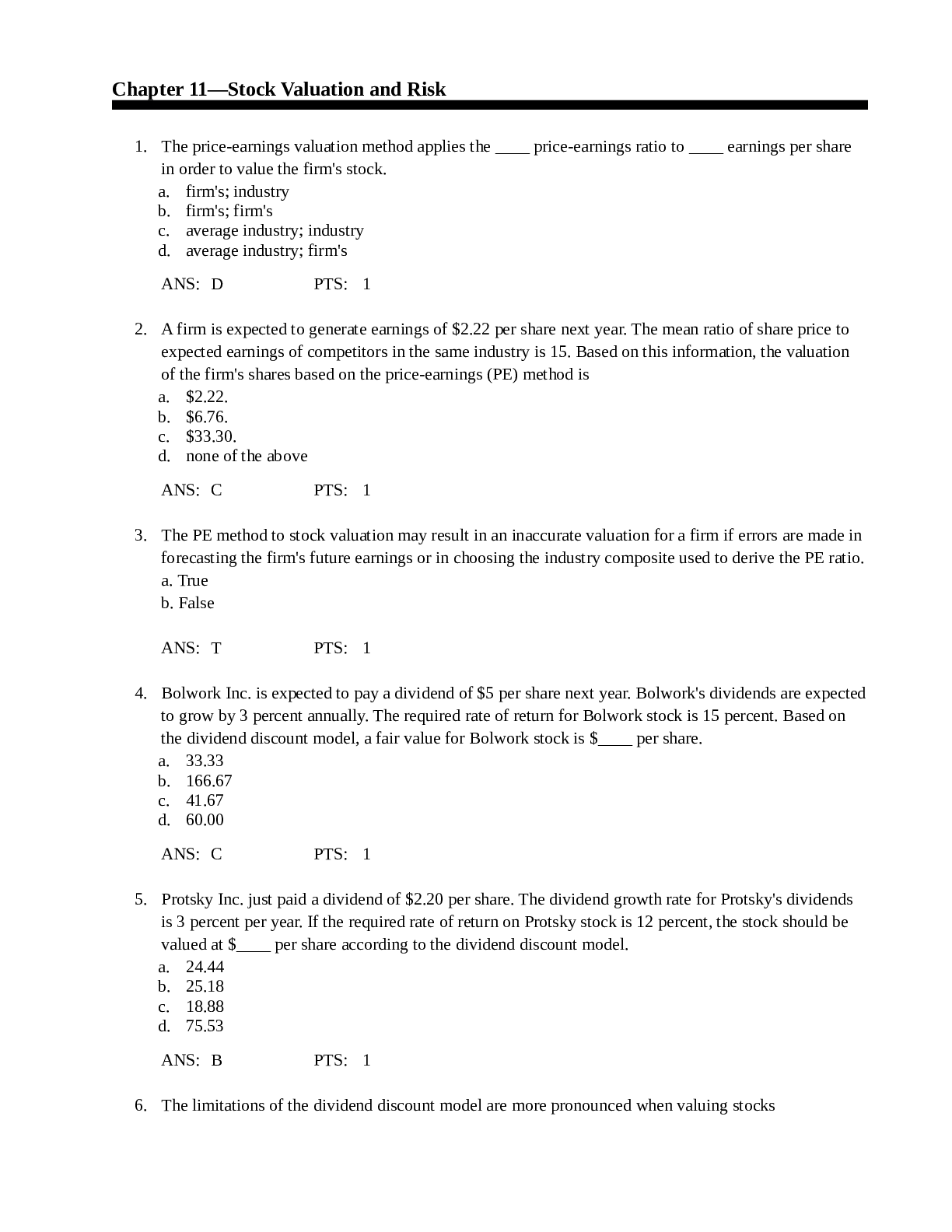
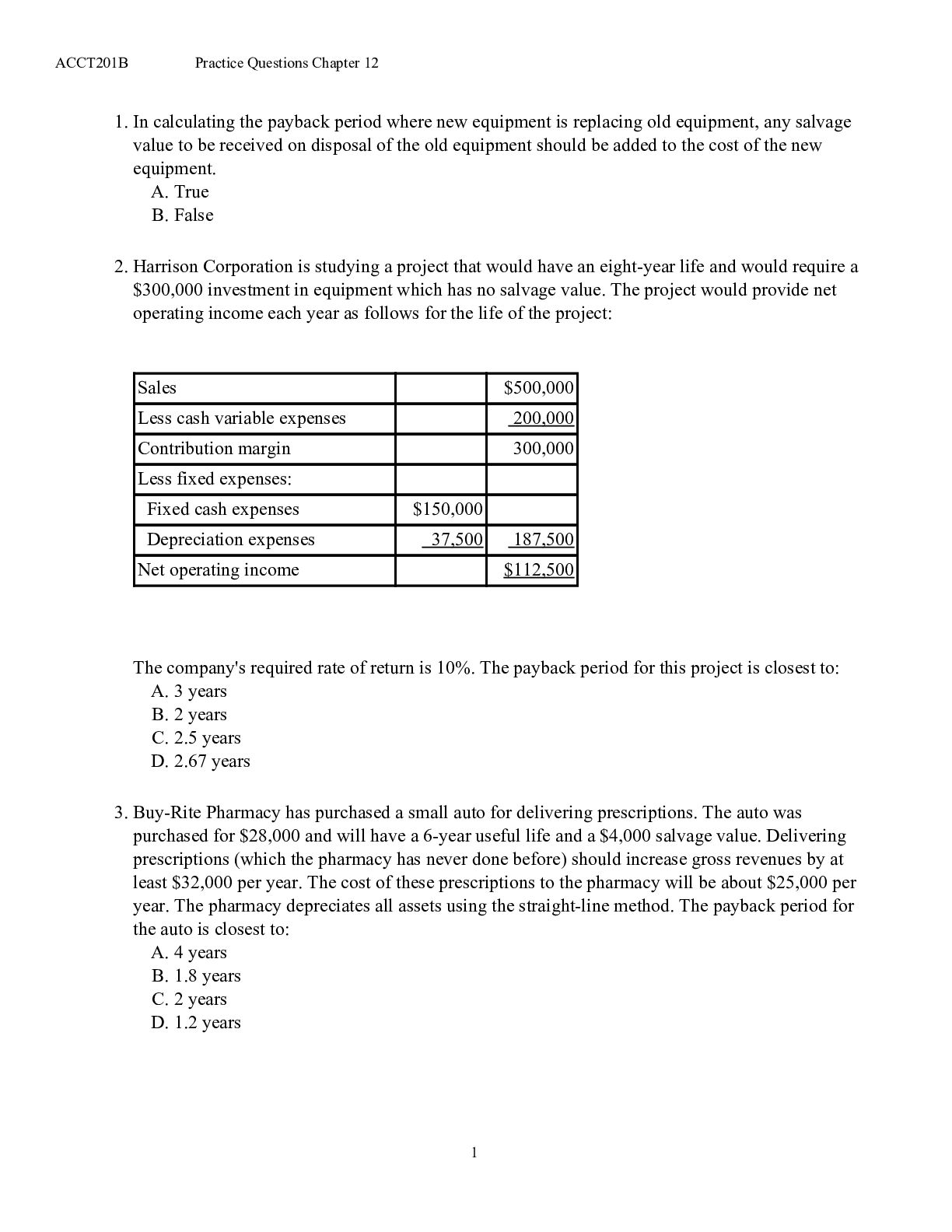
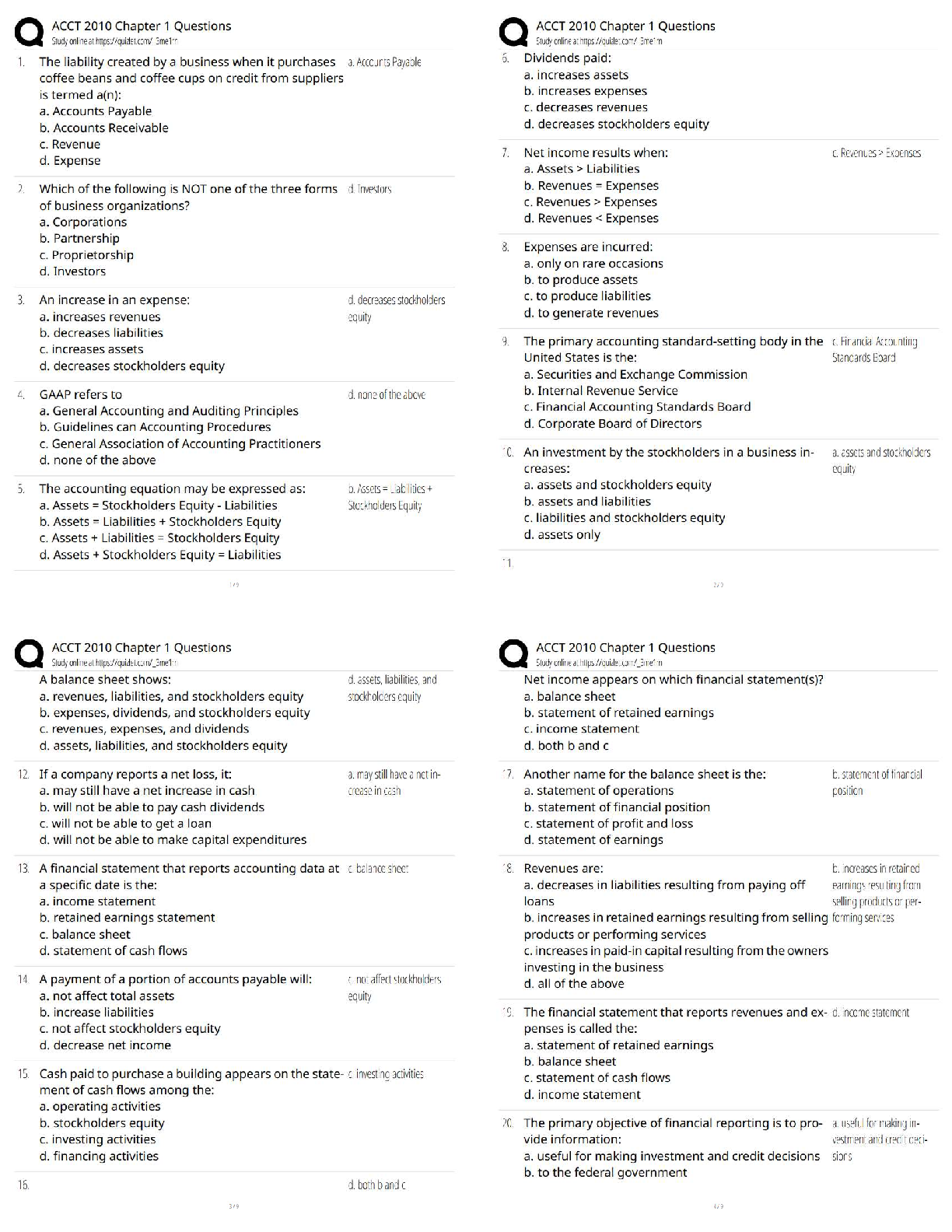
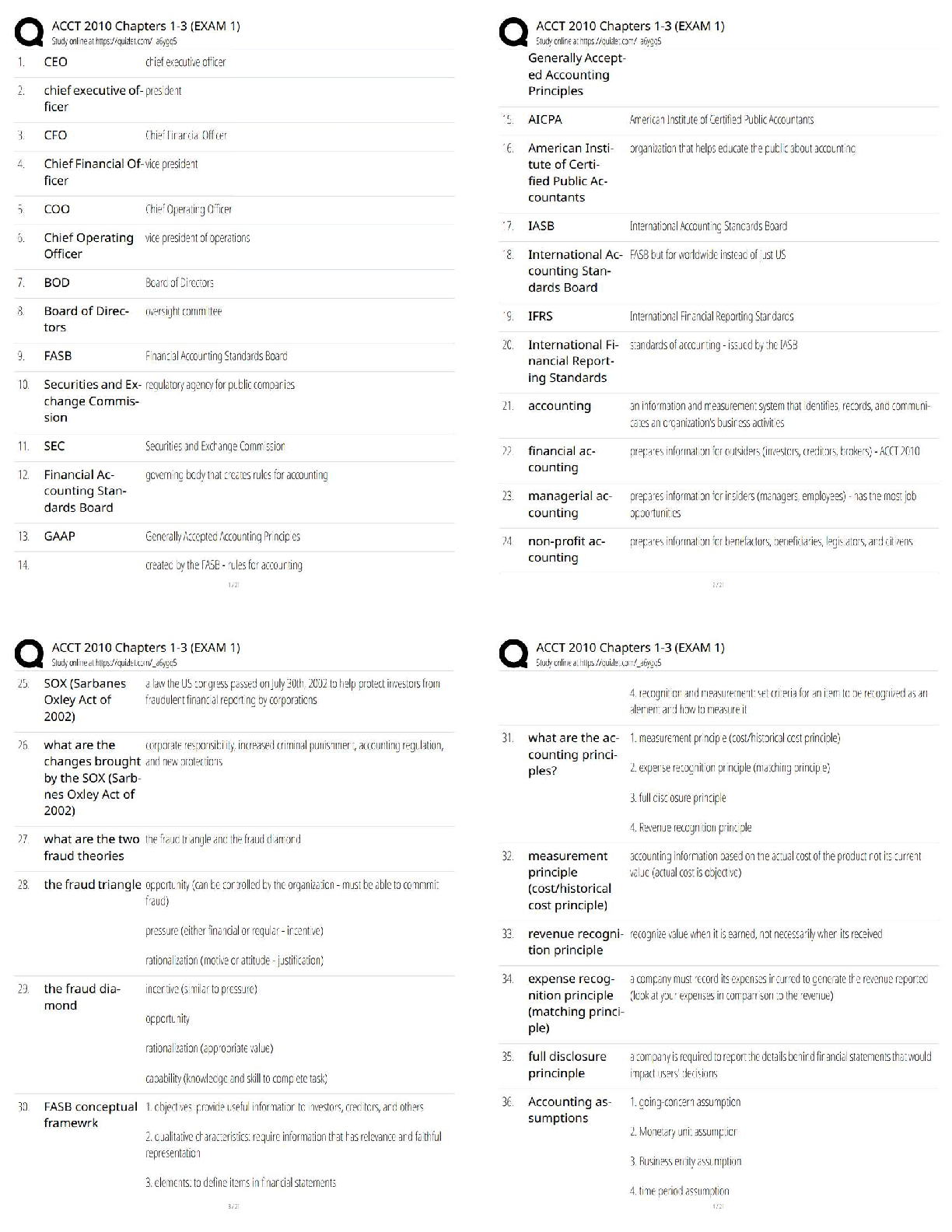
ACCT 201A Final Exam Review (Ch. 9 – 12) KEY
Ch. 9
1. Which of the following accounts is credited in the loss method of writing-down of inventory to its net realizable value?
a. Allowance to Reduce Inventory to NR
...
ACCT 201A Final Exam Review (Ch. 9 – 12) KEY
Ch. 9
1. Which of the following accounts is credited in the loss method of writing-down of inventory to its net realizable value?
a. Allowance to Reduce Inventory to NRV
b. Loss Due to Decline of Inventory to NRV
c. Cost of Goods Sold
d. Inventory
, LO: 1, Bloom: K, Difficulty: Moderate, Min: 2, AACSB: Analytic, AICPA BB: None, AICPA FN: Measurement, AICPA PC: Prob. Solving, IMA: FSA, IFRS: None
2. Net realizable value is
a. acquisition cost plus costs to complete and sell.
b. selling price.
c. selling price plus costs to complete and sell.
d. selling price less costs to complete, sell, and transport
, LO: 1, Bloom: K, Difficulty: Easy, Min: 2, AACSB: Analytic, AICPA BB: None, AICPA FN: Measurement, AICPA PC: Prob. Solving, IMA: FSA, IFRS: None
3. When valuing raw materials inventory at lower-of-cost-or-market, what is the meaning of the term "market"?
a. Net realizable value
b. Net realizable value less a normal profit margin
c. Replacement cost, Net realizable value, or Net realizable value less a normal profit margin.
d. Discounted present value
, LO: 2, Bloom: K, Difficulty: Easy, Min: 2, AACSB: Analytic, AICPA BB: None, AICPA FN: Measurement, AICPA PC: Prob. Solving, IMA: FSA, IFRS: None
4. The designated market value
a. is always the middle value of replacement cost, net realizable value, and net realizable value less a normal profit margin.
b. should always be equal to net realizable value.
c. may sometimes exceed net realizable value.
d. should always be equal to net realizable value less a normal profit margin.
, LO: 2, Bloom: K, Difficulty: Easy, Min: 2, AACSB: Analytic, AICPA BB: None, AICPA FN: Measurement, AICPA PC: Prob. Solving, IMA: FSA, IFRS: None
5. The floor to be used in applying the lower-of-cost-or-market method to inventory is determined as the
a. net realizable value.
b. net realizable value less normal profit margin.
c. replacement cost.
d. selling price less costs of completion and disposal.
, LO: 2, Bloom: K, Difficulty: Easy, Min: 2, AACSB: Analytic, AICPA BB: None, AICPA FN: Measurement, AICPA PC: Prob. Solving, IMA: FSA, IFRS: None
6. What is the rationale behind the ceiling when applying the lower-of-cost-or-market method to inventory?
a. Prevents understatement of the inventory value.
b. Allows for a normal profit to be earned.
c. Allows for items to be valued at replacement cost.
d. Prevents overstatement of the value of obsolete or damaged inventories.
, LO: 2, Bloom: C, Difficulty: Moderate, Min: 2, AACSB: Analytic, AICPA BB: None, AICPA FN: Measurement, AICPA PC: Prob. Solving, IMA: FSA, IFRS: None
7. If a material amount of inventory has been ordered through a formal purchase contract at the balance sheet date for future delivery at firm prices,
a. this fact must be disclosed.
b. disclosure is required only if prices have declined since the date of the order.
c. disclosure is required only if prices have since risen substantially.
d. an appropriation of retained earnings is necessary.
, LO: 3, Bloom: K, Difficulty: Moderate, Min: 2, AACSB: Analytic, AICPA BB: None, AICPA FN: Measurement, AICPA PC: Prob. Solving, IMA: FSA, IFRS: None
8. In hedging, the purchaser in the purchase commitment simultaneously enters into a contract in which it agrees to sell in the future:
a. the same quantity of the same goods at a fixed price.
b. a higher quantity of the same goods at a higher price.
c. a lower quantity of the same goods at a fixed price.
d. same quantity of different goods at a lower price.
, LO: 3, Bloom: C, Difficulty: Moderate, Min: 2, AACSB: Analytic, AICPA BB: None, AICPA FN: Measurement, AICPA PC: Prob. Solving, IMA: FSA, IFRS: None
9. In 2017, Orear Manufacturing signed a contract with a supplier to purchase raw materials in 2018 for $700,000. Before the December 31, 2017 balance sheet date, the market price for these materials dropped to $510,000. The journal entry to record this situation at December 31, 2017 will result in a credit that should be reported
a. as a valuation account to Inventory on the balance sheet.
b. as a current liability.
c. as an appropriation of retained earnings.
d. on the income statement.
, LO: 3, Bloom: AP, Difficulty: Difficult, Min: 3, AACSB: Analytic, AICPA BB: None, AICPA FN: Reporting, AICPA PC: Prob. Solving, IMA: FSA, IFRS: None
10. At the end of the fiscal year, Apha Airlines has an outstanding non-cancellable purchase commitment for the purchase of 1 million gallons of jet fuel at a price of $4.10 per gallon for delivery during the coming summer. The company prices its inventory at the lower of cost or market. If the market price for jet fuel at the end of the year is $4.50, how would this situation be reflected in the annual financial statements?
a. Record unrealized gains of $400,000 and disclose the existence of the purchase commitment.
b. No impact.
c. Record unrealized losses of $400,000 and disclose the existence of the purchase commitment.
d. Only disclose the existence of the purchase commitment.
, LO: 3, Bloom: AP, Difficulty: Difficult, Min: 3, AACSB: Analytic, AICPA BB: None, AICPA FN: Reporting, AICPA PC: Prob. Solving, IMA: FSA, IFRS: None
11. Oslo Corporation has two products in its ending inventory, each accounted for at the lower of cost or market. A profit margin of 30% on selling price is considered normal for each product. Specific data with respect to each product follows:
Product #1 Product #2
Historical cost $10 $ 18
Replacement cost 11 14
Estimated cost to dispose 3 7
Estimated selling price 20 33
In pricing its ending inventory using the lower-of-cost-or-market, what unit values should Oslo use for products #1 and #2, respectively?
a. $10 and $16.
b. $13 and $16.
c. $13 and $15.
d. $11 and $14.
, LO: 1, Bloom: AP, Difficulty: Moderate, Min: 3, AACSB: Analytic, AICPA BB: None, AICPA FN: Measurement, AICPA PC: Prob. Solving, IMA: FSA, IFRS: None
Product 1: RC = $11, NRV = $20 – $3 = $17
NRV – PM = $17 – ($20 × .3) = $11, cost = $10.
Product 2: RC = $14, NRV = $33 – $7 = $26
NRV – PM = $26 – ($33 × .3) = $16 (rounded), cost = $18.
12. Rodriguez Corporation sells its product, a rare metal, in a controlled market with a quoted price applicable to all quantities. The total cost of 5,000 pounds of the metal now held in inventory is $315,000. The total selling price is $840,000, and estimated costs of disposal are $15,000. At what amount should the inventory of 5,000 pounds be reported in the balance sheet?
a. $300,000.
b. $315,000.
c. $825,000.
d. $840,000.
, LO: 3, Bloom: AP, Difficulty: Difficult, Min: 3, AACSB: Analytic, AICPA BB: None, AICPA FN: Measurement, AICPA PC: Prob. Solving, IMA: FSA, IFRS: None
$840,000 – $15,000 = $825,000.
13. During the prior fiscal year, Jeremiah Corp. signed a long-term noncancellable purchase commitment with its primary supplier to purchase $2.0 million of raw materials. Jeremiah paid the $2.0 million to acquire the raw materials when the raw materials were only worth $1.6 million. Assume that the purchase commitment was properly recorded. What is the journal entry to record the purchase?
a. Debit Inventory for $1,600,000, and credit Cash for $1,600,000.
b. Debit Inventory for $1,600,000, debit Unrealized Holding Gain or Loss for $400,000, and credit Cash for $2,000,000.
c. Debit Inventory for $1,600,000, debit Estimated Liability on Purchase Commitments for $400,000 and credit Cash for $2,000,000.
d. Debit Inventory for $2,000,000, and credit Cash for $2,000,000.
, LO: 3, Bloom: AP, Difficulty: Difficult, Min: 3, AACSB: Analytic, AICPA BB: None, AICPA FN: Measurement, AICPA PC: Prob. Solving, IMA: FSA, IFRS: None
$2.0 million – $1.6 million = $400,000.
14. During 2017, Larue Co., a manufacturer of chocolate candies, contracted to purchase 250,000 pounds of cocoa beans at $4.00 per pound, delivery to be made in the spring of 2018. Because a record harvest is predicted for 2018, the price per pound for cocoa beans had fallen to $3.30 by December 31, 2017.
Of the following journal entries, the one which would properly reflect in 2017 the effect of the commitment of Larue Co. to purchase the 250,000 pounds of cocoa is
a. Cocoa Inventory 1,000
Accounts Payable 1,000
b. Cocoa Inventory 825,000
Loss on Purchase Commitments 175,000
Accounts Payable 1,000
c. Unrealized Holding Gain or Loss-Income 175,000
Estimated Liability on Purchase Commitments 175,000
d. No entry would be necessary in 2017
, LO: 3, Bloom: AP, Difficulty: Moderate, Min: 3, AACSB: Analytic, AICPA BB: None, AICPA FN: Measurement, AICPA PC: Prob. Solving, IMA: FSA, IFRS: None
($4.00 – $3.30) × 250,000 = $175,000.
15. RS Corporation, a manufacturer of ethnic foods, contracted in 2017 to purchase 600 pounds of a spice mixture at $3.00 per pound, delivery to be made in spring of 2018. By 12/31/17, the price per pound of the spice mixture had risen to $3.25 per pound. In 2017, RS should recognize
a. a loss of $1,800.
b. a loss of $150.
c. no gain or loss.
d. a gain of $150.
, LO: 3, Bloom: AP, Difficulty: Moderate, Min: 3, AACSB: Analytic, AICPA BB: None, AICPA FN: Measurement, AICPA PC: Prob. Solving, IMA: FSA, IFRS: None
No gain or loss since 12/31 price ($3.25) > contract price ($3.00).
16. The following information is available for October for Barton Company.
Beginning inventory $350,000
Net purchases 1,050,000
Net sales 2,100,000
Percentage markup on cost 66.67%
A fire destroyed Barton’s October 31 inventory, leaving undamaged inventory with a cost of $21,000. Using the gross profit method, the estimated ending inventory destroyed by fire is
a. $119,000.
b. $539,000.
c. $560,000.
d. $700,000.
, LO: 4, Bloom: AP, Difficulty: Moderate, Min: 3, AACSB: Analytic, AICPA BB: None, AICPA FN: Measurement, AICPA PC: Prob. Solving, IMA: FSA, IFRS: None
($350,000 + $1,050,000) – ($2,100,000 ÷ 5/3) – $21,000 = $119,000.
17. A markup of 25% on cost is equivalent to what markup on selling price?
a. 20%
b. 25%
c. 75%
d. 80%
, LO: 4, Bloom: AP, Difficulty: Easy, Min: 3, AACSB: Analytic, AICPA BB: None, AICPA FN: Measurement, AICPA PC: Prob. Solving, IMA: FSA, IFRS: None
18. Kesler, Inc. estimates the cost of its physical inventory at March 31 for use in an interim financial statement. The rate of markup on cost is 25%. The following account balances are available:
Inventory, March 1 $550,000
Purchases 430,000
Purchase returns 20,000
Sales during March 750,000
The estimate of the cost of inventory at March 31 would be
a. $210,000.
b. $360,000.
c. $397,500.
d. $280,000.
, LO: 4, Bloom: AP, Difficulty: Moderate, Min: 3, AACSB: Analytic, AICPA BB: None, AICPA FN: Measurement, AICPA PC: Prob. Solving, IMA: FSA, IFRS: None
COGS = $750,000 ÷ 1.25 = $600,000
($550,000 + $430,000 – $20,000) – $600,000 = $360,000.
19. On April 15 of the current year, a fire destroyed the entire uninsured inventory of a retail store. The following data are available:
Sales, January 1 through April 15 $600,000
Inventory, January 1 100,000
Purchases, January 1 through April 15 500,000
Markup on cost 25%
The amount of the inventory loss is estimated to be
a. $120,000.
b. $60,000.
c. $150,000.
d. $100,000.
, LO: 4, Bloom: AP, Difficulty: Moderate, Min: 3, AACSB: Analytic, AICPA BB: None, AICPA FN: Measurement, AICPA PC: Prob. Solving, IMA: FSA, IFRS: None
$600,000
$100,000 + $500,000 – ————— = $120,000.
1.25
20. Crane Sales Company uses the retail inventory method to value its merchandise inventory. The following information is available for the current year:
Cost Retail
Beginning inventory $ 30,000 $ 45,000
Purchases 190,000 260,000
Freight-in 2,500 —
Net markups — 8,500
Net markdowns — 10,000
Employee discounts — 1,000
Sales revenue — 205,000
If the ending inventory is to be valued at the lower-of-cost-or-market, what is the cost-to-retail ratio?
a. $222,500 ÷ $305,000
b. $222,500 ÷ $313,500
c. $220,000 ÷ $315,000
d. $222,500 ÷ $303,500
, LO: 5, Bloom: AP, Difficulty: Moderate, Min: 4, AACSB: Analytic, AICPA BB: None, AICPA FN: Measurement, AICPA PC: Prob. Solving, IMA: FSA, IFRS: None
Cost: $30,000 + $190,000 + $2,500 = $222,500.
Retail: $45,000 + $260,000 + $8,500 = $313,500.
21. Goren Corporation had the following amounts, all at retail:
Beginning inventory $ 3,600 Purchases $120,000
Purchase returns 6,000 Net markups 18,000
Abnormal shortage 4,000 Net markdowns 2,800
Sales 77,000 Sales returns 1,800
Employee discounts 1,600 Normal shortage 2,600
What is Goren’s ending inventory at retail?
a. $49,400.
b. $51,000.
c. $52,600.
d. $53,400
, LO: 5, Bloom: AP, Difficulty: Moderate, Min: 4, AACSB: Analytic, AICPA BB: None, AICPA FN: Measurement, AICPA PC: Prob. Solving, IMA: FSA, IFRS: None
$3,600 + $114,000 + $18,000 – $4,000 – $75,200 – $1,600 – $2,800 – $2,600
= $49,400.
22. East Corporation’s computation of cost of goods sold is:
Beginning inventory $ 60,000
Add: Cost of goods purchased 482,000
Cost of goods available for sale 542,000
Ending inventory 70,000
Cost of goods sold $472,000
The average days to sell inventory for East are
a. 44.0 days.
b. 47.4 days.
c. 50.0 days.
d. 54.0 days.
, LO: 6, Bloom: AP, Difficulty: Difficult, Min: 3, AACSB: Analytic, AICPA BB: None, AICPA FN: Measurement, AICPA PC: Prob. Solving, IMA: FSA, IFRS: None
$472,000 ÷ [($60,000 + $70,000) ÷ 2] = 7.3; 365 ÷ 7.3 = 50
MULTIPLE CHOICE—CPA Adapted
23. Ryan Distribution Co. has determined its December 31, 2017 inventory on a FIFO basis at $980,000. Information pertaining to that inventory follows:
Estimated selling price $1,020,000
Estimated cost of disposal 40,000
Normal profit margin 120,000
Current replacement cost 900,000
Ryan records losses that result from applying the lower-of-cost-or-market rule. At December 31, 2017, the loss that Ryan should recognize is
a. $0.
b. $20,000.
c. $40,000.
d. $80,000.
, LO: 2, Bloom: AP, Difficulty: Moderate, Min: 3, AACSB: Analytic, AICPA BB: None, AICPA FN: Measurement, AICPA PC: Prob. Solving, IMA: FSA, IFRS: None
$980,000 – $900,000 (RC) = $80,000.
24. Under the lower-of-cost-or-market method, the replacement cost of an inventory item would be used as the designated market value
a. when it is below the net realizable value less the normal profit margin.
b. when it is below the net realizable value and above the net realizable value less the normal profit margin.
c. when it is above the net realizable value.
d. regardless of net realizable value.
, LO: 2, Bloom: K, Difficulty: Moderate, Min: 2, AACSB: Analytic, AICPA BB: None, AICPA FN: Measurement, AICPA PC: Prob. Solving, IMA: FSA, IFRS: None
25. The original cost of an inventory item is above the replacement cost and the net realizable value. The replacement cost is below the net realizable value less the normal profit margin. As a result, under the lower-of-cost-or-market method, the inventory item should be reported at the
a. net realizable value.
b. net realizable value less the normal profit margin.
c. replacement cost.
d. original cost.
, LO: 2, Bloom: C, Difficulty: Moderate, Min: 2, AACSB: Analytic, AICPA BB: None, AICPA FN: Measurement, AICPA PC: Prob. Solving, IMA: FSA, IFRS: None
26. Keen Company's accounting records indicated the following information:
Inventory, 1/1/17 $ 1,800,000
Purchases during 2017 9,000,000
Sales during 2017 11,400,000
A physical inventory taken on December 31, 2017, resulted in an ending inventory of $2,100,000. Keen's gross profit on sales has remained constant at 25% in recent years. Keen suspects some inventory may have been taken by a new employee. At December 31, 2017, what is the estimated cost of missing inventory?
a. $150,000.
b. $450,000.
c. $600,000.
d. $750,000.
, LO: 4, Bloom: AP, Difficulty: Difficult, Min: 4, AACSB: Analytic, AICPA BB: None, AICPA FN: Measurement, AICPA PC: Prob. Solving, IMA: FSA, IFRS: None
$11,400,000 × .75 = $8,550,000 (COGS)
$1,800,000 + $9,000,000 – $8,550,000 – $2,100,000 = $150,000.
27. Henke Co. uses the retail inventory method to estimate its inventory for interim statement purposes. Data relating to the computation of the inventory at July 31, 2017, are as follows:
Cost Retail
Inventory, 2/1/17 $ 300,000 $ 375,000
Purchases 1,500,000 2,362,500
Markups, net 262,500
Sales 2,400,000
Estimated normal shoplifting losses 30,000
Markdowns, net 165,000
Under the lower-of-cost-or-market method, Henke's estimated inventory at July 31, 2017 is
a. $243,000.
b. $261,000.
c. $279,000.
d. $405,000.
, LO: 5, Bloom: AP, Difficulty: Difficult, Min: 4, AACSB: Analytic, AICPA BB: None, AICPA FN: Measurement, AICPA PC: Prob. Solving, IMA: FSA, IFRS: None
($300,000 + $1,500,000) ÷ ($375,000 + $2,362,500 + $262,500) = 0.6
($375,000 + $2,362,500 + $262,500 – $30,000 – $165,000 –
$2,400,000) × 0.6 = $243,000.
28. At December 31, 2017, the following information was available from Kohl Co.'s accounting records:
Cost Retail
Inventory, 1/1/17 $147,000 $ 203,000
Purchases 833,000 1,155,000
Additional markups 42,000
Available for sale $980,000 $1,400,000
Sales for the year totaled $1,250,000. Markdowns amounted to $10,000. Under the lower-of-cost-or-market method, Kohl's inventory at December 31, 2017 was
a. $294,000.
b. $112,000.
c. $105,000.
d. $98,000.
, LO: 5, Bloom: AP, Difficulty: Moderate, Min: 3, AACSB: Analytic, AICPA BB: None, AICPA FN: Measurement, AICPA PC: Prob. Solving, IMA: FSA, IFRS: None
$980,000 ÷ $1,400,000 = 0.7
($1,400,000 – $10,000 – $1,250,000) × 0.7 = $98,000.
29. On December 31, 2017, Pacer Co. adopted the dollar-value LIFO retail inventory method. Inventory data for 2018 are as follows:
LIFO Cost Retail
Inventory, 12/31/17 $900,000 $1,260,000
Inventory, 12/31/18 ? 1,650,000
Increase in price level for 2018 10%
Cost to retail ratio for 2018 70%
Under the LIFO retail method, Pacer's inventory at December 31, 2018, should be
a. $1,084,800.
b. $1,155,500.
c. $1,173,000.
d $1,200,300.
, LO: 7, Bloom: AN, Difficulty: Difficult, Min: 3, AACSB: Analytic, AICPA BB: None, AICPA FN: Measurement, AICPA PC: Prob. Solving, IMA: FSA, IFRS: None
$1,650,000 ÷ 1.1 = $1,500,000
$900,000 + ($240,000 × 1.1 × .7) = $1,084,800.
Problem 1
Determine the unit value that should be used for inventory costing following "lower of cost or market value".
A B C D E F
Cost $2.35 $2.47 $2.35 $2.54 $2.44 $2.44
Replacement cost 2.20 2.55 2.20 2.52 2.37 2.46
Net realizable value 2.50 2.50 2.50 2.45 2.50 2.50
Net realizable value less normal profit 2.25 2.30 2.40 2.30 2.30 2.30
Ans: N/A, LO: 2, Bloom: AP, Difficulty: Easy, Min: 5-7, AACSB: Analytic, AICPA BB: None, AICPA FN: Measurement, AICPA PC: Prob. Solving, IMA: FSA, IFRS: None
Problem 2
At 12/31/17, the end of Jenner Company's first year of business, inventory was $6,100 and $5,100 at cost and at market, respectively.
Following is data relative to the 12/31/18 inventory of Jenner:
Original Net Net Realizable Appropriate
Cost Replacement Realizable Value Less Inventory
Item Per Unit Cost Value Normal Profit Value
A $ .65 $ .45
B .45 .40
C .70 .75
D .75 .65
E .90 .85
Selling price is $1.00/unit for all items. Disposal costs amount to 10% of selling price and a "normal" profit is 30% of selling price. There are 1,500 units of each item in the 12/31/18 inventory.
Instructions
(a) Prepare the entry at 12/31/17 necessary to implement the lower-of-cost-or-market procedure assuming Jenner uses a contra account for its balance sheet.
(b) Complete the last three columns in the 12/31/18 schedule above based upon the lower-of-cost-or-market rules.
(c) Prepare the entry(ies) necessary at 12/31/18 based on the data above.
(d) How are inventory losses disclosed on the income statement?
Ans: N/A, LO: 2, Bloom: AP, Difficulty: Difficult, Min: 18-20, AACSB: Analytic, AICPA BB: None, AICPA FN: Measurement, AICPA PC: Prob. Solving, IMA: FSA, IFRS: None
Problem 3
Doran Realty Company purchased a plot of ground for $1,900,000 and spent $4,100,000 in developing it for building lots. The lots were classified into Highland, Midland, and Lowland grades, to sell at $120,000, $90,000, and $60,000 each, respectively.
Instructions
Complete the table below to allocate the cost of the lots using a relative sales value method.
No. of Selling Total % of Apportioned Cost
Grade Lots Price Revenue Total Sales Total Per Lot
Highland 20 $ $ $ $
Midland 40 $ $
Lowland 100 $ $
160 $ $
Ans: N/A, LO: 3, Bloom: AP, Difficulty: Moderate, Min: 8-10, AACSB: Analytic, AICPA BB: None, AICPA FN: Measurement, AICPA PC: Prob. Solving, IMA: FSA, IFRS: None
Ch. 10
1. Fences and parking lots are reported on the balance sheet as
a. current assets.
b. land improvements.
c. land.
d. property and equipment.
, LO: 1, Bloom: K, Difficulty: Easy, Min: 2, AACSB: Analytic, AICPA BB: None, AICPA FN: Reporting, AICPA PC: Communication, IMA: Reporting, IFRS: None
2. To be consistent with the historical cost principle, overhead costs incurred by an enterprise constructing its own building should be
a. allocated on the basis of lost production.
b. eliminated completely from the cost of the asset.
c. allocated on an opportunity cost basis.
d. allocated on a pro rata basis between the asset and normal operations.
, LO: 2, Bloom: K, Difficulty: Moderate, Min: 2, AACSB: Analytic, AICPA BB: None, AICPA FN: Measurement, AICPA PC: Prob. Solving, IMA: Reporting, IFRS: None
3. Which of the following costs are capitalized for self-constructed assets?
a. Materials and labor only
b. Labor and overhead only
c. Materials and overhead only
d. Materials, labor, and overhead
, LO: 2, Bloom: K, Difficulty: Easy, Min: 2, AACSB: Analytic, AICPA BB: None, AICPA FN: Measurement, AICPA PC: Prob. Solving, IMA: Reporting, IFRS: None
4. When computing the amount of interest cost to be capitalized, the concept of "avoidable interest" refers to
a. the total interest cost actually incurred.
b. a cost of capital charge for stockholders' equity.
c. that portion of total interest cost which would not have been incurred if expenditures for asset construction had not been made.
d. that portion of weighted-average accumulated expenditures on which no interest cost was incurred.
, LO: 3, Bloom: K, Difficulty: Easy, Min: 2, AACSB: Analytic, AICPA BB: None, AICPA FN: Measurement, AICPA PC: Prob. Solving, IMA: Reporting, IFRS: None
5. The period of time during which interest must be capitalized ends when
a. the asset is substantially complete and ready for its intended use.
b. no further interest cost is being incurred.
c. the asset is fully depreciated.
d. the activities that are necessary to get the asset ready for its intended use have begun.
, LO: 3, Bloom: K, Difficulty: Easy, Min: 2, AACSB: Analytic, AICPA BB: None, AICPA FN: Measurement, AICPA PC: Prob. Solving, IMA: Reporting, IFRS: None
6. Which of the following statements is true regarding capitalization of interest?
a. Interest cost capitalized in connection with the purchase of land to be used as a building site should be debited to the land account and not to the building account.
b. The amount of interest cost capitalized during the period should not exceed the actual interest cost incurred.
c. When excess borrowed funds not immediately needed for construction are temporarily invested, any interest earned should be offset against interest cost incurred when determining the amount of interest cost to be capitalized.
d. The minimum amount of interest to be capitalized is determined by multiplying a weighted average interest rate by the amount of average accumulated expenditures on qualifying assets during the period.
, LO: 3, Bloom: C, Difficulty: Difficult, Min: 2, AACSB: Analytic, AICPA BB: None, AICPA FN: Measurement, AICPA PC: Prob. Solving, IMA: Reporting, IFRS: None
7. Which of the following nonmonetary exchange transactions may result in recorded gains or losses?
a. Exchange of assets with no difference in future cash flows.
b. Exchange of products by companies in the same line of business with no difference in future cash flows.
c. Exchange of assets with a difference in future cash flows.
d. Exchange of an equivalent interest in similar productive assets that causes the companies involved to remain in essentially the same economic position.
, LO: 4, Bloom: K, Difficulty: Moderate, Min: 2, AACSB: Analytic, AICPA BB: None, AICPA FN: Measurement, AICPA PC: Prob. Solving, IMA: Reporting, IFRS: None
8. When boot is involved in an exchange having commercial substance
a. gains or losses are recognized in their entirely.
b. a gain or loss is computed by comparing the fair value of the asset received with the fair value of the asset given up.
c. only gains should be recognized.
d. only losses should be recognized.
, LO: 4, Bloom: K, Difficulty: Easy, Min: 2, AACSB: Analytic, AICPA BB: None, AICPA FN: Measurement, AICPA PC: Prob. Solving, IMA: Reporting, IFRS: None
9. The cost of a nonmonetary asset acquired in exchange for another nonmonetary asset when the exchange has commercial substance is usually recorded at
a. the fair value of the asset given up, and a gain or loss is recognized.
b. the fair value of the asset given up, and a gain but not a loss may be recognized.
c. the fair value of the asset received if it is equally reliable as the fair value of the asset given up.
d. either the fair value of the asset given up or the asset received, whichever one results in the largest gain (smallest loss) to the company.
, LO: 4, Bloom: C, Difficulty: Moderate, Min: 2, AACSB: Analytic, AICPA BB: None, AICPA FN: Measurement, AICPA PC: Prob. Solving, IMA: Reporting, IFRS: None
10. A company should immediately recognize:
a. any gain when it makes a bargain purchase.
b. any loss when it ignorantly pays too much for an asset originally.
c. any gain when it constructs a piece of equipment at a cost savings.
d. any loss when it receives any asset lower than its book value.
, LO: 4, Bloom: K, Difficulty: Moderate, Min: 2, AACSB: Analytic, AICPA BB: None, AICPA FN: Measurement, AICPA PC: Prob. Solving, IMA: Reporting, IFRS: None
11. Accounting recognition should be given to some or all of the gain realized on a nonmonetary exchange of plant assets except when the exchange has
a. no commercial substance and additional cash is paid.
b. no commercial substance and additional cash is received.
c. commercial substance and additional cash is paid.
d. commercial substance and additional cash is received.
, LO: 4, Bloom: C, Difficulty: Moderate, Min: 2, AACSB: Analytic, AICPA BB: None, AICPA FN: Measurement, AICPA PC: Prob. Solving, IMA: Reporting, IFRS: None
12. For a nonmonetary exchange of plant assets, accounting recognition should not be given to
a. a loss when the exchange has no commercial substance.
b. a gain when the exchange has commercial substance.
c. part of a gain when the exchange has no commercial substance and cash is paid (cash paid/received is less than 25% of the fair value of the exchange).
d. part of a gain when the exchange has no commercial substance and cash is received (cash paid or received is less than 25% of the fair value of the exchange).
, LO: 4, Bloom: C, Difficulty: Moderate, Min: 2, AACSB: Analytic, AICPA BB: None, AICPA FN: Measurement, AICPA PC: Prob. Solving, IMA: Reporting, IFRS: None
13. When a company is the recipient of a donated asset, the account credited may be a
a. paid-in capital account.
b. revenue account.
c. deferred revenue account.
d. All of these answers are correct.
, LO: 4, Bloom: K, Difficulty: Easy, Min: 2, AACSB: Analytic, AICPA BB: None, AICPA FN: Measurement, AICPA PC: Prob. Solving, IMA: Reporting, IFRS: None
14. An improvement made to a machine increased its fair value and its production capacity by 25% without extending the machine's useful life. The cost of the improvement should be
a. expensed.
b. debited to accumulated depreciation.
c. capitalized in the machine account.
d. allocated between accumulated depreciation and the machine account.
, LO: 5, Bloom: C, Difficulty: Moderate, Min: 2, AACSB: Analytic, AICPA BB: None, AICPA FN: Measurement, AICPA PC: Prob. Solving, IMA: Reporting, IFRS: None
15. Which of the following is not a capital expenditure?
a. Repairs that maintain an asset in operating condition
b. An addition
c. A betterment
d. A replacement
, LO: 5, Bloom: C, Difficulty: Moderate, Min: 2, AACSB: Analytic, AICPA BB: None, AICPA FN: Reporting, AICPA PC: Prob. Solving, IMA: FSA, IFRS: None
16. Termination of an asset’s service due to theft, fire, etc, is called:
a. special assessment.
b. nonreciprocal transfers.
c. speculation.
d. involuntary conversion.
, LO: 6, Bloom: K, Difficulty: Easy, Min: 2, AACSB: Analytic, AICPA BB: None, AICPA FN: Measurement, AICPA PC: Prob. Solving, IMA: Reporting, IFRS: None
17. On February 1, 2017, Nelson Corporation purchased a parcel of land as a factory site for $320,000. An old building on the property was demolished, and construction began on a new building which was completed on November 1, 2017. Costs incurred during this period are listed below:
Demolition of old building $ 20,000
Architect's fees 35,000
Legal fees for title investigation and purchase contract 5,000
Construction costs 1,390,000
(Salvaged materials resulting from demolition were sold for $10,000.)
Nelson should record the cost of the land and new building, respectively, as
a. $345,000 and $1,415,000.
b. $330,000 and $1,430,000.
c. $330,000 and $1,425,000.
d. $335,000 and $1,425,000.
, LO: 1, Bloom: AP, Difficulty: Difficult, Min: 4, AACSB: Analytic, AICPA BB: None, AICPA FN: Measurement, AICPA PC: Prob. Solving, IMA: Reporting, IFRS: None
Land: $320,000 + $20,000 + $5,000 – $10,000 = $335,000.
Building: $35,000 + $1,390,000 = $1,425,000.
18. Worthington Chandler Company purchased equipment for $40,000. Sales tax on the purchase was $2,400. Other costs incurred were freight charges of $600, repairs of $350 for damage during installation, and installation costs of $675. What is the cost of the equipment?
a. $40,000
b. $42,400
c. $43,675
d. $44,025
, LO: 1, Bloom: AP, Difficulty: Moderate, Min: 3, AACSB: Analytic, AICPA BB: None, AICPA FN: Measurement, AICPA PC: Prob. Solving, IMA: Reporting, IFRS: None
$40,000 + $2,400 + $600 + $675 = $43,675.
19. During self-construction of an asset by Samuelson Company, the following were among the costs incurred:
Fixed overhead for the year $1,000,000
Portion of $1,000,000 fixed overhead that would
be allocated to asset if it were normal production 90,000
Variable overhead attributable to self-construction 50,000
What amount of overhead should be included in the cost of the self-constructed asset?
a. $ -0-
b. $50,000
c. $90,000
d. $140,000
, LO: 2, Bloom: AP, Difficulty: Moderate, Min: 3, AACSB: Analytic, AICPA BB: None, AICPA FN: Measurement, AICPA PC: Prob. Solving, IMA: Reporting, IFRS: None
$90,000 + $50,000 = $140,000.
20. Gutierrez Company is constructing a building. Construction began in 2017 and the building was completed 12/31/17. Gutierrez made payments to the construction company of $3,000,000 on 7/1, $6,600,000 on 9/1, and $6,000,000 on 12/31. Weighted-average accumulated expenditures were
a. $3,150,000.
b. $3,700,000.
c. $9,600,000.
d. $15,600,000.
, LO: 3, Bloom: AP, Difficulty: Difficult, Min: 3, AACSB: Analytic, AICPA BB: None, AICPA FN: Measurement, AICPA PC: Prob. Solving, IMA: Reporting, IFRS: None
($3,000,000 × 6/12) + ($6,600,000 × 4/12) = $3,700,000.
21. During 2017, Kimmel Co. incurred weighted-average accumulated expenditures of $1,600,000 during construction of assets that qualified for capitalization of interest. The only debt outstanding during 2017 was a $2,000,000, 10%, 5-year note payable dated January 1, 2017. What is the amount of interest that should be capitalized by Kimmel during 2017?
a. $0.
b. $40,000.
c. $160,000.
d. $200,000.
, LO: 3, Bloom: AP, Difficulty: Moderate, Min: 3, AACSB: Analytic, AICPA BB: None, AICPA FN: Measurement, AICPA PC: Prob. Solving, IMA: Reporting, IFRS: None
$1,600,000 × .10 = $160,000.
22. Dodson Company traded in a manual pressing machine for an automated pressing machine and gave $40,000 cash. The old machine cost $465,000 and had a net book value of $355,000. The old machine had a fair value of $300,000.
Which of the following is the correct journal entry to record the exchange assuming commercial substance?
a. Equipment 340,000
Loss on Disposal 55,000
Accumulated Depreciation 110,000
Equipment 465,000
Cash 40,000
b. Equipment 304,000
Equipment 200,000
Cash 40,000
c. Cash 40,000
Equipment 300,000
Loss on Disposal 55,000
Accumulated Depreciation 110,000
Equipment 505,000
d. Equipment 615,000
Accumulated Depreciation 110,000
Equipment 465,000
Cash 40,000
, LO: 4, Bloom: AP, Difficulty: Moderate, Min: 3, AACSB: Analytic, AICPA BB: None, AICPA FN: Measurement, AICPA PC: Prob. Solving, IMA: Reporting, IFRS: None
Equipment = $300,000 + $40,000; Loss: $355,000 – $300,000 = 55,000.
23. Storm Corporation purchased a new machine on October 31, 2017. A $4,800 down payment was made and three monthly installments of $14,400 each are to be made beginning on November 30, 2017. The cash price would have been $46,400. Storm paid no installation charges under the monthly payment plan but an $800 installation charge would have been incurred with a cash purchase. The amount to be capitalized as the cost of the machine on October 31, 2017 would be
a. $48,800.
b. $48,000.
c. $47,200.
d. $46,400.
, LO: 4, Bloom: AP, Difficulty: Difficult, Min: 3, AACSB: Analytic, AICPA BB: None, AICPA FN: Measurement, AICPA PC: Prob. Solving, IMA: Reporting, IFRS: None
$46,400 + $800 = $47,200.
MULTIPLE CHOICE—CPA Adapted
24. On December 1, 2017, Hogan Co. purchased a tract of land as a factory site for $780,000. The old building on the property was razed, and salvaged materials resulting from demolition were sold. Additional costs incurred and salvage proceeds realized during December 2017 were as follows:
Cost to raze old building $70,000
Legal fees for purchase contract and to record ownership 10,000
Title guarantee insurance 16,000
Proceeds from sale of salvaged materials 8,000
In Hogan 's December 31, 2017 balance sheet, what amount should be reported as land?
a. $806,000.
b. $842,000.
c. $868,000.
d. $876,000.
, LO: 1, Bloom: AP, Difficulty: Moderate, Min: 3, AACSB: Analytic, AICPA BB: None, AICPA FN: Measurement, AICPA PC: Prob. Solving, IMA: Reporting, IFRS: None
$780,000 + $70,000 + $10,000 + $16,000 – $8,000 = $868,000.
25. Land was purchased to be used as the site for the construction of a plant. A building on the property was sold and removed by the buyer so that construction on the plant could begin. The proceeds from the sale of the building should be
a. classified as other income.
b. deducted from the cost of the land.
c. netted against the costs to clear the land and expensed as incurred.
d. netted against the costs to clear the land and amortized over the life of the plant.
, LO: 1, Bloom: C, Difficulty: Moderate, Min: 2, AACSB: Analytic, AICPA BB: None, AICPA FN: Measurement, AICPA PC: Prob. Solving, IMA: Reporting, IFRS: None
26. A company is constructing an asset for its own use. Construction began in 2017. The asset is being financed entirely with a specific new borrowing. Construction expenditures were made in 2017 and 2018 at the end of each quarter. The total amount of interest cost capitalized in 2018 should be determined by applying the interest rate on the specific new borrowing to the
a. total accumulated expenditures for the asset in 2017 and 2018.
b. weighted-average accumulated expenditures for the asset in 2017 and 2018.
c. weighted-average expenditures for the asset in 2018.
d. total expenditures for the asset in 2018.
, LO: 3, Bloom: C, Difficulty: Difficult, Min: 2, AACSB: Analytic, AICPA BB: None, AICPA FN: Measurement, AICPA PC: Prob. Solving, IMA: Reporting, IFRS: None
27. Colt Football Co. had a player contract with Watts that is recorded in its books at $8,400,000 on July 1, 2017. Day Football Co. had a player contract with Kurtz that is recorded in its books at $10,500,000 on July 1, 2017. On this date, Colt traded Watts to Day for Kurtz and paid a cash difference of $1,050,000. The fair value of the Kurtz contract was $12,600,000 on the exchange date. The exchange had no commercial substance. After the exchange, the Kurtz contract should be recorded in Colt's books at
a. $9,450,000.
b. $10,500,000.
c. $11,550,000.
d. $12,600,000.
, LO: 4, Bloom: AP, Difficulty: Difficult, Min: 3, AACSB: Analytic, AICPA BB: None, AICPA FN: Measurement, AICPA PC: Prob. Solving, IMA: Reporting, IFRS: None
($12,600,000 – $1,050,000) – $8,400,000 = $3,150,000 (deferred gain)
$12,600,000 – $3,150,000 = $9,450,000 (Basis).
28. Huff Co. exchanged nonmonetary assets with Sayler Co. No cash was exchanged and the exchange had no commercial substance. The carrying amount of the asset surrendered by Huff exceeded both the fair value of the asset received and Sayler's carrying amount of that asset. Huff should recognize the difference between the carrying amount of the asset it surrendered and
a. the fair value of the asset it received as a loss.
b. the fair value of the asset it received as a gain.
c. Sayler's carrying amount of the asset it received as a loss.
d. Sayler's carrying amount of the asset it received as a gain.
, LO: 4, Bloom: AP, Difficulty: Moderate, Min: 2, AACSB: Analytic, AICPA BB: None, AICPA FN: Measurement, AICPA PC: Prob. Solving, IMA: Reporting, IFRS: None
29. Chase County owned an idle parcel of real estate consisting of land and a factory building. Chase gave title to this realty to Patton Co. as an incentive for Patton to establish manufacturing operations in the County. Patton paid nothing for this realty, which had a fair value of $250,000 at the date of the grant. Patton should record this nonmonetary transaction as a
a. memo entry only.
b. credit to Contribution Revenue for $250,000.
c. credit to Comprehensive Income for $250,000.
d. credit to Donated Capital for $250,000.
, LO: 4, Bloom: AP, Difficulty: Moderate, Min: 3, AACSB: Analytic, AICPA BB: None, AICPA FN: Measurement, AICPA PC: Prob. Solving, IMA: Reporting, IFRS: None
30. On September 10, 2017, Jenks Co. incurred the following costs for one of its printing presses:
Purchase of attachment $55,000
Installation of attachment 5,000
Replacement parts for renovation of press 18,000
Labor and overhead in connection with renovation of press 7,000
Neither the attachment nor the renovation increased the estimated useful life of the press. However, the renovation resulted in significantly increased productivity. What amount of the costs should be capitalized?
a. $0.
b. $67,000.
c. $78,000.
d. $85,000.
, LO: 5, Bloom: AP, Difficulty: Moderate, Min: 3, AACSB: Analytic, AICPA BB: None, AICPA FN: Measurement, AICPA PC: Prob. Solving, IMA: Reporting, IFRS: None
$55,000 + $5,000 + $18,000 + $7,000 = $85,000.
31. On January 2, 2017, York Corp. replaced its boiler with a more efficient one. The following information was available on that date:
Purchase price of new boiler $150,000
Carrying amount of old boiler 10,000
Fair value of old boiler 4,000
Installation cost of new boiler 20,000
The old boiler was sold for $4,000. What amount should York capitalize as the cost of the new boiler?
a. $170,000.
b. $164,000.
c. $160,000.
d. $150,000.
, LO: 5, Bloom: AP, Difficulty: Moderate, Min: 3, AACSB: Analytic, AICPA BB: None, AICPA FN: Measurement, AICPA PC: Prob. Solving, IMA: Reporting, IFRS: None
$150,000 + $20,000 = $170,000.
Problem 1
On March 1, Mocl Co. began construction of a small building. The following expenditures were incurred for construction:
March 1 $ 300,000 April 1 $ 296,000
May 1 720,000 June 1 1,080,000
July 1 400,000
The building was completed and occupied on July 1. To help pay for construction $200,000 was borrowed on March 1 on a 12%, three-year note payable. The only other debt outstanding during the year was a $2,000,000, 10% note issued two years ago.
Instructions
(a) Calculate the weighted-average accumulated expenditures.
(b) Calculate avoidable interest.
Ans: N/A, LO: 3, Bloom: AP, Difficulty: Difficult, Min: 10, AACSB: Analytic, AICPA BB: None, AICPA FN: Measurement, AICPA PC: Prob. Solving, IMA: Reporting, IFRS: None
Problem 2
A machine cost $300,000, has annual depreciation expense of $60,000, and has accumulated depreciation of $150,000 on December 31, 2017. On April 1, 2018, when the machine has a fair value of $120,000, it is exchanged for a similar machine with a fair value of $360,000 and the proper amount of cash is paid. The exchange lacked commercial substance.
Ans: N/A, LO: 4, Bloom: AP, Difficulty: Moderate, Min: 8, AACSB: Analytic, AICPA BB: None, AICPA FN: Measurement, AICPA PC: Prob. Solving, IMA: Reporting, IFRS: None
Instructions
Prepare all entries that are necessary at April 1, 2018.
Problem 3
Equipment that cost $600,000 and has accumulated depreciation of $475,000 is exchanged for equipment with a fair value of $240,000 and $60,000 cash is received. The exchange lacked commercial substance.
Instructions
(a) Show the calculation of the gain to be recognized from the exchange.
(b) Prepare the entry for the exchange. Show a check of the amount recorded for the new equipment.
Ans: N/A, LO: 4, Bloom: AP, Difficulty: Difficult, Min: 10-15, AACSB: Analytic, AICPA BB: None, AICPA FN: Measurement, AICPA PC: Prob. Solving, IMA: Reporting, IFRS: None
Ch. 11
1. Economic factors that shorten the service life of an asset include
a. obsolescence.
b. supersession.
c. inadequacy.
d. all of these answers are correct.
, LO: 1, Bloom: K, Difficulty: Easy, Min: 2, AACSB: Analytic, AICPA BB: None, AICPA FN: Reporting, AICPA PC: Communication, IMA: Reporting, IFRS: None
2. Under MACRS, which one of the following is not considered in determining depreciation for tax purposes?
a. Cost of asset
b. Property class
c. Half-year convention
d. Salvage value
, LO: 6, Bloom: K, Difficulty: Easy, Min: 2, AACSB: Analytic, AICPA BB: None, AICPA FN: Measurement, AICPA PC: Problem Solving, IMA: Reporting, IFRS: None
3. Falcon Company purchased a depreciable asset for $175,000. The estimated salvage value is $14,000, and the estimated useful life is 10 years. The straight-line method will be used for depreciation. What is the depreciation base of this asset?
a. $16,100
b. $17,500
c. $161,000
d. $175,000
, LO: 1, Bloom: AP, Difficulty: Easy, Min: 3, AACSB: Analytic, AICPA BB: None, AICPA FN: Measurement, AICPA PC: Problem Solving, IMA: Reporting, IFRS: None
$175,000 – $14,000 = $161,000.
4. Slotkin Products purchased a machine for $65,000 on July 1, 2017. The company intends to depreciate it over 8 years using the double-declining balance method. Salvage value is $5,000. Depreciation for 2017 is
a. $32,500
b. $8,125
c. $14,219
d. $15,000
, LO: 1, Bloom: AP, Difficulty: Easy, Min: 3, AACSB: Analytic, AICPA BB: None, AICPA FN: Measurement, AICPA PC: Problem Solving, IMA: Reporting, IFRS: None
($65,000 – 0) × .25 × 6/12 = $8,125.
5. Grover Corporation purchased a truck at the beginning of 2017 for $109,200. The truck is estimated to have a salvage value of $4,200 and a useful life of 120,000 miles. It was driven 21,000 miles in 2017 and 29,000 miles in 2018. What is the depreciation expense for 2017?
a. $19,845
b. $18,375
c. $25,375
d. $43,750
, LO: 1, Bloom: AP, Difficulty: Moderate, Min: 3, AACSB: Analytic, AICPA BB: None, AICPA FN: Measurement, AICPA PC: Problem Solving, IMA: Reporting, IFRS: None
($109,200 – $4,200) ÷ 120,000 = $0.875; $0.875 × 21,000 = $18,375.
6. On July 1, 2017, Mendes Corporation purchased factory equipment for $300,000. Salvage value was estimated to be $8,000. The equipment will be depreciated over five years using the double-declining balance method. Counting the year of acquisition as one-half year, Mendes should record depreciation expense for 2018 on this equipment of
a. $120,000.
b. $96,000.
c. $93,440.
d. $72,000.
, LO: 1, Bloom: AP, Difficulty: Difficult, Min: 3, AACSB: Analytic, AICPA BB: None, AICPA FN: Measurement, AICPA PC: Problem Solving, IMA: Reporting, IFRS: None
[$300,000 – ($300,000 × 0.2)] × 0.4 = $96,000.
7. On January 1, 2017, Garden Company purchased a new machine for $4,200,000. The new machine has an estimated useful life of nine years and the salvage value was estimated to be $150,000. Depreciation was computed on the sum-of-the-years'-digits method. What amount should be shown in Garden's balance sheet at December 31, 2018, net of accumulated depreciation, for this machine?
a. $3,390,000
b. $2,670,000
c. $2,613,331
d. $2,488,500
, LO: 1, Bloom: AP, Difficulty: Moderate, Min: 3, AACSB: Analytic, AICPA BB: None, AICPA FN: Measurement, AICPA PC: Problem Solving, IMA: Reporting, IFRS: None
$4,200,000 – [($4,200,000 – $150,000) × (9/45 + 8/45)] = $2,670,000.
8. On January 1, 2011, Forrest Company purchased equipment at a cost of $390,000. The equipment was estimated to have a salvage value of $12,000 and it is being depreciated over eight years under the sum-of-the-years'-digits method. What should be the charge for depreciation of this equipment for the year ended December 31, 2018?
a. $10,500
b. $10,833
c. $48,750
d. $47,250
, LO: 1, Bloom: AP, Difficulty: Moderate, Min: 3, AACSB: Analytic, AICPA BB: None, AICPA FN: Measurement, AICPA PC: Problem Solving, IMA: Reporting, IFRS: None
($390,000 – $12,000) × 1/36 = $10,500.
9. Orton Corporation, which has a calendar year accounting period, purchased a new machine for $80,000 on April 1, 2013. At that time Orton expected to use the machine for nine years and then sell it for $8,000. The machine was sold for $44,000 on Sept. 30, 2018. Assuming straight-line depreciation, no depreciation in the year of acquisition, and a full year of depreciation in the year of retirement, the gain to be recognized at the time of sale would be
a. $8,000.
b. $6,000.
c. $4,000.
d. $0.
, LO: 1, Bloom: AP, Difficulty: Difficult, Min: 4, AACSB: Analytic, AICPA BB: None, AICPA FN: Measurement, AICPA PC: Problem Solving, IMA: Reporting, IFRS: None
$80,000 – [($80,000 – $8,000) ÷ 9 × 5] = $40,000 (BV)
$44,000 – $40,000 = $4,000 (gain).
10. During 2017, Node Co. sold equipment that had cost $392,000 for $235,200. This resulted in a gain of $17,200. The balance in Accumulated Depreciation—Equipment was $1,300,000 on January 1, 2017, and $1,240,000 on December 31. No other equipment was disposed of during 2017. Depreciation expense for 2017 was
a. $60,000.
b. $77,200.
c. $114,000.
d. $234,000.
, LO: 1, Bloom: AP, Difficulty: Difficult, Min: 4, AACSB: Analytic, AICPA BB: None, AICPA FN: Measurement, AICPA PC: Problem Solving, IMA: Reporting, IFRS: None
$1,240,000 – {$1,300,000 – [$392,000 – ($235,200 – $17,200)]} = $114,000.
11. Rock Company purchased a depreciable asset for $600,000 on April 1, 2015. The estimated salvage value is $60,000, and the estimated total useful life is 5 years. The straight-line method is used for depreciation. What is the balance in accumulated depreciation on May 1, 2018 when the asset is sold?
a. $234,000
b. $252,000
c. $297,000
d. $333,000
, LO :2, Bloom: AP, Difficulty: Difficult, Min: 3, AACSB: Analytic, AICPA BB: None, AICPA FN: Measurement, AICPA PC: Problem Solving, IMA: Reporting, IFRS: None
[($600,000 – $60,000) ÷ 5] × 3 1/12 = $333,000.
12. If Labor, Inc. uses the composite method and its composite rate is 7.5% per year, what entry should it make when plant assets that originally cost $120,000 and have been used for 10 years are sold for $36,000?
a. Cash 36,000
Accumulated Depreciation - Plant Assets 84,000
Plant Assets 120,000
b. Cash 36,000
Loss on Sale of Plant Assets 84,000
Plant Assets 120,000
c. Cash 36,000
Accumulated Depreciation - Plant Assets 90,000
Plant Assets 120,000
Gain on Sale of Plant Assets 6,000
d. Cash 36,000
Plant Assets 36,000
, LO: 2, Bloom: AP, Difficulty: Moderate, Min: 3, AACSB: Analytic, AICPA BB: None, AICPA FN: Measurement, AICPA PC: Problem Solving, IMA: Reporting, IFRS: None
$120,000 – $36,000 = $84,000 Accumulated Depreciation.
13. Regis Inc. bought a machine on January 1, 2008 for $800,000. The machine had an expected life of 20 years and was expected to have a salvage value of $80,000. On July 1, 2018, the company reviewed the potential of the machine and determined that its future net cash flows totaled $400,000 and its fair value was $280,000. If the company does not plan to dispose of it, what should Regis record as an impairment loss on July 1, 2018?
a. $ 0
b. $22,000
c. $40,000
d. $142,000
, LO: 3, Bloom: AP, Difficulty: Difficult, Min: 4, AACSB: Analytic, AICPA BB: None, AICPA FN: Measurement, AICPA PC: Problem Solving, IMA: Reporting, IFRS: None
$400,000 < $422,000 [$800,000 – [($800,000 – $80,000) ÷ 20) × 10.5]
$422,000 – $280,000 = $142,000.
14. Norton, Inc. purchased equipment in 2016 at a cost of $900,000. Two years later it became apparent to Norton, Inc. that this equipment had suffered an impairment of value. In early 2018, the book value of the asset is $585,000 and it is estimated that the fair value is now only $360,000. The entry to record the impairment is
a. No entry is necessary as a write-off violates the historical cost principle.
b. Retained Earnings 225,000
Accumulated Depreciation—Equipment 225,000
c. Loss on Impairment of Equipment 225,000
Accumulated Depreciation—Equipment 225,000
d. Retained Earnings 225,000
Reserve for Loss on Impairment of Equipment 225,000
, LO: 3, Bloom: AP, Difficulty: Moderate, Min: 3, AACSB: Analytic, AICPA BB: None, AICPA FN: Measurement, AICPA PC: Problem Solving, IMA: Reporting, IFRS: None
$585,000 – $360,000 = $225,000.
15. Sifton Company reported the following data:
2017 2018
Sales $3,000,000 $4,550,000
Net Income 300,000 400,000
Assets at year end 1,800,000 2,500,000
Liabilities at year end 1,100,000 1,500,000
What is Sifton’s asset turnover for 2018?
a. 1.82
b. 1.88
c. 2.12
d. 2.53
, LO: 5, Bloom: AP, Difficulty: Moderate, Min: 3, AACSB: Analytic, AICPA BB: None, AICPA FN: Measurement, AICPA PC: Problem Solving, IMA: FSA, IFRS: None
$4,550,000 ÷ [($1,800,000 + $2,500,000) ÷ 2] = 2.12
MULTIPLE CHOICE—CPA Adapted
16. Piazza Co. purchased a machine on July 1, 2017, for $1,000,000. The machine has an estimated useful life of five years and a salvage value of $200,000. The machine is being depreciated from the date of acquisition by the 150% declining-balance method. For the year ended December 31, 2017, Piazza should record depreciation expense on this machine of
a. $300,000.
b. $200,000.
c. $150,000.
d. $120,000.
, LO: 1, Bloom: AP, Difficulty: Moderate, Min: 3, AACSB: Analytic, AICPA BB: None, AICPA FN: Measurement, AICPA PC: Problem Solving, IMA: Reporting, IFRS: None
$1,000,000 × 0.3 × 0.5 = $150,000.
17. A machine with an eight year estimated useful life and an estimated 10% salvage value was acquired on January 1, 2016. The depreciation expense for 2018 using the double-declining balance method would be original cost multiplied by
a. 90% × 25% × 25%.
b. 75% × 75% × 25%.
c. 90% × 75% × 25%.
d. 25% × 25%.
, LO: 1, Bloom: C, Difficulty: Difficult, Min: 3, AACSB: Analytic, AICPA BB: None, AICPA FN: Measurement, AICPA PC: Problem Solving, IMA: FSA, IFRS: None
18. On April 1, 2016, Verlin Co. purchased new machinery for $450,000. The machinery has an estimated useful life of five years, and depreciation is computed by the sum-of-the-years'-digits method. The accumulated depreciation on this machinery at March 31, 2018, should be
a. $300,000.
b. $270,000.
c. $180,000.
d. $150,000.
, LO: 1, Bloom: AP, Difficulty: Moderate, Min: 3, AACSB: Analytic, AICPA BB: None, AICPA FN: Measurement, AICPA PC: Problem Solving, IMA: Reporting, IFRS: None
$450,000 × (5/15 + 4/15) = $270,000.
19. Harris Co. takes a full year's depreciation expense in the year of an asset's acquisition and no depreciation expense in the year of disposition. Data relating to one of Harris's depreciable assets at December 31, 2018 are as follows:
Acquisition year 2016
Cost $280,000
Residual value 40,000
Accumulated depreciation 192,000
Estimated useful life 5 years
Using the same depreciation method as used in 2016, 2017, and 2018, how much depreciation expense should Harris record in 2019 for this asset?
a. $32,000
b. $48,000
c. $56,000
d. $64,000
, LO: 1, Bloom: AP, Difficulty: Difficult, Min: 4, AACSB: Analytic, AICPA BB: None, AICPA FN: Measurement, AICPA PC: Problem Solving, IMA: FSA, IFRS: None
2/15 × ($280,000 – $40,000) = $32,000.
20. A depreciable asset has an estimated 15% salvage value. At the end of its estimated useful life, the accumulated depreciation would equal the original cost of the asset under which of the following depreciation methods?
Straight-line Productive Output
a. Yes No
b. Yes Yes
c. No Yes
d. No No
, LO: 1, Bloom: C, Difficulty: Moderate, Min: 2, AACSB: Analytic, AICPA BB: None, AICPA FN: Measurement, AICPA PC: Problem Solving, IMA: FSA, IFRS: None
21. Net income is understated if, in the first year, estimated salvage value is excluded from the depreciation computation when using the
Straight-line Production or
Method Use Method
a. Yes No
b. Yes Yes
c. No No
d. No Yes
, LO: 1, Bloom: C, Difficulty: Moderate, Min: 2, AACSB: Analytic, AICPA BB: None, AICPA FN: Measurement, AICPA PC: Problem Solving, IMA: FSA, IFRS: None
22. A plant asset with a five-year estimated useful life and no residual value is sold at the end of the second year of its useful life. How would using the sum-of-the-years'-digits method of depreciation instead of the double-declining balance method of depreciation affect a gain or loss on the sale of the plant asset?
Gain Loss
a. Decrease Decrease
b. Decrease Increase
c. Increase Decrease
d. Increase Increase
, LO: 1, Bloom: AN, Difficulty: Difficult, Min: 3, AACSB: Analytic, AICPA BB: None, AICPA FN: Measurement, AICPA PC: Problem Solving, IMA: FSA, IFRS: None
23. Galt Company acquired a tract of land containing an extractable natural resource. Galt is required by the purchase contract to restore the land to a condition suitable for recreational use after it has extracted the natural resource. Geological surveys estimate that the recoverable reserves will be 5,000,000 tons, and that the land will have a value of $600,000 after restoration. Relevant cost information follows:
Land $6,400,000
Estimated restoration costs 1,200,000
If Galt maintains no inventories of extracted material, what should be the charge to depletion expense per ton of extracted material?
a. $1.28
b. $1.40
c. $1.60
d. $1.52
, LO: 4, Bloom: AP, Difficulty: Moderate, Min: 3, AACSB: Analytic, AICPA BB: None, AICPA FN: Measurement, AICPA PC: Problem Solving, IMA: Reporting, IFRS: None
($6,400,000 + $1,200,000 – $600,000) ÷ 5,000,000 = $1.40.
24. In January 2017, Fritz Mining Corporation purchased a mineral mine for $6,300,000 with removable ore estimated by geological surveys at 2,500,000 tons. The property has an estimated value of $600,000 after the ore has been extracted. Fritz incurred $1,725,000 of development costs preparing the property for the extraction of ore. During 2017, 585,000 tons were removed and 525,000 tons were sold. For the year ended December 31, 2017, Fritz should include what amount of depletion in its cost of goods sold?
a. $1,197,000
b. $1,333,800
c. $1,559,250
d. $1,737,000
, LO: 4, Bloom: AP, Difficulty: Difficult, Min: 4, AACSB: Analytic, AICPA BB: None, AICPA FN: Measurement, AICPA PC: Problem Solving, IMA: Reporting, IFRS: None
[($6,300,000 – $600,000 + $1,725,000) ÷ 2,500,000] × 525,000 = $1,559,250.
Problem 1
A machine cost $900,000 on April 1, 2017. Its estimated salvage value is $90,000 and its expected life is eight years.
Instructions
(1) Calculate the depreciation expense (to the nearest dollar) by each of the following methods, showing the figures used.
(a) Straight-line for 2017
(b) Double-declining balance for 2018
(c) Sum-of-the-years'-digits for 2018
(2) Which method would result in the smallest income amount for 2018?
Ans: NA, LO: 1, Bloom: AP, Difficulty: Moderate, Min: 8, AACSB: Analytic, AICPA BB: None, AICPA FN: Measurement, AICPA PC: Problem Solving, IMA: Reporting, IFRS: None
(2) Which method would result in the smallest income amount for 2018?
Answer: Double-declining depreciation
Problem 2
Callon Co. uses the composite method to depreciate its equipment. The following totals are for all of the equipment in the group:
Initial Residual Depreciable Depreciation
Cost Value Cost Per Year
$1,000,000 $100,000 $900,000 $90,000
Instructions
(a) What is the composite rate of depreciation? (To nearest tenth of a percent.)
(b) A machine with a cost of $25,000 was sold for $15,000 at the end of the third year. What entry should be made?
Ans: NA, LO: 2, Bloom: AP, Difficulty: Moderate, Min: 8, AACSB: Analytic, AICPA BB: None, AICPA FN: Measurement, AICPA PC: Problem Solving, IMA: Reporting, IFRS: None
Ch. 12
1. Which of the following costs incurred internally to create an intangible asset is generally expensed?
a. Research and development costs.
b. Filing costs.
c. Legal costs.
d. All of these answer choices are correct.
, LO: 1, Bloom: K, Difficulty: Easy, Min: 2, AACSB: Analytic, AICPA BB: None, AICPA FN: Reporting, AICPA PC: Prob. Solving, IMA: Reporting, IFRS: None
2. Which of the following methods of amortization is normally used for intangible assets?
a. Sum-of-the-years'-digits
b. Straight-line
c. Units of production
d. Double-declining-balance
, LO: 1, Bloom: K, Difficulty: Easy, Min: 2, AACSB: Analytic, AICPA BB: None, AICPA FN: Measurement, AICPA PC: Prob. Solving, IMA: Reporting, IFRS: None
3. Companies should test indefinite life intangible assets at least annually for
a. recoverability.
b. amortization.
c. impairment.
d. estimated useful life.
, LO: 1, Bloom: K, Difficulty: Easy, Min: 2, AACSB: Analytic, AICPA BB: None, AICPA FN: Measurement, AICPA PC: Prob. Solving, IMA: Reporting, IFRS: None
4. One factor that is not considered in determining the useful life of an intangible asset is
a. salvage value.
b. provisions for renewal or extension.
c. legal life.
d. expected actions of competitors.
, LO: 1, Bloom: K, Difficulty: Moderate, Min: 2, AACSB: Analytic, AICPA BB: None, AICPA FC: Measurement, AICPA PC: Prob. Solving, IMA: Reporting, IFRS: None
5. Which intangible assets are amortized?
Limited-Life Indefinite-Life
a. Yes Yes
b. Yes No
c. No Yes
d. No No
, LO: 1, Bloom: K, Difficulty: Easy, Min: 2, AACSB: Analytic, AICPA BB: None, AICPA FC: Measurement, AICPA PC: Prob. Solving, IMA: Reporting, IFRS: None
6. The cost of successfully defending a patent suit should be
a. charged off in the current period.
b. amortized over the legal life of the purchased patent.
c. added to factory overhead and allocated to production of the product.
d. amortized over the remaining estimated useful life of the patent.
, LO: 2, Bloom: K, Difficulty: Moderate, Min: 2, AACSB: Analytic, AICPA BB: None, AICPA FN: Measurement, AICPA PC: Prob. Solving, IMA: Reporting, IFRS: None
7. Broadway Corporation was granted a patent on a product on January 1, 2007. To protect its patent, the corporation purchased on January 1, 2018 a patent on a competing product which was originally issued on January 10, 2014. Because of its unique plant, Broadway Corporation does not feel the competing patent can be used in producing the product. The cost of the competing patent should be
a. amortized over a maximum period of 20 years.
b. amortized over a maximum period of 16 years.
c. amortized over a maximum period of 9 years.
d. expensed in 2018.
, LO: 2, Bloom: AP, Difficulty: Difficult, Min: 3, AACSB: Analytic, AICPA BB: None, AICPA FN: Measurement, AICPA PC: Prob. Solving, IMA: Reporting, IFRS: None
8. Which of the following intangible assets should not be amortized?
a. Copyrights
b. Customer lists
c. Perpetual franchises
d. All of these intangible assets should be amortized.
, LO: 2, Bloom: K, Difficulty: Moderate, Min: 2, AACSB: Analytic, AICPA BB: None, AICPA FN: Measurement, AICPA PC: Prob. Solving, IMA: Reporting, IFRS: None
9. When a patent is amortized, the credit is usually made to
a. the Patents account.
b. an Accumulated Amortization account.
c. a Deferred Credit account.
d. an expense account.
, LO: 2, Bloom: K, Difficulty: Easy, Min: 2, AACSB: Analytic, AICPA BB: None, AICPA FN: Measurement, AICPA PC: Prob. Solving, IMA: Reporting, IFRS: None
10. The right granted to all authors, painters, musicians, sculptors, and other artists for their creations and expressions is termed as a
a. copyright
b. trademark
c. patent
d. franchise
, LO: 2, Bloom: K, Difficulty: Easy, Min: 2, AACSB: Analytic, AICPA BB: None, AICPA FN: Reporting, AICPA PC: Communication, IMA: Reporting, IFRS: None
11. Which of the following is a type of technology-related intangible asset?
a. Copyright
b. Franchise
c. License
d. Patent
, LO: 2, Bloom: K, Difficulty: Easy, Min: 2, AACSB: Analytic, AICPA BB: None, AICPA FN: Reporting, AICPA PC: Communication, IMA: Reporting, IFRS: None
12. Trademarks, newspaper mastheads, and internet domain names are all examples of
a. contract-related intangible assets
b. artistic-related intangible assets
c. marketing-related intangible assets
d. customer-related intangible assets
, LO: 2, Bloom: C, Difficulty: Moderate, Min: 2, AACSB: Analytic, AICPA BB: None, AICPA FN: Reporting, AICPA PC: Prob. Solving, IMA: Reporting, IFRS: None
13. Goodwill may be recorded when
a. it is identified within a company.
b. one company acquires another in a business combination.
c. the fair value of a company’s assets exceeds their cost.
d. a company has exceptional customer relations.
, LO: 3, Bloom: K, Difficulty: Moderate, Min: 2, AACSB: Analytic, AICPA BB: None, AICPA FN: Measurement, AICPA PC: Prob. Solving, IMA: Reporting, IFRS: None
14. When the purchaser in a business combination pays less then the fair value of the identifiable net assets, such a situation is referred to as a:
a. goodwill purchase.
b. bargain purchase.
c. residual purchase.
d. blanket purchase.
, LO: 3, Bloom: C, Difficulty: Moderate, Min: 2, AACSB: Analytic, AICPA BB: None, AICPA FN: Measurement, AICPA PC: Prob. Solving, IMA: Reporting, IFRS: None
15. The recoverability test is used to determine any impairment loss on which of the following types of intangible assets?
a. Indefinite life intangibles other than goodwill.
b. Indefinite life intangibles.
c. Goodwill.
d. Limited life intangibles.
, LO: 4, Bloom: K, Difficulty: Easy, Min: 2, AACSB: Analytic, AICPA BB: None, AICPA FN: Measurement, AICPA PC: Prob. Solving, IMA: Reporting, IFRS: None
16. Buerhle Company needs to determine if its indefinite-life intangibles other than goodwill have been impaired and should be reduced or written off on its balance sheet. The impairment test(s) to be used is (are)
Recoverability Test Fair Value Test
a. Yes Yes
b. Yes No
c No Yes
d. No No
, LO: 4, Bloom: C, Difficulty: Moderate, Min: 2, AACSB: Analytic, AICPA BB: None, AICPA FN: Measurement, AICPA PC: Prob. Solving, IMA: Reporting, IFRS: None
17. The carrying value of an intangible is
a. the fair value of the asset at a balance sheet date.
b. the asset's acquisition cost less the total related amortization recorded to date.
c. equal to the balance of the related accumulated amortization account.
d. the assessed value of the asset for intangible tax purposes.
, LO: 4, Bloom: K, Difficulty: Moderate, Min: 2, AACSB: Analytic, AICPA BB: None, AICPA FN: Measurement, AICPA PC: Prob. Solving, IMA: Reporting, IFRS: None
18. Which of the following intangible assets should be shown as a separate item on the balance sheet?
a. Goodwill
b. Franchise
c. Patent
d. Trademark
, LO: 4, Bloom: K, Difficulty: Easy, Min: 2, AACSB: Analytic, AICPA BB: None, AICPA FN: Reporting, AICPA PC: Prob. Solving, IMA: Reporting, IFRS: None
19. The notes to the financial statements should include information about acquired intangible assets, and aggregate amortization expense for how many succeeding years?
a. 6
b. 5
c. 4
d. 3
, LO: 4, Bloom: K, Difficulty: Easy, Min: 2, AACSB: Analytic, AICPA BB: None, AICPA FN: Reporting, AICPA PC: Communication, IMA: Reporting, IFRS: None
20. Which of the following should be reported under the “Other Expenses and Losses” section of the income statement?
a. Goodwill impairment losses.
b. Trade name amortization expense.
c. Patent impairment losses.
d. Loss on sale of patent.
, LO: 4, Bloom: K, Difficulty: Moderate, Min: 2, AACSB: Analytic, AICPA BB: None, AICPA FN: Reporting, AICPA PC: Prob. Solving, IMA: Reporting, IFRS: None
21. If a company constructs a laboratory building to be used as a research and development facility, the cost of the laboratory building is matched against earnings as
a. research and development expense in the period(s) of construction.
b. depreciation deducted as part of research and development costs.
c. depreciation or immediate write-off depending on company policy.
d. an expense at such time as productive research and development has been obtained from the facility.
, LO: 5, Bloom: C, Difficulty: Difficult, Min: 2, AACSB: Analytic, AICPA BB: None, AICPA FN: Measurement, AICPA PC: Prob. Solving, IMA: Reporting, IFRS: None
22. Operating losses incurred during the start-up years of a new business should be
a. accounted for and reported like the operating losses of any other business.
b. written off directly against retained earnings.
c. capitalized as a deferred charge and amortized over five years.
d. capitalized as an intangible asset and amortized over a period not to exceed 20 years.
, LO: 5, Bloom: C, Difficulty: Moderate, Min: 2, AACSB: Analytic, AICPA BB: None, AICPA FN: Measurement, AICPA PC: Prob. Solving, IMA: Reporting, IFRS: None
23. The costs of organizing a corporation include legal fees, fees paid to the state of incorporation, fees paid to promoters, and the costs of meetings for organizing the promoters. These costs are said to benefit the corporation for the entity's entire life. These costs should be
a. capitalized and never amortized.
b. capitalized and amortized over 40 years.
c. capitalized and amortized over 5 years.
d. expensed as incurred.
, LO: 5, Bloom: C, Difficulty: Moderate, Min: 2, AACSB: Analytic, AICPA BB: None, AICPA FN: Measurement, AICPA PC: Prob. Solving, IMA: Reporting, IFRS: None
24. Which of the following would not be considered an R & D activity?
a. Adaptation of an existing capability to a particular requirement or customer's need.
b. Searching for applications of new research findings.
c. Laboratory research aimed at discovery of new knowledge.
d. Conceptual formulation and design of possible product or process alternatives.
, LO: 5, Bloom: C, Difficulty: Moderate, Min: 2, AACSB: Analytic, AICPA BB: None, AICPA FN: Reporting, AICPA PC: Prob. Solving, IMA: Reporting, IFRS: None
25. Which of the following research and development expenditures should be capitalized and depreciated?
a. Engineering costs incurred to advance the new product to a production stage
b. Cost of marketing research to promote a new product
c. Material, labor, and overhead costs incurred in developing a new product
d. Acquisition of machinery that can also be used for future R&D projects
, LO: 5, Bloom: C, Difficulty: Moderate, Min: 2, AACSB: Analytic, AICPA BB: None, AICPA FN: Measurement, AICPA PC: Prob. Solving, IMA: Reporting, IFRS: None
26. Lynne Corporation acquired a patent on May 1, 2017. Lynne paid cash of $90,000 to the seller. Legal fees of $2,000 were paid related to the acquisition. What amount should be debited to the patent account?
a. $2,000
b. $88,000
c. $90,000
d. $92,000
, LO: 1, Bloom: AP, Difficulty: Moderate, Min: 3, AACSB: Analytic, AICPA BB: None, AICPA FN: Measurement, AICPA PC: Prob. Solving, IMA: Reporting, IFRS: None
$90,000 + $2,000 = $92,000.
27. Thompson Company incurred research and development costs of $100,000 and legal fees of $40,000 to acquire a patent. The patent has a legal life of 20 years and a useful life of 10 years. What amount should Thompson record as Patent Amortization Expense in the first year?
a. $ -0-.
b. $ 4,000.
c. $ 7,000.
d. $14,000.
, LO: 1, Bloom: AP, Difficulty: Easy, Min: 3, AACSB: Analytic, AICPA BB: None, AICPA FN: Measurement, AICPA PC: Prob. Solving, IMA: Reporting, IFRS: None
$40,000 ÷ 10 = $4,000.
28. The general ledger of Vance Corporation as of December 31, 2018, includes the following accounts:
Copyrights $ 50,000
Deposits with advertising agency (will be used to promote goodwill) 27,000
Discount on bonds payable 70,000
Excess of cost over fair value of identifiable net assets of
Acquired subsidiary 480,000
Trademarks 90,000
In the preparation of Vance's balance sheet as of December 31, 2018, what should be reported as total intangible assets?
a. $570,000.
b. $597,000.
c. $620,000.
d. $647,000.
, LO: 2, Bloom: AP, Difficulty: Moderate, Min: 3, AACSB: Analytic, AICPA BB: None, AICPA FN: Reporting, AICPA PC: Prob. Solving, IMA: Reporting, IFRS: None
$50,000 + $480,000 + $90,000 = $620,000.
29. Day Company purchased a patent on January 1, 2017 for $640,000. The patent had a remaining useful life of 10 years at that date. In January of 2018, Day successfully defends the patent at a cost of $288,000, extending the patent’s life to 12/31/29. What amount of amortization expense would Day record in 2018?
a. $64,000
b. $72,000
c. $77,000
d. $96,000
, LO: 2, Bloom: AP, Difficulty: Moderate, Min: 3, AACSB: Analytic, AICPA BB: None, AICPA FN: Measurement, AICPA PC: Prob. Solving, IMA: Reporting, IFRS: None
[($640,000 – $64,000) + $288,000] ÷ 12 = $72,000.
30. On January 2, 2017, Klein Co. bought a trademark from Royce, Inc. for $2,000,000. An independent research company estimated that the remaining useful life of the trademark was 10 years. Its unamortized cost on Royce’s books was $1,500,000. In Klein’s 2017 income statement, what amount should be reported as amortization expense?
a. $200,000.
b. $150,000.
c. $100,000.
d. $ 75,000.
, LO: 2, Bloom: AP, Difficulty: Moderate, Min: 3, AACSB: Analytic, AICPA BB: None, AICPA FN: Measurement, AICPA PC: Prob. Solving, IMA: Reporting, IFRS: None
$2,000,000 ÷ 10 = $200,000.
31. A company acquires a patent for a drug with a remaining legal and useful life of six years on January 1, 2016 for $3,000,000. The company uses straight-line amortization for patents. On January 2, 2018, a new patent is received for a timed-release version of the same drug. The new patent has a legal and useful life of twenty years. The least amount of amortization that could be recorded in 2018 is
a. $500,000.
b. $100,000.
c. $136,362.
d. $115,000.
, LO: 2, Bloom: AP, Difficulty: Moderate, Min: 3, AACSB: Analytic, AICPA BB: None, AICPA FN: Measurement, AICPA PC: Prob. Solving, IMA: Reporting, IFRS: None
$3,000,000 – [($3,000,000 ÷ 6) × 2] = $2,000,000.
$2,000,000 ÷ 20 = $100,000.
32. Blue Sky Company’s 12/31/18 balance sheet reports assets of $7,000,000 and liabilities of $2,800,000. All of Blue Sky’s assets’ book values approximate their fair value, except for land, which has a fair value that is $420,000 greater than its book value. On 12/31/18, Horace Wimp Corporation paid $7,140,000 to acquire Blue Sky. What amount of goodwill should Horace Wimp record as a result of this purchase?
a. $ -0-
b. $140,000
c. $2,520,000
d. $2,940,000
, LO: 3, Bloom: AP, Difficulty: Difficult, Min: 3, AACSB: Analytic, AICPA BB: None, AICPA FN: Measurement, AICPA PC: Prob. Solving, IMA: Reporting, IFRS: None
($7,000,000 + $420,000) – $2,800,000 = $4,620,000
$7,140,000 – $4,620,000 = $2,520,000.
33. General Products Company bought Special Products Division in 2017 and appropriately recorded $750,000 of goodwill related to the purchase. On December 31, 2018, the fair value of Special Products Division is $6,000,000 and it is carried on General Product’s books for a total of $5,100,000, including the goodwill. An analysis of Special Products Division’s assets indicates that goodwill of $600,000 exists on December 31, 2018. What goodwill impairment should be recognized by General Products in 2018?
a. $0.
b. $300,000.
c. $75,000.
d. $450,000.
, LO: 3, Bloom: AP, Difficulty: Easy, Min: 4, AACSB: Analytic, AICPA BB: None, AICPA FN: Measurement, AICPA PC: Prob. Solving, IMA: Reporting, IFRS: None
Since $6,000,000 > $5,100,000, $0 impairment.
34. Twilight Corporation acquired End-of-the-World Products on January 1, 2017 for $6,400,000, and recorded goodwill of $1,200,000 as a result of that purchase. At December 31, 2018, the End-of-the-World Products Division had a fair value of $5,440,000. The net identifiable assets of the Division (excluding goodwill) had a fair value of $4,740,000 at that time. What amount of loss on impairment of goodwill should Twilight record in 2018?
a. $ -0-
b. $500,000
c. $460,000
d. $960,000
, LO: 4, Bloom: AP, Difficulty: Moderate, Min: 3, AACSB: Analytic, AICPA BB: None, AICPA FN: Measurement, AICPA PC: Prob. Solving, IMA: Reporting, IFRS: None
$5,440,000 – $4,740,000 = $700,000
$1,200,000 – $700,000 = $500,000.
MULTIPLE CHOICE—CPA Adapted
35. Lopez Corp. incurred $840,000 of research and development costs to develop a product for which a patent was granted on January 2, 2015. Legal fees and other costs associated with registration of the patent totaled $160,000. On March 31, 2018, Lopez paid $350,000 for legal fees in a successful defense of the patent. The total amount capitalized for the patent through March 31, 2018 should be
a. $510,000.
b. $1,000,000.
c. $1,190,000.
d. $1,350,000.
, LO: 2, Bloom: AP, Difficulty: Moderate, Min: 3, AACSB: Analytic, AICPA BB: None, AICPA FN: Measurement, AICPA PC: Prob. Solving, IMA: Reporting, IFRS: None
$160,000 + $350,000 = $510,000.
36. On June 30, 2018, Cey, Inc. exchanged 6,000 shares of Seely Corp. $30 par value common stock for a patent owned by Gore Co. The Seely stock was acquired in 2018 at a cost of $165,000. At the exchange date, Seely common stock had a fair value of $48 per share, and the patent had a net carrying value of $310,000 on Gore's books. Cey should record the patent at
a. $165,000.
b. $180,000.
c. $288,000.
d. $310,000.
, LO: 2, Bloom: AP, Difficulty: Difficult, Min: 3, AACSB: Analytic, AICPA BB: None, AICPA FN: Measurement, AICPA PC: Prob. Solving, IMA: Reporting, IFRS: None
6,000 × $48 = $288,000.
37. On May 5, 2018, MacDougal Corp. exchanged 4,000 shares of its $25 par value treasury common stock for a patent owned by Masset Co. The treasury shares were acquired in 2017 for $90,000. At May 5, 2018, MacDougal's common stock was quoted at $36 per share, and the patent had a carrying value of $115,000 on Masset's books. MacDougal should record the patent at
a. $90,000.
b. $100,000.
c. $115,000.
d. $144,000.
, LO: 2, Bloom: AP, Difficulty: Difficult, Min: 3, AACSB: Analytic, AICPA BB: None, AICPA FN: Measurement, AICPA PC: Prob. Solving, IMA: Reporting, IFRS: None
4,000 × $36 = $144,000.
38. Ely Co. bought a patent from Baden Corp. on January 1, 2018, for $900,000. An independent consultant retained by Ely estimated that the remaining useful life at January 1, 2018 is 15 years. Its unamortized cost on Baden’s accounting records was $450,000; the patent had been amortized for 5 years by Baden. How much should be amortized for the year ended December 31, 2018 by Ely Co.?
a. $0.
b. $45,000.
c. $60,000.
d. $90,000.
, LO: 2, Bloom: AP, Difficulty: Moderate, Min: 3, AACSB: Analytic, AICPA BB: None, AICPA FN: Measurement, AICPA PC: Prob. Solving, IMA: Reporting, IFRS: None
$900,000 ÷ 15 = $60,000.
39. January 2, 2015, Koll, Inc. purchased a patent for a new consumer product for $800,000. At the time of purchase, the patent was valid for 15 years; however, the patent’s useful life was estimated to be only 10 years due to the competitive nature of the product. On December 31, 2018, the product was permanently withdrawn from the market under governmental order because of a potential health hazard in the product. What amount should Koll charge against income during 2018, assuming amortization is recorded at the end of each year?
a. $ 80,000
b. $480,000
c. $560,000
d. $640,000
, LO: 2, Bloom: AP, Difficulty: Difficult, Min: 4, AACSB: Analytic, AICPA BB: None, AICPA FN: Measurement, AICPA PC: Prob. Solving, IMA: Reporting, IFRS: None
$800,000 – [($800,000 ÷ 10) × 3] = $560,000.
40. On January 1, 2014, Russell Company purchased a copyright for $2,500,000, having an estimated useful life of 16 years. In January 2018, Russell paid $375,000 for legal fees in a successful defense of the copyright. Copyright amortization expense for the year ended December 31, 2018, should be
a. $0.
b. $156,250.
c. $179,686.
d. $187,500.
, LO: 2, Bloom: AP, Difficulty: Moderate, Min: 4, AACSB: Analytic, AICPA BB: None, AICPA FN: Measurement, AICPA PC: Prob. Solving, IMA: Reporting, IFRS: None
($2,500,000 – [($2,500,000 ÷ 16) × 4] = $1,875,000
($1,875,000 + $375,000) ÷ 12 = $187,500.
41. Which of the following legal fees should be capitalized?
Legal fees to Legal fees to successfully
obtain a copyright defend a trademark
a. No No
b. No Yes
c. Yes Yes
d. Yes No
, LO: 2, Bloom: C, Difficulty: Easy, Min: 2, AACSB: Analytic, AICPA BB: None, AICPA FN: Measurement, AICPA PC: Prob. Solving, IMA: Reporting, IFRS: None
42. Which of the following costs of goodwill should be amortized over their estimated useful lives?
Costs of goodwill from a Costs of developing
business combination goodwill internally
a. No No
b. No Yes
c. Yes Yes
d. Yes No
, LO: 3, Bloom: C, Difficulty: Easy, Min: 2, AACSB: Analytic, AICPA BB: None, AICPA FN: Measurement, AICPA PC: Prob. Solving, IMA: Reporting, IFRS: None
43. During 2018, Leon Co. incurred the following costs:
Testing in search for process alternatives $ 380,000
Costs of marketing research for new product 250,000
Modification of the formulation of a process 560,000
Research and development services performed by Beck Corp. for Leon 475,000
In Leon's 2018 income statement, research and development expense should be
a. $560,000.
b. $1,035,000.
c. $1,415,000.
d. $1,635,000.
, LO: 5, Bloom: AP, Difficulty: Moderate, Min: 3, AACSB: Analytic, AICPA BB: None, AICPA FN: Measurement, AICPA PC: Prob. Solving, IMA: Reporting, IFRS: None
$380,000 + $560,000 + $475,000 = $1,415,000.
44. Riley Co. incurred the following costs during 2018:
Significant modification to the formulation of a chemical product $160,000
Trouble-shooting in connection with breakdowns during commercial
production 150,000
Cost of exploration of new formulas 200,000
Seasonal or other periodic design changes to existing products 185,000
Laboratory research aimed at discovery of new technology 355,000
In its income statement for the year ended December 31, 2018, Riley should report research and development expense of
a. $715,000.
b. $865,000.
c. $90,000.
d. $1,050,000.
, LO: 5, Bloom: AP, Difficulty: Difficult, Min: 4, AACSB: Analytic, AICPA BB: None, AICPA FN: Measurement, AICPA PC: Prob. Solving, IMA: Reporting, IFRS: None
$160,000 + $200,000 + $355,000 = $715,000.
Problem 1
Remington Corporation purchases a patent from Durler Company on January 1, 2017, for $84,000. The patent has a remaining legal of 16 years. Remington feels the patent will be useful for 10 years. Assume that at January 1, 2019, the carrying amount of the patent on Remington's books is $67,200. In January, Remington spends $20,000 successfully defending a patent suit. Remington still feels the patent will be useful until the end of 2026. Prepare Remington's journal entries to record the amortization for 2017 and 2019.
Ans: N/A, LO: 2, Bloom: AP, Difficulty: Moderate, Min: 4-6, AACSB: Analytic, AICPA BB: None, AICPA FN: Measurement, AICPA PC: Prob. Solving, IMA: Reporting, IFRS: None
Problem 2
On September 1, 2018, Vernon Corporation acquired Barlow Enterprises for a cash payment of $820,000. At the time of purchases, Barlow's balance sheet showed assets of $620,000, liabilities of $240,000, and owner's equity of $420,000. The fair value of Barlow's assets is estimated to be $970,000. Compute the amount of goodwill acquired by Vernon.
N/A, LO: 3, Bloom: AP, Difficulty: Moderate, Min: 5, AACSB: Analytic, AICPA BB: None, AICPA FN: Measurement, AICPA PC: Prob. Solving, IMA: Reporting, IFRS: None
Problem 3
Merlin Corporation owns a patent that has a carrying amount of $600,000. Merlin expects future net cash flows from this patent to total $505,000. The fair value of the patent is $465,000. Prepare journal entry, if necessary, to record the loss on impairment.
Ans: N/A, LO: 4, Bloom: AP, Difficulty: Moderate, Min: 4, AACSB: Analytic, AICPA BB: None, AICPA FN: Measurement, AICPA PC: Prob. Solving, IMA: Reporting, IFRS: None
Problem 4
Weaver Corporation purchased Merando Company 3 years ago and at that time recorded goodwill of $720,000. The Division's net assets, including the goodwill, have a carrying amount of $1,200,000. The fair value of the division is estimated to be $1,100,000 and implied goodwill is $630,000. Prepare Weaver's journal entry, if necessary, to record impairment of the goodwill.
Ans: N/A, LO: 4, Bloom: AP, Difficulty: Moderate, Min: 4, AACSB: Analytic, AICPA BB: None, AICPA FN: Measurement, AICPA PC: Prob. Solving, IMA: Reporting, IFRS: None
Problem 5
Barkley Corp. obtained a trade name in January 2016, incurring legal costs of $72,000. The company amortizes the trade name over 8 years. Barkley successfully defended its trade name in January 2017, incurring $19,600 in legal fees. At the beginning of 2018, based on new marketing research, Barkley determines that the fair value of the trade name is $60,000. Estimated future net cash flows from the trade name are $64,000 on January 4, 2018.
Instructions
Prepare the necessary journal entries for the years ending December 31, 2016, 2017, and 2018. Show all computations.
Ans: N/A, LO: 2, Bloom: AP, Difficulty: Moderate, Min: 8-10, AACSB: Analytic, AICPA BB: None, AICPA FN: Measurement, AICPA PC: Prob. Solving, IMA: Reporting, IFRS: None
[Show More]


.png)