Final exam section 2
51. Metabolism can be categorized in the following phases
A. catabolism
B. metabolism
C. anabolism
D. A and C
E. B and C
F. A and B
52. BMR stands for
A. basic memory retention
B. basal met
...
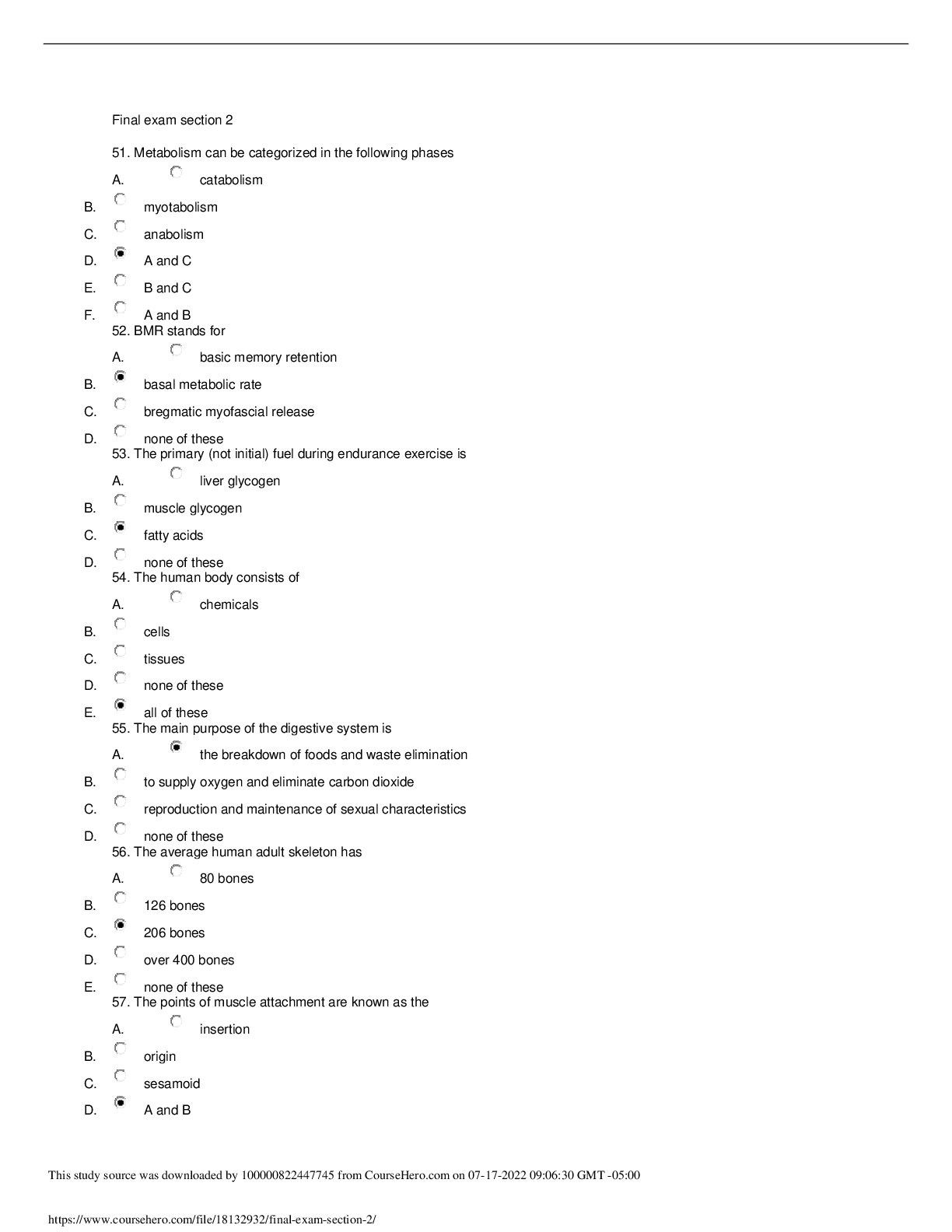
Final exam section 2
51. Metabolism can be categorized in the following phases
A. catabolism
B. metabolism
C. anabolism
D. A and C
E. B and C
F. A and B
52. BMR stands for
A. basic memory retention
B. basal metabolic rate
C. bregmatic myofascial release
D. none of these
53. The primary (not initial) fuel during endurance exercise is
A. liver glycogen
B. muscle glycogen
C. fatty acids
D. none of these
54. The human body consists of
A. chemicals
B. cells
C. tissues
D. none of these
E. all of these
55. The main purpose of the digestive system is
A. the breakdown of foods and waste elimination
B. to supply oxygen and eliminate carbon dioxide
C. reproduction and maintenance of sexual characteristics
D. none of these
56. The average human adult skeleton has
A. 80 bones
B. 126 bones
C. 206 bones
D. over 400 bones
E. none of these
57. The points of muscle attachment are known as the
A. insertion
B. origin
C. sesamoid
D. A and B
This study source was downloaded by 100000822447745 from CourseHero.com on 07-17-2022 at 09:06:30 GMT -05:00
https://www.coursehero.com/file/18132932/final-exam-section-2/E. none of these
58. Muscular hypertrophy is a(n)
A. increase in muscle fiber size
B. a decrease in muscle fiber size
C. increase in the number of muscle fibers
D. a decrease in the number of muscle fibers
E. none of these
59. Kinesiology is
A. the science or study of movement, and the active and passive structures involved
B. the science of the morphology or structure of organisms
C. the science concerned with the normal vital processes of animal and vegetable organisms
D. the science concerned with the action of forces, internal, and external, on the living body
E. none of these
60. An example of an antagonist's muscle is the
A. biceps during a biceps curl
B. internal and external obliques during a crunch
C. triceps during a biceps curl
D. pronator teres during pronation
E. none of these
61. The angle of pull is
A. the act of maintaining your body's balance
B. an angle in which the muscle pulls relative to the long axis of the bone on which it pulls
C. the sequential combination of movement outlining a geometric cone
D. A and B
E. A and C
62. A lever is defined as
A. the work done in a unit of time
B. the rotary (angular) movement in any plane around an axis
C. a rigid bar that turns around an axis of rotation or fulcrum
D. none of these
63. Musculoskeletal deviations can result in
A. poor muscle balance
B. poor flexibility
C. improper spinal alignment
D. all of these
E. A and C
64. The knee is stabilized on the anterior side by which muscle?
A. soleus
B. hamstrings
C. quadriceps
[Show More]